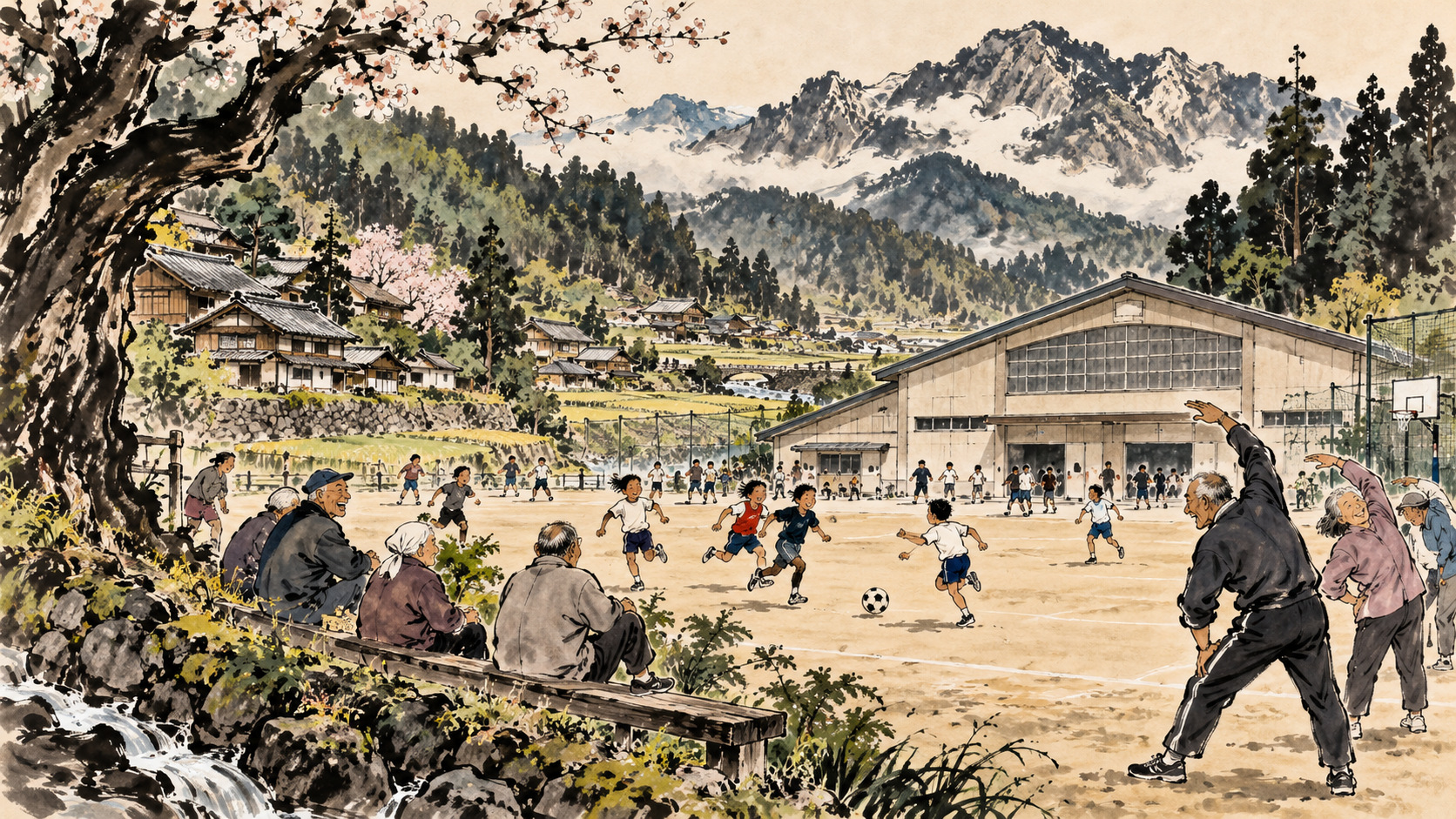
The hardest part of sport in a small Japanese town may not be the exercise itself. It may be getting to the gym, finding an affordable evening slot, or discovering that the pool has been shut for repairs. Japan’s Sports Day weekend invites celebration, but it also raises a more demanding question: who can participate when public buildings age and municipal budgets tighten?
The Sports Agency’s latest annual participation survey, released in March 2026, found that 51.7% of adults aged 20 or older exercised or played sport at least once a week. The reported rates were 55.0% for men and 48.8% for women, with participation relatively weak across many working-age groups. That is well short of the third Basic Plan for Sport’s aspiration of 70% weekly adult participation. The survey does not establish that a shortage of gyms caused the gap; time, health, care responsibilities and motivation also matter. [1][7]
The distinction between having a facility and being able to use one
In April and May 2026, the national government released its finalized 2024 survey of physical education and sports facilities, including the number and ownership of sites and information on the opening of school sports spaces to wider communities. It is a valuable national inventory. It is not, by itself, a map of whether a resident can book a court at 7 p.m., reach it without a car, or afford the fees. [2][3]
That distinction shapes the economics. A building can exist on a municipal balance sheet but offer few usable hours because of repairs, staff shortages or competing school schedules. A small facility close to homes may deliver more practical access than a larger regional center requiring a long drive. These are analytical possibilities, not findings about every municipality; comparable local transport, booking and budget data would be necessary to establish them.
From a building boom to a maintenance problem
Japan’s network of sports facilities grew through decades of public investment and school-centered physical education. Municipal gyms, swimming pools, baseball grounds, martial-arts halls and school courts now form a patchwork of public infrastructure. Each has recurring costs: structure and roofing, heating and cooling, electrical systems, accessible entrances, staffing and safety compliance. Deferred work may eventually mean an expensive renovation or extended closure.
The Sports Agency explicitly identifies aging facilities, deteriorating local finances and demographic change as reasons municipalities need to rationalize their sports-facility stock. Its guidance does not mandate preserving every existing building. It argues for a sustainable supply of safe places to play. That requires weighing renovation, consolidation, new uses and transport access together rather than equating a closure with efficiency or a new building with success. [4][8]
A striking city–town divide in community clubs
Facilities need organizers as well as walls. Japan’s system of comprehensive community sports clubs, or sōgōgata chiiki supōtsu kurabu, is intended to provide locally based opportunities across ages and disciplines. A 2025 Sports Agency survey counted 1,378 of 1,741 municipalities as having at least one established or planned club, or 79.1%. But the coverage rate was 92.5% among cities and special wards, against 67.4% among towns and villages—a 25.1 percentage-point difference. [5][6]
These are presence measures, not proof that 92.5% of urban residents have adequate access or that every club is active and affordable. The definition includes clubs still being prepared, and the number of clubs per municipality varies. Even so, the disparity is evidence that the organizational network supporting recreational sport is uneven. A person in an underserved neighborhood of Tokyo can face serious obstacles too; a simple urban–rural binary would miss that reality.
The hidden price of a cheap public gym
Admission can be inexpensive while total access is costly. A resident may need a car, a parent’s lift, a paid bus or a long detour after work. In remote areas, travel time can outweigh the fee. A useful municipal access audit would therefore track travel times by transport mode, opening hours, successful bookings, disability access, staffing and cost per visit—alongside conventional operating deficits.
Opening school facilities after hours can be effective in some settings, but it also requires security, cleaning, supervision, insurance and coordination with the school calendar. Outsourcing facility management to a private operator may improve services, but the public should be able to examine contract terms, fee increases and whether less profitable sports or time slots are squeezed out.
Counting the cost of not repairing
A municipal sports hall is not a one-off capital expense. Roof leaks can damage flooring. Hot summers may make uncooled venues unsuitable at certain times. Pools bring filtration and water-quality obligations. The cheapest annual maintenance budget may produce a more expensive future if the facility becomes unusable. Conversely, renovating every little-used site without a demographic or access assessment could lock a shrinking municipality into unsustainable costs.
Regional consolidation can be defensible where a safer, better-maintained hub offers broader activities and longer hours, especially if transport is integrated. But a rigorous comparison must include what residents lose: extra travel, inaccessible evening slots, the disappearance of a neighborhood meeting point, and reduced opportunities for children or older adults who do not drive.
Sports policy and public health: promise versus proof
Accessible exercise opportunities can support social participation and healthier habits. It would still be misleading to credit a new gym with reduced medical spending without examining participant behavior over time and controlling for other differences. Japan’s participation and infrastructure surveys measure distinct things. They should inform policy together, not be combined casually to manufacture a causal claim. [1][2]
There is a serious business dimension. Energy-efficient lighting and climate systems, digital reservations, shared coaching services and management contracts could help local authorities make public assets more usable. Vendors may find recurring demand. But a high-value procurement contract is not automatically a community benefit; success should be measured in access, reliable operations and transparent lifecycle costs.
What municipalities should disclose next
The most revealing local data would be straightforward: facility inventories with condition ratings; annual repair and replacement forecasts; prices and bookable hours; booking rejection rates; public transport or shuttle availability; school opening arrangements; and plans for users displaced by closures. Data should be broken down where possible by age, disability and geography without exposing personal information.
October 10 also marks the anniversary of the opening of the 1964 Tokyo Olympics. Spectacular stadiums helped present a modern Japan to the world. Six decades later, the country’s sporting promise can be tested on a smaller scale: whether a family can get to a gym, whether an older resident can move safely, and whether a small-town sports hall can keep its lights on. The true infrastructure of participation is not merely concrete. It is the affordable, repeated opportunity to walk through the door.
Sources and references
Research cutoff: October 8, 2026 JST. Individual municipal pricing, closures, procurement costs and the causal effects of facility access were not independently established; national indicators are not presented as local facility audits.