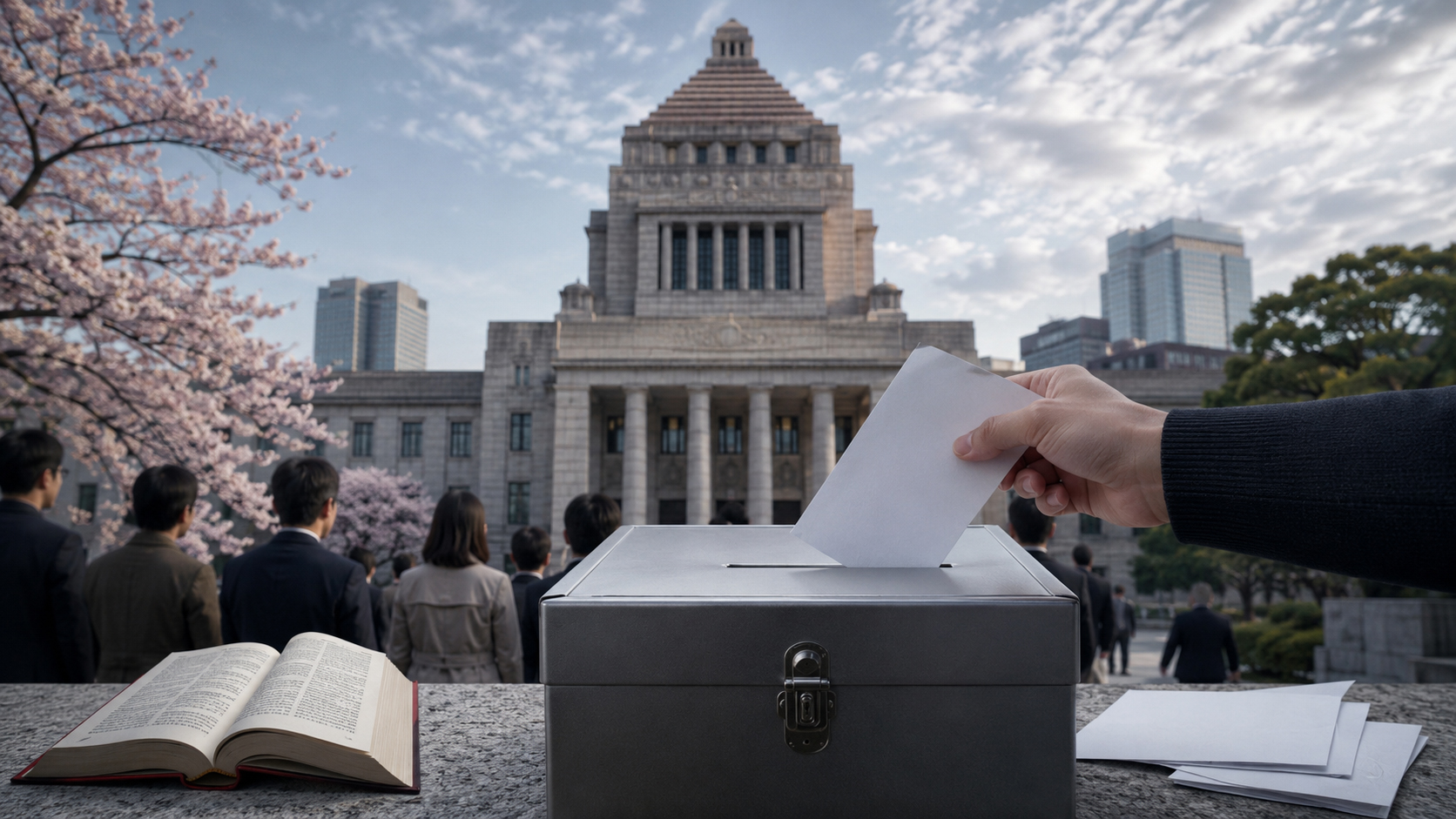
A small procedural bill has opened a large constitutional door
Some political stories arrive wearing small clothes. Japan’s new referendum law revision bill is one of them. On paper, the measure looks technical: referendum observers, remote islands, ballot boxes, FM radio, alignment with election law. It is not, by itself, a constitutional amendment. It does not rewrite Article 9. It does not place the Self-Defense Forces in the Constitution. It does not create an emergency clause.
Yet the bill matters because it deals with the machinery of Japan’s ultimate political act: a national referendum to amend the Constitution. Japan’s postwar Constitution, in force since May 3, 1947, has never been revised. If the country ever does amend it, the final decision will not belong to the prime minister, a party headquarters, or a Diet committee. It will go to the people.
On June 19, the House of Representatives passed a bill revising the National Referendum Law. The measure was supported by the Liberal Democratic Party-led ruling side and several opposition parties. It is now headed to the House of Councillors, where deliberations at the Commission on the Constitution are reported to begin on June 24. The current Diet session runs until July 17, and the ruling camp wants enactment before then.
What the bill actually changes
The bill is mainly about making referendum operations look more like ordinary election operations. Reports from Jiji Press, ConstitutionNet, and News On Japan describe several practical changes: easing requirements for appointing referendum watchers, allowing local vote counting on remote islands when bad weather or transport problems prevent ballot boxes from being moved, and permitting broadcasts about proposed amendments on FM radio after Japan’s AM-to-FM transition.
That sounds dry until one remembers that democracy is partly logistics. Ballots must be transported. Observers must be found. Remote islands must be included. Weather must be survived. Japan is an island country, a disaster country, and a rapidly aging country. If a constitutional referendum is ever held, it must work not only in Tokyo television studios, but also on small islands, in mountain towns, and in aging municipalities where staffing an ordinary polling station is already a challenge.
Supporters say the bill simply modernizes the rules. Critics and skeptics worry that procedural modernization may become a quiet accelerator for constitutional revision. Both instincts are understandable. A referendum system should be practical. But the more practical the system becomes, the closer Japan moves to being able to use it.
The missing fight: advertising, money, and the AI election age
The most important thing about the bill may be what it does not include. ConstitutionNet notes that the bill does not regulate party television or online advertising campaigns in referendums, nor campaign funding. Jiji Press reported that the Centrist Reform Alliance had raised the need to specify rules on advertising for or against constitutional amendments.
This is not a minor issue. A constitutional referendum is different from an ordinary election. Voters are not choosing a candidate who can be removed at the next election. They are deciding whether to change the country’s supreme law. Once an amendment proposal is placed before the public, advertising, funding, digital platforms, influencers, foreign disinformation, and AI-generated political content could all shape the campaign environment.
The National Referendum Law was born in an earlier media age. In 2007, the debate was still largely about television, newspapers, and formal campaign periods. In 2026, the information environment is a storm of short video, anonymous accounts, generative AI audio, deepfakes, targeted ads, clipped speeches, and platform algorithms. Japan has never held a constitutional referendum. Its first one would not be a quiet civics exercise. It would be a full-scale test of democratic information integrity.
Article 96: why Japan’s amendment process is so heavy
Article 96 of the Constitution sets a high bar. An amendment must be initiated by the Diet with the concurring vote of two-thirds or more of all members of each house. It must then be submitted to the people for ratification, requiring a majority of votes cast in a national referendum. After approval, the Emperor promulgates the amendment in the name of the people.
That structure makes the Constitution different from ordinary law. A statute can be changed by an ordinary legislative majority. A constitution is supposed to bind the state itself. It is the rulebook for power, not merely another product of power. Japan’s framers placed two gates in front of revision: a supermajority in both chambers and direct approval by voters.
This difficulty has shaped the entire postwar political landscape. The Liberal Democratic Party, founded in 1955, has long treated constitutional revision as part of its political identity. The political left, especially the old Socialist Party, the Communist Party, and later the Constitutional Democratic Party of Japan, has treated defense of the postwar Constitution, especially Article 9, as a core mission. Between those two poles, the Constitution became central to politics while remaining untouched.
The 1947 Constitution: defeat, occupation, and a new national promise
Japan’s current Constitution was promulgated on November 3, 1946, and took effect on May 3, 1947. It emerged from the ruins of war and the Allied occupation. The Emperor became the symbol of the state rather than the sovereign ruler. Popular sovereignty, fundamental human rights, and pacifism became the document’s pillars.
The preamble declares that government authority comes from the people, that its powers are exercised by representatives of the people, and that its benefits are enjoyed by the people. Article 9 renounces war as a sovereign right and rejects the threat or use of force as a means of settling international disputes. It was an extraordinary statement by a country that had just been defeated after devastating war.
But the Constitution’s birth has always been politically contested. Conservatives have argued that it was drafted under occupation and should be rewritten by the Japanese people themselves. Defenders respond that, whatever its origins, the Constitution became the operating charter of Japan’s postwar democracy and peace. That disagreement is why every procedural change around constitutional revision carries historical weight.
The 2007 referendum law: the mechanism without the experience
For decades, Japan’s Constitution contained an amendment procedure but no detailed statute for holding the national referendum that Article 96 required. Revision seemed so politically distant that the practical machinery was left undeveloped.
That changed in the 2000s. Both houses created constitutional research commissions, and their reports helped prepare the ground for legal procedures. In 2007, under Shinzo Abe’s first administration, the Diet enacted the National Referendum Law. CFR notes that the first such law passed in 2007 and was revised in 2014, including lowering the voting age to 18.
Still, Japan has never used it. The country has a referendum mechanism without referendum experience. No campaign has tested the rules. No court has been forced to resolve a disputed constitutional referendum. No broadcaster, platform, local election board, school, or family dinner table has yet lived through the pressure of an actual amendment vote.
Why now: Prime Minister Takaichi and the one-year clock
Jiji Press reported that Prime Minister Sanae Takaichi said in April that she intended to create an environment within a year for the Diet to submit a constitutional revision proposal. The LDP’s move to revise the referendum law is therefore not isolated administrative housekeeping. It is connected to a broader political timetable.
Takaichi comes from the conservative wing of Japanese politics and is closely associated with a more assertive revision agenda. But constitutional revision cannot be delivered by prime ministerial will alone. It requires two-thirds in both houses, coalition management, cooperation or acquiescence from some opposition forces, and enough public trust to survive a referendum campaign.
The current bill shows that the old map of constitutional politics is changing. It is not simply LDP versus anti-revision opposition. The bill has drawn support from parties outside the ruling bloc, while critics focus less only on the idea of revision and more on the rules of democratic fairness: advertising, money, observers, local administration, and the information environment.
Article 9 is still central, but it is no longer the only issue
For many readers, constitutional revision in Japan means Article 9. That is understandable. The question of how the Self-Defense Forces fit into a Constitution that renounces war has defined postwar constitutional politics. China’s military rise, North Korea’s missiles, Russia’s war in Ukraine, Taiwan contingency planning, and Japan’s own defense buildup have all made the text-versus-reality gap more urgent.
But the debate has widened. Emergency powers, Diet member terms during national crises, education, decentralization, privacy, environmental rights, family law, foreign residents, digital rights, and even imperial succession all hover around the constitutional conversation. Modern Japan is not the Japan of 1947. That does not automatically mean the Constitution should be changed. But it does mean the argument has become broader than one article.
The serious question is not whether change is always good or always dangerous. The serious question is what should be changed, why, under what safeguards, and after what kind of public explanation. A constitution is not a museum artifact. It is also not a campaign flyer. It must be able to endure politics without being swallowed by politics.
From remote island ballot boxes to the supreme law of the nation
One of the most symbolic pieces of the bill concerns remote islands and vote counting. It is easy to dismiss this as a technicality. It is not. If Japan holds a constitutional referendum, a vote cast on an island must count as securely and promptly as a vote cast in central Tokyo. A typhoon, ferry cancellation, or transport delay should not become a constitutional crisis.
Japan’s geography matters. The country is long, mountainous, islanded, and disaster-prone. It is also aging. Maintaining democratic procedure in that landscape requires boring details done well. Polling stations need staff. Ballot boxes need routes. Observers need appointment rules. Local governments need instructions that work in bad weather.
That is why procedural reform has value. But it should not be confused with substantive consensus. Paving the road does not decide the destination. It only makes the journey possible.
The preparation Japan really needs may be preparation not to rush
Both sides of Japan’s constitutional debate can move too quickly. Revision advocates say the world has changed and Japan’s supreme law must catch up. Opponents warn that constitutional revision could weaken pacifism, rights, or democratic restraints. Both sides contain serious concerns. But if Japan ever holds a referendum, slogans will not be enough.
Which article will be changed? Which articles will not? If the Self-Defense Forces are written into the Constitution, what changes legally? If emergency powers are added, how will abuse be prevented? If education or local autonomy is revised, why must it be constitutional rather than statutory? How will advertising be regulated? How will money be disclosed? How will AI-generated falsehoods be handled?
Japan’s Constitution has remained unchanged for nearly eight decades. Its first referendum would be a national civic event, not just a political contest. Schools, media organizations, lawyers, local governments, businesses, civic groups, and families would all be drawn into a rare act of constitutional self-definition.
What this bill tells us about Japan in 2026
The referendum bill is not the big amendment fight. It is the preface. But prefaces matter. They tell us how the author wants the story to begin.
The Takaichi government wants to prepare the ground for revision. Some opposition parties are willing to cooperate on procedural updates. Skeptics are focused on advertising, money, and public fairness. Local election realities are pressing against national constitutional ambition. And Japan’s aging, islanded democracy must decide whether it can hold a first-ever constitutional referendum in an information age that is far harsher than the one in which the referendum law was written.
If the Upper House begins deliberations on June 24, the calendar becomes important. The Diet session ends July 17. Enactment would not amend the Constitution. But it would mark another step toward a question Japan has avoided, argued around, and lived beside since 1947.
The Constitution is not the property of politicians. It is not a party poster, a bureaucratic file, or a television prop. It belongs, finally, to the people. If Japan is going to change the rules for asking the people to change it, then those rules deserve the same seriousness as the Constitution itself.
- The bill is procedural, not a constitutional amendment proposal.
- The Lower House passed it on June 19, and Upper House constitutional commission deliberations are reported to begin June 24.
- The main changes concern referendum watchers, remote-island vote counting, and FM radio broadcasting.
- Advertising, online campaigning, funding rules, and AI-age disinformation remain the unresolved core issues.
- Article 96 requires two-thirds approval in both houses and majority approval by voters. Japan’s Constitution has never been amended since 1947.
Sources and references
This article draws on Jiji Press/Nippon.com, News On Japan, ConstitutionNet, the House of Representatives text of the Constitution of Japan, Council on Foreign Relations background on constitutional revision, and National Diet Library constitutional materials.
- Nippon.com / Jiji Press: Japan Lower House Passes Referendum Reform Bill
- Nippon.com / Jiji Press: Lower House Commission OKs Referendum Reform Bill
- Nippon.com / Jiji Press: LDP Proposes Revision to National Referendum Law
- News On Japan: Referendum Revision Bill Passes Lower House
- ConstitutionNet: In Japan, legislators propose changes to referendum law
- The House of Representatives: The Constitution of Japan
- Council on Foreign Relations: The Politics of Revising Japan’s Constitution
- National Diet Library: Birth of the Constitution of Japan