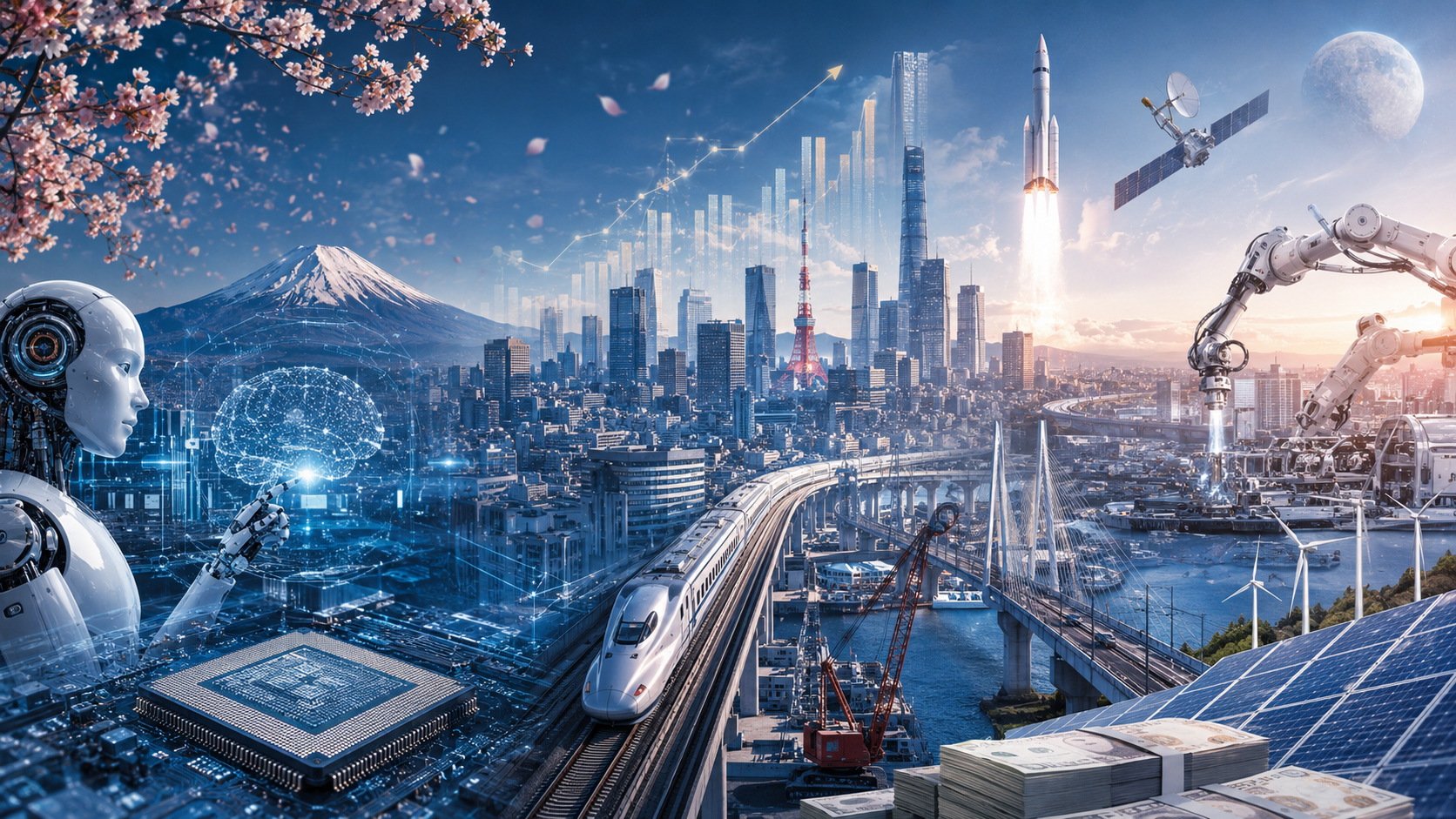
Is Japan returning to the age of national projects?
¥370 trillion is almost too large to feel real. It is the kind of number that slides across a screen, impresses for three seconds, and then disappears into the fog of public finance. But put it against the calendar, and it becomes serious. By 2040, Japan will be older, smaller and more dependent on technology to make up for missing workers. AI will pull more electricity. Semiconductors will remain a national-security asset. Space will be infrastructure. Robots will not be a science-fiction luxury; they will be a labor-force strategy.
Reuters, citing Nikkei, reported that Japan plans to set a target of about ¥370 trillion in combined public and private investment by 2040 across 17 strategic sectors. The focus will include AI, chips and space development. The government is reportedly considering a multi-year budget framework for investments deemed critical to economic security, and some funding may come through bridging bonds.
This is not a normal stimulus package. It is a bid to move Japan from being called a cheap country back toward being a country that builds, earns and cannot easily be replaced. Japan has written many growth strategies before: deregulation, regional revitalization, digital transformation, womenomics, productivity reform. The words were often correct. The execution was often late. Whether this plan is different will not depend on the headline number. It will depend on where the money goes, who follows with private capital, how long the funding lasts and whether Japan can kill weak projects before they become permanent.
Japan’s miracle was never only private enterprise
Japan likes to tell its postwar story as a story of companies: Toyota, Sony, Panasonic, Hitachi, Toshiba, Nintendo. Factory discipline, quality control, long-term employment and engineering pride were real. But that is only half the story.
Postwar Japan also had MITI, the Ministry of International Trade and Industry. In a country short of foreign exchange, short of resources and rebuilding from defeat, the state helped choose which industries to nurture, which technologies to import, which firms to finance and which sectors to protect. Steel, shipbuilding, chemicals, autos, appliances and electronics did not rise from pure laissez-faire. They rose from a complicated system of markets, bureaucrats, banks, engineers and export discipline.
The 1960 Income Doubling Plan gave households a simple promise. Highways, the shinkansen, ports, power plants, homes and factories physically remade the country. In the 1970s, Japan absorbed oil shocks and pollution crises. In the 1980s, it stunned the world in electronics and semiconductors. Japanese companies dominated DRAM and made the United States genuinely anxious.
Then the crown slipped. Trade friction with the United States, the yen’s rise, the collapse of the bubble economy, confused domestic electronics giants, South Korea and Taiwan’s rise, and the arrival of U.S. platform companies shifted the profit pools. Japan retained world-class strengths in materials, components and equipment. But the center of value moved toward software, platforms, design and ecosystems. The factories were still beautiful. The profits increasingly lived elsewhere.
Semiconductors: Can Japan pick up the crown it dropped?
The most symbolic pillar of the ¥370 trillion vision is semiconductors. In March 2026, Japan set a target to raise annual sales of domestically produced semiconductors to ¥40 trillion by 2040, roughly five times today’s level of about ¥8 trillion. That pushes beyond the existing 2030 target of ¥15 trillion and places chips at the center of national economic strategy.
Semiconductors are no longer just export components. They are the foundation of AI, robotics, vehicles, defense, communications, healthcare, energy systems and space. Japan once saw chips as a high-value product category. Now chips are economic oxygen. Without them, factories stop, militaries slow, hospitals strain and data centers go dark.
Japan still has advantages. Equipment, materials, precision processing, cleaning, inspection, power semiconductors, automotive quality and deep manufacturing control all matter. Even if Japan no longer dominates advanced logic, it remains difficult to remove from the global chip supply chain. That is why Rapidus, TSMC-related investment in Kumamoto, advanced materials capacity and power-chip investment should not be read as isolated company news. They are pieces of a national industrial map.
But semiconductors cannot be won by subsidy alone. Talent, yield, customers, design, electricity, water, global partnerships and manufacturing experience all matter. Japan will fail if it tries to relive the 1980s. To win in 2040, it must find where Japan is indispensable in the AI-era chip map, not where it was famous in the memory of old executives.
AI and robots: Why Japan is betting on AI with a body
In the AI world, the United States has the giant platforms, China has state scale and Europe has regulatory power. Japan is not the center of the large-language-model race. But it has another route: AI with a body. Robots, factory systems, autonomous vehicles, logistics machines, inspection tools, caregiving support and construction automation.
Japan is interested in physical AI not because it is fashionable, but because it is necessary. There are not enough workers. There are not enough caregivers. Logistics is stretched. Construction skills are aging. Factory expertise is retiring. Text-generating AI matters, but Japan’s deeper need is AI that can move things, inspect things, assist people, drive vehicles, predict failure and connect software to machinery.
METI’s recent industrial-policy discussions have emphasized cyber-physical convergence: taking analysis in cyberspace and turning it into action in physical space through software, sensors and actuators. That is where Japan has a plausible edge. Not merely making AI speak Japanese, but making AI tighten bolts, guide robots, operate beds, move freight, detect defects and keep factories running.
Space: From romance to infrastructure
Space is another symbolic pillar. In the Showa-era imagination, space meant science, national pride and romance. Rockets, satellites and astronauts gave the public a sense of technological dignity. In 2026, space is more practical and more competitive.
Satellite communications, earth observation, positioning, disaster monitoring, agriculture, maritime surveillance, defense, financial data and climate risk all depend on orbital infrastructure. The United States has SpaceX. China, Europe and India are moving fast. If Japan treats space only as research and occasional national ceremony, the market will pass it by.
Japan has the H3 rocket, JAXA, Mitsubishi Heavy Industries, IHI, satellite companies and space startups. What it needs is not applause after a successful launch. It needs recurring demand, private customers, insurance, standards, government data use, defense integration and export channels. Space must become a monthly business, not an occasional fireworks show.
GX and energy: Growth strategy cannot run without electricity
AI, semiconductors, data centers, electric furnaces, batteries, space systems and robots all use electricity. Discussing Japan’s growth strategy without discussing power is like discussing sushi and forgetting the rice. METI’s GX 2040 work has stressed the need to pursue decarbonization and industrial competitiveness together. The government has already promoted a framework to mobilize more than ¥150 trillion in public and private GX investment over 10 years.
This is where Japan’s problem becomes difficult. It wants decarbonization. It wants stable power. It wants lower electricity costs. Nuclear power remains politically hard. Renewables face land, grid and regional acceptance limits. Fossil fuels raise import and emissions risks. If Japan wants to win in AI and semiconductors, it must supply power that is stable, affordable and low-carbon. That is not an environmental slogan. It is a factory-location condition.
By 2040, industrial policy and energy policy cannot be separated. Chip plants, data centers, batteries, grid lines, ports, water resources, labor pools and local governments all have to sit on the same map. A new growth strategy is also a new national land strategy.
The funding problem: Bridging bonds are not magic
Reuters reported that Japan is considering a multi-year budget framework and possibly bridging bonds for some strategic investments. That matters. Japan’s public debt is already enormous. If fiscal discipline is dismissed too casually, markets may eventually answer in a colder voice. Bridging bonds, with specified redemption resources, allow the government to argue that it is still mindful of discipline.
But bridging bonds are not magic. The issue is not simply whether Japan borrows. The issue is whether borrowed money becomes future productivity, wages, exports and tax revenue. Building roads in a fast-growing country and funding AI compute, chip yields and robotics talent in an aging country are not the same problem.
Good debt and bad debt are separated by what the debt creates. Good debt raises productivity, export capacity, wages, tax revenue and strategic resilience. Bad debt creates slogans, conferences, subsidy dependency, empty buildings, weak pilot projects and protected incumbents. Anyone who remembers Japan’s past should be very sensitive to the difference.
The memory of failure: Japan loves plans and struggles with exits
Japanese industrial policy has achievements worth respecting. It also has failures worth remembering. There were sectors where Japan had technology but lost the global standard. There were industries protected by domestic demand that could not fight abroad. There were bureaucracies, industry groups and large companies that held elegant meetings while the world moved faster.
That is the danger of the ¥370 trillion plan. Big money attracts big incumbents. “Strategic sector” is a beautiful phrase, but it is also a useful phrase for any company seeking subsidy. If the government chooses too much, protects too much and never closes failing projects, then in 2040 we will be writing another article titled: Why Did Japan Fall Behind Again?
What Japan needs is the discipline to choose and exit. Invest heavily where it can win. Close projects that fail. Open opportunities to mid-sized firms, universities and startups. Accept foreign talent. Reform rules. Prepare land, power and water. Spend money on new industries, not only on extending the lives of old ones. That is hard. But if it were easy, it would not be a national strategy.
Do not let 2040 become only a story of decline
2040 is not an easy year for Japan to imagine. The country will be older. Regional depopulation will be more severe. Social-security costs will be heavier. Labor will be precious. But a country with fewer people does not automatically become poor. The question is productivity per person, income per person and the technological density of society.
AI, robotics, semiconductors, space, GX, healthcare, biotechnology, quantum, oceans and critical minerals are not buzzwords. They are tools for a country that must compensate for demographic pressure with knowledge, machines and energy. Japan’s 2040 strategy should not end as another lament about population decline. It should design how to win under that condition.
Japan should not aim merely to be big. It should aim to be indispensable. Materials needed for AI factories. Precision components that move robots. Resilient energy systems. Medical and care technologies for aging societies. Satellite data. Secure supply chains. If Japan cannot win by population scale, it must win by density.
¥370 trillion: Fireworks or engine?
¥370 trillion is seductive. Politicians like big numbers. Bureaucrats like long plans. Companies like subsidies. Newspapers like headlines. That makes the plan dangerous. But it may also be necessary.
Japan became too afraid of investment. The memory of the bubble collapse left companies, households and governments cautious. Cash piled up. Risk was avoided. Equipment aged. Digital transformation was delayed. Wages were restrained. Young people were told to seek stability. Then the yen weakened, Japan became a cheaper destination for tourists, and Japanese wages looked less powerful in global terms.
That is why the number matters. Not because ¥370 trillion guarantees success, but because it signals a possible change of posture. Will Japan bet on the future? Will it tolerate failure? Will it choose sectors where it can actually win? Will it do more than protect old industries? Will young people in 2040 believe their country still has something to build?
Japan once surprised the world with factories. It may yet surprise the world again with AI-enabled factories, materials that support semiconductors, satellite data that protects life on the ground, and robots that help an aging society keep moving.
¥370 trillion is a bet. But refusing to bet is also a bet, and probably the more dangerous one.
- Japan is reportedly considering a ¥370 trillion public-private investment target through 2040.
- The focus includes AI, semiconductors, space, GX and economic-security sectors.
- The semiconductor target alone calls for annual domestic chip sales of ¥40 trillion by 2040.
- The hard questions are not only about money. Talent, power, exits, regulation and private-sector commitment will decide the outcome.
- The real test is whether Japan can move from being seen as cheap to being seen as indispensable.
Sources and references
This article draws on Reuters, METI, RIETI and other public materials. Dollar conversion uses the Japan.co.jp market strip rate of ¥161.55 per U.S. dollar.
- Reuters: Japan to target $2.3 trillion public-private investment by 2040
- Reuters: Japan targets fivefold rise in domestically made chip sales by 2040
- METI: Industrial Structure in 2040 Led by Growth Investment
- METI: Action Plan to Strengthen Industrial and Technological Basis for Economic Security
- Reuters: Japan to craft 2040 decarbonisation and industrial policy strategy
- RIETI: Industrial Policy in Japan — 70-Year History since World War II
- Reuters: Microsoft to invest $10 billion in Japan for AI and cyber defence expansion