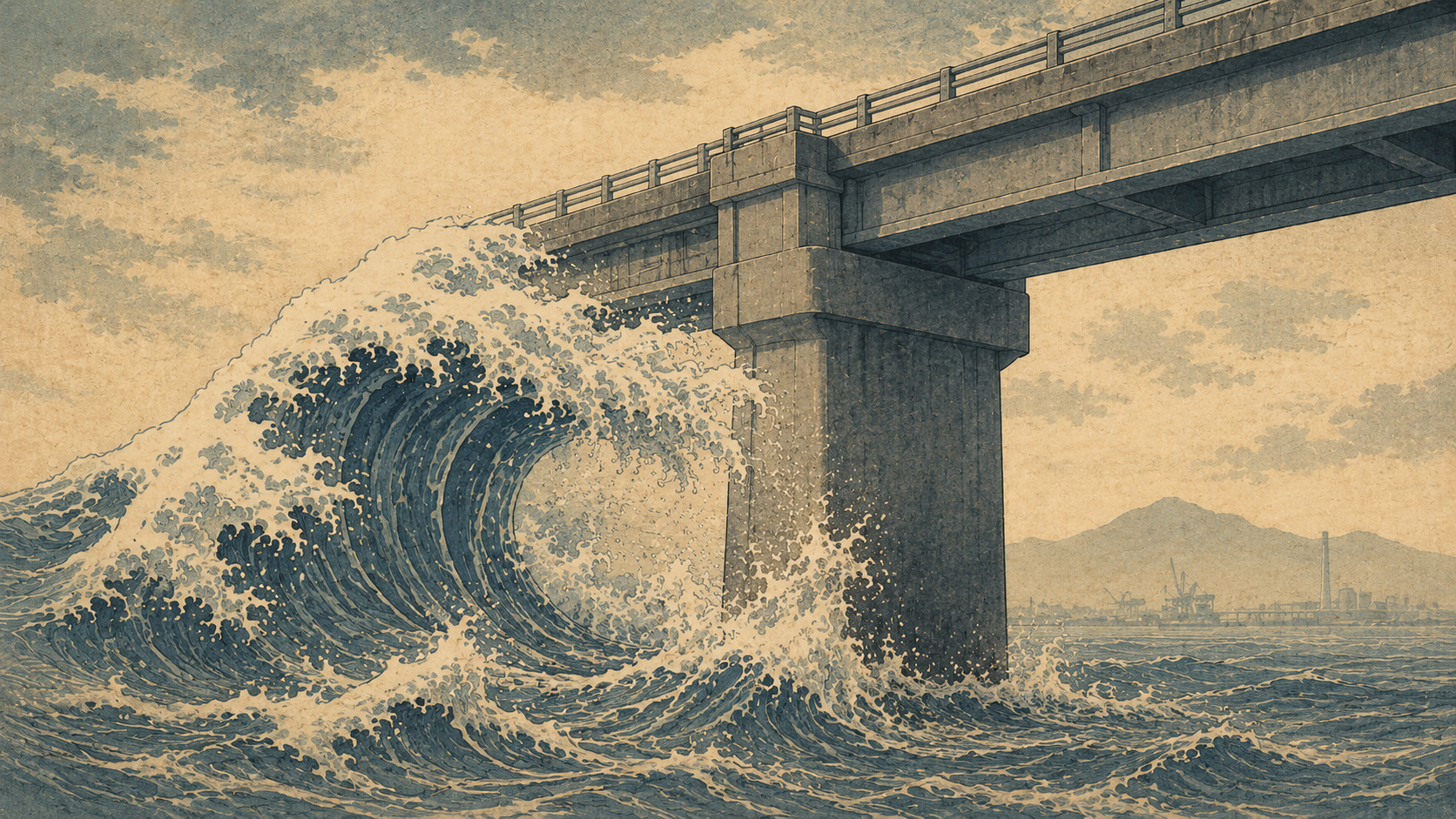
For decades, public works in Japan have carried two meanings at once. They are the backbone of the country: rivers tamed, bridges thrown across valleys, ports defended against the sea, highways and railways cut through mountains to connect cities, factories and remote communities. They are also a political memory: cost overruns, local pork, white-elephant projects, and the nagging question of whether every road, dam or tunnel was truly needed. The 2026 debate over Japan’s public works guidelines sits precisely at that intersection.
According to public reporting, the government is preparing to move away from placing excessive weight on narrow cost effectiveness when judging whether public works should proceed. The draft guidelines point to expressways, some shinkansen lines, disaster-critical transport corridors and other infrastructure whose value cannot always be captured by ordinary profitability calculations. The shift is not from numbers to nostalgia. It is from simple efficiency toward resilience: the ability of a society to keep functioning when the map breaks.
That distinction matters because Japan is entering the most difficult infrastructure decade of its postwar history. The bridges, tunnels, water systems, ports and highways built during the rapid-growth era are aging together. The population is shrinking. The construction workforce is tight. Fiscal space is limited. Japan cannot simply build everything, repair everything and preserve everything. It must choose. But it also cannot judge every project as if tomorrow will be ordinary.
The age of the benefit-cost ratio
The focus on cost effectiveness did not come from nowhere. After the bubble burst, public investment was repeatedly used to support demand. Across Japan, highways, dams, ports, airports, cultural halls and other facilities were built under the promise of regional revitalization. By the late 1990s and early 2000s, the backlash was powerful. Critics argued that demand forecasts were too optimistic, local construction interests too influential, and the national balance sheet too strained.
Project evaluation therefore became more disciplined. Benefits were translated into money: shorter travel times, fewer accidents, smoother logistics, regional economic effects and other measurable gains. Costs were compared against those benefits. The benefit-cost ratio became a way to limit political discretion and make infrastructure decisions more transparent. That was a real improvement.
But the method has a blind spot. Some infrastructure looks unconvincing on ordinary days. A mountain road may carry too few cars. A rural bridge may not produce enough time savings. A port reinforcement may not look urgent while the weather is calm. Then a quake, flood, landslide or tsunami arrives, and the same asset becomes the only route for ambulances, fuel, food and repair crews. Japan’s question is how to price the value of not failing.
A country that cannot be designed by efficiency alone
Japan’s geography resists simple accounting. Much of the country is mountainous. Population, industry and transport concentrate along coasts, river basins and narrow plains. Rivers are short and steep. Typhoons bring heavy rain. Earthquakes are a permanent condition, not an exception. The same corridors that move tourists and machine parts also carry evacuation buses, emergency vehicles, fuel trucks and recovery crews.
The Great Hanshin-Awaji Earthquake, the Great East Japan Earthquake, the Kumamoto earthquakes, the Noto Peninsula earthquake and repeated torrential-rain disasters all showed that infrastructure is not merely an economic asset. It is a life-support system. When a bridge falls, an ambulance may not arrive. When a port is unusable, fuel and supplies stop. When a water system breaks, an evacuation center becomes fragile.
This is the world behind Japan’s national resilience policy. The Prime Minister’s Office has framed intensified weather disasters, imminent large earthquakes and aging infrastructure as risks that cannot be postponed. The government’s five-year accelerated package for disaster prevention, mitigation and national resilience was 15 trillion yen in scale through 2025, and Japan is now moving into another phase of medium- and long-term reinforcement.
Aging infrastructure: the quiet disaster
Earthquakes and typhoons are visible disasters. Aging infrastructure is quieter. It accumulates in seams, bolts, concrete, tunnel linings, river gates and buried pipes. Japan built much of its modern infrastructure in a concentrated burst during the high-growth decades. That was the miracle of postwar construction. The bill is now arriving all at once.
The U.S. Commercial Service has described Japan’s highways, bridges, tunnels, dams, ports and railways as heavily shaped by the 1960s and 1970s building boom, with large numbers of bridges, tunnels, water gates, sewer pipes and harbor quays already more than 50 years old as of 2023. MLIT has promoted early detection, preventive maintenance and digital inspection technologies because waiting for failure can be far more expensive than repairing risk early.
This changes the economics. It may look cheaper to postpone repairs. But once a road closes, costs spread across the economy: detours, lost work hours, delayed deliveries, emergency response, tourism cancellations, supply-chain disruption and sometimes human loss. Preventive maintenance is not a luxury. In an aging country, it is a way of buying down future chaos.
What the 2026 guideline shift means
The new direction in public works assessment moves beyond the old binary of “benefit-cost ratio versus politics.” The more interesting question is how to evaluate redundancy, substitution and continuity. Does a route serve a hospital, port, airport, Self-Defense Force base or evacuation shelter? Is there an alternative if a tunnel is closed? Would a rail corridor help distribute population and industry away from a single metropolitan concentration? Would a coastal project reduce the chance that a flood becomes a national logistics problem?
Under that lens, a lightly used road may be valuable if it is the only remaining route after a landslide. A shinkansen extension may be more than a travel-time project if it strengthens national redundancy. A port upgrade may matter not because daily throughput is spectacular, but because it keeps energy, food and medical supplies moving after a disaster.
The danger is obvious. “Resilience” can become a magic word. If any project can be justified by saying it might help in a disaster, Japan risks returning to the bad old habits that made public works politically toxic. The new guidelines therefore need more transparency, not less. For every project, officials should be able to state which disaster scenario is being addressed, what function is being protected, what alternatives exist, and how success will be measured.
Concrete meets data
The 2026 debate is not just about pouring more concrete. The future of public works is increasingly digital. Drones can inspect bridges. AI can read cracks. Sensors can monitor movement. Satellites can detect ground deformation. Digital twins can model what happens when a river rises, a tunnel closes or a port loses power. Infrastructure is becoming something Japan watches in real time, not just something it builds once and hopes will last.
The Cabinet Office’s disaster white paper describes three major pillars in the five-year acceleration plan: countermeasures against increasingly severe storm and flood disasters and large-scale earthquakes, measures to shift aging infrastructure toward preventive maintenance, and digitalization to promote national resilience more efficiently. That is the real transformation: not concrete versus digital, but concrete governed by better data.
Labor scarcity makes that even more important. Japan cannot inspect and repair everything by hand forever. Municipalities need tools that rank risk, reduce labor hours and identify the assets whose failure would hurt the most. In that world, public works becomes less like a ribbon-cutting ceremony and more like preventive medicine for the national body.
The regional question
For local Japan, the guideline shift is also existential. Depopulated areas perform poorly under narrow efficiency measures. But rural and coastal regions still contain farms, ports, power plants, forests, tourist sites, fishing communities and evacuation routes. If evaluation simply follows population density, the country becomes more brittle. If evaluation ignores demographics entirely, the country wastes scarce money.
The hard task is to decide the skeleton. Japan cannot maintain every facility exactly as it was built in the high-growth era. Some consolidation, retreat and redesign are unavoidable. But retreat also requires a map of what must be preserved. Resilience does not mean keeping everything. It means knowing which lines cannot be allowed to break.
The Japan.co.jp view
This is a quieter story than the yen, AI chips or the World Cup, but it may say more about Japan’s future than any of them. Every growth strategy rests on infrastructure. AI data centers need power and water. Semiconductor plants need roads, ports and stable logistics. Tourism needs trains and airports. Rural revival needs bridges, broadband and disaster-safe routes. A country cannot innovate on top of cracked foundations.
Japan should not abandon cost discipline. Its public debt is large, its workforce is aging, and public works have a troubled political history. But Japan also should not pretend that ordinary-day efficiency is the full measure of value in a disaster-prone archipelago. The cheapest national system may be the one that fails at the worst possible moment.
The 2026 guideline debate is therefore a search for a new public language. From efficiency to resilience. From construction to maintenance. From growth-era expansion to aging-era selection. If Showa public works were the story of a country building itself, Reiwa public works may become the story of a country deciding what it must protect.
| Question | Why it matters |
|---|---|
| Is cost effectiveness being abandoned? | No. The issue is whether narrow benefit-cost ratios should be supplemented with disaster resilience, redundancy, evacuation and logistics value. |
| Why now? | Japan’s infrastructure is aging at the same time that climate, earthquake and workforce risks are intensifying. |
| What is the risk? | “Resilience” could become a loose justification for weak projects unless the new guidelines demand clear scenarios and measurable outcomes. |
| What does it mean for regions? | Rural and coastal infrastructure may have low daily traffic but high emergency value as lifelines for hospitals, ports, farms and evacuation. |
| What is the future model? | Less ribbon-cutting, more preventive maintenance, digital inspection, drones, AI, sensors and risk-based prioritization. |
Sources and references
This article was prepared from public reporting and government materials. Project details, budget figures and official guidelines may change as ministries finalize implementation documents.
- The Japan Times / Jiji: reporting on the draft guideline shift away from excessive focus on cost effectiveness.
- Prime Minister’s Office of Japan: policy explanation on disaster prevention, reduction, aging infrastructure and national resilience.
- Cabinet Office Disaster Management White Paper: summary of the Five-Year Acceleration Plan and its focus on severe storms, earthquakes, aging infrastructure and digitalization.
- U.S. Commercial Service / Trade.gov: overview of Japan’s aging infrastructure, MLIT maintenance priorities and digital inspection opportunities.
- World Economic Forum: 2026 context on Japan’s data-driven disaster preparedness and resilience investment.
- Reuters: context on Japan’s 2026 economic blueprint and long-term public-private investment agenda.