Imagine two identical six-sided tables joined at one corner, each set with five empty chairs. A chemist wants to place one guest at a particular chair on each table—the third seat from the joint—and nowhere else. Every chair looks chemically similar. The obvious routes favor other seats. A misplaced guest is not a cosmetic error; it is a different molecule, with different behavior and a new separation problem.
That is the positional puzzle behind the Japanese research announced August 6. The “tables” are two benzene rings joined to form biphenyl. The “guests” are hydroxyl groups, −OH. Put one at the 3 position of each ring and the result is 3,3′-dihydroxybiphenyl, abbreviated 33DHBP. Its rigid aromatic framework and two reactive hydroxyl handles make it a valuable building block for high-performance polymers, where researchers seek heat resistance and mechanical strength.
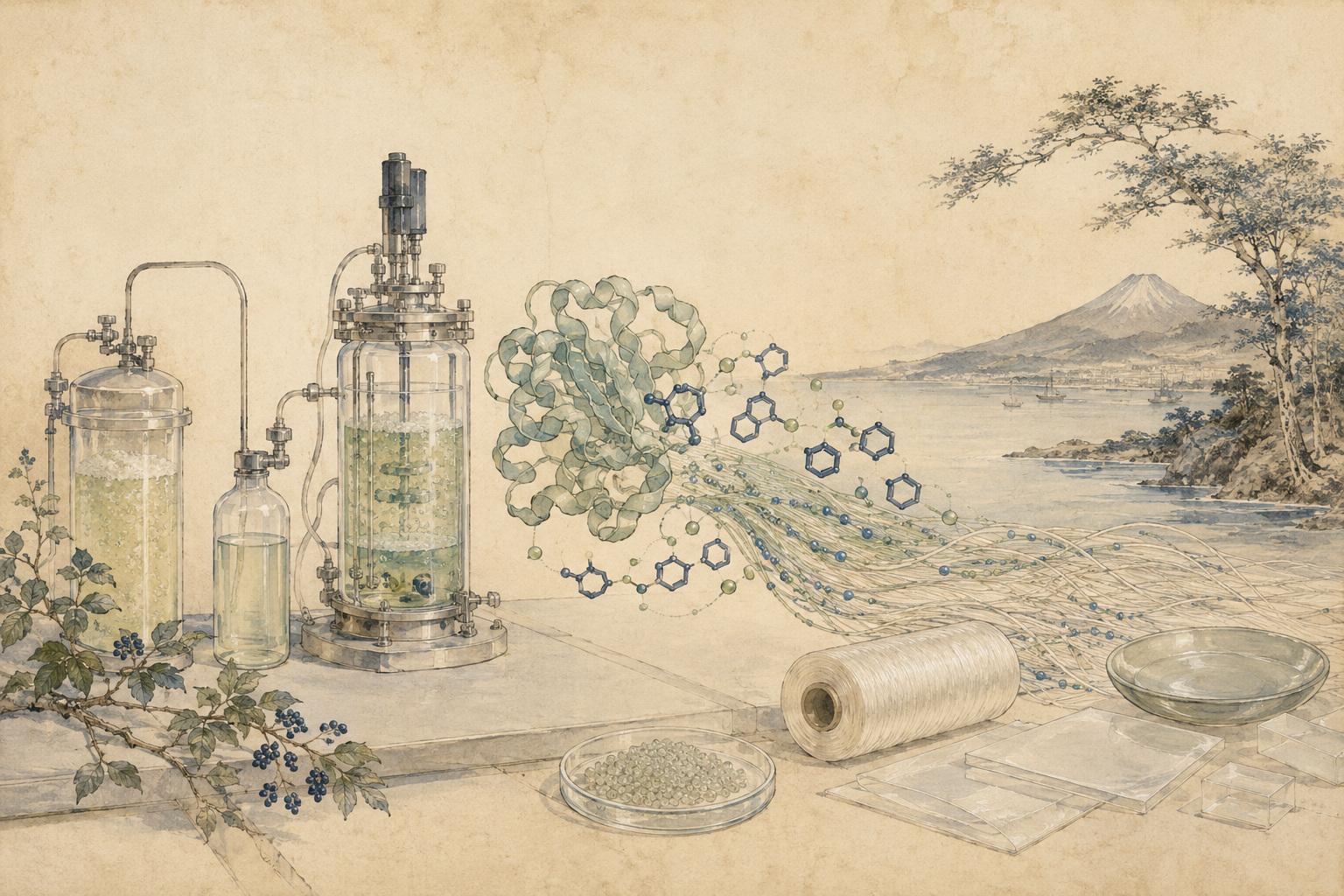
The team did not solve the problem by inventing a larger reactor. It remodeled a protein. Starting with an oxygen-activating enzyme used by bacteria to metabolize aromatic hydrocarbons, the researchers changed selected amino acids around its catalytic pocket and access channel. Molecular-docking calculations let them test hundreds of candidate structures on a computer and choose a much smaller set to build and assay. The final variants held biphenyl in orientations that favored the difficult meta positions.
A small molecule with an exact address
Biphenyl is simple enough to sketch: two benzene rings connected by a carbon–carbon bond. Chemists number the carbon atoms around each ring. Positions next to the connecting bond are called ortho; the next positions are meta; the opposite positions are para. The prime symbol in 3,3′ distinguishes the third carbon on one ring from the third carbon on the other.
Those labels are not bookkeeping trivia. The position of a substituent changes a molecule’s symmetry, shape, electron distribution, hydrogen bonding and the direction in which it can be incorporated into a larger structure. The three dihydroxybiphenyl arrangements 2,2′, 3,3′ and 4,4′ have the same elemental formula. They are nevertheless different monomers. A polymer is a molecular architecture; moving a doorway changes the building.
Adding hydroxyl groups to aromatic rings is a classic way to create useful chemical handles. But an unadorned aromatic substrate offers several carbon–hydrogen bonds with similar reactivity. Ordinary electronic effects and many catalysts favor positions other than the remote meta site. Conventional synthesis may therefore need directing or protecting groups, precious-metal catalysts and a sequence of installation and removal steps. Every extra operation can add reagents, solvent, energy, purification and waste.
An enzyme offers another kind of control. Its folded protein creates a three-dimensional pocket. If the pocket presents a single carbon–hydrogen bond to the reactive oxygen center while shielding the others, geometry can override much of the substrate’s natural preference. The catalyst behaves less like a hammer and more like a microscopic jig that holds a workpiece at the required angle.
The enzyme was borrowed from a bacterial cleanup crew
The starting catalyst, toluene/o-xylene monooxygenase—ToMO—is part of the chemistry by which Pseudomonas bacteria consume aromatic compounds. It is a multicomponent, non-heme diiron enzyme system. Electrons move through its protein components; molecular oxygen is activated at an iron-containing catalytic center; one oxygen atom is inserted into the hydrocarbon substrate while the oxygen chemistry is completed with reducing power supplied by the cell.
ToMO is not a blank slate. Its natural and previously demonstrated substrate range includes toluene, xylenes, benzene, phenols, naphthalene and styrene. Structural studies revealed a roughly 35-ångström channel leading from the protein surface to the active site. That channel is a molecular hallway: substrates enter, react near the diiron center and products leave. Its width, hydrophobicity and the side chains lining it influence which compounds fit and how they face the catalytic machinery.
The new work focused on TouA, the catalytic subunit. One engineered form—identified by the amino-acid substitutions I100V, E103V and F205G—converted biphenyl to 3-hydroxybiphenyl with reported 100 percent meta selectivity. For the second hydroxylation, variants I100V–E103V–F176H and I100V–E103V–I162Y–F205G converted the intermediate toward 33DHBP with more than 90 percent meta selectivity. Altering the hydrophobic channel also improved activity.
The mutation shorthand records a precise edit. I100V means that at amino-acid position 100, isoleucine was replaced by valine. The two are chemically similar, yet valine is smaller. F205G replaces a bulky phenylalanine with tiny glycine, opening space. F176H exchanges phenylalanine for histidine, changing both shape and chemical character. Each edit slightly redraws the pocket in which biphenyl tumbles and pauses.
| Stage | Engineered TouA variant | Reported result |
|---|---|---|
| First hydroxylation | I100V–E103V–F205G | Biphenyl → 3-hydroxybiphenyl with 100% meta selectivity. |
| Second hydroxylation | I100V–E103V–F176H | 3-hydroxybiphenyl → 33DHBP with more than 90% meta selectivity. |
| Second hydroxylation | I100V–E103V–I162Y–F205G | Another route to more than 90% meta selectivity for the intermediate. |
| Longer aim | A single optimized variant | Potential continuous two-step conversion from biphenyl to 33DHBP. |
Selectivity is not yield
The most impressive numbers require the most careful language. One hundred percent meta selectivity means the first enzyme variant directed the observed hydroxylation to the desired position under the reported conditions. It does not mean that every molecule of biphenyl in a reactor became product. Selectivity, conversion, isolated yield, titer and productivity answer different questions.
- Selectivity: Of the products formed, what share has the desired molecular arrangement?
- Conversion: What share of the starting biphenyl reacted?
- Yield: How much desired 33DHBP was recovered relative to the theoretical maximum?
- Titer: How many grams of product accumulated in each liter of process liquid?
- Productivity: How many grams were made per liter per hour, enzyme mass or cell mass?
A catalyst can be perfectly selective but painfully slow. It can convert only a small fraction of a poorly soluble substrate. Cells can make product that then inhibits the enzyme or damages their membranes. A beautiful chromatogram at analytical scale can still be far from a process that fills drums at a competitive cost.
The university announcement foregrounds positional selectivity and the first biological route. It does not present the discovery as commercial production, nor does its public summary provide an industrial titer, space-time yield, enzyme lifetime or production cost. The researchers themselves identify the next work: metabolic engineering to raise productivity, fermentation optimization, practical production and expansion to other functional chemicals.
Why 33DHBP interests polymer chemists
Monomers are the alphabet of polymer chemistry. Repeating one or more small molecular units produces long chains or networks whose properties emerge from both the units and their arrangement. Flexible aliphatic segments can permit motion; rigid aromatic rings restrain it. Strong intermolecular interactions can resist heat and deformation. Functional groups determine how the pieces link and how a resin cures.
33DHBP combines a biphenyl core with two hydroxyl groups. The aromatic rings contribute rigidity. The hydroxyl groups can serve as reaction points for incorporation into polymer structures. Kobe University describes the compound as a high-performance polymer feedstock capable of improving heat resistance and mechanical strength. That is a statement about its value as a building block, not a claim that any polymer containing it will automatically outperform every alternative. Molecular weight, comonomers, cross-link density, processing, defects and final morphology still decide the material.
The placement of the two hydroxyl groups is part of the design freedom. A linear, symmetric para-substituted building block may encourage one chain geometry; a meta-substituted one introduces a different angle and packing behavior. Polymer scientists can use those differences to balance stiffness, solubility, processability, glass-transition temperature and other properties. Reliable access to an uncommon isomer expands the materials vocabulary available to them.
High-performance polymers occupy the less visible but demanding corners of the plastics world: electronics, coatings, adhesives, membranes, automobiles, aircraft and equipment exposed to heat or stress. Their tonnage can be far below polyethylene packaging, yet purity and exact structure are often worth more. That is why a specialized monomer may be a rational first target for biomanufacturing. A new process has a better chance when each kilogram carries high value.
From Bakelite’s pressure vessel to a protein pocket
The modern polymer age began with a phenolic reaction. In 1907, Leo Baekeland controlled the unruly reaction of phenol and formaldehyde in a heated, pressurized vessel and produced Bakelite, the first wholly synthetic plastic. Its resistance to heat and electricity made it useful for switches, sockets, radios and countless molded parts. The American Chemical Society dates the opening of the Polymer Age to that invention.
The theory came later. In 1920, Hermann Staudinger argued that polymers were genuinely enormous molecules made of covalently linked units, not loose clusters of small molecules. His macromolecular idea was resisted before it became the foundation of polymer science. Wallace Carothers and his colleagues then turned chain architecture into design, creating nylon in the 1930s and showing how monomer structure could become fiber strength, elasticity and manufacturability.
For much of the century, the extraordinary precision was in the product, while the factory depended on heat, pressure, acids, bases, solvents and metal catalysts. The feedstock map followed coal and then petroleum refining. Those systems made modern life possible and became exceptionally efficient at scale. They also locked material production to fossil carbon and created processes in which unwanted isomers or protective groups could become expensive waste.
The new study does not reject that history. It turns the control mechanism inside out. Instead of forcing a population of molecules through conditions that favor the desired outcome statistically, researchers reshape the nanometer-scale chamber in which one substrate meets activated oxygen. Baekeland’s control device was an iron autoclave. The present one is a folded protein assembled from amino acids.
1907 Baekeland develops Bakelite, the first wholly synthetic plastic.
1920 Staudinger proposes the macromolecular chain concept.
1926 James Sumner crystallizes urease, strengthening the proof that enzymes can be proteins.
1930s Carothers and DuPont develop nylon through deliberate polymer design.
1993 Frances Arnold demonstrates the first directed evolution of an enzyme.
2004 Researchers show that mutations in ToMO’s TouA subunit can redirect aromatic hydroxylation.
2018 Arnold receives half of the Nobel Prize in Chemistry for directed evolution of enzymes.
2026 The Japanese team reports the first biological production of 33DHBP.
Enzymes became industrial tools one argument at a time
Fermentation is ancient, but the idea of an isolated biological catalyst is recent. In 1926, James Sumner crystallized urease from jack beans and argued that the enzyme was a protein—a conclusion many contemporaries doubted. Twenty years later he shared the Nobel Prize in Chemistry. Once enzymes could be purified, measured and eventually produced through recombinant DNA, they became engineerable objects rather than mysterious properties of living cells.
Early industrial enzymes performed reactions biology already knew well: breaking starch into sugars, clotting milk, processing food, cleaning stains. Genetic engineering increased supply and changed stability. Immobilization allowed catalysts to be retained and reused. Biocatalysis moved into pharmaceutical production because enzymes could distinguish between mirror-image molecules and operate under relatively mild conditions.
A major conceptual turn came in 1993, when Frances Arnold demonstrated directed evolution. Instead of assuming that humans could rationally calculate every useful change in a complicated protein, researchers generated mutations, selected improved variants and repeated the cycle. The method imitated natural evolution at laboratory speed. It earned Arnold half of the 2018 Nobel Prize in Chemistry and has yielded catalysts for pharmaceuticals, fuels and reactions not known in nature.
The Japanese work belongs to a newer synthesis of strategies. It is neither blind mutation alone nor computer design alone. Structural data and molecular docking predict how substrates may sit in candidate pockets. Computation screens hundreds of ideas cheaply. Protein engineering then builds the promising variants, and experiments reveal where the model was right or incomplete. The result feeds the next design cycle.
This combination matters because enzyme sequence space is unimaginably large. A protein with hundreds of amino-acid positions cannot be exhaustively tested; at each position there are many possible replacements, and combinations multiply explosively. Calculation does not remove experiments. It spends them more intelligently.
A research trail more than twenty years long
The mutations in the 2026 paper did not appear from an empty computer. ToMO has been studied structurally and engineered for decades. A 2004 crystal structure showed the diiron center and the long substrate channel. Research that same year demonstrated that substitutions including I100Q and F205G in TouA could change where the enzyme hydroxylated phenols and cresols, making compounds such as resorcinol, hydroquinone and pyrogallol.
Later studies used recombinant ToMO in Escherichia coli to transform non-natural aromatic substrates and produce antioxidant compounds. Others examined component interactions, electron transfer and the residues that govern regioselectivity. Each paper made the machine less mysterious: where the substrate enters, which amino acids change its orientation, how oxygen is activated and how one component talks to the next.
The 2026 team extended that lineage to a larger two-ring substrate and a double meta hydroxylation. Its novelty is therefore both specific and cumulative. It is specific because 33DHBP had not previously been produced by a reported biological process. It is cumulative because the result rests on structural biology, bacterial metabolism, earlier mutagenesis, protein expression, analytical chemistry and computational docking developed across institutions and years.
That is how “new-to-nature” chemistry often emerges. Nature supplies a scaffold with useful promiscuity—a weak ability to accept an unfamiliar substrate or perform a side reaction. Scientists find the residues that control the pocket, amplify the faint activity and steer it toward a product evolution never needed.
Biological production is not automatically bio-based
The phrase bio-production describes the catalyst and process route. It does not, by itself, certify the origin of every carbon atom. In this study the immediate substrate is biphenyl, a compound found in coal tar, crude oil and natural gas and widely used in organic synthesis. The research demonstrates biological conversion of biphenyl to 33DHBP. It does not yet demonstrate that the biphenyl was made from biomass or captured carbon.
That distinction prevents a common category error. A fossil-derived substrate can pass through an enzyme and produce a lower-waste route without becoming renewable. Conversely, a biomass feedstock can be processed with so much energy, solvent or fertilizer that its life-cycle advantage shrinks. “Biological,” “bio-based,” “biodegradable” and “low-carbon” are separate claims.
The enzyme step may still offer important gains. Molecular oxygen is a potentially attractive oxidant. High positional selectivity can reduce unwanted isomers. Biocatalysis can avoid some protecting groups or precious metals and operate under milder temperature and pressure. But a full comparison must count the origin of biphenyl, the reducing equivalents used by the cells, fermentation media, oxygen delivery, water, product extraction, solvent recovery, purification and treatment of biomass and wastewater.
The green-chemistry scorecard
Paul Anastas and John Warner’s 12 principles of green chemistry, published in 1998, provide a useful test. The new approach clearly advances catalysis: a selective enzyme is preferable in principle to stoichiometric reagents consumed in the reaction. It may reduce derivatives by avoiding temporary protecting and directing groups. Mild aqueous operation could improve energy and solvent performance.
Other principles remain questions. Is the feedstock renewable? How much of every input atom reaches the product? What hazards come from substrate, product and extraction solvent? Can the enzyme or whole-cell catalyst be reused? Does the polymer degrade safely after service, or is durability the very property the application requires? How much waste is prevented rather than treated?
Process mass intensity is especially revealing. A reaction can have excellent selectivity and still use hundreds of kilograms of water, buffer and solvent per kilogram of isolated specialty chemical. At laboratory scale those liquids disappear into glassware and waste containers. At factory scale they determine pumps, tanks, evaporators, emissions, capital and cost.
| Possible advantage | Evidence still needed |
|---|---|
| Selective catalysis | Conversion, isolated yield, by-product profile and selectivity over long continuous operation. |
| Milder conditions | Total energy for cultivation, aeration, cooling, sterilization, separation and drying. |
| Fewer synthetic steps | A direct comparison with the best current chemical route, not an outdated laboratory route. |
| Less precious metal | Full inventory of iron, cofactors, nutrients, salts, solvents and disposable materials. |
| Future renewable carbon | A scalable route from biomass, waste carbon or CO₂ to biphenyl or another compatible precursor. |
| Lower climate impact | Cradle-to-gate life-cycle assessment at realistic titer, recovery and electricity assumptions. |
The scale-up enemies: water, oxygen and the product itself
Biphenyl is hydrophobic and only sparingly soluble in water, while enzymes and cells generally prefer an aqueous environment. That creates the first engineering conflict: the catalyst and substrate do not naturally occupy the same phase. Adding organic solvent can improve substrate delivery but damage cells or distort the enzyme. Emulsions and two-phase systems can increase contact but complicate separation.
Oxygen is the reactant that gives monooxygenases their power and the gas that bioreactors struggle to distribute. Its solubility in water is low. Agitation and aeration improve transfer but consume electricity, create foam and impose mechanical stress. In a scale-up, the center of a vessel may experience different oxygen, temperature and substrate concentrations from the wall.
The cell must also supply reducing power to activate oxygen. Divert too much metabolism toward the reaction and growth may slow. Product or intermediate may inhibit the enzyme, poison membranes or undergo further oxidation. The catalyst must remain active for hours or days, not only through a short assay. A useful strain has to balance expression of multiple ToMO components, cofactor regeneration, tolerance and export.
Then comes purification. Polymer chemistry can be unforgiving of trace isomers, water, salts, colored oxidation products or metals. A monomer present at high purity in a small analytical sample may require crystallization, extraction, filtration and drying at scale. If purification consumes more energy and solvent than the reaction saves, the green advantage can disappear.
- Confirm reproducibility, enzyme kinetics, material balance and the exact by-product spectrum.
- Increase enzyme stability and whole-cell activity while retaining meta selectivity.
- Raise substrate loading, titer and productivity without solvent or toxicity penalties.
- Design oxygen transfer and cofactor regeneration for larger vessels.
- Recover polymer-grade 33DHBP with recyclable solvents and acceptable process mass intensity.
- Polymerize the recovered monomer and prove the promised material properties.
- Compare cost, safety and life-cycle emissions with the best commercial chemical synthesis.
Why Japan is funding the bridge
The research was supported by NEDO’s project “Development of Production Technologies for Bio-derived Products to Accelerate Carbon Recycling,” program P20011, and by the Japan Society for the Promotion of Science’s J-PEAKS initiative. NEDO’s seven-year program runs from fiscal 2020 through 2026 and has a fiscal 2026 budget of ¥2.36 billion.
The program is explicitly organized around the gap between discovery and production. It supports new enzyme and microbial resources, integrated analysis, fermentation, separation and recovery, biofoundry infrastructure, demonstration and workforce development. NEDO acknowledges the uncomfortable economic fact: present biological processes can be too expensive for companies to pursue under ordinary market incentives, even when the public value of lower-carbon manufacturing is large.
The partnership in this paper reflects that bridge. Kobe University contributed its Advanced Bioengineering Research Center and researchers including Tomohisa Hasunuma and Akihiko Kondo. Christopher J. Vavricka’s group at Tokyo University of Agriculture and Technology brought enzyme design and bioengineering. Idemitsu Kosan’s Next Generation Technology Research Laboratories, represented among the authors by Takeshi Matsui, supplied industrial materials perspective. A catalyst is more likely to cross the “valley of death” when polymer requirements are considered before fermentation optimization, not after.
Japan’s interest is also strategic. METI documents place biomanufacturing among the growth fields expected to create large markets by 2030. The country has strong chemical, materials, fermentation and precision-manufacturing industries but imports much of its fossil feedstock. Technology that uses domestic biomass, recycled carbon or efficient biological conversions could improve both industrial competitiveness and resource security—if it clears cost and scale barriers.
The wider prize may be a method, not one monomer
33DHBP is useful, but the enzyme-design workflow could be more valuable. Aromatic rings appear in pharmaceuticals, agrochemicals, dyes, electronic materials and specialty polymers. Manufacturers often need a functional group at one exact position. If computational screening and pocket engineering can reliably turn a broad monooxygenase into a family of positional tools, one platform could serve many low-volume, high-value products.
That is the meaning of a new-to-nature reaction. The enzyme scaffold evolved to help a bacterium use aromatic hydrocarbons, not to supply a human polymer plant. Its catalytic apparatus nonetheless contains possibilities outside its ecological job. Computation identifies how a novel substrate might fit; mutation creates new space or interactions; selection discovers combinations that theory missed.
Generality must be earned. A method proven on biphenyl may fail when a substrate is larger, charged, toxic or electronically different. Docking scores are hypotheses, not reaction rates. Each new product brings a new separation problem. The platform becomes industrially powerful only when design cycles repeatedly shorten development time and produce catalysts whose performance survives scale-up.
What success should look like next
The next paper should be judged by more than another selectivity percentage. It should report a complete carbon balance, titer, yield, productivity and stability under increasing substrate load. It should disclose whether a single variant can drive both hydroxylations efficiently, or whether a controlled enzyme cascade is better. It should show how oxygen and reducing equivalents limit the rate.
The next process study should put recovery beside reaction. How pure is the isolated 33DHBP? How much solvent and water are required? Can the catalyst be reused? Does the material polymerize cleanly, and do measured thermal and mechanical properties justify the added monomer cost? A life-cycle assessment should compare a plausible scaled biological route with the best available chemical synthesis.
The most transformative step would move the carbon source upstream. If biphenyl or a suitable precursor could eventually be made from biomass, waste aromatics or captured carbon, the project could connect selective biological chemistry to genuinely renewable feedstock. Until then, the strongest claim is narrower and still important: researchers have created a biological tool for a chemical placement that was difficult to achieve.
A new chapter in the old argument between force and finesse
Chemical manufacturing has always balanced force and finesse. Heat and pressure make reluctant molecules react. Catalysts lower the demand. Protecting groups hide the places that must remain untouched. Separations rescue the desired product from its chemical relatives. The expense of a process often records how imperfectly those controls align.
The Japanese team’s enzyme makes its decision in a pocket only a few nanometers wide. The hydrophobic channel admits biphenyl. A handful of amino-acid substitutions alter its pose. An iron center activates oxygen. The first hydroxyl group appears at one third position, the substrate returns or advances, and the second appears at the other. The desired material begins with an act of orientation.
There is poetry in that precision, but industry will demand arithmetic. Grams per liter. Hours of activity. Kilograms of solvent. Kilowatt-hours of aeration. Yen per kilogram. Carbon dioxide across the life cycle. Polymer performance after thousands of thermal cycles. Those numbers will decide whether the redesigned protein becomes an elegant paper, a specialty process or a foundation for a new way of manufacturing aromatic materials.
For now, the result deserves both excitement and accuracy. A Japanese university-industry team has crossed a genuine scientific boundary: the first reported biological production of 33DHBP from biphenyl, with unusually high control over two meta hydroxylations. It has not yet crossed the factory gate. Between those two milestones lies the real history still to be written.
Reporting notes and principal sources
This article is based on information published through August 8, 2026, 6:00 a.m. Japan Standard Time. “Bio-production” refers to biological conversion of biphenyl; it does not establish that the starting carbon was renewable. Reported positional selectivity is not treated as conversion, isolated yield, titer or industrial productivity. Commercial performance and environmental benefit require process and life-cycle evidence not yet presented in the public announcement.
- Kobe University: research announcement, variants, selectivity and paper details
- Tokyo University of Agriculture and Technology: research release and enzyme-structure summary
- ACS Catalysis: “Engineering a Highly meta-Selective Biphenyl Monooxygenase for the Biosynthesis of High-Value Polymer Precursors”
- NEDO: first reported biological production of 33DHBP and program context
- NEDO: P20011 biomanufacturing project, scope, period and fiscal 2026 budget
- NEDO: basic plan for carbon-recycling and bio-derived production technologies
- RCSB Protein Data Bank: ToMO hydroxylase structure, diiron center and substrate channel
- Journal of Biological Chemistry: 2004 crystal structure of ToMO hydroxylase
- Biochemistry: component interactions and electron transfer in ToMO
- PLOS ONE: recombinant ToMO for hydroxylated aromatic compounds
- Applied and Environmental Microbiology: 2004 TouA protein engineering and positional control
- PubMed: molecular determinants of ToMO regioselectivity
- Nobel Prize: history and principle of directed enzyme evolution
- Nobel Prize: James Sumner’s 1926 crystallization of urease
- American Chemical Society: Bakelite and the beginning of the Polymer Age
- American Chemical Society: Staudinger and the foundation of macromolecular science
- American Chemical Society: Carothers, nylon and deliberate polymer design
- American Chemical Society: 12 principles of green chemistry
- NIH PubChem: biphenyl properties, occurrence and industrial uses
- METI: biomanufacturing in Japan’s growth-investment strategy