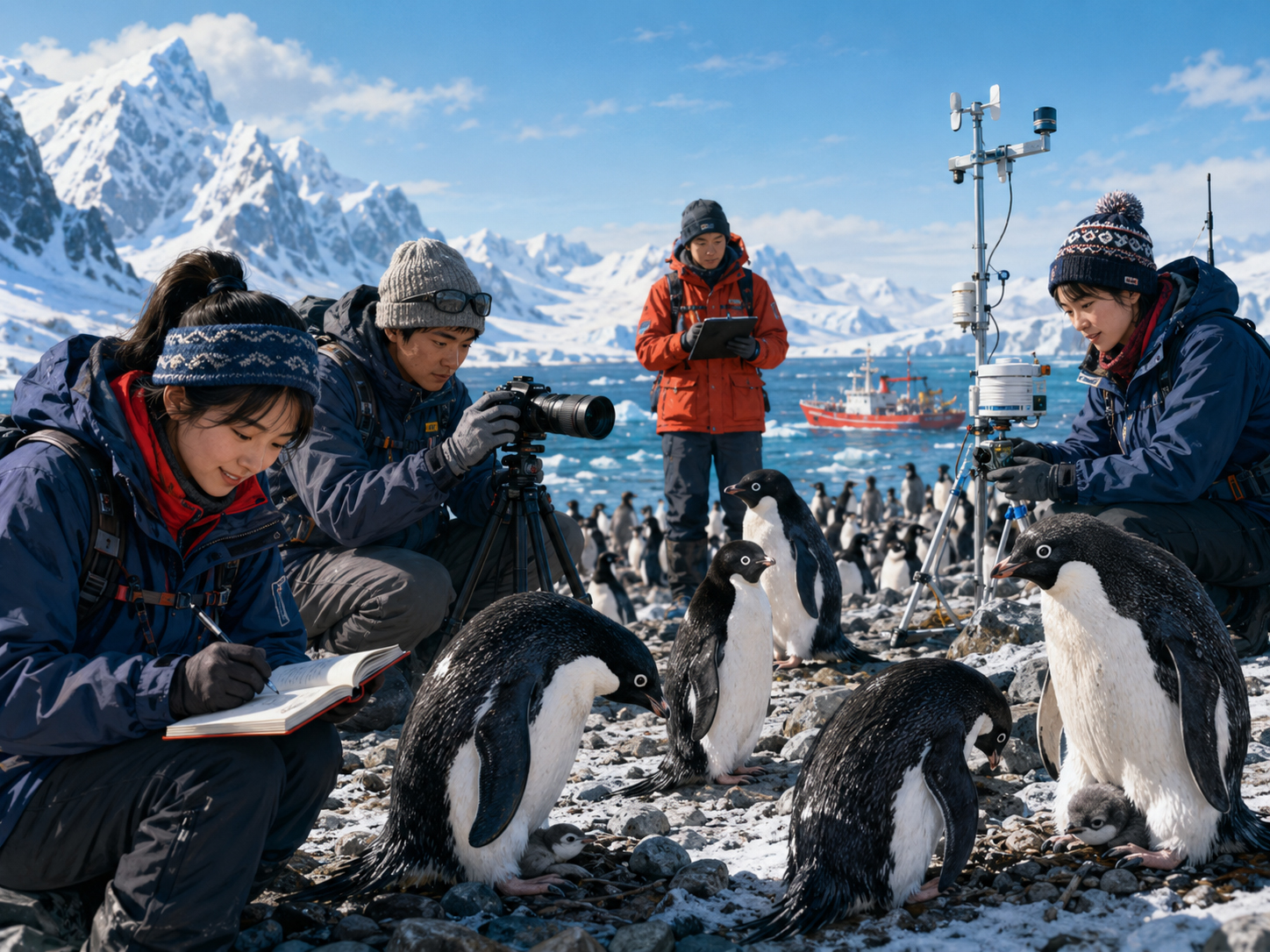
People look at penguins and often stop at the obvious word: cute. The black-and-white body, the awkward walk, the dense little crowd on ice. Science asks a better question. What does that crowd know?
A new study by researchers connected with Japan’s Graduate University for Advanced Studies, SOKENDAI, reads an Adélie penguin colony as an information system. The setting is Torinosu Cove in Lützow-Holm Bay, Antarctica. During chick-rearing season, parent penguins leave the colony for the sea, search for food, and return to feed their young. Each trip is a decision: go back to yesterday’s place, search somewhere new, or move with others who may know more.
The team fitted penguins with GPS and behavior loggers and simultaneously followed a remarkable share of the colony. The colony contained 135 breeding pairs; 96 to 116 birds were tracked at the same time, representing 35.6% to 43.0% of active breeders. Across 653 foraging trips, the pattern emerged. Many penguins returned to sites they had used before. But birds that had done poorly on a previous trip were more likely to shift, depart with other penguins, and use cues from companions.
A failed foraging trip did not simply end in hunger. The next morning, another penguin’s route could become a map.
Personal memory, social memory
The simple version is memorable: when penguins succeed, they often trust their own memory; when they fail, they are more likely to use the movement of others. Researchers describe this as a “win-stay, lose-shift” pattern. It is a phrase from behavioral science, but anyone who has ever chosen a restaurant understands it. If yesterday’s place was good, return. If it was bad, look at where the locals are going.
The penguins do not hold a meeting. They do not pass a map from flipper to flipper. The information is carried in timing, direction and association. Who leaves together? Which way do they swim? Which areas had those companions used before? The colony becomes a living information board, updated every time a bird returns from the sea.
Why animals live in groups
Group living is not free. It increases competition for food. It can spread disease. It can bring conflict. Yet group living has evolved again and again across animal lineages, and seabird colonies are among the most striking examples. One reason is safety. Another is information.
For colonial seabirds, the behavior of neighbors can reveal where food is, whether a patch is still productive, and which direction may now be worth trying. In the Adélie study, the strongest story is not simple cooperation but social learning after failure. The bird that did not find enough food does not merely repeat the same poor decision. It changes its information source.
This matters because it restores agency to animals too often treated as mascots. Penguins are not wind-up toys marching across ice. They are parents, hunters and decision-makers working in a landscape that changes daily.
Japan’s quiet polar science
The discovery also fits into a longer Japanese story. Japan’s Antarctic research program, anchored by Syowa Station, has produced decades of field science. Penguin work has benefited from biologging, animal-borne cameras, GPS tracking, depth recorders and accelerometers—technologies that turn invisible behavior into data.
The open ocean is nearly impossible to watch directly. A penguin disappears beneath the surface and, for the human eye, the story is gone. A biologging device restores part of it. It records position, depth, motion and sometimes images or sound. Over time, those traces create an animal’s hidden itinerary.
Earlier research on gentoo penguins showed that vocal behavior at sea may be linked to group association. In that study, offshore calls were followed by group association within one minute in a large share of cases. The new Adélie research looks at another layer: not just calls, but how departure and travel with others can provide social information about foraging sites. Different studies are approaching the same deeper question: are penguins alone at sea, or moving through a network of cues?
Climate makes information more valuable
The story becomes more urgent in a changing Antarctic. Sea ice, storms, currents and prey distribution affect where penguins can find food. If yesterday’s successful foraging ground becomes unreliable, then personal memory alone may not be enough. A flexible animal needs more than habit; it needs ways to read its community.
Other recent research has found major shifts in Antarctic penguin breeding timing, likely linked to climate change. Some penguin species and colonies may adapt better than others. Generalists may gain; specialists may lose. In that world, the social life of a colony may become part of its resilience—or reveal its limits.
There is a caution here. The study does not claim penguins think like people, nor that they consciously know which neighbor succeeded yesterday. It shows, through movement and behavior data, that less successful birds were more likely to change sites and rely on information associated with companions. Good science lets the story breathe without crossing beyond the evidence.
Five ways to read the finding
- A colony may be an information center, not just a crowd.
- Successful birds tend to reuse personal experience; unsuccessful birds are more likely to shift.
- Biologging makes invisible ocean behavior visible.
- Climate change may increase the value of flexible information use.
- The cute penguin story is really a story about failure, learning and social life.
From the aquarium window to Antarctica
For many readers in Japan, penguins are both distant and familiar. They live in Antarctic imagination, but also in urban aquariums. Visitors learn that penguins have individual personalities, pair bonds, rivalries, habits and voices. A crowd becomes a set of individuals.
Conservation work in Japan adds another layer. Tokyo Sea Life Park and Osaka Aquarium Kaiyukan have worked on artificial insemination and preservation techniques for Southern Rockhopper Penguins, a species under pressure in the wild and increasingly difficult to maintain in Japanese facilities. That is not simply exhibit management. It is conservation science taking place inside the city.
Field science in Antarctica and aquarium research in Japan may seem far apart, but they share the same moral question: how well can humans understand another species, and what responsibilities follow from that understanding?
Japan.co.jp reads this as a Sunday science story about more than penguins. It is about what happens after failure.
The Adélie penguin that fails to find food does not simply repeat the same route. It changes the source of information. Human organizations could learn something from that icy morning: systems that transform failure into shared knowledge are stronger than systems that hide it.
Sources and references
This Japan.co.jp report is based on SOKENDAI’s press release, the Proceedings of the Royal Society B study, Phys.org’s research summary, prior Scientific Reports work on penguin vocal behavior, Oxford University coverage of Antarctic penguin breeding shifts, and Tokyo Metropolitan Government reporting on penguin conservation science.
- SOKENDAI: Unsuccessful penguins use socially acquired information
- Proceedings of the Royal Society B: Unsuccessful foragers acquire social information through group departure and travel in penguins
- Phys.org: Adélie penguins use colony cues to switch foraging sites
- Scientific Reports: Group association and vocal behaviour during foraging trips in Gentoo penguins
- University of Oxford: Antarctic penguins’ climate adaptation
- Tokyo Metropolitan Government: Penguin conservation science