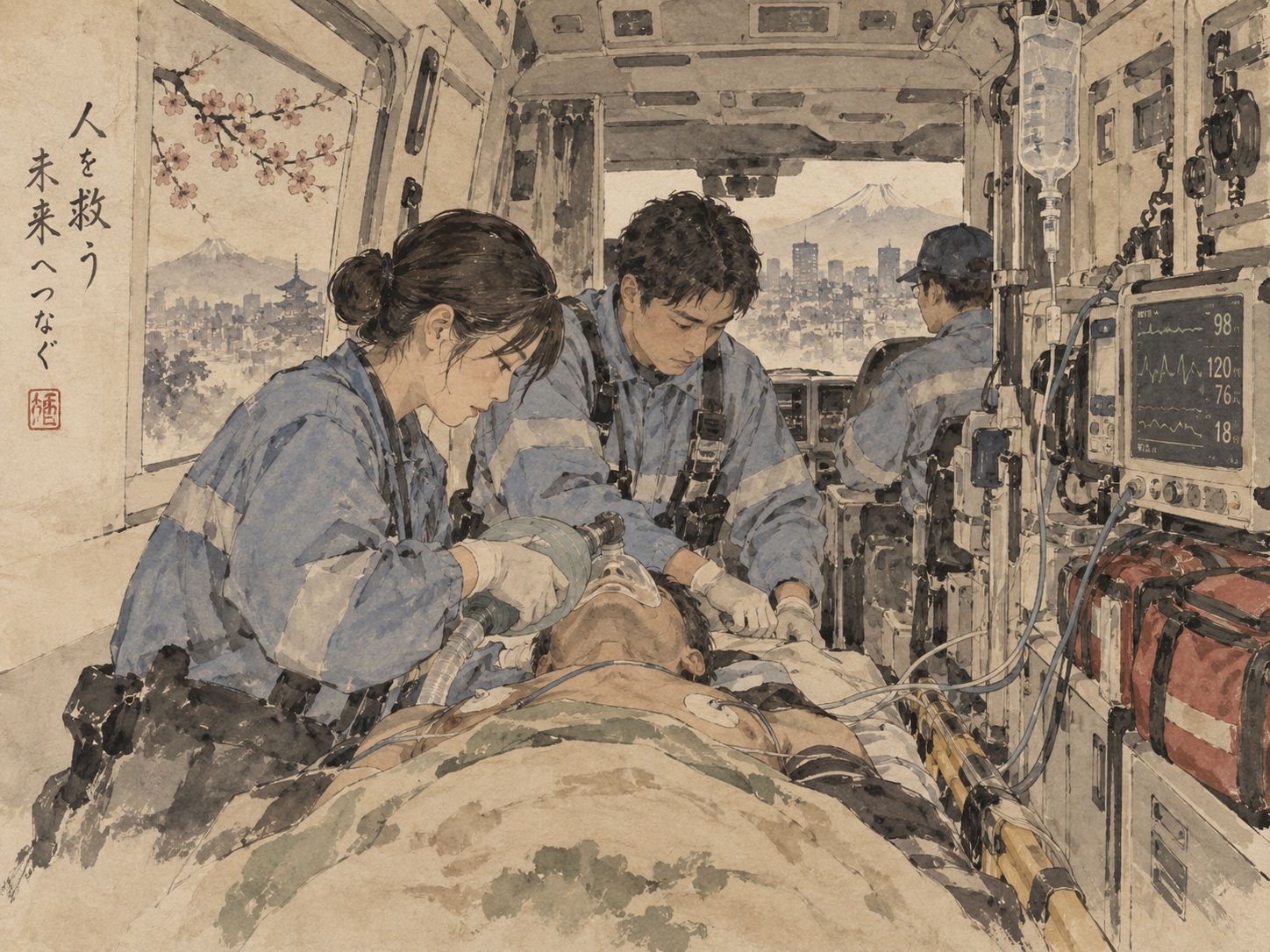
When an ambulance reaches a patient in Japan, the hospital may still be a long way away. In 2024, Japanese ambulances were dispatched 7,718,380 times. Average arrival at the scene took about 9.8 minutes, while average time to hospital admission stretched to 44.6 minutes — about 5.1 minutes longer than before the COVID-19 pandemic.[1]
That creates a basic medical question: how much treatment should begin before the patient reaches the hospital? On October 7, Japan’s Ministry of Health, Labour and Welfare held the third meeting of its committee reviewing the scope of emergency life-saving procedures that licensed emergency life-saving technicians can perform. The review comes as an aging population drives ambulance demand higher and emergency systems face pressure in both cities and rural areas.[2]
Japan created the profession to turn transport time into treatment time
Japan established its national emergency life-saving technician system in 1991. At the time, the government concluded that hospital emergency systems had improved faster than medical care during the period between an emergency scene and hospital arrival. Putting physicians in every ambulance was not realistic, so a new nationally licensed profession was created to perform advanced emergency procedures under medical direction.[4]
The initial scope was narrow. It included semi-automatic defibrillation, IV access with lactated Ringer’s solution and certain airway devices for severely ill patients.[5]
The scope expanded step by step over three decades
Japan did not broaden paramedic authority in one leap. Each major addition came after training standards, medical-control systems and implementation rules were developed.
In 2003, defibrillation moved from case-specific physician orders to broader standing authority. Endotracheal intubation followed in 2004 for appropriately trained technicians. Epinephrine for cardiac arrest was added in 2006, patient-prescribed auto-injector epinephrine in 2009, video-laryngoscope intubation in 2011, and IV fluids before cardiac arrest plus glucose administration for documented hypoglycemia in 2014. A 2021 legal change also allowed qualified emergency life-saving technicians to perform procedures after hospital arrival until admission under defined conditions.[6]
What is Japan considering now?
A regulatory-reform plan approved in June 2025 called for continuous review of the procedures emergency life-saving technicians can perform rather than treating the existing list as fixed. The Health Ministry created a new review structure in March 2026.[3]
Five procedures have been placed in a priority track: broader standing orders for epinephrine and related care in cardiac arrest; intramuscular epinephrine for anaphylaxis even when the patient does not already possess a prescribed auto-injector; reinsertion of an accidentally dislodged tracheostomy tube; acquisition and transmission of a 12-lead ECG for suspected acute coronary syndromes; and automated ventilation for patients in cardiac arrest.[3]
Several additional proposals are still in earlier stages of evaluation.
Epinephrine: can Japan safely remove the delay of a specific order?
Emergency life-saving technicians can already administer epinephrine in cardiac arrest, but the procedure generally falls under “specific acts” requiring explicit physician direction. One question now is whether some of that authority can move toward standing medical orders.
The benefit is time. In the field, transmitting patient information and obtaining direct authorization can add delay. But medication errors can also cause harm, so any broader standing authority would depend on training, protocols, medical control, documentation and post-case review.
Anaphylaxis: what if the patient does not have an EpiPen?
Current Japanese practice allows emergency life-saving technicians to use a patient’s prescribed epinephrine auto-injector under defined circumstances. The more difficult scenario is a first-time or otherwise unprepared patient with severe anaphylaxis who has no prescribed device available.
Anaphylaxis can progress rapidly to airway obstruction and circulatory shock. Allowing intramuscular epinephrine before hospital arrival could shorten treatment time, but the system must also ensure accurate recognition, correct dosing and appropriate monitoring after administration.
When a tracheostomy tube comes out
More patients with complex medical needs now live at home with tracheostomies. An accidentally dislodged tracheostomy tube can become an airway emergency.
Routine reinsertion is not currently part of the nationwide standard scope for emergency life-saving technicians. The new review asks whether trained personnel should be allowed to reinsert a tube under specific conditions. The potential benefit is obvious, but anatomy, stoma maturity and device differences make the procedure technically and clinically demanding.
A 12-lead ECG could move hospital decision-making into the ambulance
Time is critical in acute myocardial infarction. Japanese emergency crews already use cardiac monitoring and can transmit ECG information, but the new review specifically considers acquisition and transmission of a full 12-lead ECG for suspected acute coronary syndromes.
If a cardiology team receives diagnostic-quality tracing before the patient arrives, it may be able to select the right destination and prepare catheterization resources earlier. The point is not necessarily for the paramedic to make the final diagnosis; it is to move the hospital’s decision process forward.
Automated ventilation: consistency during a crowded resuscitation
Manual bag-mask ventilation is a basic part of resuscitation, but cardiac arrest scenes demand many simultaneous tasks: chest compressions, airway management, medication, rhythm analysis and transport preparation.
An automatic ventilator could provide consistent breaths while freeing personnel for other critical tasks. But inappropriate settings or poor airway control could cause harm, making training and patient-selection rules essential.
Ultrasound is also entering the discussion
At the committee’s July 2026 meeting, the ministry presented a separate paper on prehospital ultrasound by emergency life-saving technicians.[7]
Portable ultrasound devices are becoming smaller and more capable. In principle, they could help assess internal bleeding, cardiac activity or lung conditions before hospital arrival. But image acquisition and interpretation require substantial training, and a key governance question is who makes the final clinical interpretation.
Japan’s emergency burden is growing in both volume and time
The Fire and Disaster Management Agency recorded roughly 7.72 million ambulance dispatches in 2024, averaging about 21,088 per day — one dispatch roughly every 4.1 seconds. Ambulances transported about 6.77 million people.[8]
Transport time is also increasing. Older patients often have multiple conditions, and finding an appropriate receiving hospital can require more coordination. Expanding what paramedics can do may improve care during that interval, but it cannot by itself create more hospital beds or emergency physicians.
About 3,000 new technicians are registered each year
At the July 2026 committee meeting, the Health Ministry said roughly 3,000 new emergency life-saving technicians are registered each year.[9]
Adding a procedure to the legal scope does not make every technician immediately competent to perform it. Intubation and other expanded procedures have historically required additional education, clinical practice or regional certification. Any new authority would similarly require training standards, equipment rules, medical direction and quality review.
Medical control is the safety architecture
Japan’s prehospital system depends heavily on “medical control”: physician direction and consultation, standardized protocols, retrospective case review and continuing education.
As technicians take on more autonomous actions, that infrastructure becomes more important, not less. Expanding authority safely depends on the quality of supervision after the call as much as communication during the call.
Legal permission does not mean universal operational permission
Even procedures already permitted under national law may be limited to technicians who have completed specified additional training or certification. Endotracheal intubation, epinephrine administration, pre-arrest IV fluid therapy and glucose treatment all developed with staged education and credentialing.[10]
If Japan approves new procedures, implementation will likely involve the same layers: education, credentialing, medical-control protocols, equipment standards and post-event review.
Japan’s “paramedic” is not identical to the role overseas
English-language coverage often uses “paramedic” for Japan’s emergency life-saving technician, but scopes of practice vary dramatically across countries. In some systems, paramedics administer broader drug formularies, provide analgesia or make more independent diagnostic decisions.
Japan’s model is built around its own medical law, fire-service structure and physician-led medical control. International comparisons can be useful, but direct one-to-one comparisons are misleading.
More procedures will not solve emergency-system congestion
Broader paramedic authority cannot by itself solve ambulance shortages, workforce constraints, emergency-bed shortages or limited specialist coverage at night and on weekends.
But in time-sensitive conditions — cardiac arrest, anaphylaxis, acute coronary syndrome — a useful intervention performed minutes earlier may matter. That makes scope-of-practice reform one component of a larger emergency-care strategy.
The next question is not only what to add, but how to add it
The Health Ministry has reorganized its review process. A technical committee evaluates medical necessity, safety, difficulty and invasiveness; the broader review committee then considers whether the procedure should enter the official scope and whether pilot implementation is needed.[9]
That procedural change may prove as important as any single new skill. It creates a clearer mechanism for updating practice as devices, evidence and emergency demand change.
Japan’s ambulance has not been merely transportation for decades. Thirty-five years after the profession was created, the country is again deciding how far the ambulance should evolve into a treatment environment — and what training, oversight and evidence should accompany that authority.
Sources and references
- Fire and Disaster Management Agency, 2025 White Paper emergency-service statistics.
- Ministry of Health, Labour and Welfare, Committee on Emergency Life-Saving Procedures, third meeting, October 7, 2026.
- MHLW, first committee meeting transcript, March 10, 2026.
- MHLW, implementation notice for the Emergency Life-Saving Technician Act, 1991.
- FDMA, historical expansion of emergency life-saving technician procedures.
- MHLW, chronology of expanded emergency life-saving procedures.
- MHLW, second committee meeting materials, including prehospital ultrasound, July 9, 2026.
- FDMA, detailed 2024 ambulance activity statistics.
- MHLW, second committee meeting transcript, July 9, 2026.
- MHLW, training and certification requirements for expanded procedures.
Reporting and verification cutoff: October 7, 2026. The procedures described as “under review” have not been approved for uniform nationwide use. Minutes from the October 7 third meeting were not yet published at the verification cutoff, so this article relies on the official meeting page and earlier published ministry materials.