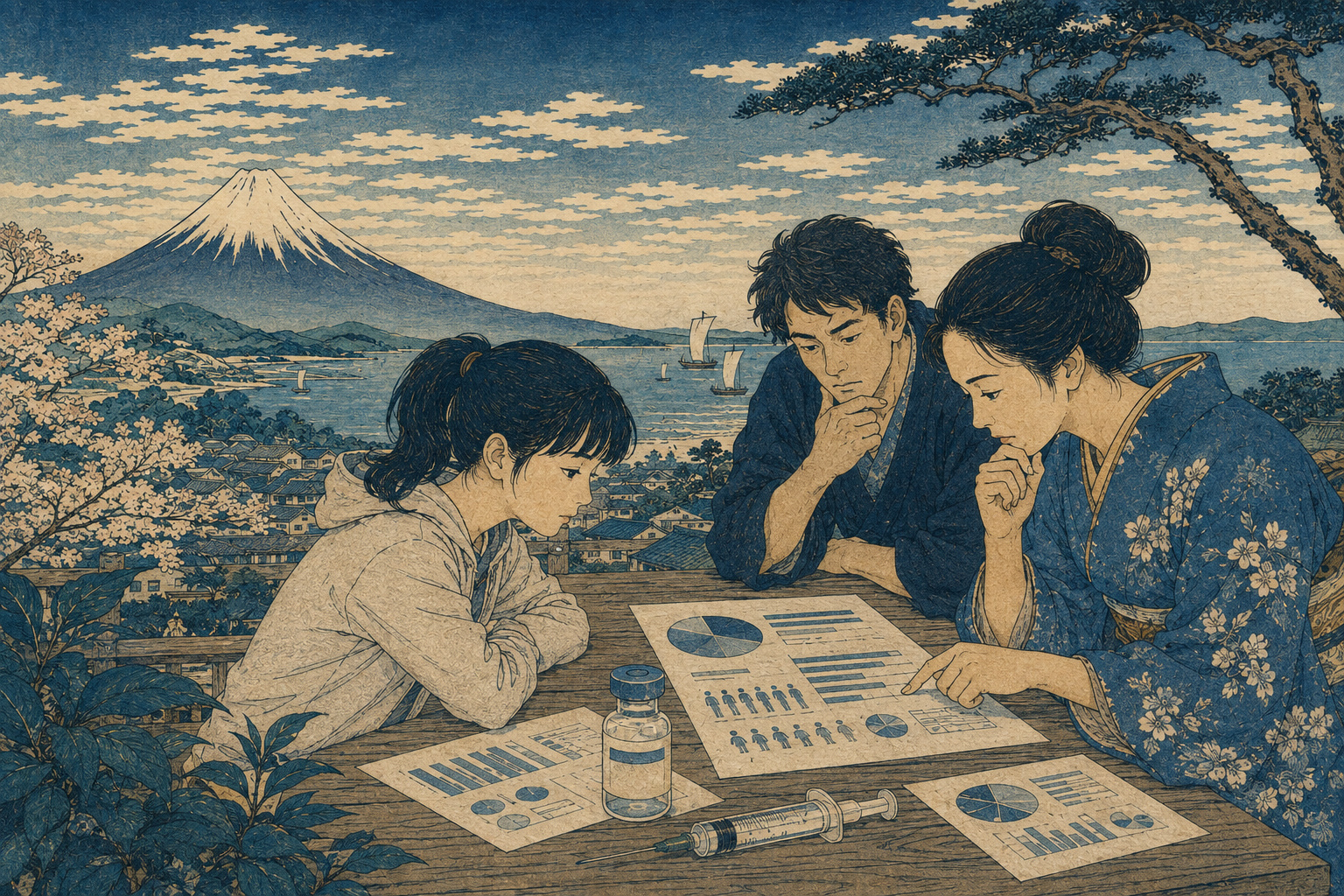
The first shortage in the next vaccine campaign may not be doses. It may be willingness. A large Japanese internet survey found that 53.1% of respondents said they would definitely or probably accept vaccination in a future pandemic under a carefully specified scenario: a disease with a COVID-like fatality rate, and a vaccine approved by Japanese and international authorities that reduced the risk of death by at least half.
That result does not describe a nation split neatly into believers and refusers. The study found a movable middle whose answers changed when the imagined disease became deadlier or protection lasted longer. It also found a more firmly opposed group that changed little. Across eight clusters of decision priorities, three conditions repeatedly mattered—free vaccination, evidence from clinical trials and a physician’s recommendation—while views on domestic production, public authorities, vaccine technology and convenience varied sharply.
A controlled thought experiment, not a prediction market
The research was led by a team including Masakaze Hamada and Professor Yuki Furuse of the University of Tokyo’s UTOPIA center and Junna Kawasaki of Chiba University’s Graduate School of Medicine, now at Osaka University. It drew on the Japan COVID-19 and Society Internet Survey, known as JACSIS. The online survey enrolled 28,000 people aged 15 to 84. After quality screening, 25,082 responses remained; the primary analysis excluded people who had been medically unable to receive a COVID-19 vaccine, leaving 24,577.
Respondents were not asked whether they would take an unknown injection with no evidence. They were told to imagine a vaccine that cut mortality risk by 50% or more and had been approved by the Japanese government and bodies such as the World Health Organization. The baseline pandemic was described as having a case-fatality range of 0.1% to 2%, comparable to COVID-19 in the study’s framing.
| Element | Study setting | Editorial interpretation |
|---|---|---|
| Fieldwork | December 2024–January 2025 | A post-emergency snapshot, not a live pandemic response |
| Mode | Nationwide internet survey, ages 15–84 | Large and diverse, but not a household probability sample |
| Primary analysis | 24,577 respondents | After response-quality screening and medical exclusions |
| Baseline threat | 0.1–2% case fatality | One hypothetical risk range, not every possible future pathogen |
| Vaccine assumption | At least 50% reduction in death risk and official approval | A defined benefit and authorization, but no specific platform or product |
The design makes the 53.1% figure more consequential, but it also limits how it can be used. It is more informative than asking about a completely undefined vaccine. Yet no real future product has a known dosing schedule, safety profile, manufacturer, recommendation, price or delivery system. The number is best treated as a preparedness stress test: under favorable minimum assumptions, nearly half of respondents were still not ready to say yes.
The people who changed sides
Japan’s COVID-19 campaign reached more than four-fifths of the population for a first dose. Past behavior, however, was not a permanent identity. Among 19,027 survey participants who had received a COVID-19 vaccine, 35.8% said they probably or definitely would not accept vaccination in the next pandemic. Among those who had not received a COVID-19 vaccine, 15.1% said they would accept one next time.
That two-way movement matters more than a simple “confidence has fallen” headline. It means the population cannot be divided once and for all into vaccinated and unvaccinated camps. Some people who accepted a product under the conditions of 2021–2023 are reassessing the bargain. Some who declined then are open to a different disease, evidence base or delivery system.
The movable middle responded to risk and duration
When researchers raised the assumed fatality of the next pandemic or lengthened the expected duration of vaccine protection, some respondents moved toward acceptance. The shift was concentrated among people who had initially said they would “probably not” vaccinate and was more pronounced among those with previous COVID-19 vaccination experience.
People who said they would “definitely not” vaccinate changed much less. That creates a practical distinction for emergency planning. A person waiting for clearer evidence about personal risk or the length of protection is not making the same decision as a person whose refusal is categorical. Treating both groups as one audience can waste the narrow window in which useful information and easier access can change behavior.
What an undecided person may need before deciding
- Age- and condition-specific risks from the disease, not only a national average.
- Separate estimates for protection against infection, severe illness and death.
- The size, composition and follow-up period of clinical trials.
- Known adverse reactions, remaining uncertainty and the plan for active surveillance.
- A clear explanation of cost, booking, time off work, transportation and childcare.
Eight publics, not one public
The study examined 20 conditions that might make vaccination more attractive, including clinical-trial evidence, recommendations from physicians and authorities, the country of development or manufacture, vaccine type, appointment and location convenience, and cost. An unsupervised clustering analysis grouped respondents into eight distinct patterns of priorities.
Free vaccination and clinical-trial evidence ranked highly across every cluster. Physician recommendation was also broadly important. Beyond that shared floor, the groups diverged. A relatively younger cluster gave particular weight to convenient sites and procedures. Another strongly valued a domestically produced vaccine while placing less weight on official recommendations. Several clusters relied more heavily on experts and public institutions, had greater infectious-disease knowledge and reported higher vaccination intention.
This is the study’s most useful finding for policy. A communications plan can fail even when every sentence is factually correct if it answers a question the audience is not asking. Someone facing a ¥15,000 bill, a difficult reservation system or a lost workday does not primarily have an information deficit. Someone asking how trial endpoints were selected will not be persuaded by convenience alone. Someone who distrusts a central institution may listen to a regular physician—but only if that physician has time, current evidence and a system for discussing uncertainty.
Information sources: an association, not a verdict
Higher stated intention was associated with obtaining information from government, health professionals, experts, television and newspapers. In models considering multiple sources together, information from friends, celebrities, video-sharing services and social media was associated with lower intention. Endorsement of vaccine misinformation and COVID-19 conspiracy claims was also associated with hesitancy.
The researchers explicitly caution that the observational design cannot establish causation. The analysis does not prove that opening a government website makes a reluctant person willing, or that using social media makes a willing person hesitant. People choose information sources partly because of beliefs they already hold. Platforms also carry both high-quality and false material. The policy question is therefore not which medium to banish; it is which claims travel through each network, which messengers are trusted and whether accurate information arrives before a false narrative hardens.
The World Health Organization’s Behavioural and Social Drivers framework makes a similar point. Readiness, social processes, motivation and practical barriers should be measured rather than collapsed into one label. The Japanese study supplies a domestic version of that map: the last mile of vaccination is built from evidence, confidence, social influence, money and access at the same time.
The adverse-reaction finding requires narrow language
The University of Tokyo release reports that self-reported experience and severity of reactions after prior COVID-19 vaccination were not associated with future vaccination intention in the adjusted analysis. The finding is notable precisely because public debate often assumes a direct line from a past reaction to future refusal.
It does not mean reactions did not occur. It does not establish that safety concerns are irrelevant to individuals. It does not evaluate the safety of any future vaccine. It is a statistical result about past self-reported reactions and hypothetical future intention within this dataset. Other unmeasured experiences—including whether a person felt heard, received care or trusted the explanation—may matter.
Safety communication cannot be treated as an obstacle to uptake. Japan’s system collects suspected adverse-event reports even when causality has not been established and operates a statutory health-damage relief program. A credible future campaign will need to show benefits, known risks, unresolved questions, surveillance findings and compensation procedures together. Selective reassurance is fragile; auditable uncertainty is more durable.
A vaccination system with a long institutional memory
Japan’s present attitudes sit inside a policy history that began long before COVID-19. The 1948 Immunization Act was built for a country confronting major infectious threats and imposed strong obligations. As vaccine injuries became a public issue, the 1976 revision established a health-damage relief structure. The 1994 revision moved many routine vaccinations from legal compulsion toward an “effort obligation,” placing greater weight on information and individual judgment.
1948: Japan enacts the Immunization Act with strong compulsory features.
1976: A major revision establishes the health-damage relief system and responds to growing concern about adverse effects.
1994: Many routine vaccinations shift from a strict duty to an effort obligation.
2009: The A/H1N1 influenza campaign uses priority groups while supply is constrained.
2013–2022: Active recommendation of HPV vaccination is suspended, then individual recommendations resume after expert review.
2021–2024: Japan conducts its extraordinary COVID-19 vaccination program.
2022: AMED establishes SCARDA to lead vaccine research and development preparedness.
2024: A revised national pandemic action plan places greater emphasis on two-way risk communication and measuring public attitudes.
2026: The new study maps intentions and decision drivers before the next emergency.
The HPV episode remains a warning about the persistence of policy signals. Japan added HPV vaccination to the routine program in April 2013, then suspended active recommendation two months later while maintaining access. The health ministry says coverage remained below 1% around 2019. Expert review concluded in November 2021 that ending the suspension was appropriate, and individual recommendations resumed in April 2022. That history does not prove why respondents answered this future-pandemic survey as they did. It does demonstrate that a change in official posture can echo for years after the underlying evidence is reassessed.
COVID-19’s 80.3% and the new 53.1% are different measures
Japan recorded 436,323,643 COVID-19 doses during the extraordinary program through March 31, 2024. First-dose coverage reached 80.3%. It is tempting to subtract 53.1 from 80.3 and call the difference a collapse in trust. That arithmetic would compare unlike things.
The 80.3% figure is observed behavior accumulated during a real emergency, as risk perceptions, workplace vaccination, peer behavior, eligibility and supply changed. The 53.1% figure is a hypothetical answer recorded before a future emergency exists. The contrast is still a warning, but it is not a 27.2-point causal measure of lost confidence.
The survey also took place after Japan ended fully publicly funded COVID-19 vaccination in March 2024. From April 2024, routine autumn-winter vaccination covers people aged 65 and older and specified high-risk people aged 60 to 64, generally with a locally set co-payment. There is no effort obligation or municipal recommendation provision; others may seek voluntary vaccination at their own expense. The study does not show that this policy transition caused lower intention. Yet the universal priority given to “free vaccination” shows that financing rules are part of preparedness, not an administrative detail to settle after approval.
A vaccine is not ready until society can receive it
After COVID-19 exposed weaknesses in domestic development, Japan created the Strategic Center of Biomedical Advanced Vaccine Research and Development for Preparedness and Response, or SCARDA, within the Japan Agency for Medical Research and Development in March 2022. Its mission is to lead research in peacetime, fund strategic programs and maintain a system capable of moving quickly in an emergency. The present study was supported through SCARDA’s research-center program and other grants.
That biomedical infrastructure is essential. It is also only one half of a vaccination system. The other half includes baseline attitude surveys, trusted clinical messengers, appointment capacity, accessible sites, paid time, affordability, safety surveillance, relief mechanisms and a rapid response to misinformation. Development speed and social delivery are not separate achievements. They are sequential links in one preparedness chain.
Japan.co.jp analysis: seven tests for the next vaccination plan
- Baseline: Does Japan repeatedly measure intention and barriers by age, income, location and prior vaccination?
- Evidence: Are trial size, endpoints, duration, benefits and uncertainties presented in comparable formats?
- Messengers: Are physicians, pharmacists, local health workers and workplaces equipped—not merely asked—to communicate?
- Cost: Does policy remove fees and the hidden costs of travel, time off and childcare?
- Convenience: Are evening, weekend, workplace, school, community, disability and language needs built in?
- Safety: Are suspected events, review decisions, recommendation changes and relief outcomes published promptly?
- Adaptation: Can the campaign change its strategy when stated intention and actual booking behavior diverge?
What the survey cannot settle
The sample is large, but it came from an online panel rather than a random household probability sample. People with limited internet access or different levels of interest in health surveys may be underrepresented. The cross-sectional design cannot determine whether an information source, value or social condition caused a person’s intention.
Respondents may also have imagined different technologies when they read “vaccine.” A future threat may have a different transmission route, age profile, long-term burden or dosing schedule. A case-fatality percentage does not capture all of those dimensions. The survey measures a response to one structured scenario, not a universal appetite for all vaccines.
Those limits do not weaken the reason for asking early. Once an outbreak begins, fear, political conflict, rumors, scarcity and personal experience rapidly change the information environment. A pre-crisis survey establishes where friction already exists. It allows authorities to design systems before every disagreement becomes an emergency.
The next number should be a moving one
The most valuable follow-up would track the same people through stages of a future threat: pathogen discovery, early mortality estimates, trial results, approval, recommendation, price, local availability and first safety signals. That would reveal which groups move, when they move and what information or barrier coincides with the change. Stated intention should also be compared with registration and actual vaccination.
Demographic associations require equally careful treatment. Lower intention among adults in their 20s to 40s, women, people with lower incomes and those with less formal education should not be converted into stereotypes or messaging targets. Each association may contain different structural barriers—work schedules, caregiving, access to a regular doctor, prior encounters with institutions, affordability or unequal exposure to reliable information. Demographics should be the start of investigation, not the end of explanation.
In the next pandemic, the measure of communication will not be how many times officials repeat that a vaccine is safe and effective. It will be whether they update evidence, state uncertainty, make clinicians available, reduce cost and effort, and answer the questions different groups are actually asking. Japan’s 53.1% is not a verdict on the future. It is an early warning that trust, access and evidence cannot be stockpiled after the emergency begins.
Sources and methodology
- University of Tokyo, “53.1% say they would be vaccinated in the next pandemic” (Japanese press release, September 1, 2026)
- Kawasaki J. et al., “Vaccine acceptance in a future pandemic after COVID-19 and its decision drivers in Japan,” npj Vaccines (August 20, 2026)
- Ministry of Health, Labour and Welfare, COVID-19 vaccination totals during the extraordinary program
- Ministry of Health, Labour and Welfare, COVID-19 Vaccine Q&A (post-April 2024 policy)
- Ministry of Health, Labour and Welfare, Immunization and Vaccine Information (safety reporting and health-damage relief)
- Ministry of Health, Labour and Welfare, minutes of the 13th vaccination policy subcommittee (history of the Immunization Act)
- Ministry of Health, Labour and Welfare, HPV vaccination (suspension and resumption of active recommendation)
- Ministry of Health, Labour and Welfare, archive of the 2009 A/H1N1 vaccination program
- Cabinet Secretariat, National Action Plan for Pandemic Influenza and New Infectious Diseases (July 2, 2024)
- Japan Agency for Medical Research and Development, SCARDA overview
- World Health Organization, Behavioural and Social Drivers of Vaccination guidebook (2022)
- World Health Organization, Infodemic
This English edition was written independently rather than translated from the Japanese article. Reporting checked the University of Tokyo’s September 1, 2026 Japanese release, the peer-reviewed npj Vaccines paper, Ministry of Health vaccination totals and policy records, Japan’s national pandemic action plan, AMED/SCARDA materials and WHO behavioural-and-social-drivers guidance. The 53.1% result is presented as stated intention under a hypothetical scenario, not a prediction of future coverage. Individual medical decisions in an actual outbreak would depend on the pathogen, product-specific evidence, personal health and current public-health recommendations.
Image rights: © 2026 Japan.co.jp. This AI-assisted editorial illustration may not be reproduced or reused without permission. For licensing, use the contact page.