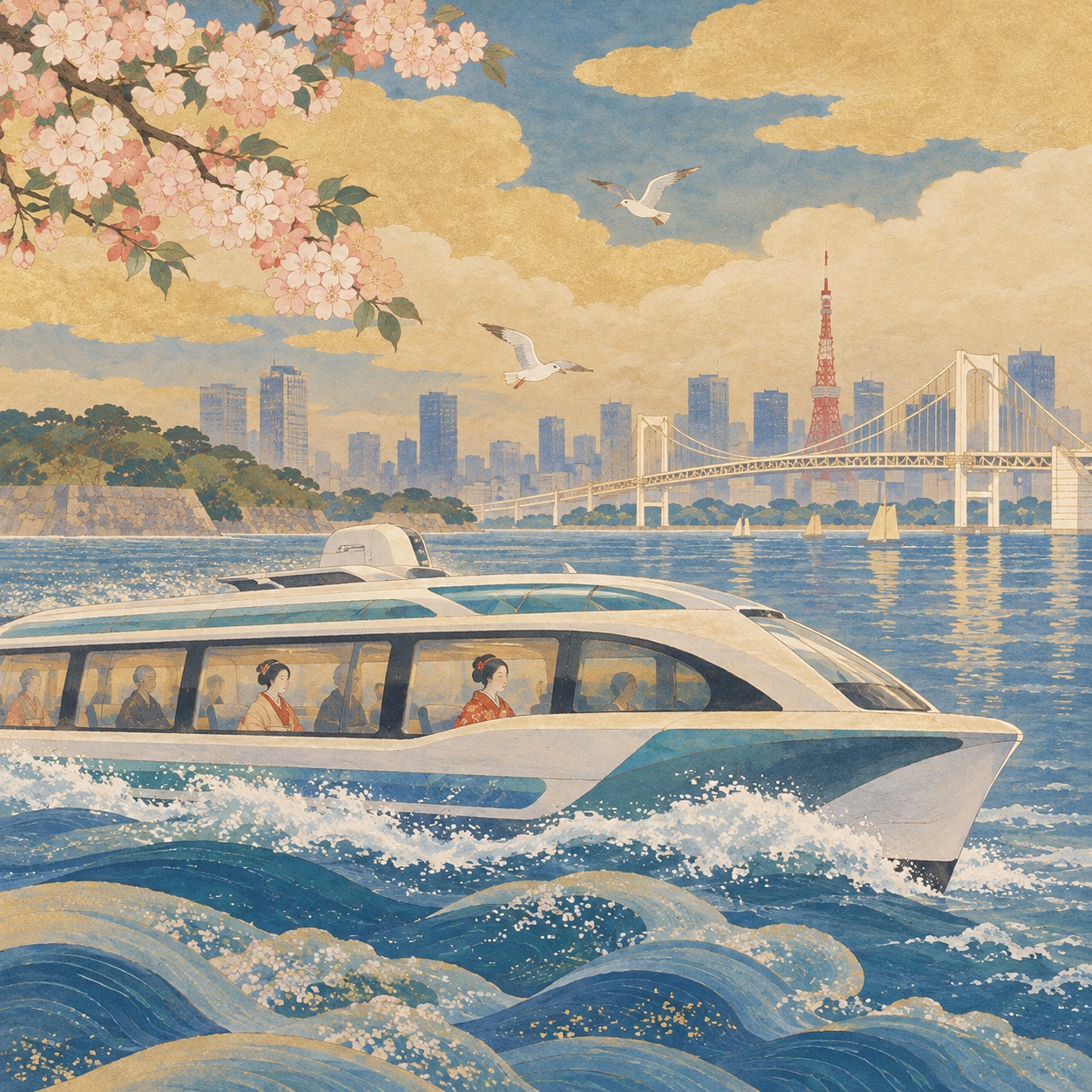
Expo technology has a habit of becoming yesterday’s future once the gates close. The hydrogen fuel-cell passenger vessel Mahoroba is attempting something more difficult: a second life. After carrying visitors across Osaka Bay to Expo 2025, the ship is scheduled to begin operating in Tokyo Port this winter under a partnership between the Tokyo Metropolitan Government and Iwatani Corporation.[1][3]
Tokyo opened public voting on September 25 for a local nickname. Five candidates—roughly “Suisui Maru,” “Hydrogen Maru,” “Tokyo Maru NEO,” “Hydro Ship” and “Mizunagi”—were selected from more than 9,000 submissions. Voting runs through November 15, with a result expected around December. The registered ship name, Mahoroba, will not change. Tokyo says service is planned for “this winter,” but the route and boarding points are still being arranged.[1]
A hydrogen ship—but not a hydrogen-only ship
Mahoroba uses electricity generated by hydrogen fuel cells together with electricity stored in rechargeable batteries. Its energy system includes fuel cells, hydrogen storage tanks and lithium-ion batteries, driving electric propulsion rather than a conventional combustion engine.[6]
Tokyo and Expo materials emphasize two operational benefits: the fuel-cell system emits no carbon dioxide while operating, and electric propulsion greatly reduces the vibration, noise and fuel odor associated with combustion engines. On a passenger and sightseeing vessel, quietness is not merely an environmental feature; it changes the product passengers experience.[4]
But “zero emissions” needs a boundary. The ship itself does not emit CO2 from the fuel-cell reaction during operation. The lifecycle footprint depends on how the hydrogen is produced, compressed or liquefied and transported, and on the electricity used to recharge the battery. Zero exhaust at the vessel is not automatically zero carbon across the fuel supply chain.
The full climate impact depends on the source of the hydrogen and electricity.
The project began in 2019
Iwatani began developing the hydrogen fuel-cell vessel in 2019. In fiscal 2021, the project was adopted under a NEDO fuel-cell research and development program. Partners included Kansai Electric Power, Tokyo University of Marine Science and Technology, Namura Shipbuilding, Development Bank of Japan and Osaka Aqua Bus.[5]
Early NEDO design material described a catamaran about 30 meters long and 8 meters wide, around 120 gross tons, carrying roughly 150 passengers. The target system combined fuel cells and lithium-ion batteries, with a planned cruising speed of 10 knots and a maximum range target of about 130 kilometers.[10]
The completed vessel grew to 33 meters in length, remained 8 meters wide, and was built as a two-deck passenger ship for up to 150 people. After construction in Hiroshima and transfer to Osaka, it underwent certification and test operations. NEDO held an unveiling ceremony on March 21, 2025, ahead of Expo operations beginning in April.[6][8]
At Expo 2025 it was a “moving pavilion”
Mahoroba was deliberately presented as more than transportation. Expo organizers called the vessel a “moving pavilion”, turning the trip between Universal City Port and Yumeshima into part of the Expo experience. Adult fares were ¥3,000 one way and ¥5,000 round trip; children paid ¥1,500 and ¥2,500 respectively.[4]
The Expo operation also generated engineering data. Working with Kansai Electric Power, Tokyo University of Marine Science and Technology and others, the project collected and analyzed hydrogen and electricity filling and consumption data to improve energy management.[4][7]
That distinction matters. A technology exhibit can work perfectly for ten minutes. A passenger vessel has to depart, refill, recharge, carry people safely and repeat the process.
The hard part of a hydrogen ship may be the port
Building the vessel is only half the system. A hydrogen ship needs a reliable way to bring fuel to the waterfront, store it, transfer it safely and coordinate fueling with passenger operations. The batteries need charging as well. NEDO therefore funded not only the shipboard energy system but also shoreside bunkering infrastructure capable of supplying hydrogen and electricity.[6]
In Osaka, hydrogen supply infrastructure was developed around facilities including Kansai Electric Power’s Nanko site. Tokyo will likewise need a practical solution for fueling, charging, safety zones, operating procedures and emergency response.
As of September 25, Tokyo says the winter route and boarding locations are still under coordination. That uncertainty is not merely a tourism-marketing detail. Where the vessel docks determines where hydrogen and charging infrastructure can be supported and how the ship fits around commercial port activity.
Tokyo is acquiring a platform, not just a boat
Tokyo and Iwatani signed their basic agreement on October 16, 2025. The arrangement covers operation in Tokyo Port, public communication about hydrogen and the role of the port, and opportunities for people to ride during environmental-education programs and international events. Iwatani retains ownership of Mahoroba.[3]
That makes the Tokyo project different from the launch of an ordinary public-ferry route. No fixed commuter timetable, fare structure or permanent transit role has yet been announced. The vessel is better understood, for now, as a platform combining demonstration, education, tourism and public engagement.
Describing it prematurely as “Tokyo’s new hydrogen water bus” would go beyond the published plan. What is confirmed is a winter operating program in Tokyo Port intended to give people real rides and advance hydrogen social implementation.
The nickname changes; Mahoroba does not
The public naming campaign is part technology outreach and part city branding. More than 9,000 nickname proposals were submitted before the end of August. Tokyo selected five finalists and opened a one-person, one-vote process, with the chosen nickname expected around December.[1]
The registered vessel name remains Mahoroba. Iwatani says the word comes from a poem associated with Yamato Takeru in the Kojiki and conveys the idea of a fine, comfortable place to live. The company chose it to express the hope that a society coexisting with nature might become a true “mahoroba.”[9]
Giving the Osaka vessel a Tokyo nickname without erasing its original name is a small but revealing symbol: the goal is not to preserve an Expo artifact untouched, but to reuse it in a new city.
Hydrogen versus batteries is the wrong question here
Debates about zero-emission vessels are often framed as fuel cells versus batteries. Mahoroba was designed around a different premise: use both.
NEDO’s development materials identified limitations on each side. Pure battery vessels face charging time and infrastructure constraints. Fuel-cell vessels face high vessel and hydrogen-infrastructure costs. A hybrid system can use batteries where they are efficient and hydrogen where additional energy storage and range are useful, potentially reducing peak infrastructure requirements.[10]
That may prove important because shipping is not one market. Deep-sea cargo vessels, ferries, harbor workboats and sightseeing craft have very different duty cycles. Mahoroba is a specific experiment: whether hydrogen-battery hybrid propulsion works operationally for a roughly 150-passenger urban and leisure vessel.
The next important data are not passenger selfies
Once Tokyo operations begin, the most useful metrics will be operational: hydrogen consumption per voyage, charging energy, refueling time, vessel availability, maintenance expense, average load factor, cost compared with conventional alternatives and the carbon intensity of the energy actually supplied.
Expo economics are forgiving in one respect: visitors are partly paying for novelty. Urban operation is less forgiving. A technology becomes infrastructure only when it works reliably, refuels predictably, can be maintained without excessive downtime and fits a business or public-service model that can continue after the demonstration budget ends.
Tokyo Bay will ask whether the technology can be used repeatedly—not merely displayed convincingly.
Can an Expo legacy survive outside the Expo?
Large exhibitions are unusually good at forcing new technologies into public view. Their weakness is what happens afterward. Equipment can become a museum piece just as quickly as it became a headline.
Mahoroba is taking the harder route. It carried Expo visitors in Osaka; now it is being prepared to carry people in Tokyo Port. Tokyo plans to use it for environmental education and international events, and is inviting the public to help name its local identity.
The route is not yet fixed. Boarding locations are not yet fixed. Fares and frequency are not yet public. That is precisely why it is too early to call the project a success.
But the move from Osaka to Tokyo changes the nature of the experiment. The question is no longer whether Japan can build and showcase a hydrogen fuel-cell passenger ship. It is whether that ship can keep working after the showcase is over.
Sources
- Tokyo Metropolitan Government: public nickname vote for hydrogen fuel-cell ship, Sept. 25, 2026
- Tokyo Port and Harbor Bureau: Hydrogen fuel-cell ship project
- Tokyo Metropolitan Government: basic agreement with Iwatani on hydrogen fuel-cell ship use
- Expo 2025 Osaka, Kansai: Mahoroba hydrogen fuel-cell ship
- Expo 2025 Osaka, Kansai: Smart Mobility / venue access boat project
- NEDO: unveiling ceremony of Mahoroba, March 2025
- NEDO: Expo 2025 demonstrations and results
- Iwatani: interim results Q&A, vessel dimensions and capacity
- Iwatani: Mahoroba ship name and origin
- NEDO: hydrogen fuel-cell vessel R&D targets and system design
