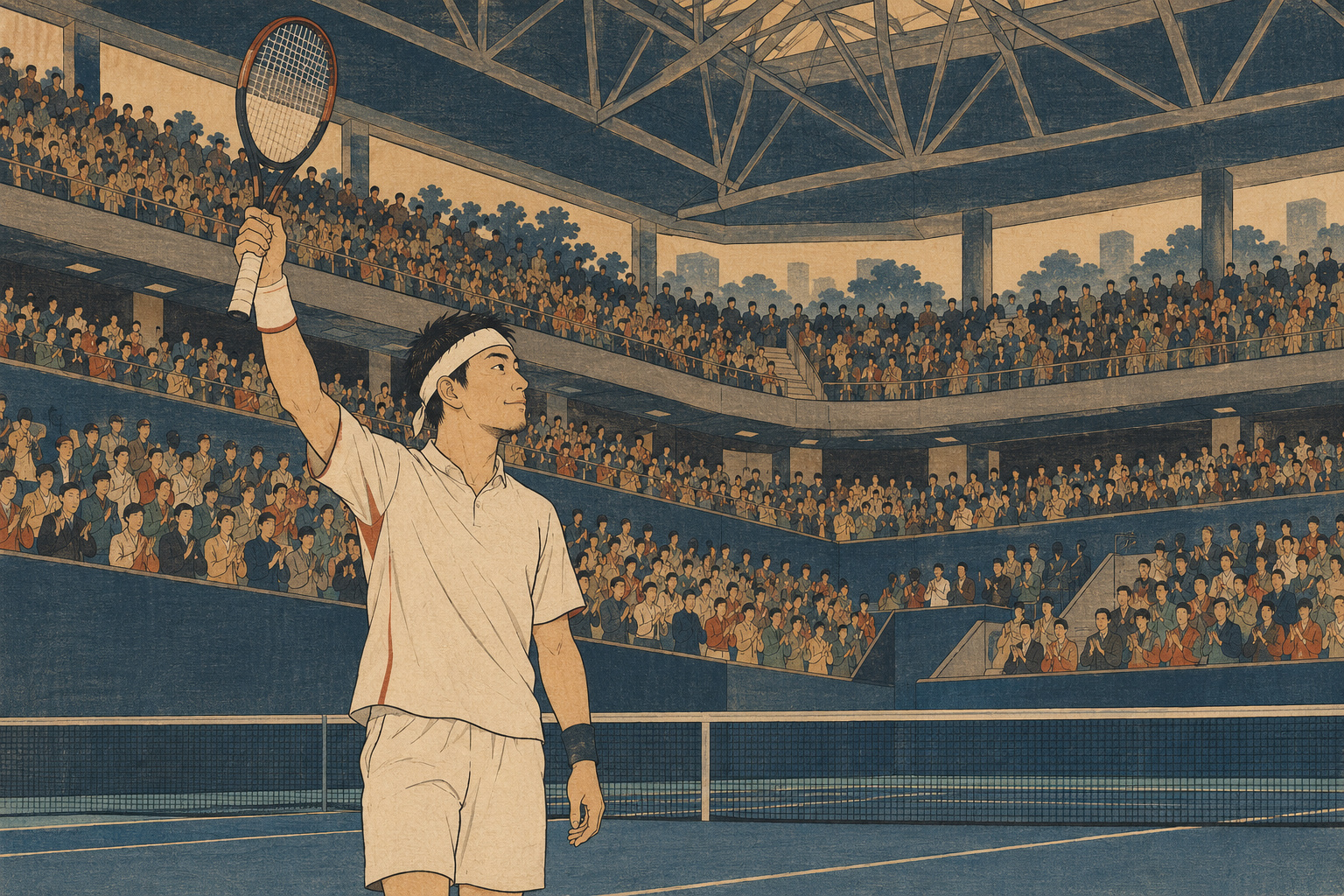
Kei Nishikori’s last Japan Open brings him back to the court where his international achievements became something a home crowd could witness at close range. The men’s main draw is scheduled for September 30–October 6 at Tokyo’s Ariake complex, with the two-time champion entering on a wild card in his announced final season.[1],[2]
The farewell carries the weight of a long career, but the event remains a competition. A place in the draw gives Nishikori an opportunity to play; it does not prescribe how his last appearance will end. That uncertainty is part of what makes this return meaningful.
A farewell tournament, with the match date still to be earned
At his September 25 press conference, reported by the Japan Tennis Association, Nishikori said he wanted to show his own tennis and finish without regrets. He did not describe his condition as exceptionally good, but expressed gratitude for the chance to compete one last time in Japan.[3]
Organizers plan a ceremony honoring him at Ariake Coliseum on October 6. The ceremony and his last competitive match are different events: the latter depends on how far he advances. A tribute on finals day is not a promise that he will be playing in the final.[4]
| Date | Stage |
|---|---|
| September 28–29 | Qualifying |
| September 30–October 1 | Main-draw first round |
| October 4 | Quarterfinals |
| October 5 | Semifinals |
| October 6 | Final |
The organizer cautions that the schedule may change, including first-round matches moving to the third main-draw day because of preceding tournaments. Spectators should consult the daily order of play as well as the overall schedule.[5]
Why the first Tokyo title mattered
Born in Shimane Prefecture on December 29, 1989, Nishikori is 36. He turned professional at 17 in 2007 and won his first tour title at Delray Beach in 2008. JTA’s historical account records that breakthrough as the achievement that made him the second Japanese man to win a tour title.[6],[7]
In 2012 he reached the Australian Open quarterfinals and then won in Tokyo. Against Milos Raonic in the Japan Open final, he prevailed 7–6, 3–6, 6–0. JTA describes him as the tournament’s first Japanese male champion in its international tour era.[7],[8]
That qualification preserves an important piece of history. The Japan Open was created in 1972, and Toshiro Sakai won the inaugural event. It joined the international Grand Prix circuit in 1973. Calling Nishikori the first Japanese winner without explaining the distinction would erase the earlier champion.[8]
For the home audience, the 2012 result changed the experience of the tournament. A Japanese player was not simply testing himself against visiting stars; he was the player left holding the trophy. Success abroad had acquired a defining home-court expression.
2014: a breakthrough followed by another test
Two years later, Nishikori reached the US Open final, becoming the first Asian man to contest a Grand Slam singles title match. His route included victories over Raonic, Stan Wawrinka and Novak Djokovic before defeat to Marin Cilic in the final.[7],[9]
He then won in Kuala Lumpur and arrived in Tokyo with another championship to pursue. Raonic again stood across the net in the final. Nishikori won 7–6, 4–6, 6–4, completing consecutive title-winning weeks after the emotional demands of New York.[9]
The Japan Open’s champions list also includes Roger Federer, Rafael Nadal and Andy Murray. Nishikori’s two entries in that company explain why this farewell is grounded in sporting achievement as well as affection. Ariake was a place where he won against international opposition, not merely somewhere supporters gathered to see him.[14]
A career measured in more than one kind of result
Nishikori reached a career-high ranking of No. 4 in 2015 and won 12 ATP Tour singles titles. His record also includes an Olympic achievement with a much longer historical interval behind it.[10]
At Rio in 2016, he defeated Nadal in the bronze-medal match, 6–2, 6–7, 6–3. It was Japan’s first Olympic tennis medal since Ichiya Kumagae and Seiichiro Kashio’s successes at Antwerp in 1920—a gap of 96 years.[11]
Those milestones do not describe every part of the career. In the September 25 account, Nishikori also reflected on time lost to injuries, balancing dissatisfaction with a feeling that he had worked hard. The distinction makes his farewell more human: a celebrated record can coexist with an athlete’s awareness of opportunities lost.[3]
A final tournament cannot restore the years spent away from competition. It can provide a last chance to compete in front of people who remember the earlier achievements, while allowing the athlete’s present ambitions to be smaller, more personal and no less demanding.
A younger opponent, then a shared home draw
Nishikori’s last US Open appearance ended on August 28 in the final qualifying round, where Rei Sakamoto beat him 6–4, 7–6(3). It was a qualifying defeat, not a main-draw exit. The US Open honored Nishikori on court afterward.[10]
Now Sakamoto is also among the Japan Open main-draw wild cards, alongside Nishikori and Sho Shimabukuro. The organizer’s September 24 announcement named Shintaro Mochizuki, Taro Daniel and Yoshihito Nishioka for qualifying wild cards.[12]
One victory over a retiring champion does not establish who will reproduce his career. It does, however, give the generational story a specific competitive encounter. Sakamoto has faced Nishikori with a main-draw place at stake; in Tokyo they enter the same tournament with separate results to pursue.
The institutions around the player
Nishikori’s career also illustrates the relationships that support an individual sport. Uniqlo began working with him as a global brand ambassador in 2011 and announced an affiliation agreement in June 2022. The company described a relationship involving clothing development and plans for social contributions and youth development.[13]
Those are documented commitments, not a measurement of their eventual impact. They nonetheless show why the public role of a prominent athlete extends beyond the weeks he is winning. The commercial partnership, the national association and the tournament provide different forms of support and continuity.
This year’s event is organized by JTA with Kinoshita Group as special sponsor. Its hard-court main draws comprise 32 singles players and 16 doubles teams, at Ariake Coliseum and Ariake Tennis Forest Park. The structure accommodates a major farewell while continuing to serve the rest of the field.[1]
That wider purpose will remain after Nishikori’s appearance ends. Japan’s younger players need opportunities to face international opposition and build records of their own. A celebrated predecessor can make those opportunities more visible; he cannot supply the results for them.
An ending that still belongs to competition
The most respectful way to watch this farewell may be to leave its ending unwritten. Another title would add to Nishikori’s record, but his place in Japanese tennis no longer depends on matching 2012 or 2014. Nor does the occasion require treating every point as a replay of those seasons.
Ariake can recognize what he has already achieved while attending to the match in front of it. The tribute has a scheduled date. The competitive ending must still be played.
