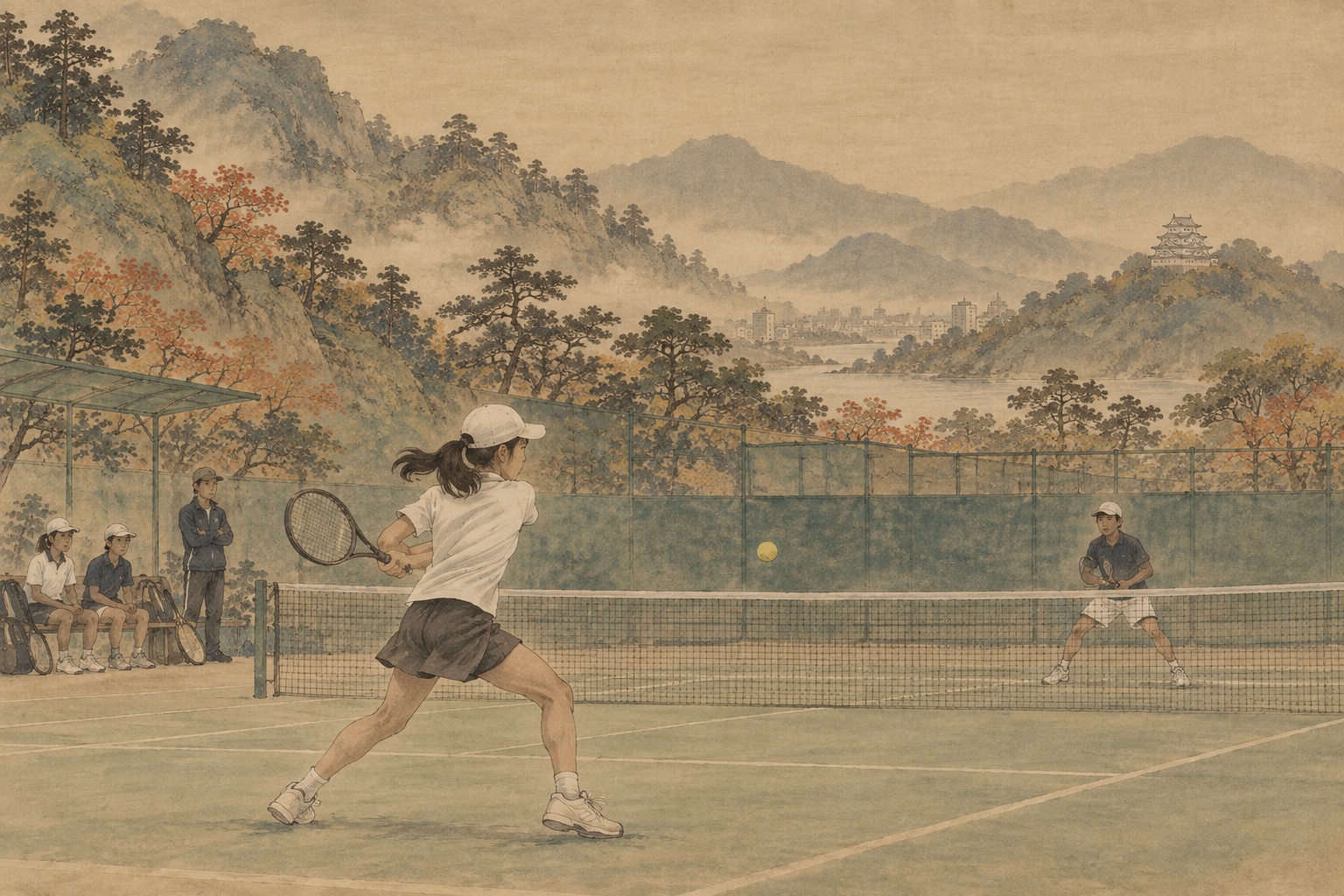
September 14 is not an empty day before the Japan Open Junior main draw. At Bourbon Beans Dome in Miki, Hyogo, it is the final day of qualifying. Thirty-two boys and 32 girls entered the qualifying singles fields; only four from each can reach the main draw. On Tuesday, 32-player boys’ and girls’ singles draws begin, alongside 16-team doubles draws, and the tournament runs through September 20. The event is an ITF World Tennis Tour Juniors J200 — the third-highest regular junior grade below J300 and J500, and, according to the Japan Tennis Association, the second-highest ITF junior tournament staged in Japan.[1] [2] [3]
Its importance is larger than the trophy. Players developed in Japan compete inside the same international entry, ranking and regulatory system as juniors from abroad. A qualifying win can produce a place in the main draw; a main-draw win can produce ranking points; those points can influence acceptance into future J200, J300 and J500 events. For a teenage player, a week in Miki is not simply a domestic championship with foreign visitors. It is part of the machinery of world junior tennis.
J200 is not just a number in the tournament title
The ITF World Tennis Tour Juniors classifies regular events as J30, J60, J100, J200, J300 and J500, with Junior Grand Slams above them. The ITF states plainly that higher-graded tournaments offer more ranking points. Japan Open Junior therefore sits in a meaningful tier: below J300 and J500 but above the much larger base of lower-grade international junior events.[4] [5]
Entry also operates through the international system rather than a purely domestic junior ranking. Players need an IPIN account and enter through the ITF platform. For the 2026 tournament, eligibility covers players born from January 1, 2008 through December 31, 2013, provided they have turned 13 by the first day of the main draw. ITF juniors may compete from age 13 through the end of the year in which they turn 18.[2] [4]
That age span matters. A newly eligible 13-year-old can share the same tournament ecosystem with a player nearing the end of junior eligibility. Strength, physical maturity and travel experience may differ sharply. Choosing which level to enter — and when — becomes part of player development.
Thirty-two enter qualifying; only four emerge
The 2026 event has 32-player qualifying fields in boys’ and girls’ singles, with four qualifiers in each event moving into a 32-player main draw. Qualifying uses two tiebreak sets followed, at one set all, by a 10-point match tiebreak instead of a conventional third set. Main-draw singles use best-of-three tiebreak sets. Doubles use no-ad scoring and a 10-point match tiebreak in place of a third set.[2]
That qualifying format compresses pressure. A player cannot assume there will be time to solve a match over a long third set. Ten points can decide entry into one of the strongest junior draws in the country. One poor service game, one loose return sequence or one double fault in a match tiebreak can determine whether the week continues.
Miki offers an indoor hard-court test
Bourbon Beans Dome sits in Miki Disaster Prevention Park in Shijimicho Mitsuda, Miki City. The ITF lists the surface as “Hard - I,” meaning indoor hard court. That removes much of the rain uncertainty that shapes outdoor tournaments and gives players a relatively stable environment for a tightly scheduled international event.[3]
The tournament did not always live in Hyogo. Earlier editions were held at Higashiyama Park Tennis Center in Aichi; the JTA’s 2016 calendar records the Japan Open Junior there in October. The JTA says the event moved to Hyogo beginning in 2024 because the Nagoya venue entered renovation for the Asian Games.[1] [8]
The move did not reduce the tournament’s status. The J200 grade was retained, and the 2025 outline used the same Bourbon Beans Dome with 32-player main and qualifying singles draws. Miki has therefore become more than a temporary substitute: it is now the venue carrying continuity for one of Japan’s most important international junior weeks.[9]
Why being Japan’s “second-highest” ITF junior event matters
The JTA describes Japan Open Junior as the second-highest-level ITF junior tournament held in Japan. That matters because international junior development is expensive. Airfare, hotels, coaching support and weeks away from school or training accumulate quickly. A J200 at home gives Japanese players access to meaningful international competition without requiring every high-level test to begin with an overseas trip.[1]
Home location does not turn it into a protected domestic event. ITF entries are international. Players still deal with sign-in rules, match scheduling, international opponents and the ranking consequences of every result. They can experience much of the competitive structure that later governs professional travel while reducing one part of the logistical burden.
Ranking points are not decoration — they affect the next doorway
The ITF publishes junior rankings weekly. Points depend on tournament grade and how far a player progresses. The ITF’s FAQ notes that, as a general rule, players must reach a round at which points are offered and win at least one main-draw match to earn ranking points; merely advancing by a bye is not treated as a match won.[4]
Those points influence tournament access. A stronger ranking can move a player from qualifying into a main draw, or improve the chances of being accepted into a higher-grade event. For a family planning an international schedule, that difference is substantial. Repeatedly playing two qualifying rounds before the main draw adds matches, hotel nights, physical load and uncertainty. Direct acceptance changes the economics and physiology of a season.
That is why one win in Miki can matter beyond the scoreboard. It may change which doors are open a month later.
The JTA points to Grand Slam-level outcomes — carefully
In promoting the 2026 event, the JTA says former Japan Open Junior participants have gone on to become Grand Slam champions and describes the tournament as important for junior strengthening and development. It also notes that the runner-up at the 2024 event went on, in 2026, to defeat a Grand Slam champion in the first round of Roland Garros at a record young age. The JTA page does not identify that player in the body text available to Japan.co.jp, so this article preserves the federation’s claim without guessing at a name.[1]
The two-year gap is revealing. A player who is still a junior finalist in Japan can, within a short period, be facing established champions in the senior majors. Junior tennis is not a finished ranking of future careers. It is a snapshot taken while careers are still accelerating at very different speeds.
Japan’s “next generation” is a system, not one prodigy
The Japan Tennis Association’s 2026 structure includes a national team, a Next Gen group and junior national selections by age. On the men’s side, Rei Sakamoto and Shintaro Mochizuki are listed as Next Gen strengthening members, while the junior national group includes Hisho Kawanishi at U18, Kanta Watanabe at U17, Kodai Kawaguchi at U16 and Ryoma Otorie at U14. The girls’ junior national group includes Eon Sawashiro at U18; Kokona Ishii and Yui Komada at U16; and Ayaka Iwasa and Shina Okuyama at U14.[7]
This article is not claiming that those players are all entered in J200 Miki. The ITF acceptance list is dynamic, and the publicly crawled tournament page available at the September 12 reporting cutoff did not expose a reliable, complete player-by-player field in plain text. The point is structural: Japan’s development program spans several ages rather than waiting for a single prodigy to emerge.
That depth matters in the post-Kei Nishikori era. Japan’s professional pool includes Yoshihito Nishioka, Taro Daniel, Yosuke Watanuki, Mochizuki and others, with another cohort being developed behind them. On the women’s side, the same need exists: a healthy system must keep producing players capable of moving between domestic competition, international juniors and the entry levels of professional tennis.
The hardest step is not junior success — it is transition
Winning in juniors does not guarantee winning as a professional. Junior eligibility ends, but the professional tour has no upper age boundary. Serve quality, return pressure, physical durability, point construction and recovery across a long season all rise another level.
The ITF itself manages age-based restrictions on junior tournament volume while connecting junior competition to the broader tennis ecosystem. For a Japanese player, a deep run at J200 Miki is therefore a milestone, not a destination. The next choices may be J300 or J500 events, Junior Grand Slams, or carefully selected entry-level professional tournaments.
The transition also requires skills invisible in a draw sheet: booking travel, adjusting to time zones, finding practice courts, managing food and recovery, entering tournaments correctly and handling weeks away from home. A home J200 strips away some of that travel burden while preserving the international competitive pressure.
- How qualifiers handle a quick turnaround into the first round of the main draw.
- How Japanese players adjust to the serve pace, ball weight and tempo of international opponents.
- Whether doubles — 16 teams in each event — reveals different net skills and decision-making than singles.
- How younger players compete against opponents several years older within the 13-to-18 junior range.
- How players use the ITF points from Miki to improve entry positions in their next international events.
September 14 is not “the day before” — it is a dividing line
From the perspective of the main draw, Monday can look like preparation. For the qualifiers, it is the tournament. The 32-player fields that began on September 13 finish on the 14th, and only four in each event move on. The ITF also sets main-draw sign-in for 6 p.m. local time on September 14. By evening, the competitive map of the week changes completely.[3]
Junior sport invites easy language about “future stars.” The international ranking system is less sentimental. Can the player get into the event? Can the player win? Does the result open the next event? Careers are built through those repeated thresholds.
No one can know which teenagers in Miki will be on an ATP or WTA stadium court several years from now, and this tournament should not be reduced to guessing. Its real value is that it gives players who might become that future a match played under world standards now. On September 14, the last ball of qualifying may be the ball that opens the next door.
- Japan Tennis Association: Japan Open Junior 2026 overview, J200 status and relocation to Hyogo
- Japan Tennis Association: 2026 tournament regulations — dates, venue, draw sizes, age eligibility and match formats
- ITF: J200 Miki 2026 tournament page — draws, sign-in, dates and venue
- ITF: World Tennis Tour Juniors FAQ — grades, age eligibility, IPIN and ranking system
- ITF: 2026 World Tennis Tour Juniors rules and regulations
- ITF: 2026 World Tennis Tour Juniors Regulations — grading, ranking and tournament rules
- Japan Tennis Association: 2026 junior national and Next Gen teams
- Japan Tennis Association: 2016 junior international calendar showing the former Aichi edition
- Japan Tennis Association: 2025 tournament outline at Bourbon Beans Dome
Editorial note: This is a preview and development analysis based on JTA and ITF information verified through September 12. Qualifying is scheduled for September 13–14 and the main draw begins September 15. This article does not guess the September 14 qualifiers, the final main draw or individual entries before they are reliably confirmed. The JTA page notes a notable 2024 runner-up achievement at Roland Garros 2026 but does not identify the player in its publicly available body text, so no name has been inferred.