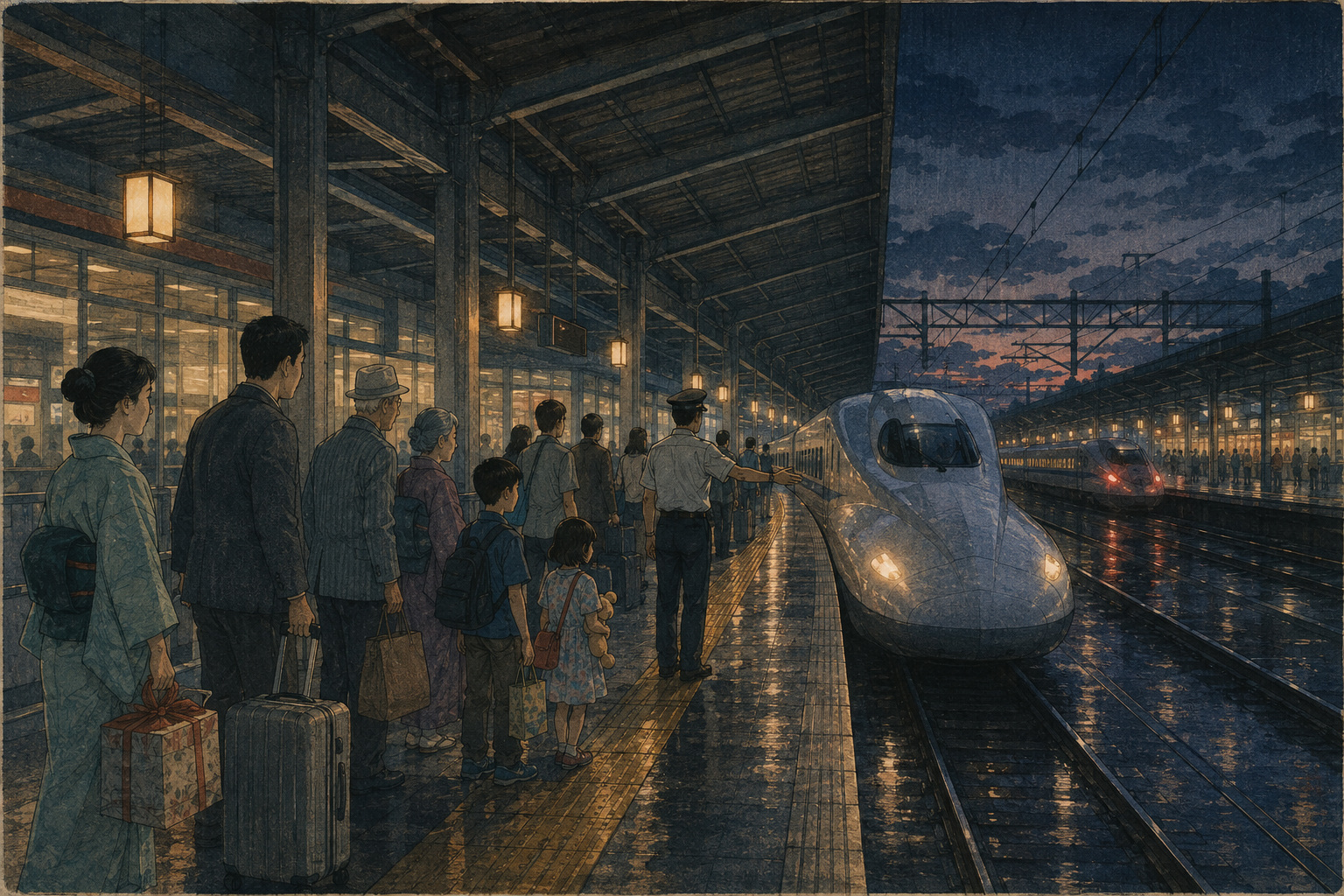
There are two ways to end Obon in 2026.
In the first, the suitcase closes on Saturday morning. Flowers have been placed at the grave, incense has burned, and the children have had one more breakfast with their grandparents. The family boards an afternoon Shinkansen so that Sunday can become a buffer: laundry, sleep, groceries, a quiet day before the ordinary calendar resumes.
In the second, the bag remains open until Sunday. There is another lunch, another conversation and, in households that observe it, the symbolic sending-off of ancestral spirits. The last possible day together matters more than the easy landing at home. That family boards later, joining the final wave toward Tokyo, Osaka or another urban life.
These are representative choices, not interviews with a single household. Yet the choices leave a measurable trace. JR East said its capital-bound reservations were spread across August 15 and 16, with congestion on both afternoons and the single-day maximum—about 119,000 booked seats—on Sunday the 16th. JR West’s published day-by-day chart showed 90,000 upper-direction reservations on Saturday and 95,000 on Sunday. The nationwide headline still named the 16th as the broad return peak. “Split” does not mean equal; it means that the shoulder became a second crest.
A Booking Is Evidence, Not a Passenger
News reports summarizing the JR group releases put Shinkansen reservations at about 2.99 million—above the comparable 2025 figure of about 2.91 million—and at 37% of the seats then offered for booking. Add conventional limited expresses and the reservation total was about 3.71 million. Those numbers are useful precisely because they are early. They reveal intention before travel happens.
They also invite overstatement. The cutoff was the close of business on July 22, compiled on July 23. Reservations could still be made, changed or cancelled. A booking is not a ticket gate count, and the national percentage is not a load factor for every departure. Popular morning and afternoon trains can be full while later services retain rows of seats. Unreserved passengers and standing travellers appear in actual use but not in this reserved-seat snapshot.
Growth was uneven. JR East reported 1.24 million Shinkansen bookings, 6% above the equivalent period in 2025. JR West reported 1.056 million, up 4%. JR Central counted 1.58 million on the Tokaido Shinkansen, essentially unchanged year on year, even as some departures approached full. The operators’ numbers must not be added casually: through services and reporting territories can overlap. The national consolidated total is the correct whole; the company releases explain its different regional textures.
| Published snapshot | Reserved seats | Year-on-year | What it reveals |
|---|---|---|---|
| JR group Shinkansen | About 2.99 million | Above 2025; about 37% of bookable supply | National intention, not final ridership |
| JR East Shinkansen | 1.24 million | 106% | Return demand distributed across Aug. 15–16 |
| JR Central Tokaido | 1.58 million | 100% | Stable total, but particular trains were already crowded |
| JR West Shinkansen | 1.056 million | 104% | Sanyo and Hokuriku peaks both fell on Aug. 16 |
Why the Holiday Ends Twice
August 15 is a Saturday in 2026; August 16 is Sunday. That arrangement turns the return journey into a negotiation between two kinds of time. Family time argues for Sunday. Work time argues for Saturday.
Obon itself is not one legally fixed national holiday with a single railway timetable. Customs vary by community and household, but the common August observance runs through the ancestral welcome around the 13th and departure around the 16th. Paid leave, school holidays, company shutdowns and the Tuesday Mountain Day holiday on August 11 widen the travel window. The public schedule and the ritual schedule overlap without perfectly matching.
The interpretation is a calendar inference, not a survey finding about every reservation. But it fits the operators’ evidence. JR East explicitly described the upward peak as dispersed across both days. Its guidance said trains arriving in the capital by about 1 p.m. on either day were expected to have relatively more room than the afternoon wave. JR West’s conventional limited expresses actually peaked on the 15th even while its Sanyo and Hokuriku Shinkansen peaks fell on the 16th. Different networks, destinations and family distances produce different endings.
One Nation, Several Rail Tides
The word Shinkansen suggests one system, but the return rush travels across corridors with distinct equipment, stopping patterns and reservation rules. On JR East, the Tohoku, Joetsu and Hokuriku lines funnel travellers into Ueno and Tokyo. JR East listed 570,000 Tohoku bookings, 160,000 on Joetsu and 340,000 on Hokuriku. It warned that Hakutaka trains were particularly busy while some Asama services from Nagano and Karuizawa were expected to offer more room.
Farther west, Sanyo services collect traffic from Hakata, Hiroshima and Okayama into Shin-Osaka, then feed through to the Tokaido artery. The JR West release placed the upper-direction peak for both Sanyo and Hokuriku on the 16th. Its chart’s near-twin totals for the last two days are the clearest numerical portrait of the split: 90,000 booked seats on the 15th, 95,000 on the 16th.
On Tokaido, JR Central reported the overall upper peak on the 16th but also found space outside a limited set of trains as of July 23. That combination is not contradictory. A railway peak is a shape across time. It can contain sold-out departures, lightly booked trains an hour later and an enormous total capacity assembled by adding services.
The Timetable Expands
A road absorbs extra cars until it becomes unstable. A reserved railway can see demand in advance and add whole trains. That is the essential operational advantage behind the booking chart.
JR Central’s May summer plan scheduled an average 434 Tokaido Shinkansen trains per day during the ten-day Obon period, compared with a 396-train daily average across July through September. At the most concentrated hours it planned as many as 13 Nozomi services. After the first reservation picture became clear, the July release added 16 more Nozomi trains between Tokyo and Shin-Osaka for August 10–15: seven down-direction and nine up-direction services.
The detail matters. This was not sixteen trains dropped only onto Sunday’s headline peak. Four Tokyo-to-Shin-Osaka additions ran on August 11; the later additions increasingly pointed toward Tokyo. Four upward trains were added on August 14, and another on the morning of the 15th. The response filled shoulders, not just the tallest point. A 16-car Shinkansen occupies track, platform, crew and maintenance capacity; it cannot be improvised like an extra bus.
JR East’s original summer plan was larger in geographic spread: 3,706 extra Shinkansen runs across July–September, 980 of them during August 7–16—457 on the Tohoku/Akita/Yamagata system, 188 on Joetsu and 335 on Hokuriku. Named return helpers included a late Hayabusa from Sendai on August 14–16 and an evening Kagayaki from Kanazawa on the 15th and 16th. Extra trains are the hidden architecture beneath the word “rush.”
- Months ahead: operators publish summer seasonal schedules and reserve train paths, rolling stock and crews.
- As sales develop: additional departures can be announced, as with JR Central’s 16 added Nozomi trains.
- Inside each train: cars normally used for unreserved seating can become reservable during the peak.
- Across the day: travellers are encouraged toward departures with remaining space, smoothing the crest.
The Railway That Made Homecoming National
Obon travel is ancient; the synchronized high-speed return is modern. When the Tokaido Shinkansen opened on October 1, 1964, Tokyo–Shin-Osaka took four hours. It did not invent the hometown visit. It changed the radius within which a worker could leave a metropolis, spend meaningful time with family and return before work.
The corridor lengthened. The Sanyo Shinkansen reached Hakata on March 10, 1975, tying roughly 1,100 kilometres from Tokyo to Fukuoka into one high-speed spine. Japan National Railways was divided into regional JR companies in 1987, but through trains continued to cross the corporate boundary at Shin-Osaka. In 1992, the faster Series 300 Nozomi entered service. Speed compressed the journey; frequency changed its social scale.
JR Central says the Tokaido line grew from an average 60 trains a day at opening to 383 in fiscal 2024, carrying an average 460,000 passengers daily that year. Its fastest Tokyo–Shin-Osaka journey fell to 2 hours 21 minutes. The holiday migration became less like an expedition and more like a slot in a day—provided a slot could be obtained.
1960 MARS-1 begins real-time reservations for four Tokyo–Osaka expresses.
1964 MARS-101 expands nationally; the Tokaido Shinkansen opens on October 1.
1975 Sanyo reaches Hakata, completing the high-speed Tokyo–Fukuoka axis.
1987 JNR is divided; through Shinkansen operation spans JR Central and JR West.
1992 Nozomi debuts as an all-reserved, faster service.
2003 Nozomi gains ordinary unreserved cars as frequency rises.
2023–24 Peak-holiday all-reserved Nozomi operation begins at New Year.
2025 Nozomi car 3 becomes reserved year-round; cars 1–2 remain normally unreserved.
2026 Every Nozomi is reserved August 7–16; the return crest spans August 15–16.
Before the Bullet Train, a Computer Learned the Seat
The deep history of the 2026 rush is not only steel and concrete. It is a history of information.
In January 1960, Japanese National Railways put MARS-1 into service. The name stood for Magnetic-electronic Automatic Reservation System. According to the Information Processing Society of Japan’s Computer Museum, it initially handled 3,600 seats on four Tokyo–Osaka limited expresses, fifteen days ahead, through terminals at nine stations. A magnetic drum in Tokyo stored whether a seat was available. For the passenger at the counter, a national journey became a question a machine could answer in real time.
MARS-101 followed in February 1964. By October, as the Shinkansen began running, Midori-no-Madoguchi reservation counters had appeared at 152 stations. The system turned individual travel into an inventory. That transformation is easy to miss because it now lives behind a seat map on a phone. But the July 23 figure—2.99 million intended Shinkansen journeys—is conceptually descended from those magnetic drums.
Today, ordinary reserved seats usually go on sale one month before travel at 10 a.m.; JR Central’s EX services can take qualifying bookings up to a year ahead. The system no longer merely records demand. It shapes it. A family sees three seats together disappearing on Sunday, notices room on Saturday, and changes the length of the visit. The booking chart predicts the rush partly because the chart helps create the choices it later measures.
Nozomi Comes Full Circle
The headline “every Nozomi is reserved” sounds like a new restriction. Historically, it is also a return. Nozomi began in 1992 with all seats reserved. In 2003, when Shinagawa opened and the high-frequency timetable was rebuilt, ordinary unreserved cars were introduced. For two decades, the platform queue offered a form of flexibility: arrive without choosing a train, line up, and take the chance of a seat.
That flexibility had a cost at the biggest holidays. Queues formed long before departure. At intermediate stations, passengers could not be certain of sitting—or even boarding. A heavily used unreserved car took longer to empty and refill, spreading seconds of dwell time into delay. In September 2023, JR Central and JR West announced that all Nozomi trains would become reserved during the three great peak periods, beginning December 28, 2023. Converting the three unreserved cars then used increased the number of reservable seats by roughly 20% per train.
The baseline changed again in March 2025, when car 3 became reserved throughout the year. In 2026, ordinary Nozomi trains normally retain unreserved cars 1 and 2. During the Obon measure, from August 7 through 16, their 165 seats per train are converted to reserved seating on every Nozomi operating between Tokyo and Hakata. The policy and extra through trains are coordinated across JR Central and JR West.
The goal is not simply to sell a higher-priced seat. It is to trade a physical queue for allocated capacity: more people know where they will sit; fewer wait for the same door; boarding becomes more predictable. The policy has expanded beyond the original three peak seasons to several long weekends in fiscal 2026, evidence that the companies increasingly treat reservation as a crowd-management instrument.
“All Reserved” Does Not Mean “Nobody May Stand”
The phrase requires careful translation. During the designated period, there is no unreserved seat on a Nozomi. To sit, a traveller needs a reserved-seat limited express ticket for that train. But JR Central’s published rule allows a holder of an unreserved-seat limited express ticket to board and stand in ordinary-car decks or aisles, subject to crowding and staff direction; Green cars 8–10 are excluded. A seat occupied without the proper reservation requires the designated charge.
Hikari, Kodama, Mizuho, Sakura and Tsubame retain ordinary unreserved cars. They may themselves be crowded. On JR East, the vocabulary differs again: Hayabusa, Komachi, Hayate, Tsubasa, Kagayaki and some Toki are all-reserved services, and limited-quantity standing limited express tickets may be sold only when seats are full, for a specified train and area.
These exceptions are not fine print to be discovered at the gate. They reveal the system’s safety valve. Reservation allocates seats; standing authority preserves some last-minute mobility. Neither guarantees that a desired departure can accept unlimited passengers. “All reserved” is a seating rule, not proof that the railway has abolished spontaneity or standing.
The Queue Moved Into the Phone
All-reserved operation removes one kind of uncertainty and creates another. The old queue was visible: a line of bodies painted on the platform, first come and possibly first seated. The new queue appears as a greyed-out seat map, an app login at 10 a.m., or three family members separated because adjacent seats have gone.
For parents with small children, older travellers and anyone carrying luggage, certainty can be a profound improvement. JR Central also designated one “children-with-families” car on 90 Nozomi services during August 7–16. For a traveller whose work schedule changes late, the reservation requirement can feel less forgiving. Digital access, payment cards, language and familiarity with multiple booking systems become part of mobility.
The railway’s answer is not merely “book earlier.” It is to show space across the day, run more trains and preserve counter and ticket-machine channels. The deeper bargain is social: accept a more specific departure in exchange for a more orderly station. The 15th–16th split shows that households use that information. Demand bends when alternatives are visible.
Reservations Cannot Reserve the Weather
A numbered seat does not guarantee a perfectly timed arrival. Typhoons, extreme rain, earthquakes, equipment faults and a passenger emergency can remove capacity from a timetable designed near its practical limit. A late train may occupy the track path of the next one; a suspended section concentrates thousands of already assigned passengers in concourses and apps.
This is where reservation improves knowledge but complicates recovery. The operator knows which train and seat each passenger expected. Yet moving a trainload onto later services is harder when those later seats are already allocated. Standing arrangements, changes, refunds and extra services become operational tools rather than footnotes.
The reservation releases were forecasts of intention, not promises against disruption. JR East directed travellers to Ekinet, JR Cyber Station and its extra-train page for current information. JR West published an Obon availability page. JR Central updated its Tokaido day-by-day picture several times after the July snapshot. A historical booking table is excellent evidence for a long read and poor evidence for an empty seat tonight.
How to Read the Two-Day Crest
- Search by arrival time as well as departure time. JR East expected relatively more room on services reaching the capital by about 1 p.m.; that was a forecast, not a guarantee.
- Check a range of trains. “Peak day” does not mean every departure is full, and a national total cannot substitute for a live seat map.
- On Nozomi, reserve if you want a seat. An unreserved ticket may permit standing in ordinary-car areas, but it does not confer a seat or unlimited boarding.
- Consider Hikari, Kodama, Sakura, Mizuho or Tsubame where the route works, remembering that their unreserved cars can also fill.
- Leave connection margin. The busiest timetable is resilient only while each handoff remains orderly.
The Seat Before the Journey
On the evening of August 15, two calendars meet inside the station. The ritual calendar says that the family visit is not quite over. The work calendar says that Monday is approaching. One household hugs on Saturday; another waits until Sunday. Their reasons remain private, but the reservation network arranges them into a visible national pattern.
That pattern rests on more than speed. It rests on a computer lineage beginning before the Shinkansen, on a corridor extended to Hakata half a century ago, on through operation across companies created from JNR, on crews and trainsets placed into provisional paths months ahead, and on the conversion of 165 ordinary seats in every Nozomi. The rush looks spontaneous only from the platform. Behind it stands an enormous act of advance allocation.
Obon asks the living to cross distance for the dead and for one another. The Shinkansen made that crossing possible within the narrow space of a modern holiday. The reservation made it countable. In 2026, the count tells a particularly human story: Japan could agree on the journey home, but not on the precise moment to leave it.
Reporting notes and principal sources
This article is based on public information checked through August 14, 2026 at 7:04 a.m. JST. Reservation totals are identified as snapshots, not final passenger counts. “Two-day crest” follows JR East’s explicit description and JR West’s daily data; August 16 remained the single nationwide peak. Calendar motives are clearly presented as inference rather than survey findings.
- JR Central: 2026 Obon reserved-seat status and 16 additional Nozomi trains
- JR East: Obon reservations, route totals and August 15–16 dispersion
- JR West: Obon reservation tables and daily upper-direction bookings
- KSB / ANN: JR group total, national peaks and added Nozomi services
- JR Central and JR West: 2026 peak-period all-reserved Nozomi rules
- JR Central: summer 2026 extra-train plan and Obon daily service level
- JR East: summer 2026 extra-train plan, including 980 Obon Shinkansen runs
- JRE Media: 2026 unreserved-seat forecasts and standing-ticket guidance
- JR Central and JR West: 2023 launch of peak-period all-reserved Nozomi operation
- JR Central Market: car 3 changed from unreserved to reserved in March 2025
- JR Central: company and Nozomi chronology
- JR Central: Tokaido train frequency, journey time and passenger history
- JR West: Sanyo Shinkansen completion to Hakata in 1975
- Information Processing Society of Japan: MARS-1 reservation system
- Information Processing Society of Japan: MARS-101 and the national reservation network