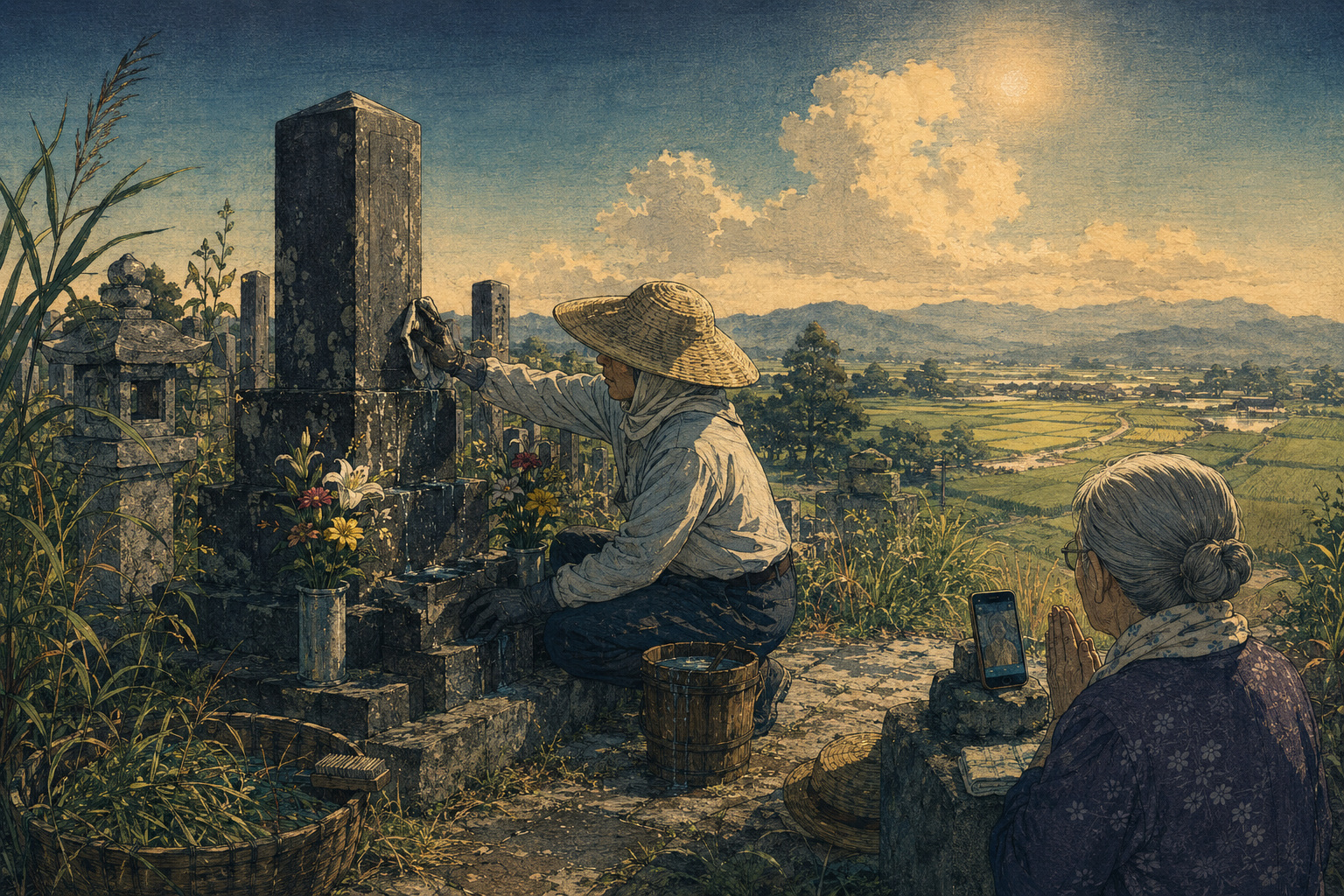
The first task is not prayer. It is finding the grave.
A plot number, a family name cut into stone, a reference photograph sent by a client who may live hundreds of kilometers away: across current service menus, the sequence is remarkably consistent. The worker takes a “before” picture. Old flowers are bagged. Leaves are swept from gravel. Roots are pulled one by one. The gravestone, flower holders, incense tray and water basin are washed. Fresh flowers may be placed, incense lit where cemetery rules allow, hands folded. Then comes the “after” picture—the image that carries the completed visit back across the distance.
What the photograph cannot transmit is the weight of the water bucket or the heat coming back from the stone. Japan’s 2026 summer had already produced readings of 37.8°C in Dazaifu on July 10, 38.3°C in Hamamatsu on July 14 and 41.1°C in Hamamatsu’s Sakuma district on July 23. A Tokorozawa cemetery warned in July that more visitors were becoming ill: graveyards offer little shade, it said, while stones reflect heat and raise the body’s felt exposure.
This is where the new economy of proxy grave care begins—not in a rejection of remembrance, but in the collision between remembrance and physical limits. The elderly parent cannot kneel safely. The adult child lives in Tokyo while the grave remains in Kumamoto. The family can travel only on the hottest holiday week of the year. A local worker clears the path that geography, age and weather have blocked.
The exchange is easy to describe as convenience. It is more accurately a transfer: of travel, of time, of bodily risk and, for a few minutes before an ancestral name, of representation. Someone else carries the water.
The Job Begins Before the Prayer
“Grave-cleaning service” conceals several different transactions. At the smallest end is an inspection: a local operator visits, photographs the plot and reports whether weeds or damage need attention. A cleaning visit generally adds weeding, sweeping and hand-washing of the stone. A proxy grave visit may add flowers, incense and a bow or prayer. Some cemeteries offer annual maintenance; transport companies may accompany an older client or send a driver to perform simple care; national matching sites connect families to independent local providers.
The boundaries matter. Cleaning is not the same as professional stone conservation, and the person performing it is not necessarily a licensed stonemason, priest or cemetery employee. There is no single national credential that transforms every provider into a “professional.” The field includes cemetery managers, specialist companies, local businesses, social-employment organizations and solo contractors. A responsible client asks who will enter the cemetery, what they are insured to do and when ordinary cleaning becomes a repair requiring specialist consent.
Current menus show how the work has been standardized. Tama-no-ya, which specializes in Tokyo’s vast Tama Cemetery, advertises a 2026 pre-Obon inspection for ¥3,000 before tax, cleaning for ¥9,000 and a proxy visit for ¥12,000, including flowers and incense valued at about ¥2,000. It promises 15 to 30 photographs. Kitayo, a specialist that says it has completed more than 1,500 jobs, lists a standard visit at ¥27,500 and says its operating area now covers 33 prefectures. Its report includes photographs and comments.
At Tokorozawa Sacred Cemetery, a proxy visit is listed at ¥9,350 and includes flowers, incense, prayer, later removal of offerings and a photograph. Futamigaura Park Cemetery lists a fuller visit—simple cleaning, flowers, incense, candle, sutra reading and photographs—for ¥8,800. These examples are not a national price index. They show something more concrete: families are buying not merely clean stone, but verified completion. The camera is part of the service.
Demand Is Rising—Within the Data We Actually Have
The clearest numerical trend comes from Mitsumoa, an online marketplace for local services. Its 2025 analysis covered 3,485 requests for grave-cleaning estimates submitted from January 2021 through June 2025. Annual requests in 2024 were about five times their 2021 level; 2024 itself rose 46.5% from the year before. July requests were about 6.4 times the July 2021 figure, and August requests about 5.3 times.
The average completed price from July 2024 through June 2025 was ¥18,442, with ¥10,000 to ¥20,000 the most common band. At the issue’s reference rate of ¥159.48 to the U.S. dollar, the average is about US$116. Broader packages that add grave visiting, substantial weeding or lantern cleaning can reach ¥30,000 to ¥50,000. Just before Obon, planning tightens: the marketplace found the interval between request and desired work date shrinking from a normal 30 to 40 days to roughly 11 to 13.
Those figures support a real conclusion and forbid an exaggerated one. On this platform, requests rose quickly, especially around Obon. They do not prove that Japan’s entire grave-care market quintupled. The company benefits when more people use its service; customers who hire temples directly, ask relatives or clean graves themselves do not appear in its data. Nor does an estimate request equal a completed job.
Yet the pattern is reinforced by the breadth of supply. Local cemeteries now publish proxy menus. Regional specialists are expanding coverage. Taxi and transport businesses sell accompaniment and simple grave-care time. The market is not one industry so much as a loose layer of local labor forming around a nationwide problem: the family grave stayed where it was while the family moved.
| 2026 evidence | Finding | What it does not prove |
|---|---|---|
| Mitsumoa platform 3,485 estimate requests, 2021–June 2025 | About fivefold annual growth by 2024; average completed price ¥18,442 | Not the whole Japanese market; requests are not all completed jobs |
| Heatstroke transports FDMA-derived weekly count | 10,857 people, July 13–19, 2026; 62.0% were 65 or older | Not specific to cemeteries or workers |
| Grave-closure survey 230 people who completed or considered closure | 47.8% cited distance; 37.8% difficulty visiting | Selected group, not all grave-owning households |
| Current provider menus | Inspection, cleaning, offerings, prayer and photo reports sold separately or together | Availability and list prices are not national adoption |
What 37 Degrees Does to a Cemetery
A graveyard magnifies ordinary summer work. The worker bends and kneels, reducing airflow. Gloves protect hands but trap heat. Buckets, refuse bags and tools have to be carried from a tap or vehicle. Pale gravel throws light upward; dark polished stone absorbs solar energy. In many cemeteries, a narrow plot offers nowhere to stand beneath a tree. The ritual expectation of leaving the place orderly encourages one more weed, one more scrub, one more minute after the body should stop.
Heatstroke is not simply “feeling hot.” As sweating and circulation fail to keep the body’s temperature controlled, judgment can deteriorate before the person recognizes danger. Older adults carry particular risk because body water is lower and the senses of heat and thirst can be blunted. During the week of July 13–19, Japan recorded 10,857 emergency transports for heatstroke; 62.0% were people aged 65 or older. Fourteen people died and 321 were classified with severe illness.
The numbers cover all settings, not graveyards. They matter here because Obon compresses a discretionary outdoor task into the most dangerous season. A family may feel it has only one date: the holiday, the reunion, the day before spirits are welcomed. Heat has no regard for the calendar’s moral pressure.
Tokorozawa’s cemetery warning gives visitors the practical minimum: drink water and replace salt before thirst, use hats or parasols, and choose early morning or evening. For workers, the minimum must be higher because repeated jobs multiply exposure. Scheduling, shade, recovery time, a buddy or reporting system, permission to postpone and a defined emergency response are not customer-service luxuries. They are the infrastructure that keeps remembrance from producing another casualty.
Age Changes the Risk Before Anyone Leaves Home
The traditional grave visit bundles together difficult movements: train platforms and station stairs, a long drive, uneven cemetery paths, crouching, lifting, twisting and sustained outdoor exposure. A person can still be devoted to the family grave while no longer being able to perform that bundle. The decisive change may be a knee replacement, a lost driving license, mild cognitive impairment, fear of falling or the death of the spouse who once organized the journey.
Japan’s aging does not make every older person frail, and grave cleaning is not automatically beyond age 65. It makes variation larger. Public-health guidance notes that older people tend to have less water in their bodies and may notice heat and thirst later. Some medications and chronic illnesses add risk. A 20-minute task imagined at an air-conditioned kitchen table can become a dangerous hour once the tap is distant and roots resist.
Proxy care can preserve autonomy rather than cancel it. One model separates the job: a worker completes the heavy cleaning early, then an older family member visits briefly with transport assistance. Hachioji Kotsu advertises both accompaniment and a one-hour option in which a driver performs simple cleaning, incense offering and a photo report. Another model has the family select flowers, write a message or join remotely while the local operator handles the physical work.
The humane question is not whether a “good child” should still clean the grave. It is which parts of the act carry meaning for this family, which parts create avoidable danger and how they can be recombined. Duty survives by changing its choreography.
Distance Is No Longer an Exception
The modern Japanese family grave was built to make continuity visible. It assumed a successor who knew the temple, paid fees, maintained the plot and would eventually be buried within the same line. High-growth migration put distance inside that arrangement. Children left rural and regional communities for metropolitan jobs. The grave remained beside the family temple or in a hometown cemetery; the household that once surrounded it spread among apartments, companies and school calendars.
A March 2026 online survey by a commercial grave-closure support company questioned 230 people who had either completed or considered haka-jimai, the closing and relocation or relinquishment of a grave. Among this selected group, 47.8% cited the cemetery’s distance and 37.8% said visiting had become difficult. Management costs were named by 31.7%, and 22.2% did not want to burden their children.
Because the sample already consisted of people engaged with grave closure, its percentages cannot describe every family with a grave. They clarify the pressures acting on the point where continuity breaks. Distance is not an abstraction. It is a Shinkansen fare, a rental car, paid leave, hotel nights, a child’s schedule and an August sun awaiting at the other end.
Another 2026 commercial survey of 1,000 adults aged 35 to 64 found 80.4% knew the location of at least one relative’s grave; among those 804 people, 65.4% said they had visited within the previous year. Again, this was an online poll, not an official census. But it cautions against a simple decline narrative. The grave remains known and visited. Proxy cleaning grows inside that continued attachment, not only after it has disappeared.
The Grave Was Built as an Inherited Duty
The social weight attached to cleaning did not fall from the sky. Sociologist Yukiko Matsumoto described the modern ie-no-haka, or household grave, as a symbol of an enduring family line. The Meiji civil order strengthened the household system and its successor logic; family graves grouped generations beneath a house name. Postwar law abolished the formal ie system, but the emotional and practical expectation that someone would inherit the grave remained.
Legal scholar Kenji Mori has shown the unusual position of graves and ritual property in Japanese civil law: objects used for ancestor rites are treated through succession rules different from ordinary divisible inheritance. That framework assumes a person who will preside over the rites. When families have fewer children, descendants live far away or an heir does not share the practice, the legal successor and the person able to perform care can separate.
Obon deepens the obligation because its history joins temple ritual with a returning household. Japanese court chronicles record offerings associated with Urabon as early as the seventh century. Over centuries, Buddhist services, local festivals and domestic ancestor hospitality became entangled. Cleaning the grave before a visit is practical, but it also stages welcome: weeds cleared, water renewed, a name made legible, the living made present to the dead.
That is why paying can feel morally awkward. If the cleaning were only groundskeeping, delegation would be easy. Because the hands at work have signified filial attention, families may fear that outsourcing the hands outsources the feeling. The history suggests another reading. The grave’s continuity has always depended on labor distributed among relatives, temples, cemetery keepers, stoneworkers and neighbors. The smartphone has made the distribution visible and billable; it did not invent dependence.
606–659 — Early Japanese records describe temple offerings and Urabon-e rites connected with ancestors.
Modern era — The household grave consolidates lineage, succession and ritual care beneath the family name.
Postwar decades — Metropolitan migration separates descendants from hometown graves.
1990s onward — Scholars document growing tension between inherited graves and changing families.
2017 — A monk-based service offers a livestreamed proxy grave visit, showing remote participation before the pandemic.
2020 — Travel restrictions draw wider attention to proxy visits and hometown-tax grave-care gifts.
2025–2026 — Platform growth, wider service coverage and record heat make delegated care more visible.
Outsourcing Is Not the Opposite of Devotion
Money does not settle the moral question, but neither does it void the act. Japanese funerary life already depends on paid expertise: priests chant, stone firms engrave, florists prepare offerings, cemetery workers maintain common ground and transport staff move bodies and mourners. A family does not cease to care because someone else performs skilled or strenuous work.
Proxy grave care becomes meaningful through agency. The client identifies the grave, chooses the timing, may select flowers, receives the report and decides what follows. The provider’s bow is not evidence that a stranger has become a descendant. It is a courteous act performed on the family’s behalf. The relationship to the dead remains with the people who commissioned it.
Remote mediation is also older than the pandemic. In 2017, a service involving Buddhist clergy advertised a live-streamed proxy grave visit so a client could participate from afar. During the 2020 travel restrictions, television reporting found growing interest in grave-care services offered as hometown-tax gifts, with before-and-after photographs returning to donors. Technology did not replace the stone. It created a narrow bridge to it.
There are still reasons for unease. A photograph can turn care into a checklist. A low-cost marketplace can squeeze the time needed for safe work. A family may stop asking who does the labor once the image arrives. The ethical answer is neither romantic self-sacrifice nor frictionless outsourcing. It is a relationship in which the task, limits, worker and meaning remain visible.
From Temple Care to Smartphone Proof
In one sense, nothing about delegated care is new. Temples and cemetery managers have long tended grounds between family visits, removed offerings and watched for damage. Neighbors once pulled weeds from adjacent plots. A relative living nearby carried out work for siblings elsewhere. Maintenance has always exceeded the moments captured in a family photograph.
The contemporary service changes the proof. A customer may never meet the worker. The job is ordered through a screen, a map pin locates the plot, photographs document each phase and payment closes the task. Trust is converted into an evidence package. Fifteen to 30 images from one Tama service is not incidental abundance; it answers the anxiety of paying for work at a place the buyer cannot inspect.
The camera also protects the provider. A pre-existing crack, tilted stone or missing ornament can be recorded before water touches it. The agreed plot can be confirmed. When cemetery rules prohibit flame, flowers or certain chemicals, the report can show compliance. Documentation is at its best when it supports a conversation, not when it masquerades as the whole meaning of the visit.
Some providers add written comments: the state of weeds, a loose vase, evidence that an adjacent tree is dropping branches. Here, proxy cleaning becomes a form of remote stewardship. A distant family learns what the grave will need next. The service is no longer simply “my hands replaced by yours”; it is local eyes sustaining a relationship across time.
What the Price Actually Buys
A ¥10,000 listing and a ¥30,000 listing may not describe comparable jobs. Plot size, travel, steep paths, weed density, the number and material of stones, flower costs, disposal, parking, water access, religious acts and photographic reporting all matter. Taxes may be included or excluded. Some providers clean only the main marker; others include lanterns, curbs, lettering and surrounding gravel.
The buyer should separate three categories. Routine maintenance removes loose dirt, dead flowers and weeds. Restoration addresses staining, biological growth, chips, unstable joints or inscriptions and may require a stone specialist. Ritual service adds offerings, incense, chanting or prayer. Treating them as one vague package invites damaged stone, unmet religious expectations and a worker scheduled for more labor than the fee recognizes.
The platform average of ¥18,442 is useful as a reference, not a fair-price command. A low price may reflect a small plot beside the road—or unpaid travel and unsafe haste. A higher price may include careful hand work, insurance, proper disposal, heat rescheduling and a return visit to remove flowers. The quote should make those differences legible.
- Permission: Confirm the cemetery or temple allows outside providers and learn its rules for entry, flame, flowers, water and waste.
- Scope: Identify every stone and fixture to be cleaned; separate ordinary washing from stain removal, repair and lettering.
- Method: Ask about tools and cleaning agents. Uncontrolled high pressure, acids or aggressive abrasion can damage stone and neighboring plots.
- Proof: Agree on before-and-after photographs, damage documentation and a written report without exposing unrelated family information.
- Safety: Put heat postponement, work hours, communication and cancellation into the agreement. A deadline should never require dangerous exposure.
- Aftercare: Decide who removes flowers and incense later, and what happens if the worker finds instability or serious deterioration.
The Heat Has Merely Changed Bodies
Japan has strengthened its workplace response. Rules effective in June 2025 require covered employers to establish reporting and emergency procedures for work expected to continue for at least an hour—or more than four hours in a day—at a wet-bulb globe temperature of 28 or higher, or an air temperature of 31°C or higher. Workers must be informed of the system. The labor ministry’s 2026 Cool Work campaign emphasizes WBGT measurement, early detection and preventing severe cases.
Those thresholds are a floor, not a guarantee. Physical intensity, direct sun, clothing, reflective stone and individual health can make a nominally lower reading dangerous. The rules do not magically protect every independent sole operator. Covered employers have specific legal duties; marketplaces, cemetery managers and customers still have moral and commercial choices about the conditions they create for contractors.
The final 2025 workplace tally recorded 1,803 workers killed or absent at least four days because of heatstroke, including 19 deaths—the highest total in the published series. Grave care is only a tiny, unseparated part of outdoor labor, so those figures cannot be assigned to it. They expose the background risk against which an Obon cleaning slot is sold.
A responsible service should be able to move work to dawn, divide a large plot across days, stop under an alert, check in with a second person and refuse unsafe requests. A responsible marketplace should not punish that decision through rankings or cancellations. A responsible family should prefer a delayed photograph to a worker collapsing beyond the frame.
How to Choose Without Damaging Stone—or Trust
Gravestones are not interchangeable hard surfaces. Granite type, age, finish, joints, inscriptions and previous repairs affect what cleaning is safe. General conservation guidance warns that high-pressure washing can damage stone; the U.S. National Park Service, for example, recommends low pressure and testing methods for government headstones. That is not a Japanese cemetery rule, but the principle travels well: begin with the gentlest effective method and obtain specialist advice for deterioration.
Trust also needs gentle handling. A family name and grave location are personal information. Photographs should frame the commissioned plot without unnecessarily capturing other graves, visitors or records. A provider should explain where images are stored and whether any may be used for advertising. Before-and-after proof belongs first to the family, not to a social-media feed.
Religious boundaries vary. A temple cemetery may require notification or restrict outsiders. A sect or family may have specific ways of arranging flowers, filling the water basin or handling old offerings. Lighting incense is not always permitted in dry, windy or high-risk conditions. The most respectful provider is not the one who promises every ritual. It is the one who asks.
Finally, proxy cleaning should prompt a larger maintenance conversation. Who holds the cemetery documents? Who pays annual fees? Is the stone stable? Which relative will receive future reports? Does the family intend to preserve, relocate or close the grave? A single clean visit can postpone neglect; stewardship requires an answer beyond this August.
Care Can Be Delegated. Responsibility Cannot.
On this Obon morning, the completed photographs will arrive quietly. A gray stone, darkened by water. White chrysanthemums standing where brittle stems had been. Gravel combed clean enough to show the worker’s footprints at the edge. For the distant client, the image may produce gratitude, relief and a sting of absence all at once.
The correct moral measure is not whose fingers held the brush. It is whether the relationship was sustained without treating another person as a disposable extension of an app. The family can acknowledge the worker, pay for realistic time, accept a heat delay and remain involved in decisions. The provider can protect the stone, respect the rite, document limits and stop when the body gives warning.
Proxy grave cleaning will not resolve the deeper succession crisis. It cannot shorten distance, make an elderly person young or decide who will inherit a grave. It buys time—sometimes one more year in which the family does not have to choose between dangerous travel and visible abandonment. Time can be a serious form of care.
At the end of the job, the bucket is emptied and the tools are loaded. The worker leaves the stone cooler than it was, though the afternoon keeps climbing. Somewhere else, a phone lights up. A family sees that the path is open, the name is legible and someone has stood in their place.
The hands may be delegated. Responsibility moves in both directions and remains.
Reporting notes and principal sources
No official national series counts proxy grave-cleaning jobs. Commercial platform, provider and survey evidence is identified as such and is not treated as a population estimate. Temperatures are observed municipal readings, not measurements at a specific cleaning job. Workplace rules apply according to employment status and conditions; independent operators may not receive identical protections.
- Mitsumoa: 3,485 grave-cleaning estimate requests, 2021–June 2025, prices and Obon lead times
- Tama-no-ya: 2026 pre-Obon service scope, prices and photographic reporting
- Kitayo: current service area, cumulative jobs, price and work report
- Tokorozawa Sacred Cemetery: July 2026 warning on heat illness at cemeteries
- Weathernews: 41.1°C in Sakuma, Hamamatsu, and seven locations at or above 40°C on July 23, 2026
- FNN: Dazaifu 37.8°C and Hita 37.1°C on July 10, 2026
- Fire and Disaster Management Agency: 2026 weekly heatstroke emergency-transport reports
- Nippon.com using FDMA data: 10,857 transports, age distribution and outcomes, July 13–19, 2026
- Ministry of Health, Labour and Welfare: 2026 Cool Work campaign and heatstroke prevention
- Tottori Labour Bureau: workplace heat measures effective June 2025 and WBGT/temperature thresholds
- Niigata Occupational Health Support Center: final 2025 workplace heatstroke injury figures
- Shinjuku City: 2026 guidance on older adults’ heat risk
- River’s Edge Grave Closure Partners: March 2026 selected survey on grave-closure pressures
- Ohakanri: June 2026 online survey of grave knowledge and visiting
- Tokorozawa Sacred Cemetery: maintenance and proxy-visit menu
- Futamigaura Park Cemetery: cleaning and proxy-visit menu
- Hachioji Kotsu: accompaniment and driver-performed grave visit
- Yukiko Matsumoto: family-change theory and the modern Japanese grave
- Kenji Mori: grave succession and Japanese civil law
- Asuka Historical Museum: early Urabon-e records in Japan
- Doko demo Obosan: 2017 livestreamed proxy grave-visit service
- TV Asahi: proxy grave visits and hometown-tax gifts during 2020 travel restrictions
- U.S. National Park Service: conservation guidance for cleaning government headstones