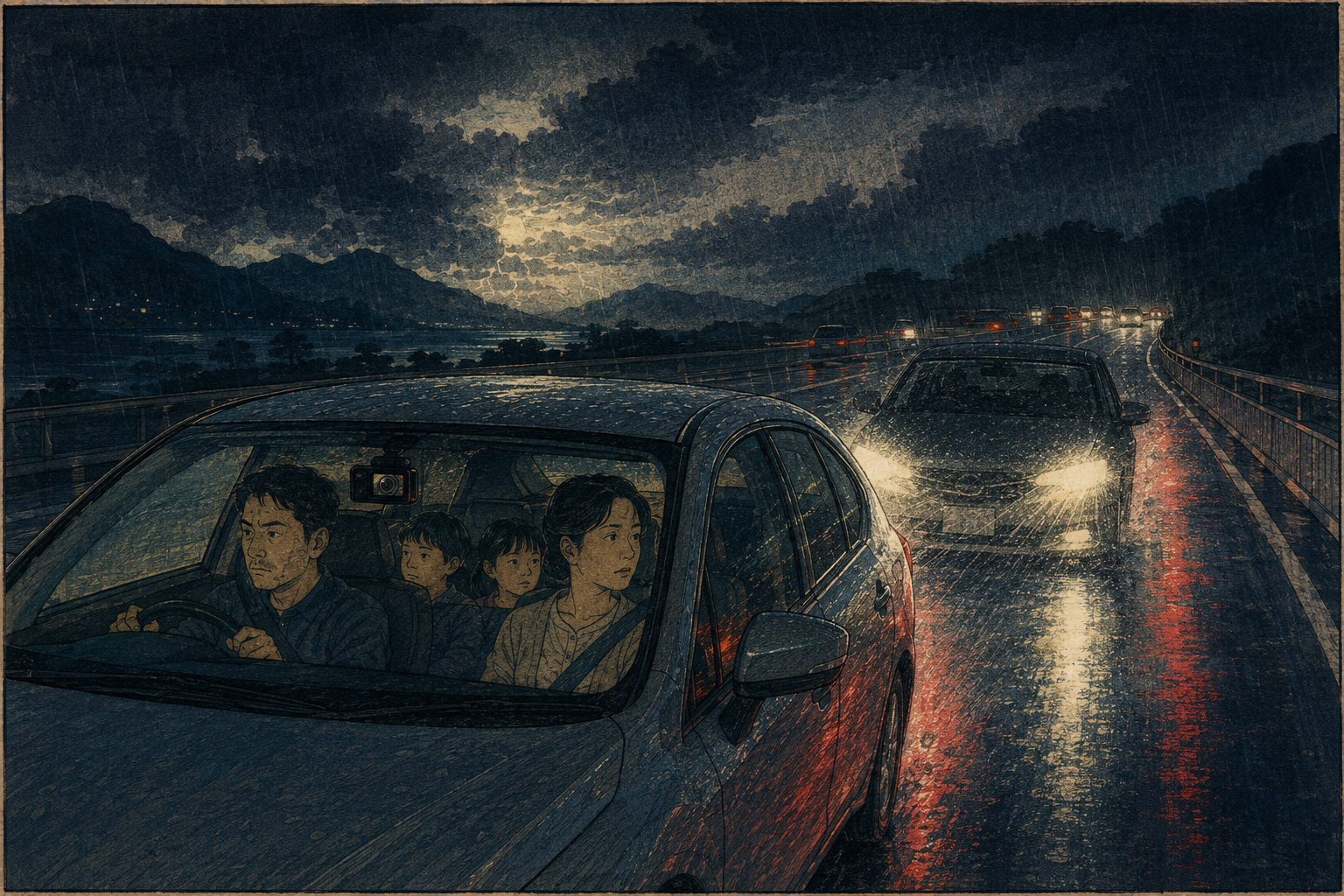
At night, the Obon road becomes a chain of red lamps.
Brake lights descend a mountain pass, gather at a tunnel mouth and spread into a stationary river before a toll gate. Children sleep in the rear seat. Flowers for the family grave lie beside gifts and luggage. The navigation screen revises the arrival time again. Beneath the windshield, a black lens records the lane ahead; on the rear glass, a second lens watches the headlights behind.
This is the new architecture of the drive home. The car is no longer merely transport. It is a small witness box. Japan’s drivers bought cameras after spectacular crashes, disturbing video clips and a growing fear that one person’s account would be powerless against another’s. A machine that began as a recorder for commercial fleets and accident analysis has become an instrument of private self-defence.
The transformation accelerated after the June 2017 Tōmei Expressway deaths. A family car was forced to stop on the main carriageway after another driver repeatedly blocked and slowed it. A truck struck the stopped vehicle; two parents died and the case left six people dead or injured in all. The National Police Agency’s own history says the investigation revealed deliberate obstruction immediately before the stop. The event gave a national name and image to aori unten—driving that pressures, pursues or obstructs another road user.
Nine years later, the road home carries both the legacy of that reckoning and its limits. The law is stronger. Cameras are common. Yet drivers still report intimidation, wrong-way incidents continue roughly every two days on expressways, summer cloudbursts erase visibility, and fatigue can turn an ordinary lane change into a fatal error without anger or criminal intent.
What 36.3% Does—and Does Not—Tell Us
Zurich’s ninth annual aggressive-driving survey ran online from May 15 to 22. Its respondents were 18 to 69, held an ordinary licence, owned a private car and drove at least once a week. Of the 2,000 participants, 36.3% recalled having been on the receiving end of aggressive driving sometime in the previous five years. The release also reported that 22.1% had experienced it within the previous year, close to the 24.0% recorded before the 2020 legal reform in Zurich’s 2019 survey.
Those are serious signals of fear and conflict among frequent drivers. They are not an administrative count. “Aggressive driving” is a survey label interpreted by each respondent, while the legal offence requires proof of an obstructive purpose and specified violations. Recall stretches over months or years. The panel is an online sample of car-owning weekly drivers, not a random draw from every licence holder. And nothing in the survey establishes that Obon itself makes attacks more frequent.
Zurich then questioned a selected group of 400 people who had reported five-year victimization. Among them, 86.5% described a vehicle approaching fiercely from behind. Just over half, 52.5%, said they yielded. Some 62.5% could identify no trigger. Among those who thought they knew one, slow driving and driving at the speed limit were common explanations. These are respondents’ interpretations of another driver’s motive, not findings from reconstructed incidents.
The most useful result may be less dramatic. Keeping an adequate following distance ranked first both as a way respondents tried to avoid victimization and as a way they tried not to be mistaken for an aggressor. Distance is mechanical safety and social language at once. It preserves braking time; it also says, without a gesture, “I am not pushing you.”
| Figure | What it measures | What it cannot prove |
|---|---|---|
| 36.3% | Five-year self-reported victimization among 2,000 car-owning weekly drivers in one insurer’s online survey. | An Obon attack rate, police incidence or a representative rate for every Japanese driver. |
| 69.7% | Dashcam installation in the same 2026 weekly-driver sample; up 3.1 points from its 2025 result. | A universal national ownership rate or a number directly comparable with every other poll. |
| 32.1% to 53.8% | Change between Sony Insurance surveys with broadly matched criteria: car owners aged 18–59 who drove monthly or more. | Proof that cameras caused aggression to rise or fall. |
| 436 jams | Operator forecast for traffic-concentration queues of at least 10 km during August 7–16. | A count of accidents, attacks or all delays. |
Tōmei: The Stop That Changed the Law
The 2017 Tōmei case was terrifying because it converted a dispute into entrapment. The danger was not only close following. It was the use of a vehicle to control where another family could move, ending with a car stopped in a live high-speed lane. The truck collision made visible a principle highway engineers already knew: on an expressway, a stationary vehicle can be more dangerous than the conflict that put it there.
Police initially had to assemble a response from offences that existed before aori unten had its own statutory category. In January 2018, the NPA instructed prefectural forces to apply all available criminal laws and administrative sanctions aggressively. Public attention widened after other incidents, including the 2019 Jōban Expressway case, whose roadside confrontation circulated nationally.
On June 30, 2020, the revised Road Traffic Act created the offence of obstruction driving. A person who, with the purpose of obstructing another road user, commits specified acts—such as unjustified sudden braking, unsafe following, cutting in or other dangerous interference—can face a custodial sentence of up to three years and licence cancellation. If the conduct creates a marked traffic danger, the maximum is five years. Conduct that kills or injures can also fall under the separate dangerous-driving law.
The statute supplied a legal name and tougher consequences. It did not abolish the human ingredients: anger, status, impatience, misread intentions and the belief that a slower stranger is personally withholding something. In Zurich’s selected group of pre-2020 drivers who had since reported victimization, 57.3% felt the frequency of experiencing or witnessing such conduct was unchanged after reform; 21.7% felt it had risen and 18.8% felt it had fallen. That perception question cannot evaluate the law’s causal effect. It does show why many drivers do not experience legislation as a protective bubble.
2007–08 The NPA studies dashcam footage as a tool for workplace traffic-safety education.
June 2017 The Tōmei obstruction and rear collision kills two parents and makes aori unten a national crisis.
January 2018 Police nationwide receive instructions for forceful investigation and administrative action using existing laws.
2019 Sony Insurance’s matched survey finds dashcams in 32.1% of respondents’ cars; JEITA/JDRC records 4.84 million domestic shipments that fiscal year.
June 2020 The new obstruction-driving offence takes effect, with licence cancellation and maximum custodial terms of three or five years.
2025 Sony’s matched installation measure reaches 53.8%; the government selects 188 expressway facilities for priority wrong-way countermeasures.
2026 Zurich’s different weekly-driver sample records 69.7% dashcam installation and 36.3% five-year self-reported victimization.
How the Dashcam Became a Civilian Black Box
Dashcams were not born from road rage. Early Japanese systems were used in taxis, trucks and fleet safety, capturing a short window around a shock or sudden manoeuvre. The NPA’s 2007–08 work emphasized replay: managers and drivers could examine a near miss, identify risky habits and turn a private mistake into a teaching scene. The device looked backward in time so future driving might improve.
Consumer adoption changed the social purpose. By fiscal 2019, manufacturers participating in the JEITA/JDRC statistics shipped 4,839,241 units domestically. Shipments are a flow, not the installed share of vehicles, but they show the scale of the market at the moment tailgating footage dominated public discussion. Sony Insurance’s survey of 1,000 car owners aged 18–59 who drove at least monthly found installation at 32.1% in 2019. A survey with the same broad age and driving criteria found 53.8% in 2025—up 21.7 percentage points, or about two-thirds.
Zurich’s 2026 measure is higher, 69.7%, but the samples differ: Zurich included drivers through age 69 and required weekly driving. It should be displayed beside the Sony series, not spliced onto it. Within Zurich’s own series, the rate rose from 66.6% in 2025 to 69.7% in 2026.
The reasons reveal a culture of disputed truth. In a separate selected subsample of 200 dashcam users, 93.5% said they used one to avoid being placed at a disadvantage after an accident or trouble. Some 66.5% said accident or tailgating stories in news or social media had prompted adoption. Among a combined selected group of 400 users and non-users, 60% believed wider use would reduce aggressive driving.
That is public expectation, not a measured deterrent effect. A camera may inhibit a driver who sees a rear lens or recording sticker. It may provide a registration plate, sequence and voice recording. It may protect an innocent driver from a false narrative. But it can also fail to capture a side approach, wash out a plate in rain, overwrite a file, carry the wrong date or reveal only the last seconds of a longer exchange.
The Camera Is a Witness, Not Armour
A front-only camera is poorly placed for the most common reported form of intimidation: fierce approach from behind. A rear camera covers that gap; a 360-degree unit may record a driver at the side window. Yet wider fields trade detail for coverage, and no specification guarantees a readable plate at speed on a wet night. An “installed” camera may not be a working camera.
Before a long drive, the useful ritual is ordinary: clean the lenses, confirm the live image from every channel, check that the clock and time zone are correct, inspect the memory-card warning and follow the maker’s replacement or formatting instructions. Learn the event-save control while parked. Continuous recording and impact-protected event files behave differently by model. Audio can preserve threats or conversation, but it also records passengers; know when it is on.
After an incident, preserve the original file and a copy before loop recording can erase it. Record the time, road, direction and nearest marker. Give material to police and an insurer through their procedures. Uploading an edited accusation to social media first can expose other people’s faces, voices and registration details, distort context and complicate an investigation. Evidence is most valuable when its chain and original quality survive.
The NPA encourages dashcam use because it records malicious conduct and may deter it. The agency also describes replay as self-examination. That second use is quieter but important. The lens may show that the “sudden” cut-in followed a long blind-spot overlap, that the driver was too close before the brake lights, or that irritation shortened following distance. A camera capable only of proving the other person wrong is less useful than one that also corrects its owner.
Wrong-Way Vehicles: When the Threat Comes Head-On
Tailgating is intentional pressure; wrong-way driving often begins in confusion. Their psychology differs, but a correctly travelling family meets both as a rapidly closing hazard. NEXCO says wrong-way events occur on Japan’s expressways roughly once every two days. A 2015 government assessment found that a wrong-way incident was four times as likely as an expressway crash overall to produce death or injury, and forty times as likely to be fatal.
Japan began unified countermeasures at all interchanges and similar facilities in 2014: large arrows, warning signs, colored pavement and flexible posts. By December 2024, basic measures were complete at about 98% of sites. Yet the event count did not decline. In November 2025, the transport ministry designated 188 priority facilities where serious incidents persisted, repeated events occurred or the layout posed special problems. Operators are now adding more physical barriers and detection technology, with completion aimed broadly at fiscal 2028.
The policy shift is revealing. More signs assume the driver can perceive, understand and obey them. Physical devices and camera detection assume that sometimes the human loop has already failed. Roadside systems are being tested to identify the wrong-way car, warn that driver and alert correct traffic. The same visual technology that documents a failure can become part of the road’s nervous system.
On July 9, 2026, a dashcam near Kushiro-Nishi Interchange on the Dōtō Expressway recorded a stopped car turn around and begin travelling against traffic. TV Asahi reported no major accident. The short clip did not establish why the driver turned or permit a diagnosis. It did demonstrate the camera’s public role: a frightening act that might once have survived only as a caller’s description arrived as a sequence of movements.
Official advice to correct-direction traffic is to slow, open a generous gap and watch the vehicles ahead when a wrong-way warning appears. Wrong-way cars tend to approach in the passing lane, though no lane is guaranteed safe. A passenger—not the driver holding a phone—should call 110, or report at a toll booth, rest facility or emergency telephone. The objective is not to film a better clip. It is to preserve room to avoid a collision.
A Wall of Summer Rain
August weather changes the meaning of distance. A dry two-second interval can become inadequate when spray hides brake lights and water reduces grip. A localized downpour can be invisible beyond the next ridge, then arrive as a gray wall. A camera may record every drop and still see less than the driver needs.
The Japan Meteorological Agency warns that developed cumulonimbus clouds can bring sudden heavy rain, lightning and violent winds. NEXCO closes roads when rainfall or associated hazards exceed set criteria and repeatedly asks drivers to check current forecasts and live road restrictions before departure. In its 2026 storm-season notice, NEXCO East recalled recent expressway flooding, landslides and fallen trees; a road can remain closed after rain stops while slopes and surfaces are inspected.
The practical response begins before loss of control: reduce speed smoothly, extend the gap, switch on lights so others can see the car, avoid abrupt steering and braking, and leave the expressway or stop at the next safe rest area if visibility is no longer sufficient. Never enter floodwater whose depth is unknown. In Sony’s 2025 survey, only 56.8% selected “do not enter and turn back” for that situation—another reminder that hazard knowledge cannot be inferred from owning safety equipment.
Sudden weather also distorts social judgment. A cautious driver slows; an impatient driver behind interprets the gap as delay. Spray makes a normal following distance appear larger, while hydroplaning makes it more necessary. The safest decision may feel rude to someone measuring only arrival time. Safety depends on refusing that pressure.
Fatigue, the Danger Without a Villain
Obon driving invites bad bargains with sleep. A family leaves after work to beat the morning queue. A driver who normally covers thirty minutes attempts five hours. A forecasted two-hour delay makes the trip longer after the rest plan has already failed. The return journey begins after meals, visiting and heat, when the person at the wheel is not the person who made the outward trip.
Fatigue rarely announces itself as a dramatic event. It narrows attention, lengthens reaction time and produces lane drift, missed signs and inconsistent speed. Irritability can make another driver’s mistake feel deliberate. A tired motorist may become both the person who endangers others and the person who believes others are attacking.
NEXCO has long urged drivers to stop at an SA or PA at least once every two hours. In a 2024 experiment aimed at overnight fatalities, NEXCO Central promoted caffeine followed by a short nap of about fifteen minutes. Neither is permission to continue when sleepiness remains. Opening a window, turning up music and relying on lane alerts do not repay sleep debt. If the eyelids feel heavy, the safe schedule is the one that changes.
A dashcam will faithfully record the center line sliding beneath the car. It may help explain the crash. It cannot restore alertness. Driver-monitoring alerts and lane support are valuable backups, not substitutes for stopping.
Why Obon Magnifies Exposure
For August 7–16, the expressway companies and Japan Road Traffic Information Center forecast 436 traffic-concentration jams at least ten kilometers long. Downbound traffic had two main waves earlier in the holiday; upbound pressure was concentrated later, including August 14 and 15. A maximum 40-kilometer queue was forecast near Sakado-Nishi Smart Interchange on the upbound Kan-Etsu Expressway on the 15th.
The forecast is not a prediction of violence. Congestion can reduce speed, and speed reduction can reduce impact energy. But stop-and-go movement multiplies opportunities for rear-end collisions, sudden lane changes and misunderstandings. It lengthens time on task. Crowded rest areas tempt a tired driver to continue past the planned stop. Family obligations create the feeling that arrival is a deadline rather than a range.
Operators’ congestion advice is strikingly close to the interpersonal lesson from the Zurich survey: maintain sufficient distance, avoid unnecessary braking and do not make purposeless lane changes in the queue. Smooth driving reduces the wave passed backward through traffic. It also reduces the visual signals that another motorist may misread as challenge.
The road home is therefore a system, not a duel between good and bad individuals. Traffic volume, road geometry, weather information, vehicle technology, enforcement, family schedules and sleep all meet inside a few meters of asphalt. The driver controls only some of them. The essential skill is to keep the uncontrollable from shrinking the margin around the car.
Four Threats, Four First Responses
| Threat | What the camera can do | What it cannot do | Safest first response |
|---|---|---|---|
| Tailgating / obstruction | Record following distance, lane changes, plate, voice and sequence. | Stop the aggressor or make confrontation safe. | Do not brake-check or retaliate. Yield only when safe; escape to an SA or PA, stay in the locked vehicle and call 110. |
| Wrong-way vehicle | Document route and movement; footage may assist investigation. | Identify a guaranteed safe lane or prevent impact. | Slow, enlarge the gap and watch ahead. A passenger reports to 110. Prioritize avoidance, not recording. |
| Sudden rain | Preserve conditions and visibility before an incident. | Restore grip or see through spray beyond its optical limits. | Slow smoothly, add distance, use lights and stop at a safe facility if visibility is inadequate. |
| Fatigue | Reveal drift, delayed reactions and speed inconsistency afterward. | Keep the driver awake. | Stop before impairment. Rest at least every two hours; if sleepy, nap or change drivers and delay arrival. |
- Do not compete, brake-check, gesture or get out to argue. The legal right of way is not a protective barrier.
- If a lane change or exit can be made safely, create separation and head for a service area, parking area or another place protected from moving traffic.
- Police guidance is to remain in the vehicle at that safe refuge and call 110 without hesitation. Lock doors and keep windows closed.
- Have a passenger call and note the road, direction, marker and vehicle description. A driver must not handle a phone while moving.
- Afterward, protect the original recording from overwrite and provide it to police. Do not make a social-media confrontation the next stage of the road confrontation.
- Tyres: pressure, visible damage and tread; wipers and washer fluid; fuel or charge margin.
- Camera: clean front and rear lenses, live image, correct clock, no memory-card warning, event-save control understood.
- Information: route alternatives, JMA weather, NEXCO/JARTIC restrictions and forecast queue times.
- People: every seat belt fastened, two-hour rest points chosen, second driver agreed, arrival time allowed to move.
From Recording Harm to Designing Margin
Japan’s dashcam boom is often told as a technology success story. The stronger story is institutional. The devices changed what victims could bring to police, what insurers could reconstruct, what newsrooms could show and what families believed they needed before joining the expressway. They redistributed the power to describe an event.
But a country cannot record its way to road safety. The 2020 law matters because intimidation is not ordinary bad manners; it can be a deliberate use of a heavy machine to control another person. The 188-site wrong-way program matters because some errors must be stopped by road design, not a clearer warning sign. Weather closures matter because mobility is not always worth preserving. Rest matters because no enforcement camera can punish tiredness out of the nervous system before a mistake.
The most powerful safety technology in the car remains empty space: the distance ahead that absorbs surprise, the exit from an argument, the extra hour in a schedule, the decision not to enter water, the unused lane change, the seat in which a tired driver is no longer driving. Cameras make events visible. Margin keeps them from becoming events.
On August 15, the cars moving toward Tokyo, Osaka, Nagoya, Sendai and dozens of smaller cities carry families away from graves and dining tables. Their lenses face both directions. Behind them is the ancestral home; ahead is the ordinary year. The best footage from the journey will be footage no one ever needs—a long, uneventful record of distance held, rain respected and arrival allowed to wait.
Reporting note and principal sources
This article uses public information checked through August 14, 2026 at 7:04 AM JST. Corporate online surveys are labeled with their sponsor, sample and denominator. Survey perception is not presented as police incidence. Different dashcam survey series are not merged. No cited source establishes that Obon causes a rise in aggressive driving.
- Zurich Insurance Japan: 2026 aggressive-driving and dashcam survey, full methodology and tables
- National Police Agency: obstruction-driving law and official response guidance
- NPA 2020 white paper: Tōmei case, enforcement history and legal reform
- NPA: dashcams, near-miss review and safety education
- Sony Insurance: 2019 matched car-life survey and 32.1% installation rate
- Sony Insurance: 2025 matched survey, 53.8% installation and floodwater question
- JEITA/JDRC: fiscal 2019 domestic dashcam shipments
- Expressway operators and JARTIC: nationwide 2026 Obon congestion forecast and safety advice
- Ministry of Land, Infrastructure, Transport and Tourism: 188 priority wrong-way sites
- NEXCO companies: wrong-way frequency and detection technology program
- NEXCO East/Hokkaido police: official advice when a wrong-way vehicle is reported
- TV Asahi: July 2026 Dōtō Expressway wrong-way dashcam report
- NEXCO East: two-hour rest guidance
- NEXCO Central: caffeine and short-nap fatigue experiment
- Japan Meteorological Agency: sudden rain, lightning and severe convective weather
- NEXCO East: 2026 heavy-rain and typhoon road-information guidance