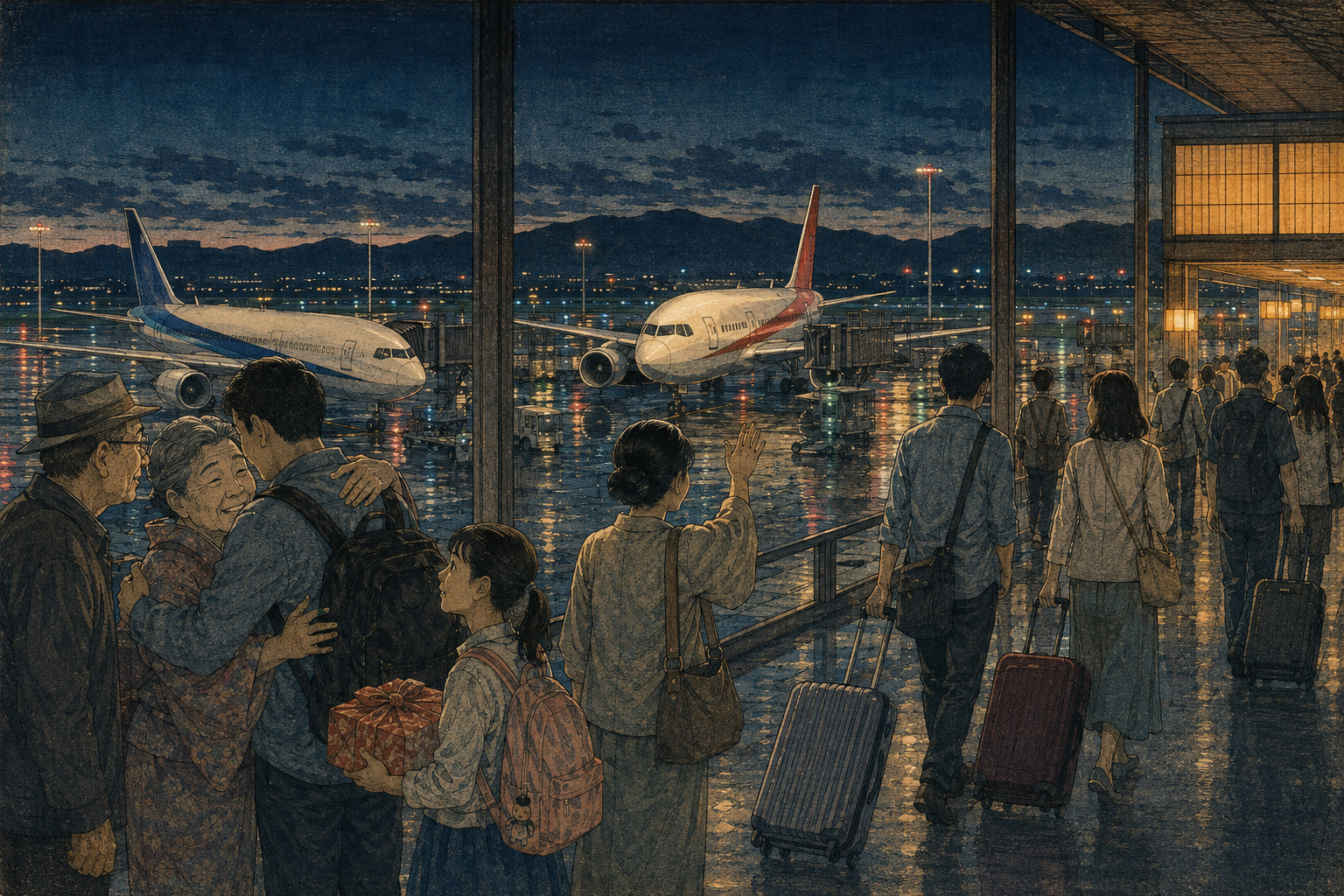
At Haneda, a departure board cannot tell you why a person is leaving.
A grandmother carrying a paper bag of Tokyo sweets may be flying to the family altar in Matsuyama. Two rows behind her, parents are negotiating the baggage allowance for a week in Ishigaki. Across the concourse, a university student is beginning an overseas trip that happens to fit inside a company or school break. Nearby, a visitor from abroad is connecting to New Chitose to exchange the furnace of Tokyo for Hokkaido’s open summer.
To the airport, all four are pieces of demand. To a family, they are different stories. The annual temptation is to compress them into a single phrase—“the Obon rush”—and then nominate one outbound day and one return day. Aviation does not cooperate so neatly. A carrier’s route map, seat supply, group companies, direction definitions and international connections all shape its peak. A reservation table is a portrait of that network, not a census of the nation.
JAL’s 2026 portrait is especially revealing. For the ten days from August 7 through 16, its group reported a 77.0% domestic reservation rate. Both “down” and “up” directions peaked on Tuesday, August 11—Mountain Day—rather than forming the familiar early-departure, late-return pair. Internationally, the JAL/JTA booking rate was 75.2%; departures from Japan peaked on August 8 and arrivals on August 15. Hokkaido and Okinawa were the strongest domestic regions. One company, one period, at least three clocks.
A Peak Is a Ratio, a Date and a Route Map
The JAL release is a booking snapshot dated July 31, not the final traffic result. Its domestic total combines JAL, J-AIR, Japan Air Commuter, Hokkaido Air System, Japan Transocean Air and Ryukyu Air Commuter. Those names matter. A trunk jet from Haneda to New Chitose, a turboprop between Kagoshima and an island, and an Okinawan route operated by JTA or RAC all enter the group picture.
The release also says its operating-carrier figures include seats sold by other companies while excluding JAL-marketed codeshares operated by another carrier. That is normal airline accounting, but it defeats casual addition. “ANA plus JAL” is not a clean national total unless the underlying definitions, observation date and codeshare treatment match.
Reservation rate is booked seats divided by offered seats at the snapshot. It is not final load factor, which uses passengers actually carried. It does not say every departure is 77% full. A 7 a.m. flight may be closed to new bookings while a late-evening service has rows available. Cancellations, late purchases, aircraft substitutions, weather and missed connections still stand between the chart and the gate.
| Evidence | Period / status | What it can tell us | What it cannot |
|---|---|---|---|
| JAL domestic 2026 | Aug. 7–16; July 31 snapshot | 77.0% booked; both directions peaked Aug. 11; Hokkaido and Okinawa strong | Final passengers or fullness of a particular flight |
| JAL international 2026 | Aug. 7–16; July 31 snapshot | 75.2% booked; Japan departures Aug. 8, arrivals Aug. 15 | A measure of domestic homecoming |
| ANA Obon 2025 baseline | Aug. 8–17, 2025; Aug. 1 snapshot | Domestic peaks Aug. 12/14; international peaks Aug. 9/16; Hokkaido and Okinawa strong | A substitute for an unlocated ANA 2026 release |
| Actual traffic | Compiled after the holiday | Passengers carried and realized load factor | Intent visible before travel |
The Mountain Day Knot
Why would JAL’s domestic traffic peak in both directions on August 11? The release states the result but not every motive. The calendar supplies a plausible interpretation. Mountain Day fell on a Tuesday in 2026. The major Obon observance was still ahead, but the long summer travel window was already open. August 11 could therefore hold opposite movements at once: people completing a leisure trip and flying home, others beginning a family visit, and travelers transferring between regions without passing through Tokyo.
This is an inference, not a passenger survey. It is also a warning against treating “up” as pure return-to-Tokyo traffic and “down” as pure homecoming. Japan’s air network is not a single radial railway diagram. Osaka, Fukuoka, Sapporo and Naha are origins as well as destinations. A traveler between Okinawa and Kyushu can be returning home in a direction that a Tokyo-centered headline misreads.
Journey One: Going Home Without a Rail
For much of Honshu, the history of mass homecoming is written along railway lines. Air travel becomes essential where the archipelago lengthens, breaks into islands or pushes beyond convenient rail time. Hokkaido, southern Kyushu and Okinawa are not peripheral to the Obon air story; they are where the aircraft most clearly performs the work of national connection.
A family bound for a town outside Sapporo may still need a train or rental car after New Chitose. A traveler to Amami, Miyako or Ishigaki may connect through Kagoshima or Naha. JAL’s corporate table is actually a family of regional operators: HAC in Hokkaido, JAC around Kyushu and the islands, and JTA and RAC in Okinawa. ANA’s domestic system similarly extends beyond the mainline brand through group operations and connections. The reservation begins with an airport code, but the homecoming often ends on a bus, ferry or narrow local road.
This is why capacity is not simply “add more planes.” Aircraft and crews must be placed in the right city the night before. Slots at Haneda are finite. Regional airports have gates, security lanes and rental-car counters that can become the true constraint. A late inbound aircraft can delay the next outbound sector. Unlike a train that runs back and forth along one corridor, a jet belongs to a daily chain of routes.
Journey Two: Summer Runs North and South
Hokkaido and Okinawa share a reservation headline but not a climate. Hokkaido sells relief: broad landscapes, flowers, food, drives and evenings cooler than Japan’s major cities. Okinawa sells the sea: beaches, reefs, island culture and resort time. One is the northward answer to extreme heat; the other is a subtropical holiday whose typhoon risk is part of summer operations.
Their popularity also scrambles the simple Obon narrative. A New Chitose passenger may be returning to parents in Asahikawa, touring Furano, or arriving from overseas for a regional itinerary. A Naha passenger may be visiting an ancestral grave, entering a resort, transferring to Miyako or Ishigaki, or continuing to a smaller island. The same occupied seat can signify kinship, tourism or both.
JAL said its 2026 Hokkaido and Okinawa bookings greatly exceeded the comparable level. The persistence is not unique to one year: ANA’s confirmed 2025 Obon release reported an 89% reservation rate for Okinawa and 88% for Hokkaido. That historical comparison does not prove ANA’s 2026 peak. It does show why both regions repeatedly appear near the top of summer airline briefings.
- Homecoming: a family trip whose destination lies beyond the airport.
- Domestic holiday: a resort, drive or nature itinerary concentrated into school and workplace breaks.
- Regional connection: a mainline flight feeding a turboprop, ferry or island route.
- Inbound tourism: an overseas visitor using a domestic sector inside Japan.
Journey Three: Obon Opens Outward
International travel occupies a different tide. JAL’s Japan-departure peak on August 8 and arrival peak on August 15 look like the conventional shape that its domestic chart lacks. Yet international bookings in every broad region were below the prior-year number; only Hawaii and Guam recorded a higher reservation rate. Fewer booked passengers and a stronger rate can coexist when seat supply also changes.
Cost presses hard on the outward journey. For tickets issued in July and August 2026, ANA listed a fuel surcharge of ¥65,000 each way to Europe, most of North America, the Middle East and Oceania, and ¥40,400 each way to Hawaii, India and Indonesia. A Japan–Hawaii round trip therefore carried ¥80,800 in fuel surcharge before base fare and taxes; a qualifying long-haul round trip carried ¥130,000. JAL adopted the same broad levels. The government’s emergency relief kept the applied band below the formula’s raw result, but “relief” did not make it cheap.
The exchange-rate strip on this edition—US$1 to ¥159.48—makes the asymmetry visible. A weak yen helps many overseas visitors buy more in Japan while making hotels, food and ground transport abroad more expensive to Japanese residents. On July 1, Japan sharply reduced online passport fees: a ten-year adult passport fell from ¥15,900 to ¥8,900. The change lowered the first step into overseas travel, but a ¥7,000 saving is small beside a transpacific surcharge.
The Airport Has Become a Border and a Domestic Station
In 2025, Japan welcomed a record 42,683,600 visitors from overseas, according to JNTO—15.8% more than in 2024. That scale changes the meaning of an Obon airport. International visitors do not disappear when Japanese workplaces close. They arrive on their own school holidays and vacation calendars, then connect to the same Hokkaido and Okinawa flights sought by domestic travelers.
ANA’s network shows how far this overlap has developed. The carrier celebrated the 40th anniversary of scheduled international service in March 2026. Its first regular international route, Narita–Guam, began in 1986; by March 2026, ANA said it served 55 international routes and 40 cities, with roughly 170 million cumulative international passengers carried by the end of 2025. A company once confined chiefly to the domestic market now treats international passenger and cargo growth as a central strategy.
The modern departure hall therefore works as both border and domestic station. A visitor clears immigration and boards a domestic jet. A Japanese family flies from a regional airport to Haneda or Narita and crosses outward. A homecoming passenger shares check-in space with both. Obon does not stop global travel; it layers a national ritual on top of it.
How the Sky Learned to Carry Homecoming
Japan’s postwar civil aviation began with scarcity. JAL was established in August 1951 and, on October 25, opened the first postwar civil service from Tokyo through Osaka to Fukuoka with a Martin 2-0-2. It did not yet own the aircraft or employ the pilots; Northwest Airlines operated the plane. The cabin offered paper-box sandwiches, and JAL introduced basic, round-trip and family-discount fares. From the beginning, the airline was selling not only speed but the possibility of moving households across a recovering country.
ANA’s ancestor, Japan Helicopter Transport, began in 1952 with two helicopters after the occupation-era ban on private flying was lifted. It launched helicopter service in 1953, started cargo on the Tokyo–Osaka trunk that December, introduced DC-3s in 1955 and became All Nippon Airways in 1957. The company grew by stitching together domestic routes and regional carriers. In 1962 it became launch customer for the YS-11, the postwar Japanese-built airliner that would become a familiar sight at local airports.
1951 — JAL opens postwar civil service on Tokyo–Osaka–Fukuoka.
1952 — ANA’s predecessor begins with two helicopters.
1960s — Turboprops and jets compress journeys between the metropolitan centers and regions.
1972 — Industry policy assigns carrier roles; ANA is largely held to domestic flying.
1985–86 — The restriction is dismantled; ANA opens scheduled Narita–Guam service.
2026 — Domestic homecoming and global tourism share the same carrier groups and hubs.
For Fourteen Years, the Carriers Were Given Different Skies
The differences between ANA and JAL are historical, not merely commercial. A 1972 industry policy divided roles among major carriers. JAL occupied international and domestic trunk routes; ANA was principally domestic; Toa Domestic Airlines served domestic routes. ANA could operate charters, but scheduled international service remained out of reach until the policy was abolished in 1985.
That division shaped corporate memory and networks. JAL’s international lineage began in 1954 with a 31-hour-and-20-minute journey from Tokyo to San Francisco via Wake Island and Honolulu. ANA spent decades deepening domestic reach before its 1986 Guam service. Competition, deregulation, new aircraft and the eventual integration of Japan Air System into JAL changed the map, but the older specialization still helps explain why each group’s holiday statistics have their own texture.
It also explains why an ANA peak and a JAL peak need not agree even when both are correct. The groups do not offer identical seats on identical routes to identical customers. One may add capacity on a date that lowers its reservation rate while carrying more people. Another may have a regional portfolio that turns over holidaymakers mid-period. A date is an outcome of supply as much as demand.
What the Missing Chart Teaches
The original premise for this story said ANA and JAL had reported different 2026 peak days. JAL’s report supports its half. The equivalent ANA document was not publicly verifiable by the reporting cutoff. The responsible choice is not to fill the blank with last year’s dates. It is to show the blank.
ANA’s 2025 release is useful precisely when labeled. For August 8–17 that year, ANA reported domestic reservation peaks on August 12 and 14, while international traffic peaked on August 9 for Japan departures and August 16 for overseas departures. Its actual results later shifted the domestic peak dates to August 9 and 17. That change is a compact lesson: reservations measure intention; operations measure what happened.
The same source discipline applies to “ANA Group.” In 2025, ANA sometimes gave an ANA-only figure and then a broader total including Peach and, internationally, AirJapan. AirJapan ceased operating under its own brand after March 2026 as ANA restructured the strategy. Group perimeter is not a footnote to be ignored; it is part of the measurement.
Reading the Departure Board on August 15
By this edition’s date, the early international departure wave and JAL’s August 11 domestic crest are already history. Saturday the 15th is JAL’s international arrival peak and one of the decisive days for return travel more broadly. But even now, the departure board remains plural. Some passengers are ending holidays, some are beginning late ones, and some are moving between family households before Sunday closes the observance.
Travelers should use airline apps and airport notices for a specific flight, not a national peak headline. Online check-in can remove one queue but not the time needed to check baggage or clear security. Parking and airport roads may become bottlenecks before the terminal. Typhoons and convective summer weather can disturb aircraft rotations far from the storm itself. A delayed inbound plane is tomorrow’s schedule arriving late.
- Was it a snapshot or final traffic?
- Which dates and operating companies were included?
- Does “peak” mean passengers, booked seats or reservation rate?
- Is the direction domestic, Japan-departing international, or overseas-departing international?
- Did offered capacity change from the comparison year?
The Country Seen From Above
The most interesting thing about Obon air travel is not which airline wins a headline comparison. It is that one national holiday period now carries three Japans at once.
There is the Japan of ancestral geography, where a person’s home is measured by kin and graves rather than present address. There is the Japan of domestic leisure, seeking cool northern roads or southern water within a narrow common break. And there is the Japan of global movement, receiving record numbers of visitors while its own residents weigh a weak yen, fuel surcharges and the restored desire to go abroad.
Those maps meet at the gate. The aircraft climbs, the city becomes lights, and the reason for the journey disappears from view. The reservation systems keep the numbers. The passengers carry the meaning.
Reporting notes and principal sources
This article is based on public information checked through August 14, 2026 at 7:04 a.m. JST. Reservation figures are identified as snapshots rather than final passenger counts. The absence of a locatable ANA 2026 Obon reservation release is stated explicitly; ANA’s 2025 figures are used only as a labeled historical baseline. Calendar and passenger-motive interpretations are presented as inferences.
- JAL: 2026 Obon reservation status, July 31 release and detailed notes
- ANA: 2025 Obon reservation status, historical comparison
- ANA: 2025 Obon actual traffic, showing realized peak dates
- JAL: fiscal 2026 domestic route and summer capacity plan
- ANA: 40 years of scheduled international service, 55 routes and 40 cities
- ANA Group: suspension of the AirJapan brand and move to a two-brand strategy
- ANA Group history: two-helicopter founding and 1972–86 international restriction
- ANA corporate chronology: domestic fleet, passenger milestones and 1986 Guam service
- JAL corporate chronology: 1951 postwar domestic service and early routes
- JAL 75th-anniversary history: early aircraft, cabins and international service
- JNTO: record 42,683,600 visitors to Japan in 2025
- ANA: July–August 2026 international fuel-surcharge table
- JAL/JTA: July–August 2026 fuel surcharge and calculation basis
- Ministry of Foreign Affairs: July 2026 passport-fee reduction