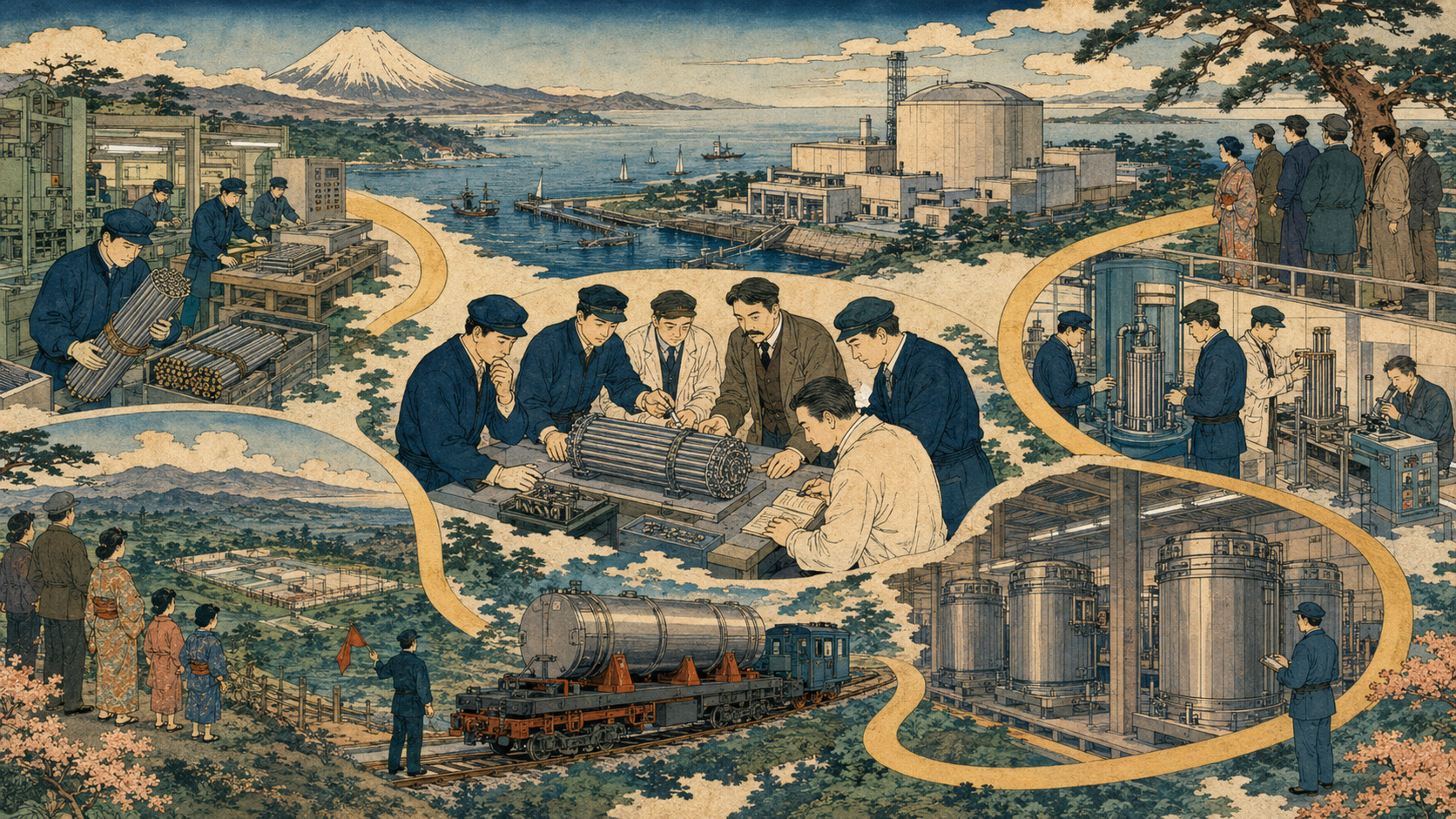
At Rokkasho in Aomori Prefecture, spent fuel assemblies are supposed to complete a transformation that looks almost effortless in a diagram. Fuel is cooled, chopped into short pieces and dissolved in nitric acid. Uranium and plutonium are separated from fission products, blended so that plutonium is not recovered alone, converted to oxide and made into fuel again. The arrow leaving a reactor eventually bends back toward another reactor. The line becomes a circle.
Outside the diagram, each arrow moves on a different clock. Reactors restart and produce more spent fuel. Pools and dry casks buy time. The reprocessing plant, begun in 1993, is still moving through regulatory review, construction and inspection toward a target of completion during fiscal 2026. The adjacent mixed-oxide, or MOX, fuel plant is targeted for completion during fiscal 2027 and fuel fabrication in fiscal 2030. Japan has not selected a final repository for the high-level waste that reprocessing will leave behind.
That is why the 2026 white paper devotes its special feature to “Prospects for the Nuclear Fuel Cycle for the Next Generation.” The Seventh Strategic Energy Plan has restored nuclear power to the center of a strategy built around decarbonization, energy security and rising electricity demand from data centers and semiconductor plants. If reactors return, their back end must move too. The white paper is both a technical primer and an account of the unfinished work left by seventy years of national ambition.
The white paper’s real subject is everything before and after generation
Debate about nuclear energy usually focuses on the moment a reactor operates: whether it is safe, how much electricity it produces and whether that power is cheap or low-carbon. Fuel begins a long international journey well before it enters the core. Ore is mined and milled, converted into uranium hexafluoride, enriched so that the share of fissile uranium-235 rises from about 0.7% to 3–5%, converted again, pressed into pellets and fabricated into assemblies. Japan imports all of the uranium used in mining and conversion stages and relies mainly on overseas enrichment.
After three to five years in a light-water reactor, the fuel starts an even longer journey. Freshly discharged assemblies are intensely radioactive and hot. Water cools them and shields workers. They then wait for reprocessing, move into dry casks or an interim facility, or eventually become waste. Under Japan’s chosen route, reprocessing recovers uranium and plutonium, MOX fabrication returns part of that material to reactors, liquid high-level waste is vitrified, and the glass is cooled for decades before burial more than 300 meters underground.
What remains inside 1,000 kilograms of “spent” fuel
Used light-water-reactor fuel is about 93–95% uranium-238, roughly 1% uranium-235, around 1% plutonium and 3–5% fission products and other materials. “Spent” does not mean empty. During normal operation, roughly 30–40% of the energy comes from plutonium created in the reactor when uranium-238 captures neutrons.
The white paper cites an assessment under which 1,000 kilograms of spent fuel could produce about 100 kilograms of MOX fuel and 130 kilograms of recovered-uranium fuel. But material remaining in an assembly is not automatically material that can be recycled repeatedly at acceptable cost and risk. Spent MOX contains more plutonium than ordinary spent uranium fuel. Some compounds dissolve less readily in nitric acid, and platinum-group elements can accumulate in a vitrification melter. Multiple recycling is a research goal, not an industrial perpetual-motion machine.
1954: radioactive fallout and an atomic budget arrive together
Japan’s atomic beginning contains both promise and exposure. In March 1954, the fishing vessel Daigo Fukuryu Maru—Lucky Dragon No. 5—was showered with fallout from the United States’ Castle Bravo hydrogen-bomb test at Bikini Atoll. Its crew became ill; radioactively contaminated tuna spread fear; a national movement against nuclear weapons grew. The same year, the Diet approved Japan’s first budget for atomic energy.
Only nine years after Hiroshima and Nagasaki, nuclear fission was presented at once as the nation’s most terrible memory and as a source of scientific progress, industrial modernization and energy independence. The contradiction was never resolved. Japanese policy would reject nuclear weapons while embracing civilian fission, drawing a legal and diplomatic line through technologies—enrichment, reprocessing and plutonium—that can approach both worlds.
1955: peace, democracy and autonomy become statutory principles
The Atomic Energy Basic Act, enacted in December 1955, restricted research, development and use to peaceful purposes and placed them under democratic management, with results made public and international cooperation encouraged. The Atomic Energy Commission began work in 1956. The principles sought to prevent a secretive military program and to give a resource-poor postwar democracy ownership of a powerful technology.
“Autonomy” never meant isolation. Japan’s earliest reactors, fuel contracts and reprocessing capabilities relied heavily on Britain, the United States and France. Real autonomy is not measured only by the domestic content of machinery. It also means preserving the ability to obtain fuel, judge safety independently, respond to an accident, resist political coercion and take responsibility for waste rather than exporting the burden. In 2026, those original questions have returned under the modern vocabulary of economic security.
From the first nuclear electricity to a commercial station
On October 26, 1963, the Japan Power Demonstration Reactor produced the country’s first electricity from nuclear energy. The date later became Japan’s Nuclear Energy Day. In 1966, the British-designed Tokai Power Station began commercial operation, the first of its kind in Japan.
Rapid growth, industrial demand and concern about imported oil all favored nuclear expansion. The 1973 oil shock transformed that concern into a strategic doctrine. Uranium was imported, but a relatively small physical quantity could support large amounts of generation and could be stockpiled for long periods. Nuclear power was described as “quasi-domestic.” Recovering useful material from spent fuel promised to extend that logic: import once, use more than once, reduce exposure to the next oil shock.
Reprocessing was a foreign-policy project as well as a resource policy
Japanese utilities signed reprocessing contracts with Britain in the 1960s and France in the 1970s. Spent fuel went overseas; recovered uranium and plutonium and vitrified waste were to return. Every contract turned domestic electricity into an international movement of nuclear material, governed by transport rules, bilateral agreements and safeguards.
Japan signed the Nuclear Non-Proliferation Treaty in 1970 and ratified it in 1976. It accepted International Atomic Energy Agency safeguards and reporting. As a non-nuclear-weapon state seeking commercial reprocessing, Japan occupied an exceptional position. The principle of possessing “no plutonium without a specific purpose” is therefore not rhetorical decoration. It is one of the political conditions that makes the entire fuel-cycle enterprise internationally tolerable.
1977: domestic reprocessing begins at Tokai
The Tokai Reprocessing Plant in Ibaraki Prefecture began operation in 1977. By 2007 it had treated about 1,140 tonnes of spent fuel from light-water reactors and the Fugen advanced thermal reactor. Its operators accumulated knowledge in chemical separation, remote handling, waste treatment and nuclear-material accounting, and much of that technology was transferred to Japan Nuclear Fuel Limited for Rokkasho.
Tokai also demonstrated why the back end never truly ends. Its decommissioning plan was approved in 2018. Work now prioritizes vitrifying high-level liquid waste to reduce risk. A plant’s useful capability does not last merely because the building stands. Corrosion, radiation, aging equipment, obsolete components, accumulated waste and retirement of skilled workers must all be managed. Reprocessing is a continuous institution, not a machine that can be purchased once.
The fast-breeder dream: making scarcity recede
Conventional light-water reactors use only a limited fraction of natural uranium efficiently. A fast reactor does not slow neutrons with water. Its neutron spectrum can convert uranium-238 into fissile plutonium-239 and can fission a wider range of plutonium isotopes. With a sufficiently high breeding ratio, a reactor can create more fissile material than it consumes. That promised to expand uranium resources by many multiples and, in the most optimistic national visions, make fuel scarcity almost irrelevant.
The Joyo experimental fast reactor, Fugen advanced thermal reactor and Monju prototype fast-breeder reactor were not isolated machines. They were intended as pieces of a closed system of reprocessing, fuel fabrication and generation. But fast-reactor fuel contains roughly 20–30% plutonium, and liquid sodium coolant reacts with air and water. The higher resource potential arrives with harder materials science, chemistry, operations and safeguards.
1995: sodium leaks from Monju—and confidence leaks with it
In December 1995, sodium leaked from Monju’s secondary cooling system in Tsuruga, Fukui Prefecture. The event was not a core meltdown, and it caused no off-site radiological release. Yet the operator’s handling of video and information damaged trust. Monju remained shut for most of the next two decades. The government decided in 2016 to move it into decommissioning, which began in 2018.
The accident did more than expose a faulty thermowell. It stalled the intended destination for plutonium in Japan’s most ambitious version of the cycle. The 2026 white paper has not abandoned fast reactors: Joyo is preparing to restart, conceptual work on a demonstration reactor continues, and a decision on moving toward basic design is scheduled around fiscal 2028. The rhetoric, however, has changed from near-term commercialization to staged decisions and preservation of technological capability.
Rokkasho: the “centerpiece” in its 33rd construction year
Construction of the Rokkasho Reprocessing Plant began in 1993. Receipt and storage of spent fuel started in 2000, followed by water-flow tests, chemical tests, uranium tests and active tests using actual irradiated fuel. By the end of March 2026, about 3,393 tonnes of spent fuel had been delivered, including roughly 425 tonnes processed during testing. The plant is designed to reprocess as much as 800 tonnes of uranium a year and store 3,000 tonnes. JNFL’s July 2026 facility summary puts construction cost at approximately ¥2.193 trillion.
Completion targets have repeatedly moved. The latest revision shifted the goal from the first half of fiscal 2024 to sometime in fiscal 2026. Regulatory and engineering work covers updated ground models, earthquake resistance, fires, tornadoes and severe-accident measures under post-Fukushima standards. It is too simple to blame delay only on regulation, and equally too simple to declare the chemistry impossible. Rokkasho combines a vast chemical plant, a nuclear installation, evolving rules, exacting quality assurance and binding relationships with Aomori and Rokkasho Village.
Completion will not mean full operation overnight. JNFL’s provisional plan has possible reprocessing rising from 70 tonnes in fiscal 2027 to 170 in 2028, 90 in 2029 and 400 in 2030. Reaching the 800-tonne annual maximum is anticipated around fiscal 2032, with planned replacement of vitrification melters along the way. “Capacity of 800 tonnes” and “800 tonnes processed every year” are fundamentally different claims.
| Rokkasho link | Plan as of 2026 | Why it matters |
|---|---|---|
| Reprocessing plant | Complete during FY2026; operation planned from FY2027 | Recover uranium and plutonium from spent fuel |
| Possible throughput | 70 tU in FY2027, rising to 400 tU in FY2030 | Will not quickly erase the storage backlog |
| MOX fuel plant | Complete during FY2027; fabrication in FY2030 | Turn recovered material into a usable product |
| Thermal recycling | At least 12 reactors targeted by FY2030 | Consume plutonium in light-water reactors |
2011: Fukushima destroys the old safety premise
The earthquake and tsunami of March 11, 2011, led to a station blackout, core damage and hydrogen explosions at Fukushima Daiichi. The catastrophe brought low-probability, high-consequence hazards back into the center of public accounting: simultaneous loss of systems, mass evacuation, contamination, compensation, decommissioning and a recovery measured in generations.
The Nuclear Regulation Authority was established in 2012, and new regulatory requirements took effect in 2013. Earthquakes, tsunami, volcanoes, tornadoes, fires, severe accidents and terrorism received stronger treatment. Existing plants could no longer operate without demonstrating compliance. Nuclear generation fell to zero in fiscal 2014. Sendai Unit 1 restarted under the new rules in 2015; the 2026 white paper counts 15 restarted reactors.
Fukushima did not erase fuel-cycle policy, but it reordered it. Safety became the explicit precondition, and construction schedules became subordinate to design review and local confidence. Fuel debris and contaminated materials at the accident site also created a vast, uncertain back end outside the normal spent-fuel cycle.
17,090 tonnes: cooling pools become policy’s waiting room
At the end of December 2025, Japanese utilities held 17,090 tonnes of spent fuel at nuclear power sites. More than half of the plants had filled over 80% of their available capacity, and nationwide roughly four-fifths was occupied. Pools provide excellent cooling and radiation shielding, but they were not designed to be a permanent national repository. Each restart adds more fuel over time.
The response has been to create space and distribute time. Utilities expanded storage capacity by about 3,800 tonnes through 2025. A dry-cask facility began operation at the Ikata plant in July 2025. The off-site interim facility at Mutsu held about 36 tonnes at the end of March 2026; it is licensed for 3,000 tonnes, with a long-term plan for 5,000. Passive air cooling reduces reliance on pumps and large volumes of water. Yet dry storage is still an interim answer. It makes a safer, longer hallway; it does not build the exit.
44.4 tonnes of plutonium: a resource and an obligation
At the end of 2024, Japan owned about 44.4 tonnes of unirradiated separated plutonium: 8.6 tonnes in Japan, 21.7 in Britain and 14.1 in France. It is misleading to divide that figure by a simple weapons quantity and declare an arsenal. Isotopic composition, chemical form, facility access, safeguards and weaponization capability matter. But it is equally misleading to pretend that a large civil stock carries no security or diplomatic weight.
Japan places the material under peaceful-use commitments and IAEA safeguards and publishes annual management and utilization plans. Rokkasho’s process mixes refined plutonium solution with an equal amount of uranium before denitration, recovering mixed oxide rather than pure plutonium. That reduces direct diversion attractiveness; it does not cause the plutonium to disappear. If separation runs faster than MOX consumption, inventories rise.
The government therefore insists that Japan will hold no plutonium without a purpose and will reduce its holdings. Rokkasho’s provisional schedule anticipates recovering 0.6 tonnes in fiscal 2027, 1.4 in 2028 and 3.2 in 2030. The domestic MOX plant is scheduled to fabricate up to 2.0 tonnes of plutonium in fiscal 2030. Those annual figures cannot simply be subtracted without considering inventories and lead times, but they reveal the governing constraint: separation, fabrication and reactor use have to be synchronized.
Four of 15: a narrow outlet through thermal recycling
MOX can be loaded alongside ordinary uranium fuel in existing light-water reactors. Japan calls this practice pluthermal, or thermal recycling. Of the 15 reactors that had restarted according to the white paper, four had experience using MOX. The industry aims to conduct it in at least 12 reactors by fiscal 2030.
The target depends on local consent, reactor-specific approvals, overseas fabrication, specialized transport, inspection schedules and the timing of restarts. In November 2025, 32 French-made MOX assemblies arrived for Takahama Units 3 and 4. Until domestic fabrication begins, the route from overseas stock to operating reactors must move first. Accelerating reprocessing without widening the outlet would collide with Japan’s pledge not to accumulate purposeless plutonium.
Reprocessing does not eliminate waste; it changes its form
The white paper presents two principal benefits: resource recovery and reduction in the volume and potential radiotoxicity of high-level waste. Per unit of electricity, it estimates that vitrified high-level waste from reprocessing occupies about one-quarter the volume of a package for direct disposal of spent fuel. On a model based on effective dose from direct ingestion, the time for potential radiotoxicity to fall to the level of the original natural uranium is estimated at roughly 8,000 years for vitrified waste, compared with around 100,000 years for direct disposal.
Neither number means that all waste disappears by three-quarters. Reprocessing also creates hulls and end pieces from fuel assemblies, operating waste at various activity levels, contaminated equipment, liquids and eventually decommissioning waste. “Radiotoxicity” in this comparison is a hazard indicator, not a direct calculation of the dose a future person would receive from a repository. Actual risk depends on geology, groundwater, engineered barriers and exposure pathways.
- The comparison uses high-level waste packages per equal amount of electricity generated.
- Recovered uranium and plutonium are removed from the waste inventory.
- The 8,000-year figure is a modelled potential-hazard threshold, not a date when the waste becomes harmless.
- Transport, plant operation, lower-level wastes and decommissioning require separate assessment.
The cost cannot be captured by ¥0.66 per kilowatt-hour
A government cost exercise published in 2025 put nuclear fuel cost at ¥1.88 per kilowatt-hour. Of that, reprocessing and related activity accounted for ¥0.58 and MOX fabrication ¥0.08. The combined ¥0.66 was about 5% of the estimated total nuclear generation cost of ¥12.6 per kilowatt-hour. The white paper presents that increment beside the claimed resource and waste benefits.
Mechanical generation-cost models move with assumptions about discount rates, capacity factors, operating life, accident risk, compensation, decommissioning, final disposal and construction delay. Rokkasho’s ¥2.193 trillion construction cost will yield a different unit cost depending on actual throughput and years of stable operation. The ¥0.66 figure is meaningful within its model; it is not a final price containing every political, social and historical cost of the cycle.
Three hundred meters down: the last arrow requires geology and consent
High-level liquid waste from reprocessing is melted with glass and sealed in a stainless-steel canister. Japan’s repository concept surrounds the vitrified waste with a metal overpack about 20 centimeters thick and approximately 70 centimeters of bentonite clay, then places the package in stable rock at least 300 meters below ground. The overpack is designed to prevent groundwater from contacting the glass for at least 1,000 years. Rock and engineered barriers slow movement after that.
Engineering cannot choose a town. The Nuclear Waste Management Organization of Japan, NUMO, uses a staged process: a literature survey based on existing data, a preliminary investigation including boreholes and a detailed investigation in underground facilities. Movement to later stages requires consultation with prefectural and municipal leaders. Suttsu and Kamoenai in Hokkaido entered literature surveys in 2020; Genkai in Saga Prefecture followed in 2024.
On May 20, 2026, a literature survey began on Minamitorishima, the remote Pacific island administered by Ogasawara Village, Tokyo. It has no ordinary civilian population, but remoteness does not remove questions about transport, ecosystems, geology, administrative consent and national responsibility. A literature survey is not selection of a disposal site. The facility with the longest lifespan cannot be governed by the shortest political calendar.
Can fast reactors shorten the waste clock to 300 years?
The white paper also describes a more ambitious fast-reactor cycle. If long-lived, heat-producing minor actinides are separated and fissioned in fast reactors, an assessment suggests that potential radiotoxicity could decline to the natural-uranium benchmark in about 300 years. High-level waste volume per unit of generation could fall to roughly one-seventh that of direct disposal.
Three centuries approaches a duration that human institutions can imagine. The experiment required to reach it remains formidable. Minor actinides constitute only around 0.1% of light-water-reactor spent fuel. They must be separated remotely from a chemically complex high-level liquid, incorporated into fuel, irradiated safely and reprocessed again. In September 2025, the Japan Atomic Energy Agency announced that it had separated about 0.3 grams of minor actinides from actual high-level liquid waste. That is a meaningful scientific result, not proof of an industrial system. The 300-year future remains conditional.
The world has not chosen one answer
France reprocesses at La Hague, whose capacity is 1,700 tonnes of heavy metal a year, and uses MOX. Russia combines reprocessing with fast-reactor development, and China is expanding its capabilities. The United States, Canada, Sweden and Finland base policy on direct disposal of spent fuel. Britain closed its large THORP reprocessing plant in 2018 and now expects domestic spent fuel to be disposed of directly.
The science does not change at national borders, but starting conditions do. Countries have different reactor fleets, existing plants, weapons status, uranium exposure, geology, financing systems, local politics and stocks of already separated plutonium. Once a state builds huge facilities and writes international contracts, changing course creates new cost and new waste. The fuel cycle is a technical choice held in place by history.
The Seventh Strategic Energy Plan accelerates every clock
Japan’s Seventh Strategic Energy Plan, approved by the Cabinet in February 2025, presents an indicative fiscal 2040 electricity mix with nuclear at about 20%. It calls for maximizing both renewables and nuclear as decarbonized sources, with safety as the precondition, and allows development of next-generation reactors at sites where existing units are being decommissioned.
The pressures are real: dependence on imported fossil fuels, climate commitments, geopolitical conflict and potential demand growth from artificial intelligence and advanced manufacturing. But increasing the nuclear share also changes the rate at which spent fuel, decommissioning work and disposal obligations accumulate. Credibility depends on managing the 12-reactor MOX goal, Rokkasho’s ramp-up, dry storage and repository surveys as one public schedule—not as unrelated announcements.
Seventy years of Japan’s nuclear fuel cycle
1954 Lucky Dragon No. 5 is exposed to Bikini fallout; Japan also approves its first atomic-energy budget.
1955 Atomic Energy Basic Act establishes peaceful purpose, democracy, autonomy and openness.
1956 Japan Atomic Energy Commission begins work.
1963 JPDR generates Japan’s first nuclear electricity.
1966 Tokai becomes the first commercial nuclear power station.
1973 First oil shock elevates nuclear power and fuel recovery as energy-security policies.
1976 Japan ratifies the Nuclear Non-Proliferation Treaty.
1977 Tokai Reprocessing Plant begins operation.
1985 Aomori, Rokkasho Village and the operators sign a siting agreement for fuel-cycle facilities.
1993 Construction begins on the Rokkasho Reprocessing Plant.
1995 Sodium leak at the Monju prototype fast-breeder reactor.
1999 Criticality accident at JCO’s Tokai facility kills two workers.
2000 Final Disposal Act takes effect; NUMO is established; Rokkasho begins receiving spent fuel.
2006 Rokkasho begins active testing with irradiated fuel.
2011 Fukushima Daiichi disaster.
2013 New nuclear regulatory requirements take effect.
2015 Sendai Unit 1 becomes the first reactor to restart under the new rules.
2016 Government decides to decommission Monju.
2024 Genkai begins a literature survey; Rokkasho completion target moves to FY2026.
2025 Seventh Strategic Energy Plan is approved; dry storage begins at Ikata.
2026 White paper focuses on the fuel cycle; Minamitorishima literature survey begins.
Seven clocks by which the policy should be judged
| Clock | The 2026 question | What should be public |
|---|---|---|
| Safety | Are post-Fukushima design and severe-accident measures complete? | Unfinished review, construction and inspection items |
| Storage | How many years of operating room remain at each plant? | Site capacity, annual discharge and transfer plans |
| Reprocessing | Can Rokkasho sustain planned throughput? | Actual tonnes, outage days and vitrified-canister output |
| Plutonium | Do recovery and consumption remain in balance? | Domestic and overseas stocks, recovery and MOX loading |
| Cost | What is unit cost after delay and lower throughput? | Cumulative cost, future liabilities and changed assumptions |
| Disposal | Can geological suitability and consent coexist? | Survey results, dissent and conditions for the next stage |
| Generations | Who inherits benefits and monitoring duties? | Long-term funds, skills, records and reversibility |
A harder question than “continue or stop”
Supporters argue that the cycle reuses uranium, reduces import exposure and cuts the volume and long-term potential hazard of high-level waste. Critics point to Rokkasho’s delay and expense, the separated-plutonium inventory, limited MOX use and the absence of a repository. They ask whether Japan should prepare direct disposal as a genuine alternative. Each side describes part of the system.
The meaningful comparison is not between a perfect fuel cycle and a perfect direct-disposal program. Japan starts with 17,090 tonnes at reactor sites, 44.4 tonnes of separated plutonium, a nearly built Rokkasho plant, overseas contracts, decommissioning facilities and agreements with host communities. Policy must compare plausible pathways from that inheritance—cost, risk, time, reversibility and international consequence included. Researching direct disposal need not mean abandoning reprocessing tomorrow; it can mean retaining an option if one of the cycle’s clocks fails.
A closed circle is one whose arrows can be seen
Even when the control-room lights turn green and the first commercial batch is sheared at Rokkasho, the circle will not yet be closed. Recovered plutonium must become qualified fuel. That fuel must enter licensed reactors. High-level liquid must become stable glass. A repository must pass scientific review and earn durable social consent. Only then does the diagram become a physical system.
Nuclear energy’s deepest temptation is temporal distance. Electricity arrives now; stewardship extends to people not yet born. Its deepest possibility has the same dimension. If law, funding, technical knowledge, records and accountability survive across generations, society can manage a danger it created rather than simply leaving it behind.
The 2026 white paper therefore asks more than whether Rokkasho will meet a completion date. Will Japan publish failure as clearly as success? Will it keep separation aligned with use, preserve alternative routes, distribute burdens fairly and name the institution responsible for the final canister?
A closed cycle is not only one in which atoms travel in a loop. It is one in which citizens can see every arrow—its cost, its delay and its destination. Japan’s nuclear circle remains open. If the country chooses to keep turning it, the whole circle must remain in the light.
Reporting note and principal sources
Public information was checked through August 7, 2026, 9:02 a.m. JST. We reviewed the full white paper, summary and special feature, the underlying government material cited in the report, JNFL’s latest facility and operating schedules, the Strategic Energy Plan and NUMO’s repository-survey announcements. Future radiotoxicity, waste volume and generation costs are conditional estimates, not observed future outcomes.
- Japan Atomic Energy Commission: FY2025 Nuclear Energy White Paper
- FY2025 Nuclear Energy White Paper, complete edition
- Special Feature: Prospects for the Nuclear Fuel Cycle for the Next Generation
- FY2025 Nuclear Energy White Paper, summary
- Japan Atomic Energy Commission: white paper and plutonium-management material
- e-Gov: Atomic Energy Basic Act
- METI: Cabinet Decision on the Seventh Strategic Energy Plan
- Agency for Natural Resources and Energy: Japan’s nuclear-generation trend
- JNFL: Nuclear fuel-cycle facility overview
- JNFL: History of the reprocessing project
- JNFL: Provisional operation plans for Rokkasho and the MOX plant
- JNFL: Progress toward completion of the reprocessing plant
- NUMO: FY2026 plan including the Minamitorishima literature survey
- METI: Request for a literature survey on Minamitorishima
- Japan Atomic Energy Agency: Monju