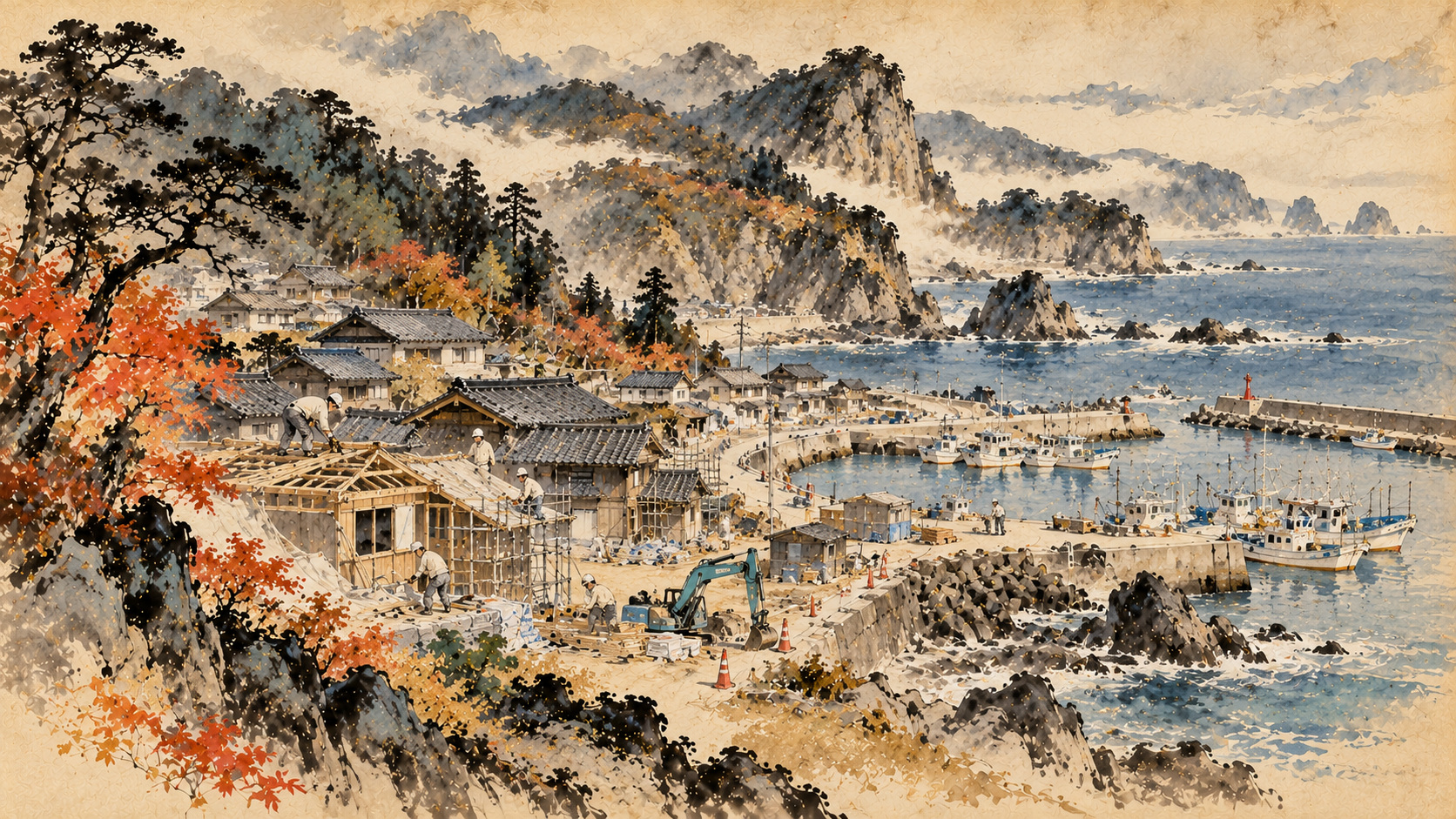
A reopened road is not a rebuilt home. A repaired port is not yet a recovered fishing economy. Nearly three years after disaster struck, Noto is confronting the distance between restoring infrastructure and restoring a community.
The latest assessment is a progress report, not a declaration of victory
Japan’s Ministry of Land, Infrastructure, Transport and Tourism released an updated reconstruction outlook on October 15, 2026, covering works and expected progress through the end of September. It follows a July assessment of the position at the end of June. The report addresses a region whose recovery has become one of Japan’s defining tests of disaster governance: how to rebuild homes, transport, harbors and public services across a rural peninsula already coping with population decline.
Its significance lies as much in the breadth of what remains to be done as in the construction accomplished. Ministry progress categories can distinguish emergency stabilization, provisional access, permanent engineering works and broader town redevelopment. Their percentages are not interchangeable. A reopened road may carry restrictions; a port may have repaired structures before its commercial activity returns. This article relies on the verified official release and other available primary sources but does not claim specific completion percentages from the detailed ministry attachment, which was not independently retrievable in full during reporting.
Why Noto was unusually vulnerable
On New Year’s Day 2024, a major earthquake tore through the Noto Peninsula on the Sea of Japan coast. The physical damage crossed sectors: collapsed houses, landslides, severed roads, damaged water networks, fires, and affected fishing ports and coastal infrastructure. Communities reached by limited road corridors could be cut off when a slope failed or a bridge became unsafe. Rescue operations and the movement of fuel, food, medical personnel and construction materials all depended on restoring access.
Geography intensified the challenge. The peninsula’s villages follow mountains, river valleys and a broken shoreline. Detours can be long or nonexistent. Coastal uplift changed shorelines in some places, complicating the challenge of restoring harbors where vessels, berths, depths and tidal conditions must function together. A single headline recovery rate cannot represent the different realities of Wajima, Suzu, Anamizu, Noto and neighboring communities.
A second disaster before the first recovery was complete
In September 2024, torrential rains struck the Oku-Noto region. Landslides, damaged rivers and new flooding added to the earthquake’s toll while infrastructure repairs and household recovery were still under way. For families and small businesses, the two disasters overlapped: the cost of rebuilding, the time without reliable access and the difficulty of deciding whether to return could all multiply.
The distinction also matters in official statistics. A project that started as earthquake restoration may have needed redesign after flood damage. Comparing a 2024 estimate with a 2026 outcome without checking the project scope risks mistaking changed obligations for slow progress. Recovery planning must also look forward: stable slopes, adequate drainage, flood resilience and usable evacuation routes are part of the job, not optional additions.
Roads: the foundation beneath every other recovery
Road reconstruction is fundamental because nearly every other recovery project uses the road network. Cement and timber must reach building sites; patients must reach hospitals; fishermen must reach harbors; tourists must reach hotels; emergency services must be able to navigate storms or snow. Officials can make a route passable well before it is restored to its intended permanent standard.
That distinction should follow every future ministry update. Which routes are provisionally open? Which are fully reconstructed? Where are speed, weight or weather restrictions still needed? How much redundancy exists when one coastal route fails? Disaster-resistant transportation is also a demographic question: governments must decide how to protect access to small settlements without reducing residents to numbers on a map.
Temporary housing is an essential bridge, not an outcome
Ishikawa Prefecture published an October 6 update on occupancy of emergency temporary housing, with data through October 1 for people affected by both the earthquake and the subsequent heavy rain. That is important evidence of continuing housing needs. But a change in the number of temporary-housing residents does not by itself measure how many households have successfully rebuilt. Some may return to repaired homes; others move into public housing, live with family, resettle elsewhere or face lasting financial constraints.
The prefecture has also provided exceptional extensions of rental-type emergency accommodation where leaving within the normal period is not feasible. A July 2026 notice describes procedures for extending housing assistance from three years to four in qualifying circumstances. Such policy adjustments show how badly a rigid timetable can fit the experience of elderly residents, families with limited savings and people whose livelihoods depend on access to a damaged locality.
Wajima's reconstruction must reconcile safety, commerce and memory
The neighborhood around Wajima’s celebrated morning market became an international symbol of the disaster following earthquake damage and fire. Rebuilding it is not merely an architectural exercise. Town planners must coordinate land rights, fire safety, evacuation routes, public infrastructure, shops and the preferences of residents who may or may not be able to return.
Every redesign creates trade-offs. Wider roads and more fire-resistant construction can improve public safety, but standardized development may erase the scale and character that made a place distinctive. Progress should be judged by transparent consultation, viable businesses and the ability of existing residents to make informed choices—not only by how quickly a construction schedule advances.
The sea that sustained Noto also complicates rebuilding
Fishing communities need working harbors, but the meaning of a working harbor is highly specific. Docks, channels, berth depths, processing areas, refrigeration, market links and access roads must operate together. Ishikawa’s fisheries recovery portal documents restoration plans for individual ports including Noroshi, Takojima, Takakura, Kaiso, Togi and Ishizaki. It identifies Hegurajima fishing port as having completed restoration; it does not imply every affected port has reached the same stage.
Even when civil engineering is finished, fishing cannot resume without vessels, gear, buyers and skilled crews. Household relocation may reduce the labor available to an industry that depends on long-standing local knowledge. The most meaningful measures are therefore not just repaired quay walls or completed contracts, but catches landed, firms reopened, workers retained and younger people willing to enter the trade.
Wakura Onsen: reconstruction as a tourism test
There was a significant fresh development on October 14: Japan’s Tourism Agency announced a new round of awards for Noto tourism recovery, selecting a project led by the Wakura Onsen Creative Reconstruction Town Development Council. Its stated goal is to refine Wakura’s reconstruction planning and demonstrate a tourism model that circulates economic benefits within the region. This is an approved initiative, not evidence that its objectives have already been delivered.
On October 15, the Hokuriku Regional Development Bureau also publicized port-reconstruction observation cruises planned for late October and early November around Wakura and Nanao. Explaining visible construction to the public is valuable. The longer test will be whether tourism revenue supports local hospitality workers, food producers, transport providers and small businesses after the immediate curiosity about disaster recovery fades.
Rebuilding a place already facing demographic change
Ishikawa’s Creative Reconstruction Plan sets a broader ambition than replacing what the earthquake destroyed. It is meant to guide a region through rebuilding while confronting a shrinking and aging population. The prefecture updated the plan in April 2025 to account for progress and adjust implementation timelines. The vision includes economic opportunity, resilient services and the cultural landscapes that give Noto its identity.
That identity is not an accessory to reconstruction. Wajima lacquerware, agricultural landscapes, fishing traditions, festivals and settlement patterns carry skills, relationships and income through generations. Yet “build back better” can become an empty phrase if it treats residents as obstacles to a master plan. A survivor returning to a historic village and a survivor building a new life elsewhere may both be making rational choices. Public policy should not make one outcome look like success and the other like failure.
What Japan—and the world—should measure next
A useful recovery scorecard would distinguish provisional from permanent road access; public-housing construction from actual stable occupancy; emergency water supply from resilient permanent systems; structural harbor restoration from fishing revenues; hotel reopening from regional employment; and town redevelopment from household satisfaction and continued access to healthcare and schools.
The ministry’s October 15 report covers physical works and expected schedules, but the detailed document was not fully accessible for independent extraction in this reporting process. Accordingly, this article deliberately omits unverified completion ratios and housing counts. Readers deserve comparisons based on consistent definitions, not persuasive figures stripped of their context.
Noto will not be rebuilt only when its roads, seawalls and houses stand again. Recovery will mean that people can choose secure lives and livelihoods—and believe their community has a future.
Visitors will see cranes, newly repaired roofs and vessels returning to harbors. Those are vital signs of work being done. But the quieter measures—the family able to move home, the shop opening for another generation, the patient reaching a hospital safely in winter—are how Japan will ultimately know whether reconstruction has become recovery.
Sources and documentation
- 国土交通省「令和6年能登半島地震からの復旧・復興状況と今後の見通し(令和8年9月末時点)」2026年10月15日
- 国土交通省・10月15日公表資料(2ページPDF)
- 国土交通省・本体資料(2026年9月末時点、PDF)
- 石川県・応急仮設住宅等の入居状況(2026年10月1日現在)
- 石川県・石川県創造的復興プラン
- 石川県・水産関係被害と漁港の復旧・復興
- 観光庁・能登半島地震からの復興に向けた観光再生支援事業、2026年10月14日採択結果
- 国土交通省北陸地方整備局・能登港湾空港復興推進室
- 石川県・能登半島地震アーカイブ「復興へのあゆみ」
- 石川県・賃貸型応急住宅の供与と期間延長
- 国土交通省・2026年6月末時点の復旧・復興状況
- 国土交通省・災害・防災情報:令和6年能登半島地震