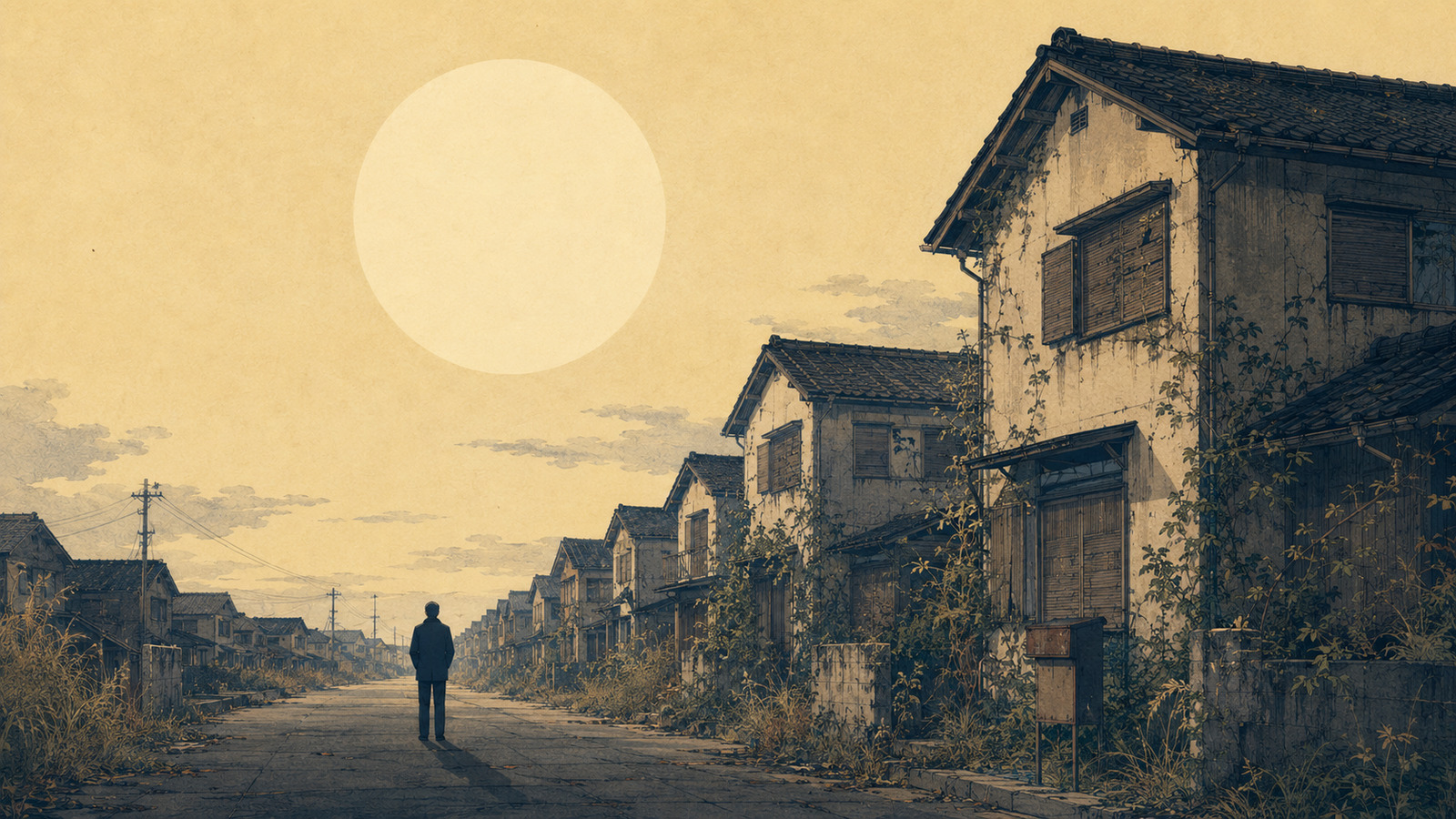
A house with closed shutters was not born abandoned. There is a shoe cabinet inside, perhaps a child’s height marked on a post and photographs beside a family altar. But when the last resident leaves, the house begins to keep a different kind of time. Tatami absorbs moisture. Gutters clog. Roof tiles shift. Branches cross the property line. The building grows quiet while sending its owner a widening series of bills: property tax, insurance, ventilation visits, weed cutting, furniture removal, roof repair and, one day, demolition.
Japan has 9,002,000 vacant dwellings. That is the final count in the Statistics Bureau’s 2023 Housing and Land Survey: 13.8 percent of the national stock, nearly one home in seven. The total rose by 513,000 in five years, setting records in both number and rate. It has almost doubled from 4.476 million in 1993.
The scale has given Japan a revealing pun. Fudōsan means real estate; write the opening sound with the character for a burden or negative balance and it becomes fu-dōsan—“negative real estate.” When the likely sale price is smaller than repairs, surveying, registration, furniture clearance, brokerage, demolition, taxes and liability risk, the home’s net economic value falls below zero. The owner no longer receives money for transferring an asset. The owner pays to escape an obligation.
Nine Million Vacancies Are Not Nine Million Ruins
The first task is to separate the categories. The 9.002 million include 4.436 million rental vacancies, 326,000 homes offered for sale and 384,000 second or occasional-use homes. An apartment waiting for its next tenant in a growing city and a collapsing farmhouse in a mountain settlement occupy the same statistical column but require different policies.
The sharper warning is the remaining 3.856 million: homes that are neither for rent nor sale nor used as second residences. This category includes houses left empty during a long hospitalization or transfer, structures awaiting demolition, and properties whose purpose cannot be determined. It accounts for 42.8 percent of vacancies and 5.9 percent of all housing, and it grew by 369,000 from 2018. Homes that have not even been prepared for a market decision are driving the increase.
There is another important limit. The survey defines a dwelling as a building or unit capable of supporting an independent household; what it considers a ruin is excluded. Nine million therefore does not mean nine million dangerous detached houses. At the other edge, some of the worst structures have already deteriorated beyond the survey’s housing count. Ignoring either distinction invites exaggeration or complacency.
4.436 million were for rent, 326,000 for sale, 384,000 for secondary or occasional use and 3.856 million none of those. The crisis is not vacancy alone. It is the rising stock for which owners cannot complete a decision to manage, use or dispose.
From Postwar Shortage to Structural Surplus
Immediately after the war, Japan’s housing objective was unambiguous. Bombed cities, returning soldiers and repatriates had produced a shortage measured in millions. The government created the Government Housing Loan Corporation in 1950, enacted the Public Housing Act in 1951 and formed the Japan Housing Corporation in 1955. The three pillars—mortgage finance, public housing and mass-produced estates—turned construction into both social repair and a national engine of employment, land development and growth.
The achievement was immense. Japan’s dwelling count exceeded its household count nationwide in 1968 and did so in every prefecture by 1973. Policy shifted from quantity toward floor space, seismic safety and residential quality, but the industries, incentives and aspirations organized around new construction remained. By 2023 the country had 65.047 million homes for 56.215 million households, or 1.16 dwellings per household. Even between 2018 and 2023, the stock increased by 2.639 million.
Stopping all construction would not, by itself, solve the mismatch. Many surplus homes are not where households need to be, do not have the required size or performance, or are disconnected from work, schools, medical care and transport. A vacant rural house cannot substitute for an accessible apartment near a Tokyo station. Japan’s problem combines aggregate excess with a profound mismatch of location and quality.
The Houses Began to Outnumber Need Before the Population Fell
Japan’s population peaked at 128.084 million in 2008 and had fallen to 123.802 million by 2024. The Japanese-national population is shrinking faster. Older residents move to hospitals or care facilities; after their deaths, children living in Tokyo, Osaka, Nagoya or another distant city do not return. The rise of one-person households has delayed a fall in the household count, but that cushion cannot last forever.
Demography is an accelerant, not a complete explanation. Japan already counted 2.679 million vacant homes—7.6 percent of stock—in 1978, three decades before the population peak. After supply overtook households, a market centered on new houses continued to leave old ones behind. Population decline did not invent the machinery. It removed buyers from it and exposed its weakest parts.
Why Beauty Does Not Automatically Become Market Value
Solid timber posts, deep eaves, carved transoms and an old garden may hold tremendous meaning for an owner. A valuation may see cost: pre-1981 seismic design, weak insulation, leaks, termites, old pipes, a septic system, uncertain boundaries or insufficient road access. A single constraint can make finance and resale difficult—a site in an urbanization-control area, a lot that cannot legally be rebuilt because it lacks qualifying road frontage, or a retaining wall requiring investigation.
It is misleading to say a Japanese timber house physically expires after 22 years. Twenty-two years is a tax depreciation period, not a safety verdict or engineering lifespan. Yet if appraisal practices rapidly reduce a building’s value, buyers prefer new construction and lenders are cautious with collateral, even a carefully maintained older house may be priced mostly as land. Missing inspection and repair records make buyers discount it further.
In a weak local market the arithmetic turns negative quickly. A buyer may offer ¥1 million for land and house, while furniture clearance, boundary work, title registration, brokerage and demolition together cost several million yen. A ¥0 or ¥1 listing is not a free home. It is a contract to accept repairs, tax and responsibility to neighbors along with the deed.
Inheritance Turns One House Into a Family Tree
Inheritance is a principal doorway into long-term vacancy. A parent dies and children receive the house. Unlike cash or shares, it cannot be divided cleanly. If an estate remains unsettled through another death, rights branch to siblings, nephews, nieces and later generations. The cost of collecting consent for a sale or demolition rises, while the registry may still name someone who died decades earlier.
Japan made inheritance registration mandatory in April 2024. In principle, a person must apply within three years of learning that inherited real estate has been acquired; failure without a valid reason can lead to an administrative fine of up to ¥100,000. Transitional rules cover older inheritances. This is an important defense against unidentified ownership, but registration does not create demand. It clarifies who must confront tax, management and demolition.
Renouncing an inheritance is not an easy property-by-property exit. The application is generally due in family court within three months of learning the inheritance began, and it rejects the estate as a whole, not only the unwanted house. The national-treasury reversion system introduced in 2023 is also narrower than its name may suggest. Land with a building is ineligible unless the structure is removed; disputed boundaries and burdensome conditions can disqualify a parcel, and examination and contribution payments apply. Owners cannot simply mail the government a key.
The One-Sixth Tax Trap
Residential land receives a fixed-asset-tax preference. The taxable base for the first 200 square meters is reduced to one-sixth; the portion above that threshold is reduced to one-third. If an old house is demolished and the site becomes vacant land, the preference can disappear and the owner’s land tax can rise. That created a rational form of delay: the building has no use, but clearing it requires a large payment followed by a higher annual carrying cost.
This does not mean every tax bill becomes exactly six times larger. Valuation, adjustment rules and local rates shape the actual result. But in a place with no buyer, paying for demolition and then losing a tax preference is a powerful disincentive.
The national government has partly closed the trap. The Vacant Houses Special Measures Act, fully effective in 2015, enabled municipalities to advise, warn, order and ultimately carry out work on “Specified Vacant Houses” posing serious safety, sanitation, landscape or neighborhood problems. A formal recommendation removes the residential-land preference. Amendments effective in December 2023 created an earlier category, the “Poorly Managed Vacant House.” If neglect is likely to produce a specified dangerous property, a recommendation can now end the preference before the house reaches the worst stage.
The Law Became Stronger. The Orders of Magnitude Did Not
Municipal action has grown. By March 31, 2025, 88 percent of Japan’s 1,741 municipalities had adopted a vacant-house plan. Measures under the law led to repair, demolition or other remediation of 3,757 poorly managed houses and 27,244 specified houses. Including other local programs, the cumulative total reached 220,030 properties. Authorities took 7,811 formal steps—guidance, recommendations, orders and substitute execution—during fiscal 2024 alone.
Those 220,030 are not trivial. They represent 220,030 sites where neighbors were better protected from collapse, fire, pests, branches or blight. But measured against 9.002 million vacancies—or the 3.856 million outside clear use categories—case-by-case intervention after danger develops cannot catch up. Identifying owners, inspecting sites, tracing heirs, issuing notices, contracting work and recovering costs requires staff and expertise. The municipalities losing the most people often have the least administrative capacity.
The 2023 amendments also introduced promotion zones for reuse and authorized municipalities to designate nonprofit groups and real-estate bodies as management and reuse support corporations. Yet only four promotion zones and 95 support corporations had been designated by March 2025. The legal container exists; a national workforce and a reliable pipeline of ready properties are still being built.
An Akiya Bank Is a Marketplace, Not a Cure
Municipal akiya banks and the national portals supported by the land ministry match owners with migrants and buyers. Genuine success stories have turned old homes into residences, shops, inns and studios. A Land Ministry Policy Research Institute study in Oyama, Tochigi Prefecture, found that 181 properties had been registered from the program’s 2014 launch through January 2024, with 136 sold or rented. The city partnered with local students and offered support for renovation and furniture removal.
But a house is ready for a bank only after title, boundaries, price, contents and condition can be described. The same research identified 15 kinds of barriers: emotional attachment and hopes of future family use; furniture that is difficult to discard; poor access to advice; repair and demolition expense; sale prices too low to justify those costs; a lack of buyers; obsolete performance; water and sewer problems; rebuilding restrictions; shared ownership and family disagreement. A thin inventory may indicate not only weak demand, but stalled preparation before listing.
“Cheap houses in Japan” can also be a dangerous sales pitch. A buyer needs an inspection and clear information about seismic performance, insulation, leaks, termites, road access, boundaries, disaster exposure, water systems and lifetime carrying costs. If a bargain is purchased without a rehabilitation budget, negative real estate has merely changed owners.
Japan.co.jp publisher Bradley L. Bartz is also developing UCHI.co.jp, a literary and archival project about a family house, inheritance, memory and preservation. UCHI is not a property listing. From inside one house, it records why beauty does not automatically become market value, and how objects, legal constraints, distance and family duty gather under one roof. “Negative real estate” is a national statistic in this article, but its weight is experienced one family at a time. When a house will not sell, what remains, what should be saved and who must decide? Read the project at UCHI.co.jp.
Memory Is Outside the Market, but Not Outside the Decision
The hardest part of an empty house is often not decay but family time. A mother’s kitchen, a father’s tools, schoolbooks in a closet, the room where relatives gathered after funerals: selling can feel like assigning a price to memory; demolition can feel like erasing a family history. “We may return someday” and “one of the children might use it” are profoundly human forms of delay.
The house continues to change while the decision is suspended. A few visits a year may not catch a leak. Clothing and furniture hold moisture. Uncollected mail advertises absence. As deterioration advances, options narrow, until even the materials a family wished to save are lost. The humane answer is not to dismiss attachment, but to separate preservation of memory from disposition of property. Photographs, plans, letters, oral histories, furniture and architectural elements can be documented or transferred before the family decides among residence, rental, sale, community use, partial preservation and demolition. An archive can be a step toward decision rather than another form of postponement.
Do Not Promise to Save Everything. Classify Early.
Nine million homes will not yield to a single solution. Japan needs an early assessment of condition and market potential, followed by distinct paths before time destroys value.
| Property type | Priority route |
|---|---|
| Market-ready | Complete title work, clear contents, inspect and price within months; minimize the period of vacancy and move to sale or rental. |
| Viable after repair | Package seismic, insulation and systems assessments with renovation budgets, grants and finance; connect to migrants, younger households and supported housing. |
| Useful to the neighborhood | Consider an adjacent-lot transfer, shop, clinic, social service, children’s space, workshop, evacuation point or gathering place—not residential reuse alone. |
| Culturally or emotionally important | Name the steward and funding. Combine whole or partial preservation with salvage and a record of plans, images, objects and testimony. |
| Dangerous with no demand | Use demolition support, lot consolidation and conversion to managed open space. Do not transfer danger and future cost under the name of preservation. |
The intervention must also begin before vacancy. While an older resident still occupies the home, families can identify heirs, confirm registration and boundaries, collect repair records, discuss contents and write down future wishes. Death, a move to care or relocation should trigger a rapid connection to municipal staff, judicial scriveners, real-estate and construction professionals, social services and clearance assistance. Supporting a decision in the first year is cheaper and kinder than using public money on a dangerous building after ten years.
Vacant Houses Are a Map of the Future City
Even a perfect market cannot repopulate every settlement and roadside at the old density. In a shrinking country, housing policy must converge with demolition, land use, transport, health care, disaster planning and the cost of maintaining water and sewer networks. Treat every vacancy as an isolated listing and the result is a perforated low-density city where the bills for roads, snow removal, buses, pipes and fire protection remain.
Guiding homes toward stations, schools, clinics and shops—a more compact urban form—will be unavoidable. But people on the far side of any boundary still possess homes, memories and claims to fairness. Without compensation, relocation help, receiving institutions for land and local agreement, “efficiency” becomes abandonment by policy. Vacant-house strategy is therefore a political decision about which communities and public services Japan intends to sustain, not only which structures should stand.
Beyond the Closed Shutters
A house does not lose all value when its last resident leaves. Its values separate. The market sees land and structure. The family remembers a life. The neighborhood carries safety risk. The municipality maintains roads and pipes. If only one of those values enters the price, the others reappear as somebody’s invisible burden.
Nine million is an overwhelming national number, but it arrives one address at a time. Someone holds the key. A wardrobe cannot be discarded. An heir cannot be reached. A neighbor worries about a branch. Each year described as “not urgent” narrows the range of decisions the house can still support.
Old houses alone do not create negative real estate. It emerges where a construction system, a valuation market, inheritance procedure, tax incentives and family silence overlap. That is why there is no single cure. Talk early. Make ownership legible. Learn the building’s condition. Preserve the memory. Give usable houses another life and houses that must end a dignified exit. The first step in opening the shutters may not be finding a buyer. It may be bringing every person who must decide into the same room.
Sources and References
The national counts are final results from Japan’s 2023 Housing and Land Survey. Legal and municipal figures use the latest implementation report available from the land and internal-affairs ministries, covering activity through March 31, 2025. Rules vary by facts and jurisdiction; owners should confirm inheritance, registration, tax, sale and demolition questions with the municipality and qualified professionals.
- Statistics Bureau: Final Results of the 2023 Housing and Land Survey
- Ministry of Land: The Historical Framework for Japan’s Long-Term Housing Plans
- Statistics Bureau: Population Estimates, 2024
- Ministry of Land: Vacant Houses Special Measures Act Resources
- Land and Internal Affairs Ministries: Act Implementation Through March 31, 2025
- Ministry of Land: Residential-Land Tax Preference and Vacant-House Measures
- Policy Research Institute: Barriers to Existing-Home Reuse
- Ministry of Land: National Vacant House and Land Banks
- Ministry of Justice: Mandatory Inheritance Registration Q&A
- Ministry of Justice: Inherited Land Reversion System
- UCHI.co.jp: About Uchi