A corridor is a useful word. It suggests direction without claiming that a road has been built. On March 5, four Japanese companies gathered at the Tokyo Chamber of Commerce and Industry and placed that word between two countries separated by the South Pacific: New Zealand, rich in hydro, geothermal and wind power; Japan, short of domestic energy and searching for low-carbon molecules for steel, chemicals, shipping, heavy transport and power.
The ambition is easy to draw. Renewable electricity makes hydrogen by splitting water. The hydrogen is conditioned into a form that can cross an ocean, loaded at a New Zealand port, carried north and unloaded beside Japanese demand. The commercial chain is much harder. Every conversion consumes energy. Every terminal requires capital. Every ship needs dependable cargo. Every producer needs a buyer, and every buyer needs a price it can defend.
This is not Japan’s first hydrogen partnership with New Zealand, nor Obayashi’s first experiment there. The story reaches back through a 2018 government agreement, a geothermal-hydrogen venture at Mōkai, a domestic refuelling network, an export demonstration to Fiji and Japanese investment in New Zealand energy technology. The new consortium is an attempt to turn those separate pieces into one trade route.
The announcement is a direction, not a project
The consortium’s public statement is precise about purpose and remarkably open about method. It will study the commercialization of green-hydrogen production in New Zealand and exports to Japan. Work starts in fiscal 2026. The stated destination is trade in the early 2030s and, eventually, a New Zealand supply hub serving Japan.
Everything that would make the corridor physically and financially real remains to be selected. The members did not identify Mōkai—or any other place—as the production site. They did not choose new hydro, geothermal, wind or solar power; name a port; select liquid hydrogen, ammonia or an organic carrier; identify a Japanese customer; or disclose a study budget. “Green hydrogen” defines the intended production principle, but no carbon-intensity threshold or certification method was published.
That distinction matters because a consortium can exist years before a project company, engineering design, offtake agreement or investment decision. The early-2030s objective is a target, not a committed operating date. It is still meaningful: a single company rarely controls renewable development, electrolysis, conversion, marine logistics, receiving infrastructure and demand. The group has assembled enough experience to investigate the whole chain.
| Commercial gate | What it must establish | Public status at the reporting cutoff |
|---|---|---|
| Consortium and study | Partners, purpose and a common work programme. | Established. Four Japanese members; work from FY2026. |
| Concept selection | Site, electricity source, electrolyzer, carrier, ports and end use. | Not disclosed. |
| Feasibility and pre-FEED | Energy balance, rough capital cost, delivered price and risks. | No result disclosed. |
| FEED, permits and community agreements | Bankable design, land and water rights, safety and environmental approval. | Not announced. |
| Offtake, support and financing | Who buys how much, for how long, and who pays the clean premium. | Not announced. |
| Final investment decision | Capital is committed and construction can begin. | Not announced. |
Four companies bring four different parts of the map
Obayashi chairs the corridor. That choice reflects more than corporate seniority. The construction company has spent years developing renewable generation and hydrogen in New Zealand. It understands local partnerships, permitting, civil works and the unglamorous operating lessons that come only after an electrolyzer is switched on.
Kawasaki Heavy Industries and Mitsui O.S.K. Lines hold vice-chair positions. Kawasaki has built a technological system around liquefied hydrogen: liquefiers, cryogenic tanks, loading equipment, receiving terminals and specialized ships. MOL supplies the commercial and operating perspective of a global shipowner—fleet economics, charter structures, port interfaces, safety and the discipline of keeping a cargo chain moving.
Chiyoda is the fourth director. Its presence prevents the study from being read automatically as a liquid-hydrogen project. Chiyoda led the 2015–2020 Brunei-to-Japan demonstration that carried 210 tonnes of hydrogen as methylcyclohexane, or MCH, a liquid organic hydrogen carrier handled near ambient conditions. Hydrogen was released at the destination and used in gas turbines.
The consortium announcement assigns governance positions, not engineering work packages. The capabilities below are therefore relevant experience, not a disclosed division of the New Zealand project.
| Member | Experience brought to the study | Question it can help answer |
|---|---|---|
| Obayashi | New Zealand renewable investment, Halcyon Power, civil and plant development. | Where and how could certified production be built? |
| Kawasaki Heavy Industries | Liquefaction, cryogenic storage, terminals and liquid-hydrogen carriers. | Can pure hydrogen cross the Pacific reliably at commercial scale? |
| Mitsui O.S.K. Lines | Ocean transport, ship operation, chartering and energy logistics. | What fleet, route, cadence and contract make the chain operable? |
| Chiyoda | Plant engineering and SPERA Hydrogen’s MCH carrier system. | Would an ambient liquid outperform a cryogenic cargo? |
The first chapter was written on Māori-owned land
The most important piece of history lies northwest of Taupō at Mōkai. Tūaropaki Trust traces its modern form to 1952, when 279 Māori landowners combined their traditional whenua to create opportunity for their families. After farming and horticulture, the owners fought to develop the geothermal resource beneath their own land. Mōkai’s first 55-MW plant opened in 2000; the geothermal station later grew to 113 MW.
This was not merely a convenient patch of renewable electricity. It was an expression of mana motuhake—authority and self-determination—and kaitiakitanga, responsibility to care for inherited land and resources. Tūaropaki describes its power company as the world’s first fully Indigenous-owned power company. Its geothermal system also supports glasshouses, dairy processing and engineering activity: energy as the base of a regional economy rather than a commodity extracted in isolation.
Obayashi and Tūaropaki signed a hydrogen research memorandum in February 2018 and created Halcyon Power as a 50–50 venture. Their 1.25-MW plant opened in December 2021, using electricity from the Mōkai station to produce hydrogen by electrolysis. Public materials put capability at about 180 tonnes a year—New Zealand’s first megawatt-scale commercial green-hydrogen facility.
The plant’s small size is part of its value. It taught the partners what a spreadsheet cannot: how a New Zealand plant is consented, operated and maintained; how hydrogen is compressed and moved; what customers need; and why a refueller has to sit near a freight route rather than beside the electrolyzer. Halcyon opened a fast-refuelling station at Wiri in South Auckland in April 2024 and has supplied vehicle trials, including buses and heavy trucks.
Fiji was the small Pacific rehearsal
The chain crossed a border before the new corridor was named. In a Japanese environment-ministry-supported demonstration, Obayashi, Halcyon and Fiji Gas filled cylinders with Mōkai hydrogen, moved them to Auckland, shipped them for roughly a week to Lautoka and used the gas in a hydrogen–diesel dual-fuel generator at an LPG terminal. Obayashi announced successful completion in January 2025.
That shipment proved a limited but useful set of things: export documentation could be prepared, gaseous hydrogen cylinders could comply with International Maritime Organization dangerous-goods requirements, a Pacific port transfer could be completed and an end-use generator could follow changing on-site electricity demand.
It did not prove the economics of Japan-scale trade. The public release did not state the hydrogen volume, delivered cost or emissions per unit of electricity. Cylinders are a sensible container for a demonstration, but an early-2030s export industry needs bulk production, conversion, storage, dedicated marine logistics and an anchor customer. The distance to Japan magnifies every inefficiency.
The lesson is not that the Fiji trial was too small. It is that demonstrations should answer one risk at a time. Mōkai proved production and local operation. Wiri tested customer access. Fiji tested a modest export chain. The new corridor must integrate them—and then show that integration can lower cost rather than merely add equipment.
The carrier decision will choose the corridor’s infrastructure
Hydrogen is the lightest molecule and difficult to move densely. The corridor must change its physical condition or attach it to something else. Each choice creates a different industrial landscape on both shores.
Liquefied hydrogen is cooled to about minus 253 degrees Celsius. It delivers pure H₂ and aligns strongly with Kawasaki’s system. The company’s 1,250-m³ Suiso Frontier took part in the Australia–Japan pilot in 2022. In January 2026, Kawasaki and Japan Suiso Energy contracted a 40,000-m³ carrier for ship-to-base and ocean-condition demonstrations by fiscal 2030, alongside a 50,000-m³ receiving tank under development at Ogishima in Kawasaki. None of that equipment has been assigned publicly to New Zealand, but it could form part of the technological bridge.
MCH follows another route. Hydrogen is chemically attached to toluene, moved as a liquid at ordinary temperature and released in Japan; the toluene is returned for reuse. Chiyoda has demonstrated the cycle across the sea from Brunei. The attraction is conventional-looking liquid logistics. The penalties are the energy and plant needed for hydrogenation, dehydrogenation, purification and return transport.
Ammonia offers a mature global shipping system and can be used directly as chemical feedstock or fuel, or cracked back into hydrogen. It adds nitrogen synthesis, toxicity controls and, if pure hydrogen is wanted, another energy-intensive conversion. The consortium has not said it is considering ammonia. It remains an obvious benchmark against which any selected carrier must compete.
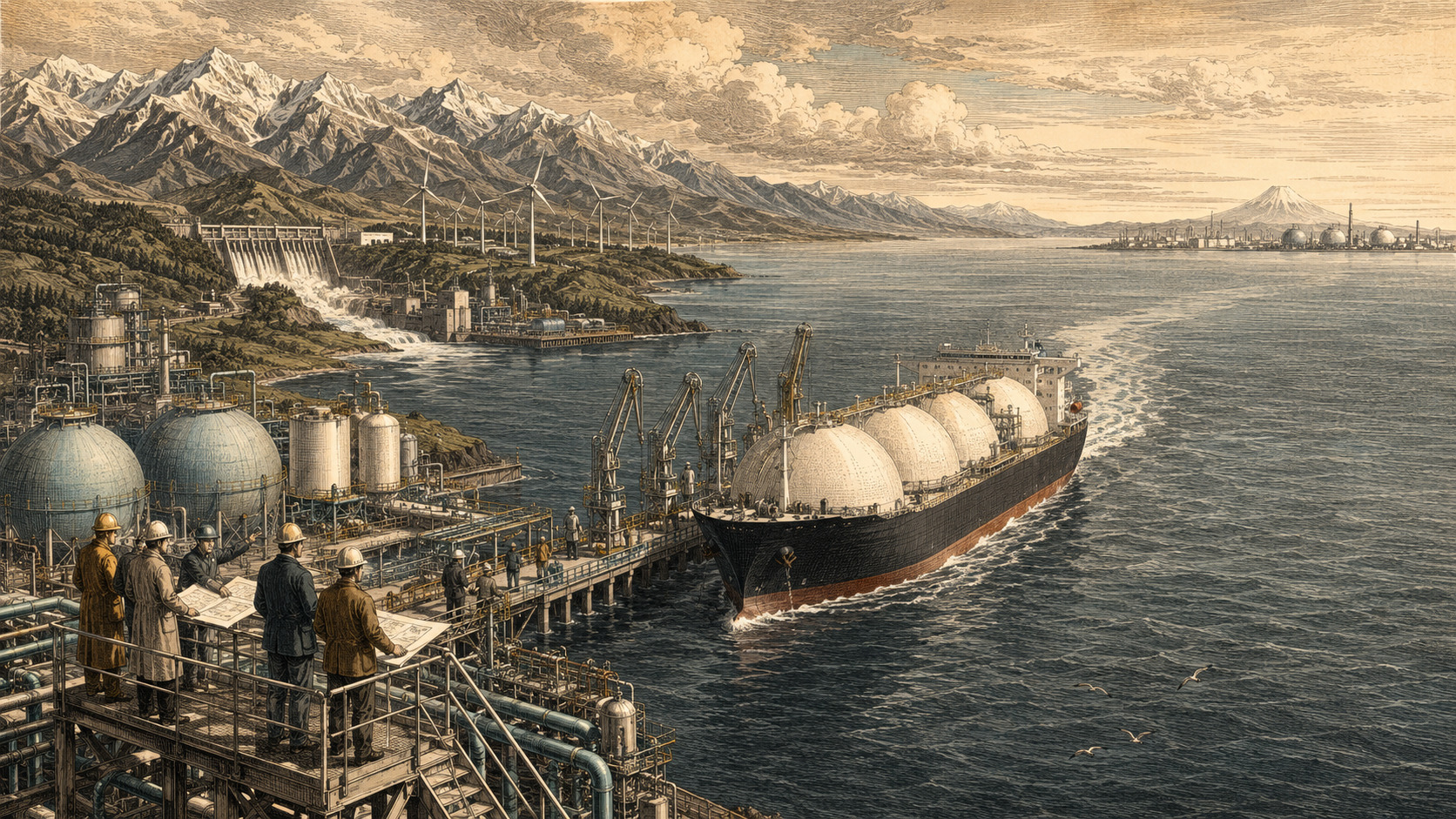
- The Stradanus-inspired hero art depicts a cryogenic-looking carrier because an ocean energy route needs a visual vessel.
- The consortium’s announcement does not select liquid hydrogen, MCH, ammonia or another derivative.
- A credible study should compare delivered cost, energy loss, carbon intensity, safety, port readiness, customer purity and the value of reusable infrastructure.
The International Energy Agency estimates that conversion to a transport carrier can lose 45% to 70% of the original energy across some pathways. Its 2026 review says shipping pure hydrogen can add at least about $2 per kilogram and consume more than 10 kWh per kilogram through liquefaction or reconversion. Those are global benchmarks, not corridor forecasts. They explain why “how” is as important as “from where.”
New Zealand’s clean-power advantage contains a paradox
New Zealand’s electricity system gives the proposal credibility. In 2024, renewables produced 85.5% of electricity, led by hydro and geothermal power. The share rose to a record 96.4% in the final quarter of 2025 and remained 94.5% in the March 2026 quarter as hydro inflows, wind and solar were strong. Geothermal provides steadier output than weather-dependent wind and solar, an advantage for an electrolyzer that earns its capital back by running many hours.
But a high renewable percentage is not the same as abundant surplus electricity. In dry periods, lower hydro storage can raise prices and call more coal and gas into the system. New homes, vehicles, factories and process heat also need clean power. An export electrolyzer that merely consumes existing grid renewables can force marginal fossil generation or delay domestic electrification.
The scale arithmetic is unforgiving. New Zealand generated 43,879 GWh in 2024. The IEA uses 50 kWh of electricity per kilogram as an illustrative electrolysis requirement, including compression to 30 bar. At that rate, an entirely hypothetical 100,000-tonne-a-year export plant would require roughly 5 TWh before liquefaction or carrier conversion—more than 11% of 2024 national generation. This is a scale illustration, not the consortium’s forecast; the members have published no volume.
New Zealand’s Hydrogen Action Plan acknowledges that electricity can represent 60% to 80% of green-hydrogen cost. It promises a market-led sector, quicker renewable consenting, enabling safety rules, internationally aligned certification and government-to-government work to attract investment. It does not promise that taxpayers will guarantee every export proposal.
The economically honest model therefore needs additional power: new generation that would not otherwise be built, connected without weakening the grid and available at a utilization rate compatible with low-cost hydrogen. It also needs water, land, transmission, port access and durable agreements with local communities and Māori rights-holders. “Renewable country” is the beginning of site selection, not its conclusion.
The bilateral bridge was built before hydrogen arrived
Japan and New Zealand first signed a provisional commerce, customs and navigation arrangement in 1928—the first treaty New Zealand signed after becoming a self-governing dominion. Legations opened in Tokyo in 1952 and New Zealand in 1953; a commerce agreement followed in 1958. The relationship later expanded through petroleum-stock arrangements, science cooperation, a 2013 strategic cooperative partnership, CPTPP and RCEP.
The older trade pattern is complementary. New Zealand sends dairy, fruit, aluminum, meat and wood to Japan. Japan sends vehicles and machinery. Two-way trade reached about NZ$9.2 billion in the year through December 2025, according to New Zealand’s foreign ministry, and cumulative Japanese direct investment stood at NZ$8.828 billion in the year through March 2025.
Hydrogen cooperation became formal on October 23, 2018, when New Zealand’s Ministry of Business, Innovation and Employment and Japan’s Ministry of Economy, Trade and Industry signed Japan’s first bilateral hydrogen memorandum of its kind. The agreement encouraged information exchange, technology and pilot projects. The New Zealand Hydrogen Council and Japan Hydrogen Association added an industry memorandum in 2022.
The corridor therefore sits on three kinds of trust: diplomatic trust between stable Pacific partners; commercial trust built through decades of food, forestry, machinery and investment; and operational trust created by projects such as Halcyon. Energy security here does not mean self-sufficiency. It means depending on a supplier whose institutions, contracts and political relationship are judged durable.
1928 The countries sign a commerce, customs and navigation arrangement.
1952–1958 Postwar legations open and a commerce agreement follows.
2000 The Māori-owned Mōkai geothermal station begins operating.
2013 Japan and New Zealand establish a Strategic Cooperative Partnership.
February 2018 Obayashi and Tūaropaki agree to study geothermal-powered hydrogen.
October 2018 The two governments sign a hydrogen cooperation memorandum.
December 2021 Halcyon’s 1.25-MW plant opens at Mōkai.
2022 The national hydrogen industry associations sign their own MOU.
April 2024 Halcyon opens a fast-refuelling station at Wiri.
January 2025 Obayashi reports completion of the New Zealand–Fiji export demonstration.
March 2026 Four Japanese companies establish the Japan–New Zealand Hydrogen Corridor.
Japan needs supply, but the corridor still needs demand
Japan’s 2023 hydrogen strategy set an ambition of 12 million tonnes of hydrogen and derivatives a year by 2040, six times the then-current level. The motive is structural. Japan’s fiscal-2023 energy self-sufficiency rate was about 15.3%, and renewables supplied about 22.9% of electricity. Domestic green hydrogen alone is unlikely to meet every potential industrial use.
Supply ambition does not create a bankable buyer. The global low-emissions-hydrogen pipeline has repeatedly contracted as costs rose and customers hesitated. The IEA’s 2025 review found only 9% of announced production to 2030 had reached final investment decision; only about one-fifth of newly signed offtake volumes in 2024 were firm commitments.
Japan’s Hydrogen Society Promotion Act created long-term support for low-carbon hydrogen and derivatives, including roughly ¥3 trillion in price-gap-focused and hub-infrastructure support. A New Zealand route would still need to qualify under carbon-intensity, supply-start, scale and demand requirements and compete with domestic projects and exporters in Australia, the Middle East, North America and elsewhere. No award or application for the corridor was announced by the reporting cutoff.
The first buyer should probably be an industrial cluster rather than a diffuse “hydrogen society.” A steelworks, refinery, chemical plant, port or power complex can provide concentrated demand and shared tanks and pipelines. The best customer is one that truly needs a molecule and cannot decarbonize more cheaply with direct electricity.
A green label must survive the whole voyage
Hydrogen emits no carbon dioxide when used, but that fact says almost nothing about the full chain. The corridor’s accounting must include electricity source, electrolyzer manufacture and operation, water treatment, compression, liquefaction or chemical conversion, storage losses, inland transport, shipping, reconversion and the final process. If geothermal power is used, the method must quantify its actual lifecycle emissions rather than rely only on a color name.
Additionality and timing will be decisive. Does a new renewable plant feed the electrolyzer, or are certificates attached to power already serving the grid? Does hydrogen production fall during a dry hydro year or continue while thermal generation rises elsewhere? Are electricity and hydrogen matched annually, monthly or hourly? Japan’s support rules and New Zealand’s export credibility will depend on answers that can be audited.
Ownership and benefit also matter. The corridor’s founding announcement lists four Japanese companies. New Zealand officials and industry representatives attended the Tokyo meeting, but no New Zealand producer, port, utility, iwi or customer was named as a consortium member. That may be reasonable at study launch. It cannot remain the operating model of an export industry grounded in New Zealand land, water, power and community consent.
- A named site and renewable-supply agreement proving additional, dependable electricity.
- Land, water, transmission, port, safety and environmental approvals.
- A selected carrier and complete energy-and-emissions balance.
- New Zealand partnership and benefit arrangements, including engagement with affected Māori rights-holders.
- A long-term Japanese offtake contract with volume, quality and carbon warranties.
- Shipping and terminal contracts synchronized with production and demand.
- Financing and public-support terms that disclose who carries price, currency, construction and policy risk.
The next milestone should replace geography with specificity
The consortium has chosen two countries. Its next useful announcement should choose the chain. It should identify a New Zealand region and port, a Japanese demand cluster, a carrier, a production range, a target delivered carbon intensity and a customer prepared to negotiate offtake. It should show how power will be added, how communities share value and which early-2030s date governs investment.
There are encouraging signs beyond the corridor. Obayashi invested in New Zealand cryogenic-hydrogen company Fabrum in 2023 and, through an affiliate, in renewable generator Eastland Generation. Eastland’s 49-MW TOPP2 geothermal plant opened in March 2026. Kawasaki is building much larger liquid-hydrogen test and logistics equipment in Japan. MOL is converting studies into real long-term charters in ammonia and carbon dioxide transport. Chiyoda has already closed a complete MCH demonstration loop.
There is also an obvious failure mode. The early 2030s arrive with excellent engineering reports but no customer willing to absorb the delivered price. The production site remains unnamed because affordable additional electricity cannot be secured. The carrier remains unsettled because each option moves cost and energy loss to a different company. The corridor survives as an institution but never carries a cargo.
The honest way to avoid that outcome is not to make the announcement sound larger than it is. It is to make the study demanding. Reject routes that waste too much clean electricity. Reject end uses that batteries, grids or direct heat can serve more cheaply. Require traceable carbon accounting and New Zealand partnership. Then put public and private support behind the one route whose customer, molecule and economics remain standing.
Stradanus made invention visible by crowding his engravings with furnaces, pulleys, vessels, workers and raw material in motion. The Japan–New Zealand corridor is still missing most of those nouns. For now there is renewable potential on one shore, industrial demand on another and four companies leaning over the chart. The real achievement will be the day that the line across the Pacific becomes a contracted, measured and genuinely low-carbon flow of energy.
Reporting notes and principal sources
The consortium’s release supplies an objective and target window, not a project design. Company capabilities are presented as relevant experience; the release does not allocate the engineering packages described here. The 100,000-tonne electricity example is an editorial scale calculation using the IEA’s 50-kWh/kg assumption and New Zealand’s published 2024 generation; it is not a corridor forecast. No public document checked by the reporting cutoff identified a site, port, carrier, customer, volume, price, subsidy application, construction schedule or final investment decision for this corridor.
- Obayashi: establishment, scope, members and early-2030s objective
- Obayashi: Japanese-language corridor announcement
- Mitsui O.S.K. Lines: consortium announcement and New Zealand/Japan energy context
- MBIE: Energy in New Zealand 2025
- MBIE: March 2026 electricity generation and renewable share
- MBIE: New Zealand Hydrogen Action Plan
- MBIE: renewable consenting and electricity’s share of hydrogen cost
- MBIE: certification, investment and market access
- Tūaropaki Trust: land amalgamation, geothermal development and ownership history
- Tūaropaki Trust: Mōkai geothermal system and capacity
- Tūaropaki Trust: Halcyon ownership, plant and production capability
- Halcyon Power: 2021 opening, Wiri refueller and transport uses
- Obayashi: 2018 Tūaropaki geothermal-hydrogen memorandum
- Obayashi: opening of New Zealand’s megawatt-scale hydrogen plant
- Obayashi: completion of the New Zealand–Fiji hydrogen export demonstration
- Obayashi: design and public-support context for the Fiji demonstration
- Chiyoda: Brunei–Japan MCH hydrogen-chain demonstration
- Kawasaki: liquid-hydrogen technology and 40,000-m³ carrier programme
- Kawasaki and Japan Suiso Energy: 40,000-m³ carrier contract
- Kawasaki: liquid-hydrogen test facilities and Japanese terminal programme
- Kawasaki: 50,000-m³ liquid-hydrogen receiving tank at Ogishima
- IEA: carrier-conversion losses and lifecycle emissions
- IEA: illustrative 50-kWh/kg electrolysis electricity requirement
- IEA: shipping cost, energy use and infrastructure maturity
- IEA: announced-project contraction and final-investment share
- New Zealand Government: 2018 bilateral hydrogen memorandum
- New Zealand Treaties Online: status and purpose of the 2018 memorandum
- New Zealand MFAT: Japan’s hydrogen strategy and bilateral opportunities
- Agency for Natural Resources and Energy: Hydrogen Society Promotion Act support measures
- Japan MOFA: bilateral history, 2024 trade and investment
- New Zealand MFAT: 2025 trade with Japan
- Fabrum: Obayashi’s 2023 investment in New Zealand hydrogen technology
- Obayashi: opening of the 49-MW TOPP2 geothermal plant
- Mitsui O.S.K. Lines: long-term ammonia transport charter
- Mitsui O.S.K. Lines: long-term liquefied-CO₂ transport charter