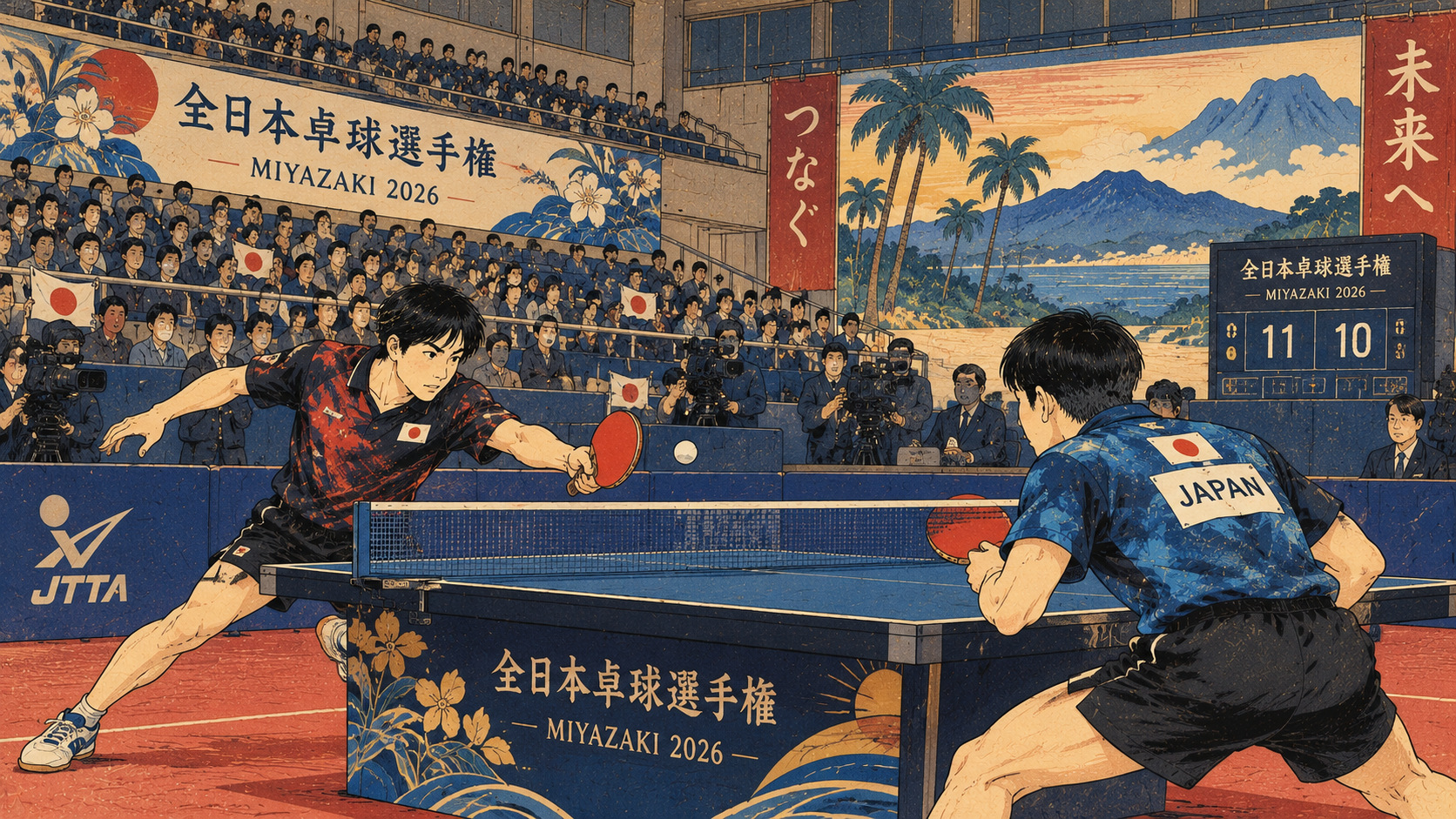
Students and corporate professionals are competing for the same trophy—a rare view into how Japan develops athletes.
Why Miyazaki is a contest unlike a professional league
The All-Japan Table Tennis Team Championships has an unusual premise: corporate squads, university champions, high-school teams, national junior prospects and a home-prefecture selection can compete for one national team title. Twelve men’s teams and twelve women’s teams began play October 23 at KING Sports Park in Miyazaki. After the October 24 quarterfinals, only four teams in each division remained. The finals are scheduled for October 25. This report draws on confirmed play through October 24; it does not claim to know champions before they have been determined.
A high-school upset supplies the weekend’s defining moment
Seisa Yokohama High School advanced past Juroku Financial Group, a leading corporate team, by three individual matches to two in the women’s quarterfinals. Its task grew complicated when Makino lost both of her matches. But Aoba Takahashi and a teammate, Fujimoto, delivered victories, and Takahashi prevailed over Yamamuro in the deciding fifth match. The contest went to deuce in the final game, according to the Japanese specialist publication Table Tennis Report. An upset in team play is not merely a higher-ranked opponent failing: it is a sequence of matchups in which a lineup must collectively produce a winning third point.
The other women’s quarterfinals tell different stories
Chugoku Electric Power’s Rysys side eliminated high-school powerhouse Shitennoji 3–0, with the Edahiro sisters, Hitomi and Ai, helping establish a decisive lead. Defending champion Denso beat the Junior National Team 3–1, with Nagao contributing two victories. Sanritsu swept Senshu University 3–0. The resulting semifinal pairings—Seisa Yokohama against Chugoku Electric Power Rysys, and Denso against Sanritsu—bring together the spectacular upset, established company programs and very different routes through the draw. Those are scheduled matchups, not reported final results.
Four contrasting contenders in the men’s draw
First beat Aichi Institute of Technology 3–0, but its opening player Takakiwa had to recover from two games down before winning a five-game contest. Nippon Steel Logistics Blazers swept Hinode Medical Welfare Group 3–0, while Kyowa Kirin beat Noda Gakuen High School by the same score. Meiji University defeated Carelyts & Partners 3–1; Kikata won twice for the university side. The confirmed semifinals pit First against Nippon Steel Logistics Blazers and Meiji against Kyowa Kirin. No semifinal winner was established at the reporting cutoff.
Why a team title demands different skills
An individual national championship tests a player through successive rounds. In team competition, three match victories are needed for the team to advance. A star can win yet still watch teammates lose; a seemingly less prominent competitor can become the decisive fifth player. Lineup selection, styles of play, tactical adaptation and managing pressure between matches all matter. The 2026 competition begins with groups of three teams; two qualify from each group for an eight-team knockout bracket. That combination rewards sustained performance before placing each contender under single-elimination pressure.
Corporate teams are part of Japan’s sporting infrastructure
Japanese company-affiliated sports clubs have historically offered athletes ways to pursue elite competition alongside different forms of employment support. Conditions vary across employers: being a member of a corporate team should not be taken to mean every player has the same job, salary or schedule. Table tennis nonetheless offers a striking example of a sport where workplaces, universities and schools help sustain the talent pipeline. The national team championship puts those institutions in direct competition, rather than separating younger athletes into a protected youth contest.
A revealing examination for the next generation
When a high-school side reaches a semifinal against corporate opponents, it exposes the depth of Japan’s school sport. When Meiji University defeats an established corporate team, it suggests how narrow the distance can be between promising student players and senior domestic competition. Neither result should be exaggerated into a promise of Olympic medals or a particular international career. But they provide evidence of competitive opportunities that are hard to replicate in age-restricted tournaments. A teenager must cope with experienced opponents, not merely other teenagers.
A historical system, not a new invention
Japan became a significant force in international table tennis during the postwar decades, and its institutions have repeatedly adapted to changing equipment, tactics and international rivalries. The country now has multiple paths into the elite game: schools, universities, company clubs, the T.League and national-team programs. Those paths compete for attention and resources, yet they can also reinforce each other. The presence of Junior National Teams in Miyazaki reflects the association’s interest in developing athletes against demanding domestic opposition, not just sending them abroad.
Miyazaki has a second purpose in hosting
This championship doubles as a rehearsal for table tennis at the 2027 National Sports Festival in Miyazaki. The city and prefecture describe the October competition as a test event. That matters beyond who lifts a trophy: officials can refine venue operations, scoring procedures, spectator arrangements and the logistics of a national competition. The venue, KING Sports Park, sits in Miyazaki City. Economic impact, visitor counts and local business benefits should be based on published data rather than guessed from the presence of a national event.
The October 25 reporting test
Semifinals and finals are scheduled for Sunday, October 25. The essential follow-up is the official result for both divisions, verified down to the order of individual matches and the decisive points. Descriptions such as “first-ever,” “record fourth title” or “historic upset” need checks against previous official champions. Correct Japanese names are especially important when romanized into English: different athletes can share surnames, and unverified given-name readings should be avoided. This story is deliberately anchored in the confirmed October 24 bracket rather than a fictional ending.
What a small ball reveals about a national sports system
The most interesting result of the weekend may not be the final medal table. A school team has beaten a corporate champion; university players have advanced against senior opposition; corporate teams still demonstrate the resources and experience associated with long-running competition programs. Together those facts make the Miyazaki event an unusually revealing snapshot of Japanese table tennis. By Sunday evening the champions should be known, but the broader story—how a country organizes opportunities for athletes across different stages of life—will last far beyond the final point.
Sources and verification
Reporting cutoff: confirmed October 24 quarterfinal results. Semifinals and finals are scheduled for October 25; update the championship winners and all final scores from official records before releasing the October 26 issue. No interviews or eyewitness reporting were conducted.
- JTTA: 2026 All-Japan team championship official results and schedule
- JTTA: Official October 23 opening announcement
- Table Tennis Report: Women’s quarterfinal scores, October 24
- Table Tennis Report: Men’s quarterfinal scores, October 24
- Miyazaki City: 2027 National Sports Festival rehearsal competition
- Miyazaki Prefecture: Official test-event listing
- JTTA: Association history and organization