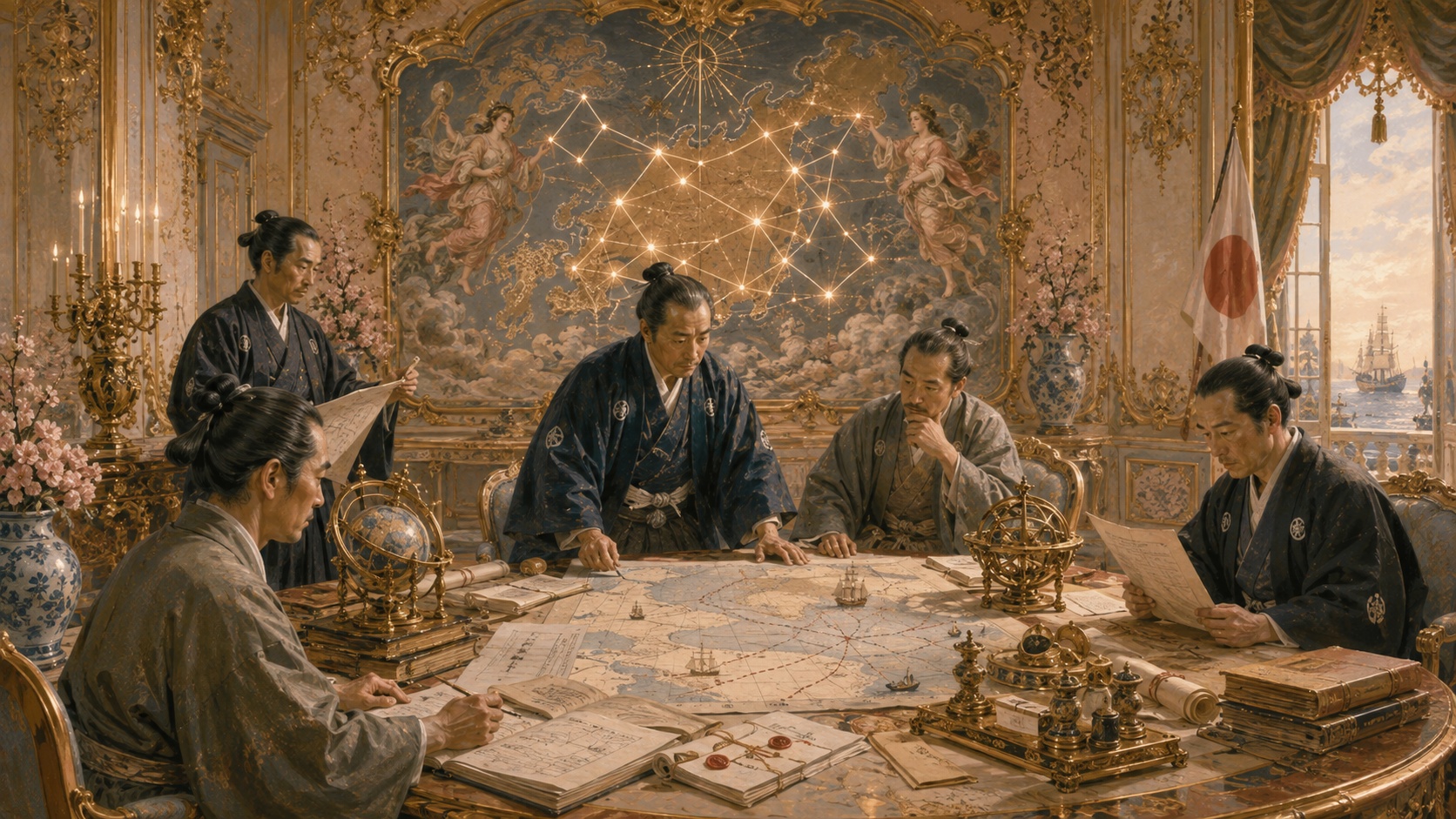
A national crisis rarely arrives wearing a label that says “crisis.” Unusual traffic appears inside a regional factory’s network. A university researcher receives an attractive partnership proposal. A port system suffers a minor outage. The same false claim spreads across social media in slightly altered forms. A rare-earth contract is halted, while sensitive components move through a maze of intermediaries.
Viewed separately, each event may look small. Seen together, they may reveal one actor, one intent and one strategic campaign. Japan created its National Intelligence Bureau to connect those points.
A new command center before a new spy service
The bureau is not the sudden birth of a cinematic overseas espionage service. Its immediate institutional purpose is more practical: elevate the existing Cabinet Intelligence and Research Office and turn it into a permanent center capable of integrating intelligence held by the police, the Public Security Intelligence Agency, the Defense Ministry, the Foreign Ministry, the Coast Guard and economic regulators.
Japan was never without intelligence organizations. CIRO handled domestic, international and economic analysis, crisis aggregation and satellite intelligence. Police pursued counterespionage and terrorism; public-security officers tracked extremist and foreign activities; defense agencies collected military intelligence; diplomats reported political developments overseas.
The weakness was often not the absence of information, but the loss of value inside vertical bureaucratic channels. Agencies used different authorities, vocabularies, sources and classification systems. The bureau will succeed only if information moves in practice—not merely on an organization chart.
The first agenda is about networks as much as weapons
The bureau’s opening mission reaches beyond conventional military threats. Modern state competition operates in the space between war and peace. Cyber intrusion, disinformation, sanctions evasion, strategic investment, covert approaches to researchers and pressure on logistics networks can each resemble an ordinary crime, transaction or technical failure.
In security terms, however, they may be preparations to disrupt electricity, communications, finance, ports, hospitals or transportation. Japan has committed to active cyber defense against serious threats and aims to bring national cyber capabilities to the level of leading Western states. The new bureau must connect technical indicators with diplomatic, police, military and economic analysis.
| Priority | What analysts must watch | Why integration matters |
|---|---|---|
| Cybersecurity | State-backed intrusions, critical infrastructure, network devices and AI-enabled attacks | Technical logs alone cannot explain an attacker’s intent or geopolitical context |
| Economic security | Semiconductors, AI, quantum technology, batteries, critical minerals and undersea cables | Commercial transactions must be compared with state strategy across ministries |
| Foreign influence | Disinformation, covert lobbying and manipulation of institutions | Foreign direction must be identified without criminalizing legitimate speech |
| Counterintelligence | Theft of secrets, technology leakage and foreign intelligence activity | Fragments held by police, diplomats, universities and companies must be connected |
| Crisis response | Terrorism, missiles, a Taiwan contingency and compound disasters | The prime minister needs one common operating picture |
Economic security is not simply another name for industrial policy
For Japan, economic security is concrete. Semiconductor equipment, advanced materials, robotics, batteries, telecommunications, pharmaceuticals, shipbuilding and space systems are both growth industries and strategic assets. Companies pursue markets and profit; government must also examine supply interruption, coercive technology transfer, sanctions evasion and dependence on foreign-controlled infrastructure.
Risk may enter through acquisitions, joint ventures, research grants, recruiting, cloud contracts, suppliers and open-source components. The bureau’s task is not to treat every international relationship as suspicious. It is to identify where strategic risk is concentrated and issue useful warnings without damaging normal trade and research.
The government is also pursuing stronger screening of foreign investment through a proposed Japanese counterpart to the U.S. Committee on Foreign Investment. Intelligence assessments of beneficial ownership, state links, technology-transfer risk and supply-chain consequences will be central to that process.
Why postwar Japan resisted centralized intelligence power
History requires caution. Before 1945, the Special Higher Police and military police were associated with surveillance, ideological control and repression. Occupation reforms dismantled those bodies and deliberately dispersed state power. Suspicion of intelligence agencies grew not only from pacifism, but from memory of secret institutions used against citizens.
Japan created the Cabinet Research Office in 1952, later developing it into CIRO, but it did not establish an independent foreign service comparable to the CIA or MI6. Functions remained divided among police, diplomacy, defense and public security. The U.S. alliance helped fill gaps in military, satellite and signals intelligence, while Japan’s own human intelligence and strategic integration remained comparatively weak.
1945: Wartime security and military intelligence institutions were dismantled.
1952: The Cabinet Research Office began work, becoming the ancestor of CIRO.
1998: North Korea’s missile launch accelerated Japan’s decision to deploy intelligence-gathering satellites.
2001: The Cabinet Satellite Intelligence Center was established.
2013: Japan created the National Security Council and National Security Secretariat.
2014: The state secrets law strengthened the basis for classified sharing with allies.
2022: The National Security Strategy placed cyber, space and economic security near the center of national policy.
2026: The Diet enacted the National Intelligence Council law and the bureau began work on July 31.
Why “Japan’s CIA” is an incomplete label
The new bureau is frequently described as Japan’s CIA. That phrase creates both excitement and confusion. The CIA is a vast foreign intelligence organization involved in collection, analysis and covert action. At launch, Japan’s bureau is primarily an integrator, analytical center and strategy secretariat. It is not yet a fully independent overseas clandestine service.
The government calls this a first step and intends to examine a separate foreign intelligence service and anti-espionage legislation. Moving too quickly could produce poorly trained officers, unclear legal authority and damaged trust with allies. Moving too slowly could allow technology and secrets to keep escaping.
The scarcest resource is skilled people
Seven hundred employees sounds substantial, but many are personnel already serving in CIRO and satellite intelligence. Real expansion requires specialists in languages, regional affairs, cyber operations, data science, finance, export controls, AI, quantum technology, energy and shipping.
More data does not automatically produce better intelligence. Processing bad information at scale simply manufactures false confidence faster. AI can assist translation, anomaly detection, satellite-image analysis and open-source research. Human expertise remains essential for deception, culture, motives and political context.
Government competes with private companies for cyber talent. Researchers may resist secrecy and publication limits. A system built mainly on temporary ministry secondments can struggle to create institutional loyalty and deep expertise. Recruitment, training, careers, classification and retention will determine whether the bureau becomes a lasting profession.
Stronger surveillance requires stronger surveillance of the surveillers
Expanded intelligence power can collide with privacy, political neutrality and press freedom. Efforts to trace foreign influence can wrongly target political activity, academic work, journalism or foreign residents. A system created to protect democracy can damage democracy if its boundaries are vague.
Diet debate focused on avoiding unnecessary intrusion into personal information and preventing intelligence collection that undermines political neutrality. A credible service needs clear authority, audit trails, parliamentary scrutiny, internal reporting channels and rules preventing classification from hiding failure or misconduct.
- Define collection purposes and powers in law.
- Do not target parties, journalists or civic groups for political reasons.
- Log access to personal data and subject it to independent audit.
- Do not use secrecy to conceal mistakes or wrongdoing.
- Give the Diet meaningful oversight of budgets, powers and major failures.
- Explain foreign threats publicly whenever disclosure is safe.
How to judge the bureau’s first year
Intelligence success is difficult to measure because prevented incidents are often never disclosed. Still, useful tests exist. Does the national strategy set genuine priorities? Do ministries receive specific collection requirements? Are competing assessments reconciled? Can companies and local governments receive actionable warnings earlier? Does the prime minister receive one coherent picture during a crisis?
Most important, can the bureau deliver unwelcome judgments? An intelligence service that anticipates political preferences may collect brilliantly and still advise badly. Good analysis must be able to say: the evidence is incomplete; the probability is low but the consequences are severe; this policy may have the opposite effect.
Japan’s security architecture changes in a quiet room
Most of the bureau’s work will remain invisible: assessments rather than press conferences, warnings rather than arrests, coordination rather than dramatic operations. Yet those quiet products may shape missile defense, energy policy, corporate acquisitions, semiconductor investment, disaster response and diplomacy.
Japan long treated intelligence as support for diplomatic and defense power. The new structure treats information itself as a pillar of national power. The challenge is not whether Tokyo can accumulate more secrets. It is whether the bureau can transform fragments into meaning, neither exaggerating threats nor missing them, and deliver honest judgment without crossing democratic boundaries.
On the bureau’s first morning, the world did not visibly change. Servers kept running, ships entered ports, research agreements were signed and millions of messages moved online. Which were ordinary, and which were warnings? Japan’s new intelligence system will be judged by that distinction.
Reporting notes and sources
Institutional details, launch timing and government policy were checked through August 2, 2026. The bureau was created by elevating CIRO; its establishment does not mean Japan already possesses a completed CIA-style foreign covert-action service.
- Prime Minister’s Office: Policy Speech to the 221st Diet
- Prime Minister’s Office: National Intelligence Council Act
- Cabinet Secretariat: CIRO organization and duties
- Jiji Press / Nippon.com: July 31 launch and roughly 700 staff
- Ministry of Defense: Cybersecurity policy
- Cabinet Secretariat: Economic Security Promotion Council
- Reuters: Japan’s intelligence and security overhaul