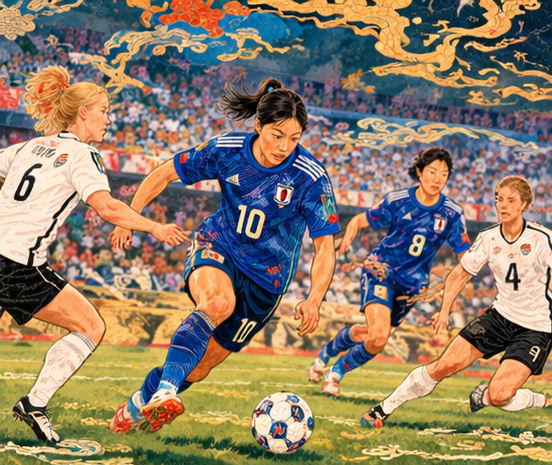
Five goals are encouraging. Bremen is a different examination.
Japan arrives in northern Germany with a convincing scoreline behind it: a 5–1 friendly win against Haiti outside Paris on October 9. But the next opponent will ask questions that cannot be answered by the margin of that victory alone. Germany combines European-level pace, established international experience and its own plans for the 2027 Women’s World Cup.
The match is scheduled for October 13 at 5:45 p.m. in Bremen’s Weserstadion—12:45 a.m. on October 14 in Japan. For Japan.co.jp’s October 13 edition, that distinction is essential: the match has not yet produced a result.[2][5]
Japan’s claim to be measured against elite opposition is well founded. It beat Australia 1–0 in the March 2026 Asian Cup final, with Maika Hamano scoring, to win its third continental title. Against Germany, that standing will be tested rather than simply celebrated.[8]
What the Haiti victory actually showed
Japan used a 4-3-3 in Saint-Ouen, with Akane Okuma in goal, Fuka Nagano in a holding midfield role, and Yui Hasegawa and Hinata Miyazawa operating further forward. The JFA’s October 10 match account identifies a 3–1 halftime advantage after Haiti scored shortly before the break.[1]
Remina Chiba added Japan’s fourth in the 57th minute. In the 82nd, substitute Maya Hijikata finished a move created by Chiba, scoring with her first touch after entering the game. Mei Shimada subsequently made her senior international debut. These details suggest useful attacking depth, not merely an inspired performance from a fixed starting eleven.[1]
The unanswered question is whether Japan can reproduce its central combinations while facing stronger pressure on the ball. The quality of the passing lanes, the timing of fullback support and the response to turnovers will matter more than an expectation of another five goals.
The coach, the squad and an injury that changes the equation
Michihisa Kano, a member of the Japan Football Association’s national coaching staff, is listed as head coach for the October internationals. His group includes English-based Yui Hasegawa and Aoba Fujino of Manchester City, Maika Hamano of Chelsea, and Germany-based Momoko Tanikawa of Bayern Munich.[3]
International club experience adds different tactical reference points, but the brief national-team window limits how thoroughly combinations can be rehearsed. Kano must determine which midfield and attacking relationships can survive the pressure of a heavyweight opponent.
One key option is missing. Mina Tanaka withdrew through injury, the JFA announced October 9, and midfielder Yui Narumiya of INAC Kobe Leonessa was called in. Japan’s formation and personnel against Germany cannot be assumed from the Haiti starting lineup.[4]
Germany has its own adjustments to make
Christian Wück has called up a squad blending senior experience and emerging talent. In late September the German federation named 19-year-old Arsenal player Lisa Baum for her first senior call-up and welcomed back other players from injury. Germany is also trying to build toward the 2027 World Cup in Brazil.[9]
But captain Giulia Gwinn withdrew from the October internationals after being injured during a club match. Wolfsburg defender Sarai Linder was called in as a replacement, the DFB reported on October 4. There is therefore no reason to discuss Germany as though its first-choice eleven were certain or fully fit.[6]
The DFB said more than 14,000 tickets for the Japan match had been sold by September 15. That is a ticket-sales announcement, not a final attendance count or a promise of a sellout.[5]
The Wolfsburg night that changed Japanese football
The historical connection is extraordinary. On July 9, 2011, Japan faced host Germany in the Women’s World Cup quarterfinals in Wolfsburg. Germany was the two-time defending champion; Japan entered as the challenger. Karina Maruyama scored in the 108th minute and Japan held on for a 1–0 extra-time victory.[7]
Japan then defeated Sweden 3–1 before overcoming the United States on penalties after a 2–2 final, winning its first World Cup. The achievement resonated far beyond sport in a country recovering from the March 2011 earthquake and tsunami. It helped bring a new level of attention to women’s football in Japan.
That history gives Tuesday’s meeting a narrative weight, but it would be analytically unsound to project a 2011 result onto the distinct players, coaching staffs and football systems of 2026. The significance lies in how far the rivalry and the game itself have evolved.
An Asian champion in a changing global game
The Asian Cup victory in March was decisive in its own right: Hamano’s goal defeated Australia in front of a record-breaking Asian Cup final crowd, according to the Asian Football Confederation.[8]
Yet international strength cannot be established by a single continental run. European programs have expanded their professional infrastructures, and Japan’s own leading players now work within clubs in England, Germany, Italy and the United States. Those cross-border careers may strengthen technical and tactical exchanges, but assembling a national side remains a demanding task.
Against Germany the key is not whether Japan can play pretty passes in unchallenged areas. It is whether its compact structures, speed of support and creative midfielders remain effective when space disappears.
Three tactical tests worth watching
First, watch how Japan exits pressure. The relationship between a holding midfielder and the two more advanced midfielders will determine whether Germany can trap Japan in its own half or whether Japan can advance cleanly through the center.
Second, watch the moments immediately after turnovers. Japan has attacking players capable of arriving quickly around the penalty area, but committing numbers forward creates defensive decisions. Germany’s transitions could expose spaces that Haiti did not regularly exploit.
Third, examine substitutions rather than treating them as an afterthought. Chiba’s and Hijikata’s contributions against Haiti showed that fresh attackers can create a different problem for opponents. Whether Kano can adjust in real time will be one of the most useful indicators for future competitions. These are informed questions, not asserted outcomes.
Beyond the scoreline
For Germany, the meeting offers a demanding match against the reigning Asian champion as its coaching staff prepares for the road to Brazil 2027. For Japan, it offers a rare opportunity to test the credibility of its recent gains against one of Europe’s traditional powers.
A meaningful report after kickoff will have to add verified lineups, goals, disciplinary events, substitutions and coaching reaction. Until then, the responsible approach is to distinguish known squad information from tentative tactical possibilities and pre-match expectations.
Fifteen years after a breakthrough in Wolfsburg, the lesson is not to ask whether this Japanese team can recreate a famous night. It is to ask what a new generation can learn against Germany—and what those lessons reveal about the future of international women’s football.
Sources and reporting notes
- 日本サッカー協会、ハイチ戦試合報告(2026年10月10日)
- 日本サッカー協会、ドイツ戦日程
- 日本サッカー協会、招集メンバー・スタッフ
- 日本サッカー協会、田中美南選手離脱・成宮唯選手招集
- ドイツサッカー連盟、ブレーメンでの親善試合案内
- ドイツサッカー連盟、グウィン負傷・リンダー追加招集
- 日本サッカー協会、女子ワールドカップの歴史
- アジアサッカー連盟、女子アジアカップ2026決勝
- ドイツサッカー連盟、2026年代表招集
Sources checked October 10, 2026. The Germany match is scheduled for October 14 at 00:45 Japan time. No result is asserted ahead of the fixture.