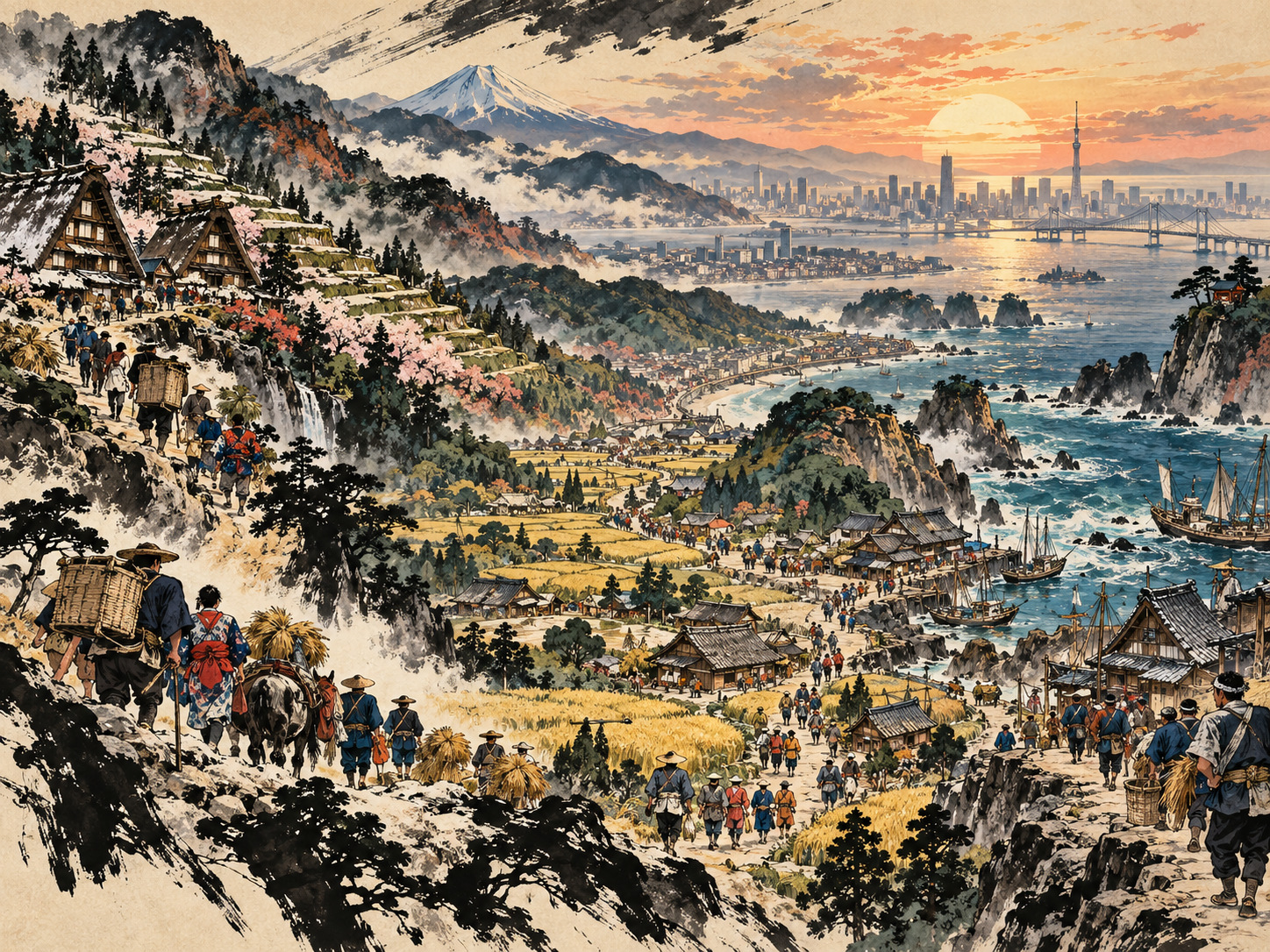
Keeping a village beautiful requires more than preserving its view. It requires keeping its community alive.
A village festival with a bigger question
On October 24, representatives of 22 villages and rural areas from across Japan are scheduled to gather at Tokyo Port City Takeshiba. The fifth Most Beautiful Villages in Japan Festival, running from 11 a.m. to 5:30 p.m. with free admission, promises regional foods, locally made products, performing arts and hands-on experiences. A new feature invites visitors to consider one-night, two-day trips recommended by people who know the destinations. As of this article’s October 20 publication date, the event has not yet taken place. Its program is a plan, not an account of what visitors actually experienced.
Beauty is not the same as a beauty contest
It would be easy to mistake the name for a ranking of Japan’s prettiest destinations. That is not what the nonprofit association claims to provide. Its designation is based on voluntary membership, screening and work to protect landscapes and living cultures. The central idea is that a village is made beautiful not simply by mountains, houses or water, but by generations of people using and caring for them. Agricultural terraces require cultivation; traditional festivals need performers; old streets need residents and livelihoods. The photographs might remain when those human systems disappear.
The movement began during Japan’s great municipal mergers
The Japanese association was established on October 4, 2005, amid the Heisei-era wave of municipal consolidation. Seven founding communities—Biei and Akaigawa in Hokkaido, Okura in Yamagata, Oshika in Nagano, Shirakawa in Gifu, Kamikatsu in Tokushima and Minamioguni in Kumamoto—chose to preserve distinct local identity through a shared framework. Its inspiration reaches further back: France launched its own most-beautiful-villages movement in 1982. Japanese organizers visited France and developed their own criteria to reflect differences in cultural landscapes, institutions and local life. Japan joined the international network in 2010.
Fifty-seven members, twenty-two festival participants
The association reported 57 member municipalities and districts as of January 2026: 27 towns, 21 villages and nine designated areas. Twenty-two refers specifically to scheduled participants in the October festival, not the network’s total size. The distinction matters because a festival can be a sampling of a nationwide movement without representing every member. Membership figures also change. A village can leave, and continued recognition requires reassessment. Nor does the association’s label mean that a government agency has ranked all settlements in Japan.
What a community must demonstrate
The published membership rules generally require a population of around 10,000 or fewer, at least two important local assets involving landscape or culture, and ongoing community activities protecting or using them. Specialists assess applicants and members face review every five years. The criteria make an explicit connection between beauty and stewardship. They do not, by themselves, show that joining increases incomes, reverses demographic decline or guarantees sustainable tourism. Those are empirical questions that deserve independent study.
Japan’s rural dilemma cannot be solved by a photograph
The demographic pressures behind this movement are formidable. When a small community loses younger residents, the losses extend beyond an abstract headcount. Farms need successors, forests and drainage channels need maintenance, festivals need musicians, shops need customers and buses need enough passengers to operate. A restored façade can look magnificent while the services essential to village life quietly disappear. The hardest measure of success may be whether people who want to remain can still make a living there—and whether newcomers are welcomed as members of the community rather than temporary visitors.
Why the overnight itinerary matters
The festival’s proposed one-night, two-day itineraries hint at a shift from sightseeing to deeper engagement. An overnight stay can generate spending on accommodation, meals, guides and transport rather than a short visit that contributes little locally. Yet tourism can also bring pressure on roads, waste management, housing and residents’ privacy. The best development model cannot be defined by visitor totals alone; it requires local choice over scale, seasonality and the distribution of benefits.
A French idea becomes distinctly Japanese
The Japanese movement borrowed an organizational insight rather than simply transplanting an overseas tourist brand. Its own criteria place importance on satoyama landscapes, farming and fishing settlements, vernacular buildings and community rituals. That raises a further question: who gets to decide what is authentic? Traditions evolve, as do residents’ needs. A successful conservation movement has to protect the right of villages to change while refusing the assumption that everything valuable can be packaged for visitors.
The economic opportunity and its limits
For companies, rural partnerships might mean sourcing regional food and craft products, developing distributed work arrangements or supporting local businesses over many years. For city residents, the more useful relationship may be returning, buying directly from producers and respecting local decisions. None of these approaches guarantees revitalization. The public debate needs evidence: changes in local jobs, retained spending, youth retention and the cost of maintaining public services. A brand is a means to an end, not a substitute for economic foundations.
A one-day meeting and a much longer test
On October 24, Tokyo residents will have an opportunity to encounter communities that are easy to overlook on the standard international itinerary. Visitors should be able to sample products, see performances and consider future journeys. Whether the gathering delivers lasting value will only become clear afterward—in sales returned to villages, repeat travel, business relationships and, ultimately, stronger local capacity. Twenty-one years after seven communities began the movement, its promise is still demanding: preserving a beautiful place means keeping it viable as a place to live.
Help us report the next chapter
Japan.co.jp welcomes independently verifiable figures and reporting leads from participating communities, including tourism revenue, resident views and projects beyond the festival. We have not attended this future event or interviewed participants exclusively. Please contact our newsroom with corrections or additional evidence.
Sources and further reading
- 第5回「日本で最も美しい村まつり」開催案内 / Official 2026 festival announcement
- 「日本で最も美しい村」連合・団体概要 / Association overview
- 連合の沿革 / History of the association
- 連合への加盟条件 / Membership criteria
- 連合の目的・再審査 / Mission and reassessment
- 2026年度総会の報告 / 2026 general meeting
- 美しい村の日・21年目の活動 / Beautiful Village Day
- よくある質問 / FAQ
- 2025年国勢調査 / 2025 census portal
- 第5回まつり公式サイト / Official festival site