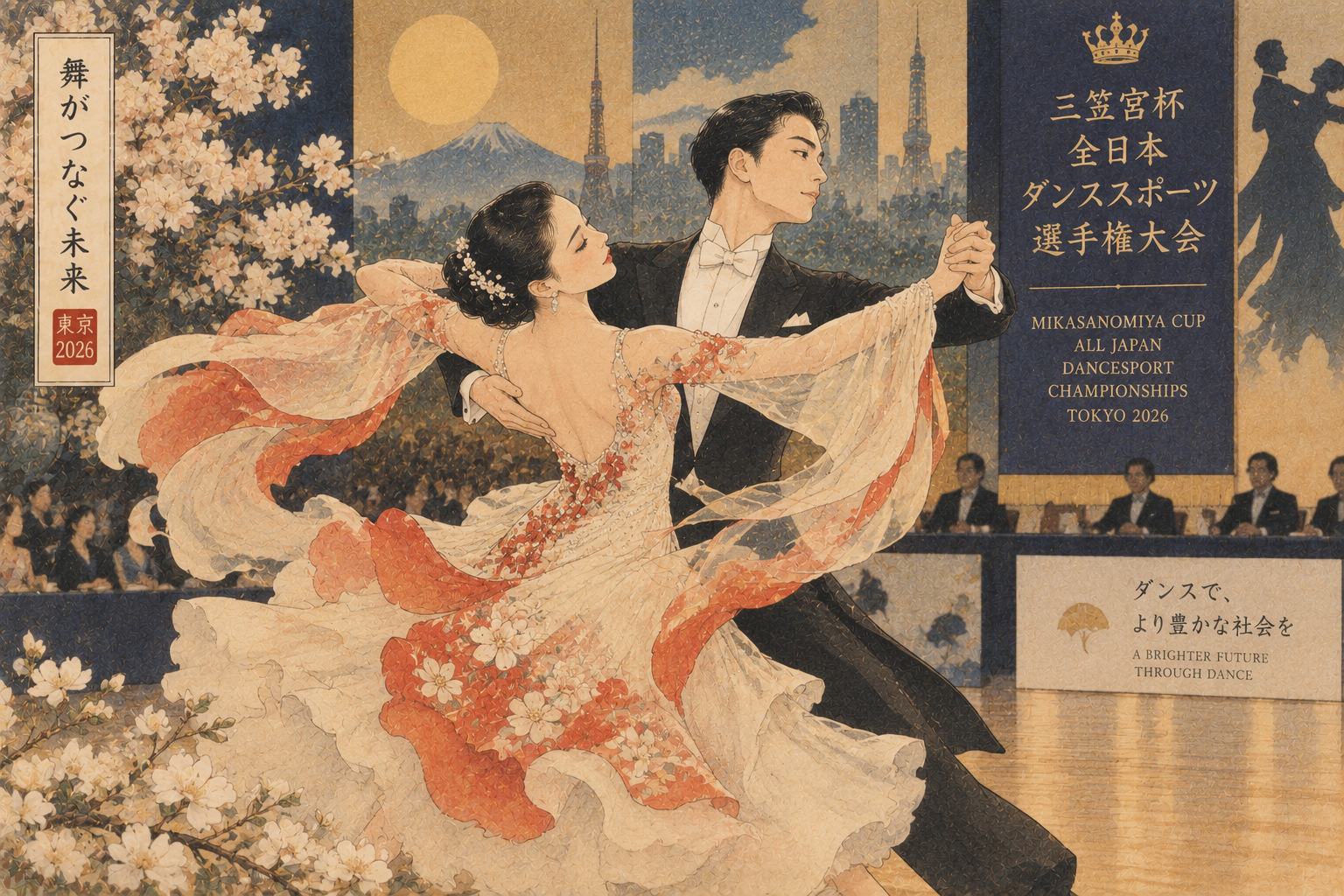
Every effortless-looking turn is built on years of disciplined practice.
A ballroom becomes a sporting arena
Imagine a crowded floor in which every partnership must turn, accelerate and change direction without colliding. The costumes may look effortless; the work is not. On October 17 and 18, Tokyo Metropolitan Gymnasium hosts the 46th Mikasanomiya Cup All-Japan DanceSport Championships, organized by the Japan DanceSport Federation (JDSF). Across two days, the contest places national-level Standard and Latin dancing alongside a separate Professional Division championship and events for children, juniors and seniors. It is an unusually accessible opportunity to see ballroom dancing judged as a sport rather than merely presented as entertainment. This is a preview: no championship outcomes are yet known.
The details visitors can actually use
The federation’s first-day syllabus specifies October 17 competition hours of 10:00 a.m. to 6:30 p.m., with doors opening at 9:10 a.m. The venue is Tokyo Metropolitan Gymnasium, 1-17-1 Sendagaya, Shibuya. A general event listing gives a slightly earlier end time of 6:20 p.m., so spectators should follow the latest official timetable. Admission is ticketed, including accompanying adults at youth events; a general listing of ¥1,000 should not be interpreted as the price of every ticket category. The syllabus says venue parking is unavailable.
What makes DanceSport more than ballroom spectacle
The two principal disciplines demand different movement languages. Standard includes Waltz, Tango, Viennese Waltz, Slow Foxtrot and Quickstep: traveling movement, sustained partnering frame and control under pressure. Latin encompasses Samba, Cha-Cha-Cha, Rumba, Paso Doble and Jive, emphasizing characteristic rhythms, changes of weight and responsive partnering. Judges see technique, musicality and performance decisions that spectators may miss amid the sweeping dresses and immaculate tailcoats. The sport’s particular challenge is that athletes share the same floor, obliging them to improvise their traffic management without losing the character of the dance.
A cup with imperial origins
The competition’s name carries a specific history. According to the federation’s historical programmes, Prince Takahito Mikasa became president of the predecessor Japan Amateur Dance Association in 1980, and a cup was presented to commemorate that appointment. The first tournament took place in 1981, attended by the prince and Princess Yuriko. Over the ensuing decades a national selection structure developed, turning a community rooted in social dancing into a championship circuit. The royal association is part of its history, not evidence of an imperial role in judging or running this year’s competition.
The road through regional qualification
This championship begins well before competitors arrive in Tokyo. JDSF held a final qualifying event on October 4 at Kose Sports Park Gymnasium in Yamanashi Prefecture. Official results list Sho Kurashina and Kasumi Hioki first in Standard, and Shintaro Nakamura and Ayane Hayashi first in Latin. Those were qualifying results, not the final results of the October 17–18 Mikasanomiya Cup. The distinction matters: the national title remains to be contested, and a qualifier’s form is not a prediction of the eventual winner.
Separate titles, separate systems
The event also incorporates the ninth Mikasanomiya Cup All-Japan PD DanceSport Championships, held alongside the Mainichi Shimbun Cup. “PD” denotes the federation’s Professional Division, with its own eligibility, fields and titles. The published first-day syllabus specifies a Standard championship for the main competition and Latin competition in the PD program. Reporting all of this under one generic “ballroom champion” label would obscure how Japan organizes elite dancing. The event also spans Senior I, junior, juvenile, solo and rising-star formats.
How can judges score something artistic?
One of competitive dance’s enduring questions is how to translate live aesthetic performance into defensible results. JDSF identifies 13 certified adjudicators for the first day and lists an absolute-evaluation judging system, Type A, for relevant stages of the Standard championship, including specified solo performances in the final. This is not simply a public popularity vote. It is a codified attempt to assess defined performance qualities. Understanding the system is important when reading a result sheet, and the exact criteria should be checked against federation regulations rather than assumed from the appearance of a routine.
Young dancers, senior dancers and the pipeline
The wider program includes the JOC Junior Olympic Cup junior championship, the Mainichi Shimbun Cup juvenile championship, an All-Japan Senior I title, solo events and rising-star competitions. Multiple age groups competing within the same venue reveal a sport with a developmental ladder. The first-day syllabus describes how results can affect eligibility for 2027 World DanceSport Federation junior representation in defined cases. The phrasing is carefully conditional: a result may establish eligibility or a pathway, not automatically secure a national-team place.
Turning spectators into participants
Organizers also want first-time visitors to experience dancing. The Japan Sports Agency’s event listing describes a midday “dance time” on both days when visitors may be able to step onto a competition floor; it advises bringing dance shoes. Food vendors and dance-related retailers are also expected. These additions make the event more than a showcase of expert performers. They are a test of whether the curiosity prompted by elite athletes can translate into local lessons, participation and a wider audience.
The larger challenge for Japanese dancing
Japan’s DanceSport structure is tied to international competition through the World DanceSport Federation, but its future will depend on more than high-profile finals. Athlete development, regional qualification routes, transparent officiating and sustained participation all matter. So does the ability to explain the competition to people who have never learned a basic Waltz. An audience that understands the difficult mechanics of an apparently graceful movement can become a repeat audience; one that sees only ornament may not.
What to watch—and what remains unknown
There will be winners after the event, but none can be reported as winners at this publication cutoff. Better questions for opening day include which partnerships retain technique as the floor becomes crowded, how judges reward musical interpretation, and whether the multi-generation program sparks new interest beyond its existing community. The Mikasanomiya Cup tells a Japanese story with international relevance: a social art transformed, through generations of practice and rules, into a demanding competitive discipline.
Sources and documents
- JDSF 2026 first-day official syllabus
- JDSF October 2026 competition schedule
- JDSF 2026 official championship site
- JDSF September 2026 announcement
- Tokyo Metropolitan Gymnasium calendar
- Japan Sports Agency Cocospo event listing
- JDSF 2017 championship historical programme
- JDSF October 4 Standard qualifying result
- JDSF October 4 Latin qualifying result