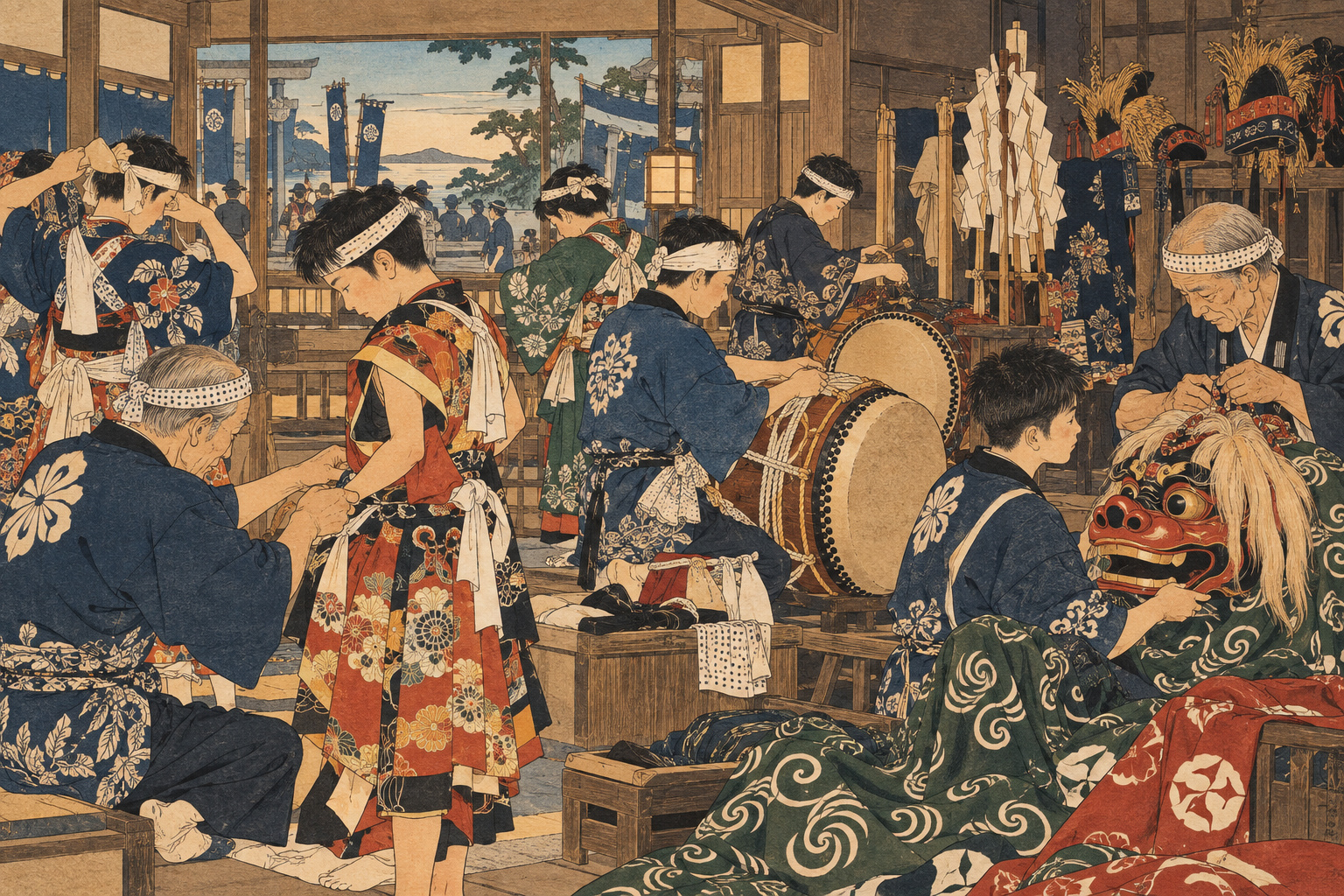
Eight groups from six prefectures are preparing to bring local performance traditions to Kuwana on November 1. Their shared stage offers a way into a larger question: how does a community keep a performance alive when the knowledge resides in people as well as in objects?[1]
The 68th Kinki–Tokai–Hokuriku Folk Performing Arts Gathering will take place at Kakiyasu City Hall, also known as Kuwana Civic Hall. Mie is hosting for the sixth time and for the first time since 2018. The prefecture identifies exchange among preservation groups and encouragement of transmission as purposes alongside public appreciation.[1]
A regional gathering, with local differences intact
| Tradition | Community |
|---|---|
| Mikohara lion dance | Hakui, Ishikawa |
| Ōmori Kentō-ryū Bō-no-te | Nagoya, Aichi |
| Ōmi Kenketo festival naginata performance | Moriyama, Shiga |
| Harada Shrine lion ritual festival | Toyonaka, Osaka |
| Koza lion dance | Kushimoto, Wakayama |
| Kuwana Ise Daikagura | Kuwana, Mie |
| Inō Shrine lion kagura | Suzuka, Mie |
| Okashira Shinji | Ise, Mie |
Several names refer to lions or kagura, but these are not interchangeable versions of one generic festival. A lion head can be part of a household blessing, a traveling performance or a shrine ritual. Learning the local setting changes what an audience sees: a striking movement becomes part of a relationship between performers, residents and a place.
The traveling art at Kuwana’s doorstep
Ise Daikagura combines lion dancing associated with warding off misfortune and the acrobatic arts known as hōka. The Agency for Cultural Affairs describes a tradition offered at Masuda Shrine in Kuwana and taken on the road through Kinki and Hokuriku. Its national designation as an Important Intangible Folk Cultural Property dates to 1981.[3]
Mie’s historical account is cautious about origins. It presents development from shrine kagura into a professional practice as a possibility, rather than supplying a securely documented founding moment. That distinction matters when longevity becomes part of an event’s appeal: a tradition need not possess an exact birthday to have a substantial history.[2]
Travel is central to the story. It complicates the idea that local heritage must always have remained within a single community. Performers carried techniques and religious functions across a wide area. The skill of holding an audience’s attention belonged alongside the ritual role, rather than outside it.
For a spectator, that suggests watching the connections between actions. An impressive feat depends on preparation, timing and cooperation. The moment that draws applause may be brief, but learning how to reach it safely and reliably is an extended undertaking.
A neighboring tradition records the movement of skills
The lion kagura of Inō Shrine in Suzuka offers another history of circulation. Mie’s cultural property account cites Edo-period records of journeys around Ise Province and describes lion dances in northern and central Mie that are said to have learned from this tradition.[4]
The same account describes a local three-year cycle and an ensemble centered on four lion heads with four attendants. These details concern the tradition in its home setting; they should not be treated as a guarantee of the precise arrangement that will appear on the Kuwana stage.[4]
A hall presentation necessarily offers a particular encounter with an art. It can make movement visible to people who might never attend the local observance. It cannot reproduce every relationship embedded in a procession, a neighborhood visit or a recurring festival calendar. Knowing that limit makes the presentation more useful, because it becomes an introduction to further questions.
What a lion head dated 1695 can tell us
At Harada Shrine in Toyonaka, a surviving lion head carries an inscription recording its dedication in 1695. The city explains that the head, locally called Oten-san, serves as a vessel for the deity in a festival seeking protection from epidemic disease. The observance also includes performances to ward off misfortune at homes.[5]
The dated object provides unusually tangible evidence of the past. But the survival of an object does not establish that every movement or social arrangement has remained unchanged since its dedication. Material evidence and living practice tell related, different stories. Both deserve attention.
That is also why preservation cannot be reduced to placing an old mask or lion head in safekeeping. An object may survive while knowledge of handling it becomes harder to pass on. Conversely, performance skills need serviceable equipment. The two kinds of care are interdependent.
UNESCO recognition is not one common status
Moriyama’s Ōmi Kenketo festival tradition forms part of Furyu-odori, inscribed on UNESCO’s intangible cultural heritage list in 2022. The city explains its local manifestations at Shimonikawa and Ozu shrines and links them with communal wishes for prosperity and secure lives.[6]
Mie’s announcement describes Kuwana’s Ise Daikagura and Okashira Shinji differently: they are traditions seeking UNESCO inscription under kagura. Aspiration should not be reported as an accomplished inscription. National and local cultural property designations also operate separately from UNESCO recognition.[1]
Recognition can provide an occasion for people outside a community to pay attention. It does not perform the recurring work of instruction, maintenance or organization. A useful measure of continuity therefore lies beyond a designation: can knowledge continue to move from experienced practitioners to people who will use it?
Children on stage are a beginning
The Ōmori neighborhood association describes children as well as adults taking part in Kentō-ryū Bō-no-te. Its account outlines performance with staffs and bamboo swords, among other implements, while acknowledging more than one explanation of the art’s origins, including ritual and self-defense.[7]
Participation provides a concrete starting point for discussing transmission. The next question is what makes repeated participation possible. Time to teach, a place to practice and equipment that can be maintained are less visible than a public performance, but they shape whether an initial experience can become a durable commitment.
Japan’s Agency for Cultural Affairs addresses those practical foundations in its regional heritage program under the fiscal 2025 supplementary budget. Eligible categories include equipment, documentation, successor training and facilities supporting that training. The agency places pressures from population aging and declining births within a wider concern about sustaining communities. These national provisions do not establish that any particular participating group has received an award.[8]
Documentation has a role, too. Earlier agency guidance emphasizes matching records to their intended use in transmission or public communication. A film made to introduce a festival may differ from a record intended to help someone relearn a sequence. The question is not simply whether an event has been filmed, but what a future learner can recover from the record.[9]
An afternoon that points beyond the stage
Doors open at noon on November 1, with performances beginning at 12:30 p.m. and an anticipated finish around 5 p.m. Admission is free, with no advance application required. The venue is at 3-20 Chūōchō, Kuwana; visitors should check the official announcement for updates.[1]
An audience can begin with a simple exercise: follow someone other than the most conspicuous performer. Watch how a musician anticipates a movement, or how one action prepares the next. That changes the focus from an isolated display of virtuosity to coordinated work.
The gathering’s longer value will depend on what attention it carries back into local life. Someone may seek out a community festival, learn the name of a tradition nearby or become curious about joining its practice. Those are possibilities, not outcomes that an announcement can promise. They are nevertheless a reason to view the afternoon as more than a sequence of spectacles. The next rehearsal matters as much as the final applause.
