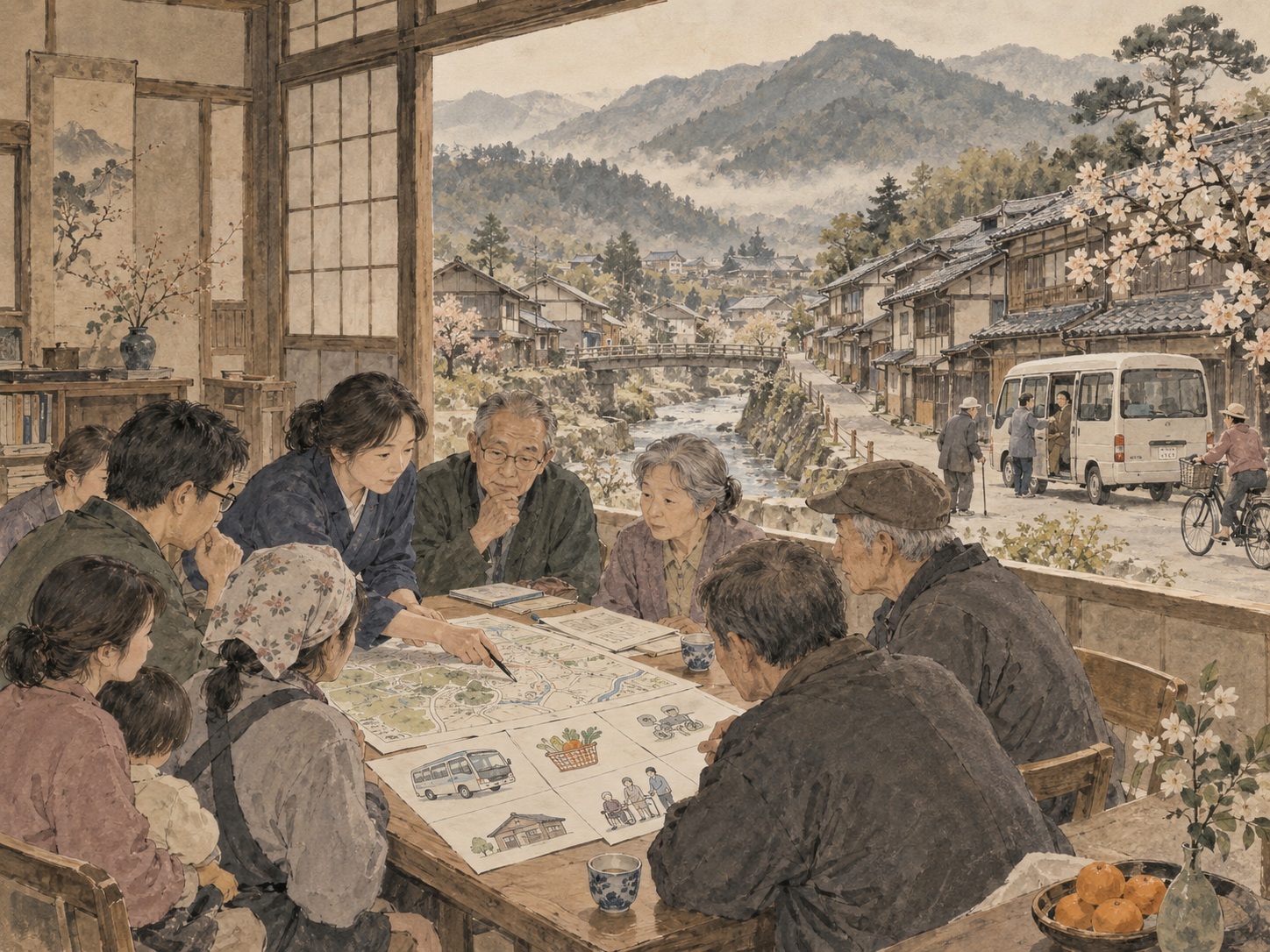
When a rural community begins to unravel, it rarely starts with the closure of city hall. More often, one of the thin lines that makes ordinary life possible disappears first: a bus route, the last local shop, the volunteer who checks on an elderly neighbor, the group that clears an irrigation ditch or the driver who can still take residents to a clinic.
Across Japan, communities are responding by creating Regional Management Organizations, or RMOs — resident-led bodies that identify local needs and coordinate services across areas that traditional neighborhood associations, private businesses or municipal departments can no longer sustain alone. In fiscal 2025, Japan had 8,587 such organizations, 394 more than a year earlier.[1]
Why Japan needs a new layer of local organization
For decades, Japanese communities relied on a dense network of neighborhood associations, volunteer fire brigades, agricultural groups, women’s associations, senior clubs and other resident organizations. Municipalities provided formal public services while residents handled local festivals, cleanup, disaster readiness and informal welfare.
Population decline is eroding the human base beneath that system. Japan’s National Institute of Population and Social Security Research projects that the national population will fall to roughly 87 million by 2070 under its medium-fertility scenario, while the share of residents age 65 or older approaches 40%.[3]
The problem is not simply that fewer people live in a place. The people who perform community functions can disappear faster than demand for those functions. A town may still have residents who need transport, shopping access and farmland maintenance even after it has lost enough workers, drivers and volunteers to provide them.
Below nine households, collective functions weaken sharply
The Agriculture Ministry says that in disadvantaged rural areas, community activities decline especially sharply when a settlement falls to nine households or fewer. That includes work such as farmland maintenance and other collective functions necessary to sustain the settlement.[2]
This is an important way to understand depopulation. A settlement does not remain fully functional until its population reaches zero. There are thresholds at which the labor needed to maintain roadsides, fields, water systems, transport and mutual aid becomes insufficient.
Rural RMO policy tries to intervene before that point by linking several settlements and bringing farmers, nonfarm residents, municipal government, agricultural cooperatives and nonprofit organizations into a broader operating structure.
The policy idea behind the “small hub”
RMOs are closely connected with a Japanese regional-policy concept known as the “small hub.”
The Ministry of Land, Infrastructure, Transport and Tourism defines a small hub as a basic living area — often around a former school district — where dispersed services and community activities are connected so that people, goods and services can continue circulating locally.[4]
The idea is not necessarily to move every clinic, shop and government counter into one building. It is to redesign the local operating system so people can continue living in familiar communities even as the population base contracts.
In April 2026, the government updated its small-hub handbook to a sixth edition, alongside revised guidance on RMO incorporation and tax measures — evidence that the framework has moved beyond a short-term pilot program and into mainstream regional policy.[5]
In Kochi, residents took over a gas station
One of the most cited examples is Matsubara district in Yusuhara, Kochi Prefecture. When the local fuel station faced closure, residents created Matsubara Co. and took over the service in 2013.
At the same time, a community activity center served as the deliberative RMO, while an NPO called Kizuna provided transportation for elderly residents. Fuel sales, agricultural products, a restaurant, meal delivery and mobility support were reorganized through different legal entities rather than treated as unrelated problems.[6]
The significance is not that volunteers simply replaced government. The community separated decision-making, commercial activity and nonprofit services into structures suited to each function.
In Shimane, community transport increased social life
Transportation is often one of the first services to become fragile in shrinking communities. Fewer riders undermine bus economics even as an aging population makes mobility more important.
In the Ida district of Oda, Shimane Prefecture, a resident-founded cooperative called Idaya operates as an RMO and participates in local transport. A prefectural case study recorded 1,904 passenger trips in fiscal 2023. In a survey, roughly 60% of respondents said they went out more often after the service began; leisure and recreational use exceeded trips for shopping or medical care.[7]
That result illustrates why mobility cannot be evaluated only as transportation. The ability to leave home affects social contact, physical activity, spending and isolation.
Rural RMOs combine farming and daily life
The defining feature of the Agriculture Ministry’s rural RMO framework is that it refuses to separate agricultural policy from daily-life policy. Its three core functions are farmland conservation, use of local resources and livelihood support.[8]
Traditionally those issues fall into different bureaucratic categories: farming under agricultural policy, transport under mobility policy, care under welfare, empty homes under housing. Residents experience them as one place and one life.
The ministry has supported prefectural teams involving municipalities, agricultural cooperatives and NPOs, as well as a national platform. It set a goal of forming rural RMOs in 100 areas by fiscal 2026.[9]
In Shimane, residents wrote 88 strategies for one district
E-Hida Company in the Hida district of Yasugi, Shimane Prefecture, is one of the better-known rural RMO examples.
Facing anxiety over the district’s survival, residents worked with the municipality and agricultural cooperative to create the “Hida Regional Vision,” containing 88 strategic plans. The agenda extended beyond agriculture into industrial development, living conditions, welfare and settlement policy.[9]
This is close to the central idea of an RMO: residents are not only recipients of public services. They become participants in deciding how local assets, money and priorities should be managed.
Mihara linked 14 districts through one organization
In Mihara, Kochi Prefecture, the nonprofit-style Mihara Village Community Activity Center Yamabiko was established in fiscal 2016. It serves all 14 districts of the village and operates across daily life, welfare and local industry.
The Agriculture Ministry describes six functional divisions, including production, retail and specialty-product sales. Agricultural products are grown, served in the organization’s restaurant and processed and sold through the same local system.[10]
Instead of treating regional development and essential services as separate projects, the model uses economic activity to reinforce community capacity.
RMOs are spreading into cities too
This is not only a remote-rural policy. Hiroshima City is building its own model, called Hiroshima LMO, as a response to population aging, weakening neighborhood ties and the long-term sustainability of local organizations.[11]
The city has even created a program that can exempt qualifying vacant houses and shops from property and city-planning taxes when they are converted into community activity spaces. Hiroshima LMOs are among the organizations eligible for that support.[12]
The lesson is that community-management problems are moving into suburbs and urban neighborhoods as well as mountain villages.
The greatest weakness is asking too much of residents
RMO success stories can make resident-led management sound easier than it is.
The first challenge is people. A policy created in response to population decline still depends on people — often older residents — to drive vehicles, keep accounts, write grant applications, manage staff, comply with food-safety rules and operate corporations.
The second challenge is money. Projects launched with public grants can struggle when subsidy periods end. Communities capable of running profitable businesses have options that poorer or more isolated communities do not.
The third challenge is responsibility. “Resident-led” cannot become a euphemism for government withdrawing services that residents cannot realistically replace.
Trying to do everything locally may be the wrong model
The Agriculture Ministry’s rural RMO handbook, updated in March 2026, emphasizes the process from formation through sustainable operation and draws lessons from communities that have struggled with those transitions.[13]
National support materials also stress cooperation with community revitalization volunteers, settlement-support personnel, care coordinators, community centers and regional worker cooperatives.[14]
A durable RMO is therefore not a community that does everything itself. It is closer to a local integrator — connecting government, professionals, businesses, nonprofits, agricultural groups and residents around a specific place.
The value cannot be measured one service at a time
Regional policy often evaluates efficiency through consolidation. But many RMO functions produce benefits that are difficult to capture through the finances of an individual service.
A weekly mobile shop, a small shuttle, a community dining room, roadside clearing or a check-in service may look expensive per user. Yet together they can help an older resident remain at home, reduce family care burdens, slow abandonment of farmland and keep local economic activity alive.
Measuring each function in isolation can miss the value of the community system that those functions preserve.
Japan’s model of local government is quietly changing
The number 8,587 does not mean Japan has created 8,587 identical organizations. They vary enormously in size, legal form, finances and purpose.
What they share is a changing division of labor. In more communities, the old model — government provides, residents receive — is no longer enough. Yet a model in which government simply hands responsibility to shrinking communities is not sustainable either.
RMOs occupy the space between those two extremes. Residents decide what matters locally, operate what they realistically can, and use government and outside organizations to support what they cannot.
Japan cannot preserve every shrinking community exactly as it once was. The practical question is which functions must remain for people to keep living there with dignity. Regional Management Organizations are becoming one of the country’s most important experiments in answering that question.
Sources and references
- Jiji Press / The Japan Times, “Regional management organizations help residents take lead in their communities,” October 7, 2026.
- Ministry of Agriculture, Forestry and Fisheries, rural RMO policy.
- National Institute of Population and Social Security Research, Population Projections for Japan.
- Ministry of Land, Infrastructure, Transport and Tourism, Small Hub guidebook.
- Regional Future Strategy Headquarters, Small Hub and RMO guidance.
- Cabinet Office material on Matsubara district, Yusuhara, Kochi.
- Shimane Prefecture, community transport case studies.
- MAFF, rural RMO case studies.
- MAFF, conditions for continued rural residence and E-Hida case study.
- MAFF, Mihara Village community-management case study.
- Hiroshima City, Hiroshima LMO policy.
- Hiroshima City, vacant-property community-space support program.
- MAFF, updated rural RMO formation handbook, March 2026.
- MAFF, cross-ministry support programs for regional management.
Reporting and verification cutoff: October 7, 2026. The nationwide figure of 8,587 refers to RMOs broadly and should not be confused with the narrower Agriculture Ministry category of rural RMOs. Individual case descriptions reflect the latest public material cited and may not capture subsequent operational changes.