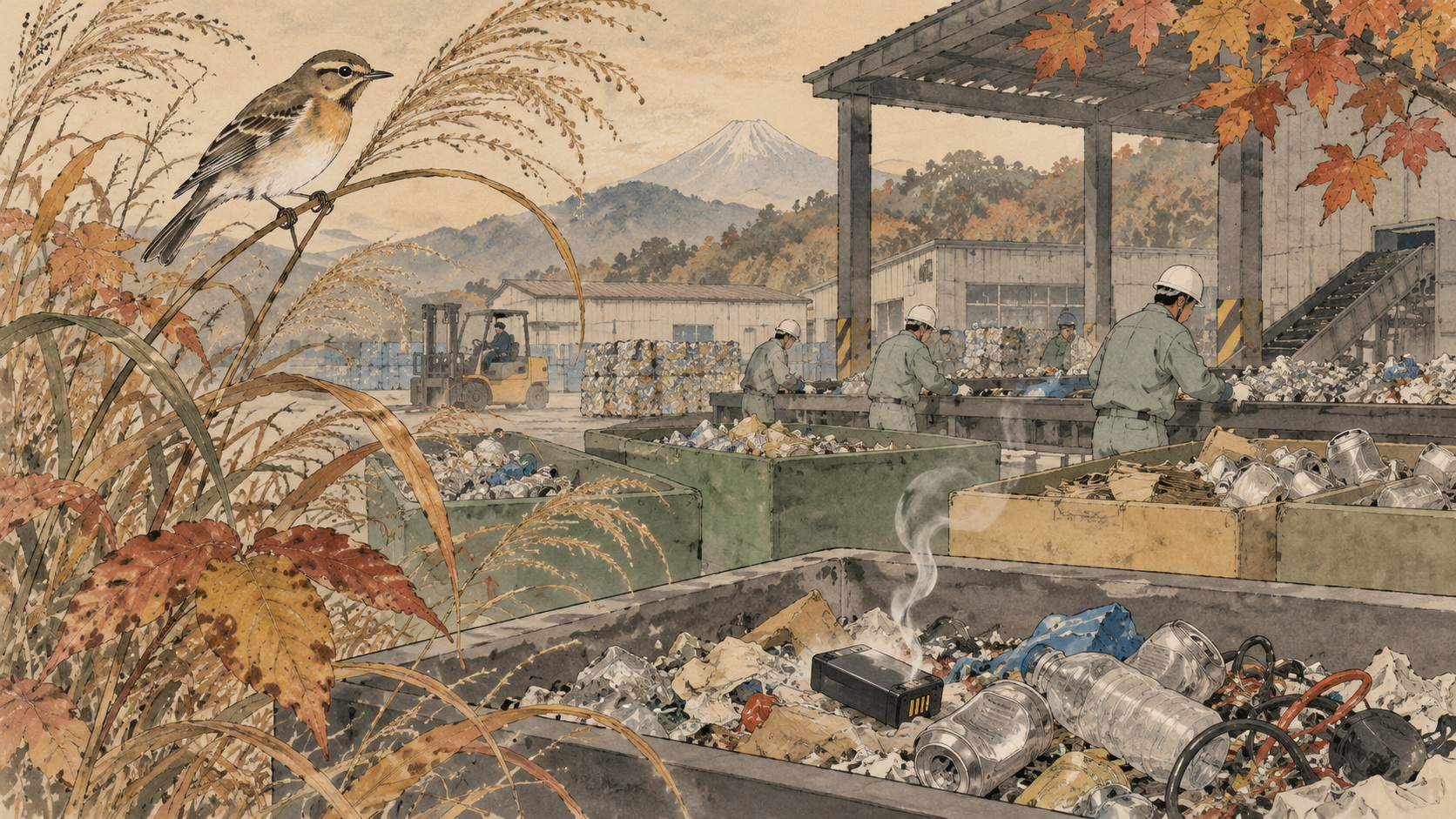
The risk hidden inside an ordinary bin
A discarded power bank can look harmless as a garbage truck rolls through a neighborhood. At a sorting plant, however, crushing or puncturing its rechargeable cell can turn the end of an everyday product into an emergency for the people processing it. Japan’s newest nationwide figures reveal how frequently that risk surfaces—and how difficult it is to count the danger correctly.
39,282 incidents—not 39,282 major fires
The Environment Ministry’s final survey, released September 29, recorded 39,282 suspected lithium-ion-battery-related incidents during municipal waste handling in fiscal 2025, up from 23,068 the year before. Crucially, the total includes smoke, sparks and ignitions contained automatically. It is misleading to call every case a fully developed fire. The ministry collected responses from all 1,741 municipal and equivalent authorities covered by the survey.
A closer look at what actually happened
The categories tell a more useful story: 17,792 incidents involved ignition extinguished by sprinklers or similar systems; 11,550 involved sparks or smoke without ignition; 9,287 required staff to extinguish a fire; 169 involved firefighters; and 484 were classified as other. Thus 9,456 cases required extinguishing by workers or fire crews. A single enormous national total conceals important differences in severity and response.
Why one measure rose while another fell
In its 2026 Environment White Paper, the ministry reported 9,923 incidents requiring extinguishing by staff or firefighters in fiscal 2024. The comparable 2025 figure, 9,456, was lower, even though the all-incident count grew sharply. That does not make the problem disappear: improved detection, reporting differences, changing waste streams and real changes in risk all warrant investigation. The published totals alone cannot identify which explanation dominates.
The collision between battery design and waste machinery
Lithium-ion technology delivers impressive energy density. But cells can be damaged by compression, impacts or electrical short circuits. Sorting and shredding systems are precisely the sort of industrial environment in which an improperly discarded battery may be crushed, sometimes amid other combustible material. Devices do not always announce that they contain a battery: power banks, heated-tobacco products and rechargeable consumer gadgets pose different sorting challenges.
A Japanese technological triumph acquires a difficult afterlife
Rechargeable lithium-ion batteries helped untether personal computing and communications during the 1990s, and they now serve electric vehicles and renewable-power systems. The 2019 Nobel Prize in Chemistry recognized M. Stanley Whittingham, John B. Goodenough and Japan’s Akira Yoshino for their contributions. The achievement transformed daily life. But the same qualities that made cells small and powerful also make the end-of-life system a serious design, collection and industrial-safety problem.
More collection programs, but a conspicuous gap
In fiscal 2025, 86.2% of surveyed municipalities collected lithium-ion cells or products containing them, an 8.9-percentage-point improvement. Yet only 41.3% reported collecting swollen or deformed batteries. That is the paradox: the items that most urgently require safe handling may be the most difficult for residents to surrender through standard programs.
Why the ordinary collection box has limits
The nonprofit recycling system operated by Japan’s JBRC accepts eligible small rechargeable batteries from member manufacturers under defined conditions. Swollen, broken, water-damaged or dismantled packs are excluded; some product classes are excluded too. A portable charging bank is generally collected as a whole rather than disassembled by its owner. A resident who discovers a damaged or ineligible battery should seek municipality or manufacturer instructions rather than forcing it into an ordinary shop collection box.
What households can do—and what they should not attempt
The most useful advice is local, not universal: check the municipality’s current disposal instructions, keep rechargeable batteries out of mixed household trash, and follow the approved collection channel’s guidance. Stop using or charging a visibly swollen, damaged or overheating battery and ask the responsible authority about safe handling. Do not puncture, dismantle, deliberately discharge or otherwise experiment with a suspect cell.
A three-month campaign and a football-stadium message
Japan’s Environment Ministry designated October through December 2026 for an intensified prevention campaign, with November as its fire-prevention month. Its “three Cs” message emphasizes choosing wisely, using batteries carefully and disposing of them correctly. In an unusual outreach partnership, the ministry is working with J.League clubs on public education and collection activities. That places a technical waste-management problem where ordinary consumers can see it.
The supply-chain case for safer collection
Lithium-ion batteries are also potential secondary sources of critical minerals including lithium, nickel and cobalt, depending on their chemistry. Japan’s inter-ministerial coordination framework launched in 2025 links fire prevention with resource circulation and economic security. Yet recycling yields, costs and technologies differ sharply among battery types. A safe take-back route is the foundation of recovering materials, not proof that every recovered cell can be profitably recycled.
The unanswered questions manufacturers and municipalities face
What proportion of the reported incidents occurred during transport versus shredding? Are operators detecting more smoke earlier, or are more batteries entering the waste stream? How readily can a resident dispose of a swollen battery in a small municipality? What are the costs of containment, insurance, downtime and new sorting equipment? These are not questions the headline total can answer on its own.
Who pays for our rechargeable world?
Japan has demonstrated the extraordinary value of putting large amounts of energy into ever smaller objects. The country’s new waste figures ask it to solve the other half of that achievement: extracting those objects safely from the economy. A collection worker should not become the final safety system for a consumer product simply because the owner did not know where it belonged.
Sources and further reading
- Environment Ministry final municipal survey
- 2026 fire-prevention campaign
- 2026 Environment White Paper
- Inter-ministerial battery policy
- JBRC battery eligibility and disposal
- JBRC collection finder
- 2019 Nobel Prize in Chemistry
- October 14 report
Based on the Environment Ministry’s final survey released September 29, 2026. October 14 news coverage did not constitute a new government data release.