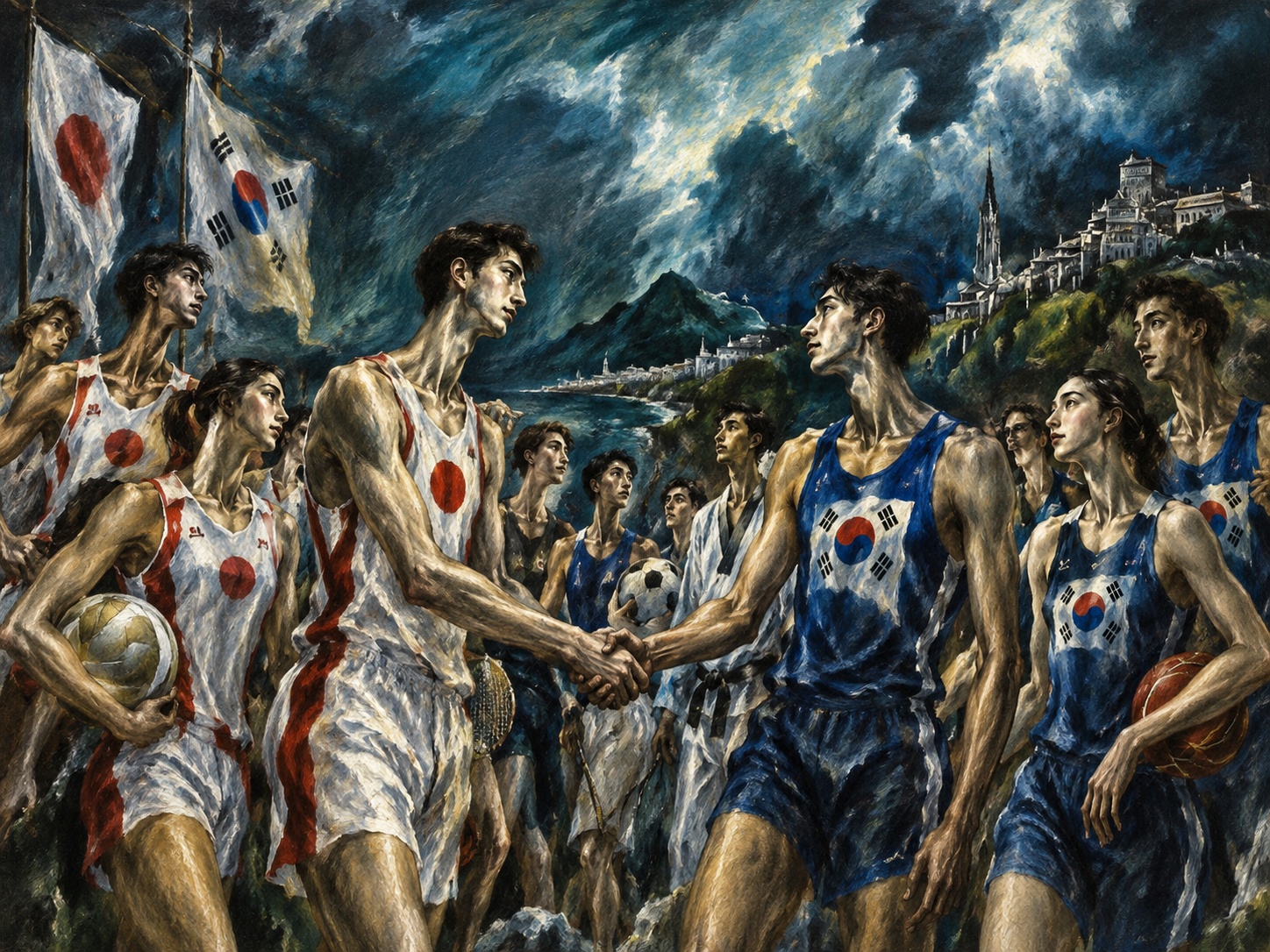
International sport is usually seen through national teams, flags and medals. The Korean delegation arriving in Ishikawa this week represents a different model.
Its athletes are sports enthusiasts in their 30s through 70s: people who have continued playing football, tennis, volleyball, basketball, baseball, badminton, bowling and other sports while living ordinary adult lives. Their Japanese counterparts are not gathering for a diplomatic ceremony. They are meeting on courts, fields and lanes.
The Japan Sport Association, JSPO, announced on September 14 that the 30th Japan–Korea Adult Sports Exchange will be held in Ishikawa from September 17 through 22. The latest announced Korean delegation is 157 people. It will participate in eight sports within the Japan Sports Masters 2026 Ishikawa program and also take part in the opening reception and cultural visits in the prefecture.[1]
An earlier April plan listed 158 people for the inbound Korean delegation. The September 14 release revised that figure to 157 without explaining the one-person change. Japan.co.jp therefore uses the latest number.[1][2]
Athletes with day jobs, not a national elite team
JSPO describes the adult exchange as a program in which Japanese and Korean sports enthusiasts aged roughly 30 to 70 visit one another’s countries, play sport and take part in cultural activities intended to deepen mutual understanding. More than 7,000 people from the two countries have participated over the life of the program.[3]
In Japan, the exchange now sits inside the Japan Sports Masters, a national multi-sport competition for highly competitive older athletes. Former elite competitors and athletes who train in regional clubs can compete on the same national stage. The 2026 Ishikawa edition contains 13 sports, with its main competition period running September 19-22.[4]
The Korean delegation will enter eight of those sports. In football, for example, the tournament regulations explicitly reserve one of the 16 team positions for a Korean team under the Japan–Korea Sports Exchange, putting it into the same group and knockout structure as Japanese regional qualifiers and the Ishikawa host team.[5]
| Item | Latest announced plan |
|---|---|
| Dates | September 17-22, 2026 |
| Host | Ishikawa Prefecture |
| Korean delegation | 157 people in the Sept. 14 release |
| Sports | Football, tennis, volleyball, basketball, soft tennis, rubber-ball baseball, badminton and bowling |
| Program | Japan Sports Masters competition, opening reception and cultural visits |
| Anniversary | 30th numbered edition since the first exchange in fiscal 1997 |
The origin lies in the 1996 decision to co-host the World Cup
The exchange began before the 2002 FIFA World Cup itself. JSPO’s history traces the starting point to May 1996, when Japan and South Korea were selected to co-host the tournament. At a Japan–Korea summit on Jeju Island in June, the two governments discussed using the shared tournament to deepen friendship and exchange between the countries.[6]
In January 1997, another summit was held in Beppu, Japan. Government support for sports exchange was approved, and working-level meetings in Tokyo and Seoul set up several programs, including youth exchange, adult exchange and athlete-development activities.[6]
The first adult exchange followed in fiscal 1997. A global tournament had produced something local and repeatable: a mechanism through which non-elite athletes could travel to the other country.
The exchange outlived the World Cup
The 2002 World Cup ended after a month. The institutions built around the co-host relationship did not.
From 2003, Japan and South Korea expanded youth and sports exchanges through the Japan–Korea Joint Future Project, and JSPO’s programs were included in that framework.[3]
That durability is part of the legacy. Mega-event legacies are often measured in stadiums, tourism and television audiences. The Japan–Korea sports program shows another kind of legacy: administrators, federations and local hosts retaining a reason and a procedure to meet again the following year.
Since 2012, Korea has entered the Japan Sports Masters
JSPO says Korean adult delegations have participated in the Japan Sports Masters during the Japan-hosted half of the exchange since fiscal 2012.[1][7]
The Masters is not merely recreational. It is designed for older athletes with a competitive orientation, giving them a national stage while promoting lifelong participation and physical and social well-being.[4]
Putting Korean teams inside that structure creates something different from a stand-alone friendship match. The competition matters. Athletes play under the same rules and tournament pressures, then move back into the exchange program afterward.
The Korean group is part of a much larger Ishikawa event
JSPO’s late-August planning figure for the 2026 Ishikawa Masters was about 7,946 participants and officials as of August 25. That figure included athletes, coaches, event and competition officials, operational staff and the Korean exchange delegation, which was still listed as 158 at the time.[8]
The later exchange announcement reduced the Korean figure to 157, so the 7,946 figure should be treated as an approximate planned scale rather than a final attendance count.
The Masters spreads competition across cities and towns including Kanazawa, Komatsu, Hakusan, Nomi, Nonoichi, Nanao, Suzu, Shika and Nakanoto. Ishikawa previously hosted the Masters in 2011 and 2015, making 2026 its third edition.[9][10]
The 2026 exchange is already halfway through its reciprocal cycle
The adult program is reciprocal. Japan does not simply host a Korean delegation.
From April 23 to 28, a 154-member Japanese delegation selected from Ishikawa and Shizuoka visited Gyeongsangnam-do in South Korea. It participated in eight sports and joined the National Sports Festival for All, Korea’s major nationwide lifelong-sports event, as a special participant.[2]
September is the return leg. Korean participants travel to Ishikawa and enter Japan’s own Masters structure.
This pairing is deeper than arranging two isolated friendship matches. Participants experience how the other country organizes adult sport — its venues, schedules, volunteers, local teams, ceremonies and community life.
“Thirty years” does not mean 30 uninterrupted years of in-person travel
The anniversary needs one important qualification. The 24th adult exchange in 2020, the 25th in 2021 and the 26th in 2022 were canceled because of COVID-19.[11][12][13]
In 2020, Japan’s planned trip to Korea was first postponed and the full reciprocal program was later canceled. Cross-border restrictions and public-health conditions also prevented the 2021 and 2022 editions from taking place in person.[11][12][13]
The exchange resumed in 2023 with the 27th edition, including a Japanese visit to Gyeongsangbuk-do and a Korean visit to Fukui.[3]
The 30th edition therefore marks the numbered program and its 30th anniversary since 1997, not 30 consecutive years in which athletes physically crossed the border. The fact that organizers returned to the same reciprocal structure after a three-year interruption is itself part of the story.
The program has also paused for reasons other than a pandemic
In 2014, the planned Japanese delegation to Korea for the 18th adult exchange was postponed after the Sewol ferry disaster. JSPO said it made the decision after consultations with its Korean counterpart and in consideration of conditions in South Korea. The Japanese-hosted exchange was still planned around that year’s Japan Sports Masters in Saitama.[14]
International exchange depends on judgment as much as a calendar. In moments of national mourning or emergency, postponing a visit can be a form of respect rather than a failure of friendship.
2025 marked 60 years of diplomatic normalization; 2026 marks 30 years of sports exchange
The 29th adult exchange in 2025 was recognized as a project commemorating the 60th anniversary of the normalization of diplomatic relations between Japan and South Korea. Japanese athletes traveled to Jeollanam-do and a Korean delegation came to Ehime.[15]
The following year gives the sports program its own anniversary.
Grassroots sport should not be romanticized as a solution to interstate disputes. Historical, security, trade and political disagreements cannot be settled by a basketball game or a bowling match.
The program’s contribution is narrower and more credible: it creates recurring contact in which the other country is represented not by an abstract national image but by people who share a sport, a meal and a few days of travel.
Age changes the subjects athletes share
This is not primarily a youth-development exchange. Participants range from their 30s into their 70s.
That changes the conversation. Adult athletes know about fitting training around work and family, recovering from injuries, adapting to changing bodies, running regional clubs and helping younger players. Those experiences can travel across language more easily than formal diplomacy.
JSPO explicitly includes understanding of culture and social conditions in the exchange’s purpose, which is why cultural visits in Ishikawa sit alongside competition rather than outside the program.[1]
Sport lowers the first barrier to conversation
Language differences are real. Sport supplies a shared starting point.
The score in tennis, a volleyball rotation, a strike, a basket or a bowling spare does not need diplomatic interpretation. An athlete can recognize a difficult shot or a good defensive play before knowing how to praise it in the other language.
That does not mean competition automatically produces understanding. Meals, cultural visits, team conversations and the relationships among local organizers turn a match into something more durable.
Serious competition and friendship are not opposites
One might argue that a friendship exchange should minimize winning and losing. The opposite case is also persuasive.
A serious opponent earns respect precisely because the match matters. Athletes compete, become frustrated, adjust strategy and try to win — then shake hands. That movement from rivalry to conversation is a practical form of fair play.
The Japan Sports Masters itself is built around competition among older athletes while promoting lifelong sport and well-being.[4]
Friendship does not require pretending the score is irrelevant. It requires knowing where competition ends.
After 30 years, participant totals are not enough
More than 7,000 cumulative participants demonstrate the scale of the program. Japan.co.jp’s analysis is that the next decade should be evaluated with more than headcount.
- Repeat relationships: do teams and individuals continue communicating or visiting after the official program?
- Local spillover: do host clubs and volunteers remain involved in international exchange?
- Participation breadth: are regions, genders, ages and sports rotating rather than becoming a closed network?
- Lifelong sport: does international exchange help participants stay active or strengthen their home clubs?
- Mutual understanding: do participant attitudes or knowledge of the other country change measurably?
JSPO has used participant surveys in past exchanges. A 30th-anniversary program creates an opportunity to look beyond immediate satisfaction and ask what remains several years later.
Six days in Ishikawa carry three decades of infrastructure
The Korean delegation arrives September 17. The Masters opening reception is September 18, and the main competition period begins September 19. By September 22, the six-day visit will be over.
But the structure behind those six days was built over three decades: a World Cup co-host decision, government talks, agreements among sports organizations, rotating local hosts, travel to Korean lifelong-sports events, Korean participation in Japanese Masters events, cancellations and restarts.
It would be inaccurate to describe 30 years of Japan–Korea relations simply as an era of friendship. Political tension and social friction have repeatedly existed alongside exchange.
What happens on an Ishikawa court or baseball field this week is smaller than diplomacy. Adults in their 30s, 40s, 50s, 60s and 70s will chase balls, argue with themselves over mistakes, applaud good plays and shake hands.
That small scale may be exactly the point. Even when relations between countries move in large and difficult cycles, the memory that there is somebody across the water with whom you once played a match moves at a different speed.
Sources & Reference Material
- Japan Sport Association, 30th Japan–Korea Adult Sports Exchange inbound program, Sept. 14, 2026
- Japan Sport Association, Japanese delegation to the 30th Japan–Korea Adult Sports Exchange, April 17, 2026
- Japan Sport Association, Japan–Korea sports exchange overview and past adult exchanges
- Japan Sport Association, Japan Sports Masters overview and 2026 Ishikawa edition
- Japan Football Association, Japan Sports Masters 2026 Ishikawa football competition format
- Japan Sport Association, historical leaflet on the Japan–Korea sports exchange
- Japan Sport Association, Korean delegation to the 28th Adult Sports Exchange, Sept. 25, 2024
- Japan Sport Association, Japan Sports Masters 2026 Ishikawa scale and participant estimate
- Japan Sport Association, Japan Sports Masters 2026 Ishikawa schedule and venues
- Japan Sport Association, Ishikawa selected to host the 2026 Japan Sports Masters, April 17, 2024
- Japan Sport Association, cancellation of the 24th Adult Sports Exchange in 2020
- Japan Sport Association, cancellation of the 25th Adult Sports Exchange in 2021
- Japan Sport Association, Adult Sports Exchange record covering 2022 cancellation and 2023 resumption
- Japan Sport Association, postponement of the 18th Japanese delegation after the Sewol ferry disaster, April 22, 2014
- Japan Sport Association, 29th Adult Sports Exchange and 60th anniversary of diplomatic normalization, 2025
Sources checked through September 14, 2026. The planned Korean delegation was listed as 158 in April but revised to 157 in the latest Sept. 14 release; no public explanation for the one-person change was found. The '30th' edition refers to the numbered program and 30th anniversary since fiscal 1997, not 30 uninterrupted years of in-person exchange: the adult program was canceled in 2020, 2021 and 2022 because of COVID-19. The approximately 7,946-person Ishikawa Masters figure was a planning estimate as of Aug. 25, not a final attendance count. Analysis is by Japan.co.jp.