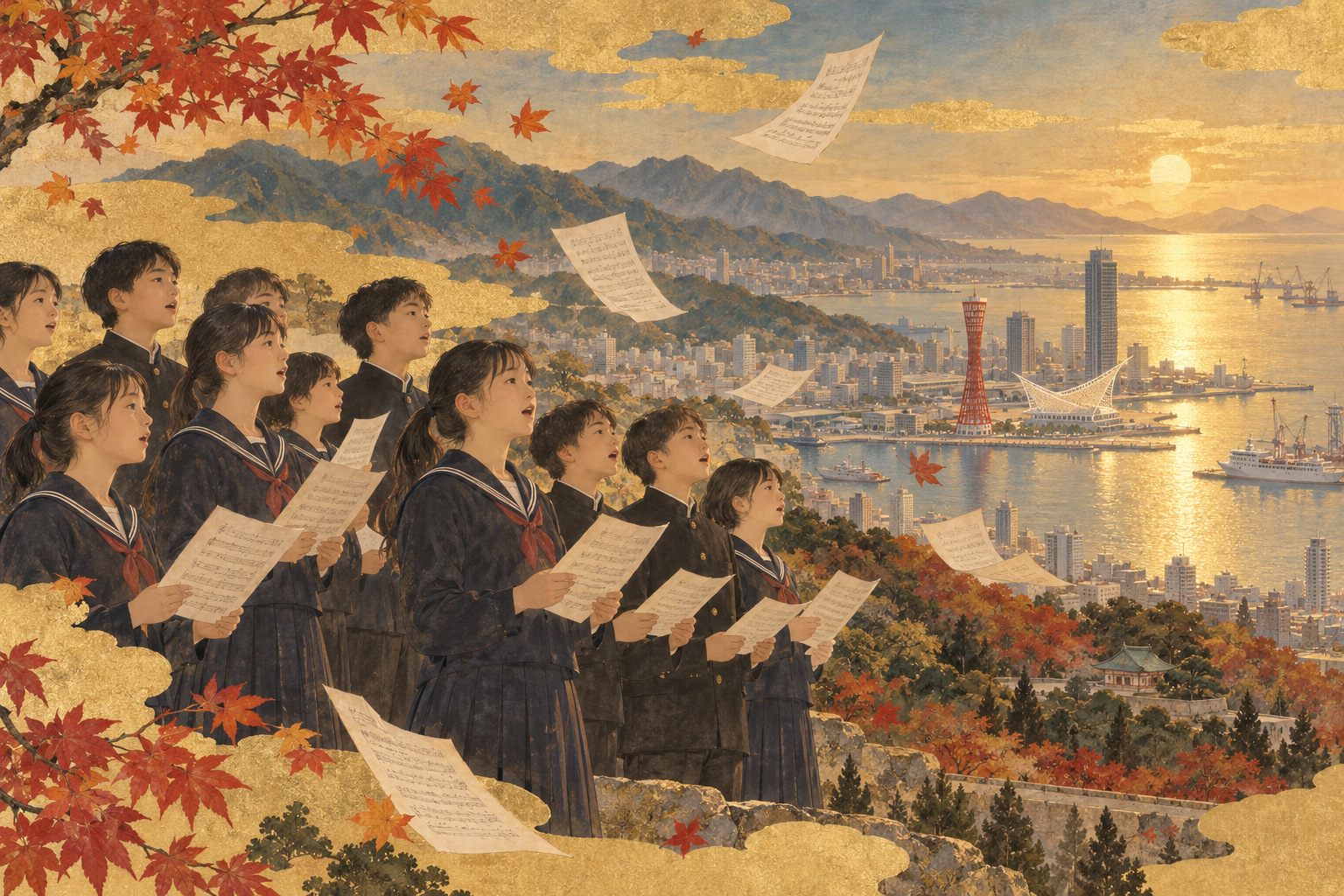
The composer was gone. The choir remained.
On September 26, roughly 200 people gathered at Kobe Shinwa University to remember Makoto Usui, a teacher and composer whose song came to define the city’s response to the Great Hanshin-Awaji Earthquake. Students, former pupils and colleagues shared memories, and those attending sang Shiawase Hakoberu Yō ni—the work he wrote after the disaster. Usui had died on July 10 at age 65.
The gathering offers a more revealing story than another obituary. A musical work born in ruins had become a shared language, independent of its creator, more than three decades later. Contemporary coverage from Sun Television and the Kobe Shimbun documents the memorial. This report draws on those published accounts and primary institutional records; it does not claim a reporter attended the service or interviewed the family.
When the city collapsed
At 5:46 a.m. on January 17, 1995, the Hanshin-Awaji earthquake devastated neighborhoods across Kobe and the surrounding region. Kobe’s municipal disaster record counts 4,571 deaths within the city and 67,421 buildings completely destroyed. These are city-specific figures, not totals for every affected prefecture.
Usui was a music teacher at a Kobe municipal elementary school. His home in Higashinada Ward was destroyed, and he sought shelter with relatives. Music educators are often asked to bring calm to children in uncertain times; in this case, the teacher himself had lost his home. That shared vulnerability helps explain the unusual emotional weight his composition would acquire.
A song composed in minutes, carried for decades
According to Kobe Shinwa University’s biographical account, Usui watched news images of his damaged hometown from a relative’s home about two weeks after the quake. He wrote the words and music of Shiawase Hakoberu Yō ni in approximately ten minutes, the university says. The elapsed time is a retrospective institutional account, not an independently reconstructed recording of his creative process.
The title can be rendered loosely as “May We Carry Happiness.” Rather than reproducing the full copyrighted lyrics, it is more useful to describe their moral direction: remember those who died, value the lives still being lived, help one another and work toward a renewed hometown. The words invite collective responsibility without pretending the losses can be reversed.
The first stage was a schoolyard
Kobe Shimbun records that roughly a month after the earthquake, Usui set up an electronic piano in the grounds of the former Azuma Elementary School and sang the completed piece with pupils. The physical setting matters. These were not ideal acoustics in a concert hall. They were children learning to sing in a city still dealing with the immediate aftermath of destruction.
Over time the work became common at memorial observances, schools, Kobe Luminarie events and coming-of-age celebrations. On January 17, 2021, Kobe formally designated it as the city’s second municipal song. The earlier anthem, adopted in 1951, remained in place. The formal designation followed decades of use by teachers and residents rather than creating the song’s popularity overnight.
How children inherit an earthquake they never saw
Most of today’s schoolchildren were born long after 1995. They cannot remember the broken streets, disrupted families or improvised classrooms firsthand. They can, however, learn a melody and ask what made its words necessary. Kobe’s education authorities include the song in their public discussion of disaster education.
This is an important distinction: music can carry memory, but a performance is not a substitute for earthquake-resistant buildings, evacuation planning or practical drills. A song can help establish why preparedness and mutual assistance matter. Effective risk reduction still requires engineering, institutions, local coordination and rehearsal.
A Kobe song that reached other disasters
Kobe officials and Usui’s university recount performances or adaptations in communities affected by the 2004 Niigata Chuetsu earthquake, the 2011 Great East Japan Earthquake, the Kumamoto earthquakes and the Noto Peninsula disaster. Some performances have adapted place names to reflect other damaged hometowns.
Such circulation has a compelling explanation, though not one measured by a formal audience study. The song was specific enough to emerge from Kobe but broad enough to offer a language of solidarity elsewhere. Each disaster remains distinct. A community has to decide whether and how a work created somewhere else speaks to its experience; the existence of a shared song cannot erase different losses or recovery needs.
A career measured in pupils, not just performances
Usui began teaching music at Kobe municipal elementary schools in 1983 and retired in 2021. He subsequently taught future educators at Kobe Shinwa University. The university lists recognition for teaching and culture, including a 2011 education-ministry honor and a 2021 JASRAC music culture award.
Those facts complicate the image of the solitary composer producing a miraculous work and disappearing behind it. His working life was devoted to the routines of instruction: helping children sing, helping new teachers learn to teach and making music accessible. The September memorial brought together people shaped by that work, not simply admirers of one famous composition.
What the September memorial showed
Kobe Shinwa University announced the September 26 memorial in advance. Local television reported that sheet music and messages from former students were displayed, and that members of Usui’s seminar spoke about what he had taught them. Those present joined in singing the song he had written after the disaster.
The university’s original July death notice explicitly asked reporters to respect the family’s wish for privacy. A responsible remembrance can honor that request. There is no need to invent a last conversation, speculate about private grief or pass off a media quote as an original Japan.co.jp interview.
Beyond the comforting recovery narrative
Disaster remembrance is vulnerable to becoming too neat. It is tempting to end every anniversary story with a triumphant skyline and a choir, as though those images erase decades of displacement, debt, physical injury or bereavement. The actual rebuilding of Kobe required construction, public finance, housing policy, education and the labor of residents over years. A song did not do that work for them.
What music can do is different. A familiar tune gives people a repeatable occasion to remember the dead and to express commitments to the living. That is a cultural observation, not proof of a clinically measured psychological benefit. It matters precisely because it operates alongside, not instead of, the material work of recovery.
The next generation becomes the custodian
The challenge now is no longer whether Usui can conduct another gathering. It is whether teachers, community groups and young singers can preserve the context along with the melody. Kobe provides an official recording and lyrics for reference, and educational institutions maintain records of the composer’s career. Reproducing or performing the work in new contexts may entail copyright procedures.
Usui’s death makes the act of transmission more visible. At the September gathering, his students sang without him. Future classes will learn from teachers who may themselves have been born after the disaster. That is how a song moves from one man’s response to a public tragedy into a living civic practice—and how Kobe’s memory may continue to reach someone who has never been there.
Sources and reporting documents
- 神戸市:神戸市歌「しあわせ運べるように」
- 神戸市:神戸市歌の指定日と作詞作曲者
- 神戸市:神戸の防災教育
- 神戸市:阪神・淡路大震災被害の状況
- 神戸親和大学:臼井真教授の訃報(7月15日)
- 神戸親和大学:「臼井真先生を偲ぶ会」案内・経歴
- サンテレビ:9月26日の偲ぶ会の模様
- 神戸新聞:9月26日追悼行事と教え子による合唱
- 神戸新聞:臼井真の活動と1995年の初演
- 神戸市:文化活動功労賞と臼井真の業績
- 「しあわせ運べるように」公式チャンネル・原曲の合唱映像
Research cutoff: October 12, 2026 JST. No direct interview with Usui’s family was conducted.