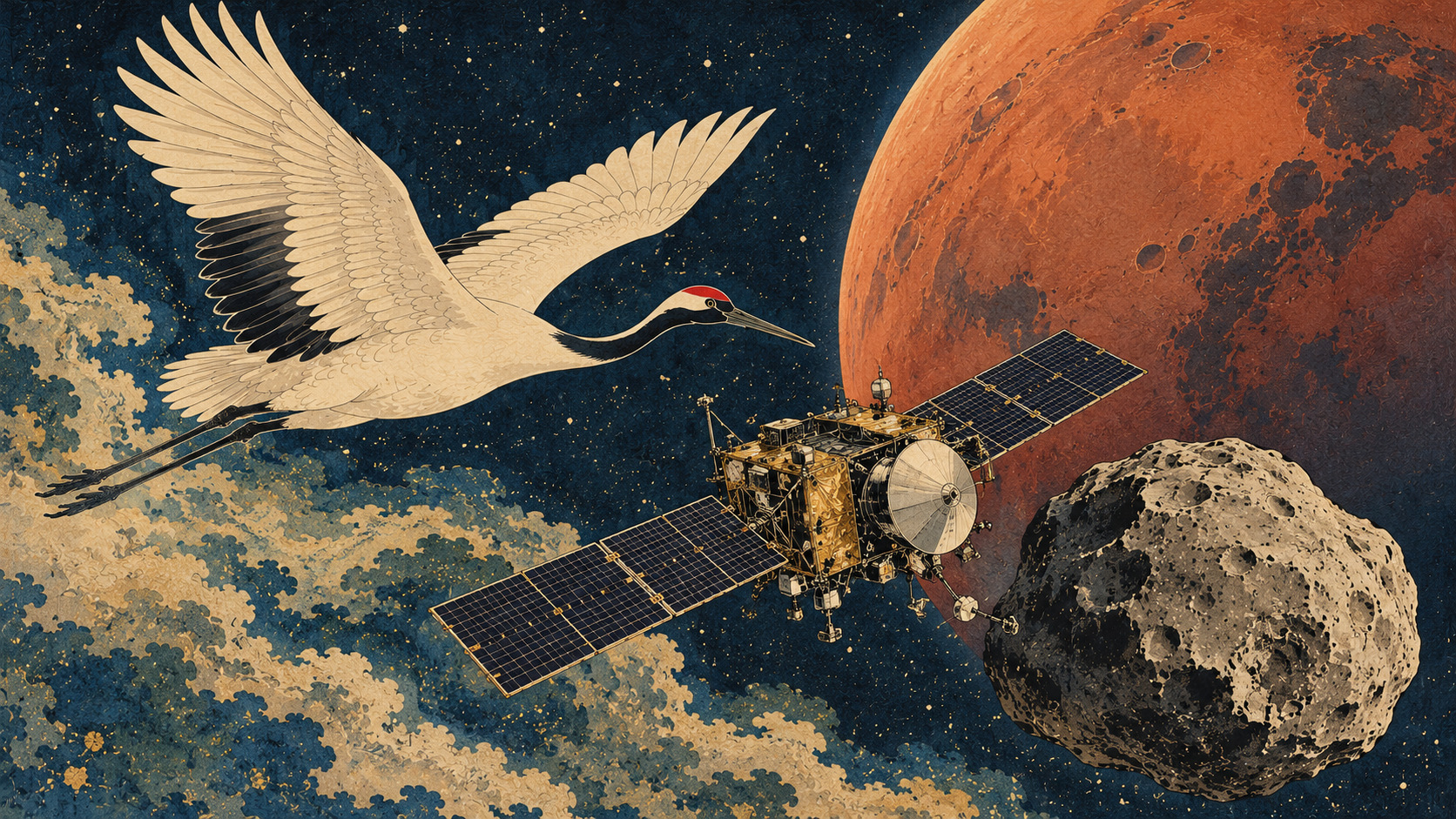
Ten grams is a tiny cargo. Getting it home from Phobos is a five-year planetary expedition.
A departure before dawn
At 4:41:03 a.m. Japan Standard Time on October 20, an H3 rocket lifted off from Tanegashima Space Center carrying Japan’s Martian Moons eXploration spacecraft. JAXA reported that the vehicle flew as planned and released MMX roughly one hour, eleven minutes and thirteen seconds after launch. That announcement establishes a successful launch and spacecraft separation. It does not mean MMX has reached Mars, landed on a moon or collected material. Those difficult milestones still lie ahead.
Why Japan wants just ten grams
MMX is not designed to bring back soil from the surface of Mars. Its principal sample target is Phobos, the larger of Mars’s two small moons. JAXA intends to collect at least ten grams of material and deliver it to Earth in fiscal 2031. The quantity sounds modest, yet ten grams can be divided among laboratories using microscopic, chemical and isotopic techniques far more sophisticated than instruments that can be flown to space. Scientists may preserve some material for future tools that have not yet been invented.
The unresolved origin of Phobos
Scientists have long debated how Mars acquired Phobos and its smaller companion Deimos. One family of explanations treats them as asteroids captured by Martian gravity. Another considers them the products of a giant collision involving Mars, with debris eventually assembling into satellites. Orbital geometry and the moons’ surface appearances complicate both broad pictures. Remote sensing will help, but the chemistry, mineralogy and age of returned grains may provide more discriminating evidence. Neither the mission nor a single sample can guarantee an unambiguous verdict.
A landing in almost no gravity
MMX faces an unusual engineering problem. Phobos is an irregular body with extremely weak gravity, so the forces involved in surface contact differ sharply from those on Earth or Mars. Mission planners must first study the terrain from proximity orbits, choose a sampling area and control a close surface operation. JAXA identifies two methods: a coring mechanism intended to reach at least two centimeters below the surface and a pneumatic P-sampler that uses nitrogen gas. Sampling beneath the most radiation-altered surface layer could improve the scientific usefulness of the material.
A scout from France and Germany
Before the main spacecraft attempts its sampling work, a compact rover called IDEFIX is planned to investigate Phobos. Developed jointly by France’s CNES and Germany’s DLR, it is intended to characterize the behavior of loose surface regolith and gather information that reduces landing and collection risks. A successful rover deployment would give engineers something precious: direct experience with terrain that no spacecraft has yet traveled across. Its contribution is both scientific and operational, illustrating how the mission distributes expertise across national space agencies.
The United States reads the moon from orbit
NASA contributes the Mars-moon Exploration with Gamma Ray and Neutrons instrument, known as MEGANE. By measuring gamma rays and neutrons emitted from the surface, the instrument seeks information about elemental composition that cameras cannot supply. Data from MEGANE and other MMX sensors will be considered alongside observations of geology and the samples ultimately analyzed on Earth. The scientific payoff comes from connecting different kinds of evidence, not simply securing an attractive image of a distant world.
A Japanese tradition of returning the evidence
Japan enters the mission with rare sample-return experience. The original Hayabusa delivered material from asteroid Itokawa to Earth in 2010. Hayabusa2 brought back samples from Ryugu in 2020, opening investigations into minerals, water-related compounds and organic molecules. The path was not uniformly triumphant: Japan’s earlier Nozomi Mars mission failed to enter Martian orbit. MMX therefore extends a history of ingenuity, operational setbacks, recovery and patient advances in navigation, robotics and the preservation of extraterrestrial material.
The long route home
JAXA’s current schedule anticipates arrival in the Martian system around fiscal 2027, several years of investigation and sampling through 2030, departure from the Mars region around fiscal 2030 and Earth return in fiscal 2031. The capsule is planned for recovery in Australia. These are objectives, not completed milestones or guaranteed dates. Planetary geometry, technical health and findings from the first phase will shape decisions throughout the mission. JAXA has also planned observations of Deimos, giving the project value beyond the single targeted sampling site.
What the samples might—and might not—tell us
Researchers hope the samples may preserve evidence of the moon’s origin and the early Martian environment. JAXA’s curation specialists also anticipate the possibility that traces of material ejected from Mars could be mixed into Phobos’s surface deposits. Such material has not been confirmed in MMX samples, which do not yet exist on Earth. The science will require contamination control, careful allocation and competing interpretations. It is more realistic to promise new evidence than a final answer to every mystery about Mars.
A launch is a beginning, not a conclusion
The October 20 launch is a significant H3 and planetary-exploration milestone, especially because it sends a Japanese spacecraft toward another planetary system. What follows is harder to photograph: trajectory corrections, communications over vast distances, site selection, operations in weak gravity and a years-long return. If MMX ultimately brings those grains home, a seemingly tiny cargo could occupy generations of scientists. That is the scale of the venture begun in the darkness above Tanegashima: a long international experiment whose results must still be earned.
Sources and further reading
JAXA confirms launch and separation, not sampling or return. This feature is based on public mission material and contains no original interview.