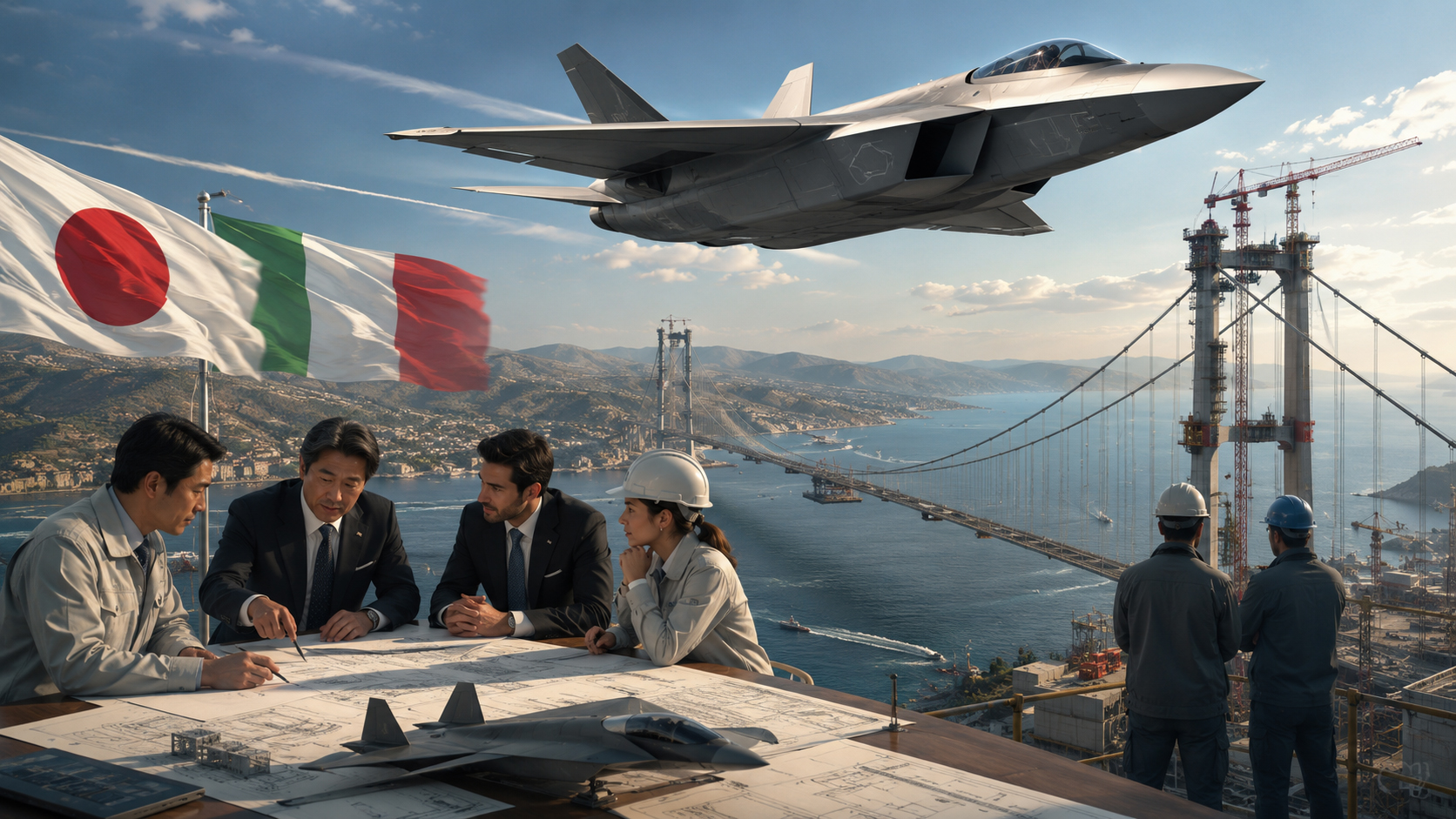
Japan and Italy are meeting in two symbolic places at once. One is the future sky: the Global Combat Air Programme, or GCAP, the next-generation fighter being developed by Japan, Britain and Italy. The other is a narrow sea: the long-delayed Strait of Messina Bridge, intended to connect Sicily with the Italian mainland. A fighter jet and a suspension bridge seem like very different stories. Together, they reveal a larger one: Japan’s engineering power is becoming a diplomatic asset.
Reuters reported that Japanese Prime Minister Sanae Takaichi, visiting Rome, strongly supported the Messina bridge project, highlighting Japanese investment and the role of IHI alongside Italy’s Webuild and Spain’s Sacyr. At the same time, GCAP continues to move forward as a trilateral fighter programme aimed at service in 2035. Both projects are long, expensive, politically difficult and technically unforgiving. Both require not only manufacturing skill, but international coordination, legal structure, export judgment and public trust.
Why a fighter and a bridge belong in the same story
A fighter aircraft is national security. A bridge is civilian infrastructure. But both are systems of trust. GCAP integrates stealth, sensors, engines, electronics, data links, unmanned cooperation and combat-cloud logic. The Messina Bridge integrates steel, seismic engineering, wind testing, cables, maintenance, environmental assessment and construction management. Neither is a simple product. Both are national-scale engineering bets.
Japan’s work with Italy is therefore not simply about selling or buying hardware. It is about designing together, sharing risk and navigating domestic politics and international rules. Japan’s manufacturing reputation has long rested on quality and reliability. The new test is whether Japan can sit inside large multinational programmes where responsibility is shared and the political stakes are high.
GCAP: from F-2 successor to exportable combat-air industry
GCAP links Japan’s need to replace the F-2 fighter with Britain and Italy’s future combat-air ambitions. Announced in December 2022, the programme aims to field a next-generation aircraft around 2035. The industrial core includes BAE Systems, Leonardo and Japan’s industrial consortium, supported by Mitsubishi Heavy Industries and other Japanese firms.
The aircraft itself matters, but so does the policy framework around it. Japan spent decades placing strict limits on defense-equipment exports. GCAP forces Tokyo to rethink how a jointly developed fighter can be transferred, under what conditions and to which countries. That makes the programme a technical project and a constitutional-political one at the same time.
What GCAP means for Italy
For Italy, GCAP is a pillar of future aerospace industry built around Leonardo and a network of suppliers. Reuters reported earlier in 2026 that Italy’s parliament approved nearly €8.8 billion for the initial phases of the programme. As Europe’s rival Franco-German-Spanish FCAS project has faced repeated strains, GCAP has gained attention as a comparatively workable multinational fighter effort.
Italy gives Japan a European industrial partner with deep aerospace experience and NATO ties. Japan gives Italy advanced manufacturing, Asia-Pacific strategic relevance and a route into a broader international fighter market. The Mediterranean and the Pacific are now connected not by geography, but by design rooms, secure data systems and defense budgets.


The Strait of Messina Bridge: dream, controversy and IHI
The idea of joining Sicily to mainland Italy has surfaced for decades, repeatedly revived and repeatedly delayed. It has been challenged by cost, environmental concerns, seismic risk, organized-crime fears, EU competition questions and politics. Reuters reported that the cost has risen to around €13.5 billion and recalled that the project was halted in 2012 under austerity measures.
IHI announced in 2025 that it had joined the project. The company describes the bridge as a road-and-rail suspension bridge with a 3,300-meter main span. If completed, it would be among the world’s longest suspension bridges. For Japan, the project is not just a construction contract. It is a test of whether Japanese long-span bridge expertise can travel into one of Europe’s most symbolic and controversial infrastructure schemes.
Japan’s hidden export: bridge engineering
Japan is a bridge country. The Seto Ohashi, the Akashi Kaikyo Bridge and other large structures reflect decades of engineering under difficult conditions: earthquakes, typhoons, salt damage and long-term maintenance. IHI is part of that industrial history. The Messina project will test whether Japan’s infrastructure export can be defined not by cheap construction, but by reliability, lifespan and risk control.
The risks are large. In Italy, questions remain about environmental impact, seismic design, governance and cost. A record-setting bridge can become a magnificent calling card. It can also become a public burden if schedules slip or costs rise. Engineering diplomacy is not only pride. It is exposure.
A new character for Japan-Italy relations
Japan and Italy are both G7 manufacturing countries with strong design cultures, complex regional economies and respected small-and-medium enterprise networks. For years, the relationship was often imagined through cars, fashion, food, tourism and cultural exchange. In 2026, it has moved into defense, infrastructure and economic security.
This reflects a broader shift in Japanese diplomacy. Tokyo remains anchored in its alliance with Washington, but it is increasingly building practical technology links with Britain, Italy, Australia, India, New Zealand and European partners. The goal is not to carry every project alone. It is to share risk and combine capabilities. Japan-Italy cooperation is one line in a wider map connecting the Indo-Pacific and Europe.
- The international GCAP design-and-development contract and Edgewing’s operating role
- Japan’s rules for defense-equipment transfer and future fighter exports
- EU, environmental and seismic review of the Messina Bridge
- The exact scope of IHI’s work and quality-management responsibility
- Whether Japan-Italy ties deepen further into economic-security cooperation
Between air and sea
GCAP flies through the air. The Messina Bridge crosses the sea. But both point to Japan’s future export identity. That identity is no longer only consumer electronics or automobiles. It is the ability to manage complex, long-term, high-stakes systems with partners.
Japan’s technology diplomacy now includes defense aviation, sea-lane infrastructure, AI, space, energy, critical minerals and data. Alliances and industry are becoming harder to separate. The Japan-Italy agenda is one early sketch of that new map.
Sources and references
This Japan.co.jp report is based on Reuters, IHI, Japan’s Ministry of Foreign Affairs and GCAP industrial background materials.
- Reuters: Japan PM backs Sicily bridge plan, highlighting Japanese investment
- Reuters: UK, Japan agree tech partnership and vow fighter jet progress
- Reuters: Italy approves GCAP funding
- IHI: Strait of Messina Bridge exchange of views
- MOFA: Treaty establishing the GCAP International Government Organisation
- BAE Systems: Global Combat Air Programme overview