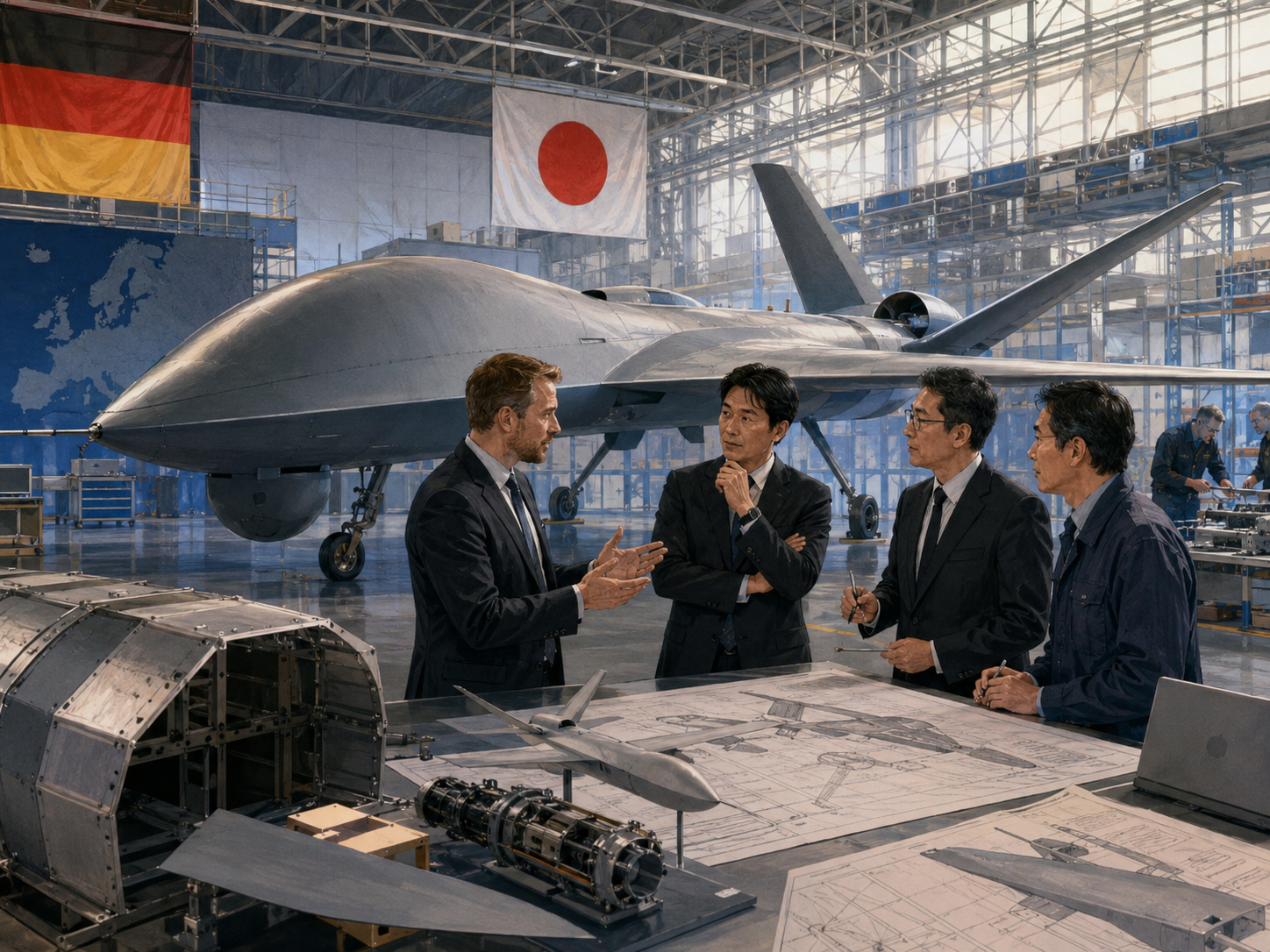
A sentence from Tokyo has connected the European sky to Japan’s defense industry. German Ambassador to Japan Petra Sigmund has voiced strong expectations that Japan may deepen its role in the European military drone program known as Eurodrone. Japan is already an observer. A fuller role would mean more than buying an aircraft; it would put Japanese industry closer to Europe’s design, certification, data and operational ecosystem.
Eurodrone, formally the European MALE RPAS, is a medium-altitude, long-endurance remotely piloted aircraft system backed by Germany, France, Italy and Spain and managed through OCCAR. Airbus Defence and Space leads the industrial side with Leonardo, Dassault Aviation and Airbus Spain as major industrial players. The aim is clear: Europe wants a sovereign intelligence, surveillance, reconnaissance and strike-capable drone system rather than permanent dependence on U.S. or Israeli platforms.
But in 2026 Eurodrone is also a troubled program. France has effectively shelved procurement in its latest defense planning, looking instead at lighter and cheaper alternatives. Airbus and Dassault are locked in a broader atmosphere of tension after disputes around FCAS, Europe’s next-generation fighter effort. Japan’s name now enters this story at a delicate time. For Europe, Japan could be an industrial and political partner. For Japan, Eurodrone could be a test case for entering European defense production not merely as a customer, but as a participant.
What Eurodrone is
Eurodrone is not the same category as the small, expendable drones that have filled battlefields in Ukraine. It is a large system designed to remain in the air for long periods, scan wide areas, gather intelligence, monitor sea lanes and provide persistent surveillance. Airbus describes it as the first remotely piloted aircraft system natively designed for safe and reliable flight in non-segregated airspace, with a payload and endurance profile suited to multiple missions, from armed ISTAR to maritime roles and future command-and-control or early-warning tasks.
OCCAR says the program grew from Europe’s concern that much of its intelligence, surveillance and reconnaissance capability relied on non-European manufacturers. The program was launched in 2016; its definition study concluded in 2018; and in 2022 a contract was signed for development, production and initial in-service support covering 20 systems, 60 aircraft and 40 ground-control stations. Eurodrone is therefore not just an air vehicle. It is a system of aircraft, control stations, sensors, certification, communications and data sovereignty.
Why Japan matters
For Japan, large unmanned aircraft touch several strategic problems at once: the Southwest Islands, long sea lanes, a vast exclusive economic zone, disaster monitoring and maritime surveillance. Historically Japan relied heavily on the United States for high-end defense systems. But the 2020s have changed the rhythm. Japan is working with Britain and Italy on the GCAP fighter; expanding ties with Australia and India; training more often with NATO countries; and deepening cooperation with Germany.
Participation in Eurodrone would matter even before any procurement decision. It would give Japan a window into European certification, open-system design, airspace integration and industrial burden-sharing. Airbus executives have said Japan’s observer status, granted in November 2023, was a strategic and industrial signal. If Japan later chose a product such as Eurodrone, Airbus has indicated that industrialization and full sovereignty in Japan could become part of the discussion.
Why Germany wants Japan closer
For Germany, Japan is not just a potential buyer. The European and Indo-Pacific security theaters are increasingly connected. Russia’s war in Europe, China’s military growth, North Korea’s weapons programs and the fragility of sea lanes have made defense planners think across regions. Sigmund’s emphasis on interoperability and pooled resources reflects that larger change: Europe and Japan may need systems that can communicate, share doctrine and support each other’s industrial resilience.
Germany also has practical reasons to widen the Eurodrone circle. France’s procurement retreat has shaken the program’s industrial balance. A deeper Japanese role could bring political support, market scale, technical collaboration and a bridge to Asian defense requirements. For Japan, the attraction is different: it could move from being a late-stage buyer to being a country present earlier in the development and industrial ecosystem.
Heavy, expensive — and still relevant?
Eurodrone has critics. It has been called large, costly and slow. Its original in-service targets slipped. The Ukraine war has made small, cheap drones appear more urgent than high-end MALE platforms. France’s interest in lighter alternatives such as Aarok reflects a real shift in military thinking.
Yet not every unmanned aircraft does the same job. Small drones are the eyes of the front line and sometimes expendable weapons. A large MALE system is designed for broader surveillance, longer endurance, maritime monitoring, infrastructure protection, signals intelligence and missions in lower-threat airspace. For Japan, the question is not whether one drone type replaces all others. The real question is which missions require persistent, sovereign, networked surveillance — and whether Japan wants to help design that system with Europe.
Japan’s defense-industry turn
Japan’s defense industry spent decades focused largely on the domestic market. Exports and international co-development were politically sensitive. But the security environment and Japan’s defense-budget expansion have changed policy. GCAP made international co-development real. The drone field could become the next place where Japanese sensors, communications, composite materials, engines, cybersecurity, mission software and data systems find international pathways.
There are obligations. Defense co-development requires export controls, intellectual-property rules, third-country transfer decisions, classified-information handling and supply-chain governance. Eurodrone would expose Japanese companies to European defense-contracting culture, certification and multinational industrial workshare. It would also require the Japanese government to explain clearly what role it wants: observer, component partner, technology contributor, future buyer or full industrial participant.


The meaning of sovereignty in the air
Eurodrone’s central word is sovereignty. For Europe it means operating, upgrading and securing data without relying on U.S. or Israeli black boxes. For Japan, the concept is equally relevant. A modern unmanned system is not finished when an aircraft is delivered. The strategic value lies in the sensors, data links, cyber protection, mission payloads and software evolution behind the aircraft.
Germany’s invitation is therefore more than a sales pitch. It is a test of whether Japan and Europe can turn shared security language into shared industrial practice. Eurodrone may be heavy. It may be contested. But the debate around it asks a larger question: which skies does Japan want to watch, with which partners, and with how much control over the technology that makes watching possible?
Sources and references
This Japan.co.jp report is based on public reporting, official program pages and defense-industry material.