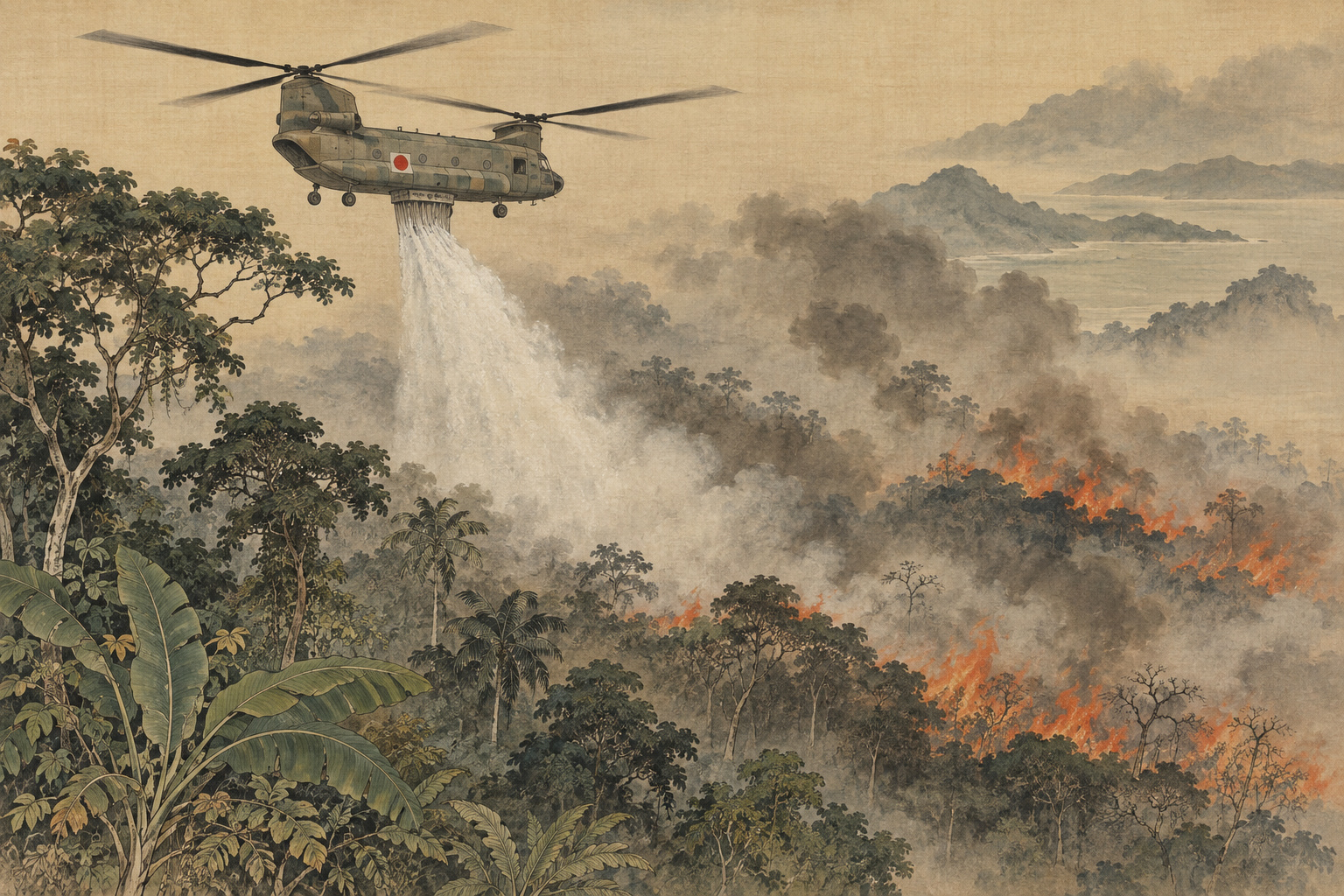
Japan has sent three Ground Self-Defense Force CH-47 transport helicopters to support Indonesia’s response to severe forest fires, moving them by sea aboard the Maritime Self-Defense Force transport ship Kunisaki. The vessel reached Kijing port on the west coast of Kalimantan on September 10. Japan’s Defense Ministry said firefighting would begin once preparations were complete.[1][3]
The deployment adds an aerial capability to a relationship with a much longer history of fire-related assistance. Its significance lies in the connection between an arriving aircraft and a functioning response: accessible water, local knowledge, ground crews and sustained attention to the smoke affecting communities beyond the flames.
What Japan has committed
The Defense Ministry’s August 28 notice records consultation between the foreign and defense ministers under Japan’s law on dispatching disaster-relief teams. The defense minister then ordered the Joint Operations Commander to conduct the mission. Kunisaki departed for Indonesia on August 30 with the helicopters aboard.[1][2]
At a September 11 press conference, the ministry explained that the deployment followed an Indonesian government request. It described the mission as the first use of Self-Defense Force assets for firefighting within an international disaster-relief operation. The wording matters: it is a first for this operational form of assistance, rather than the beginning of Japan’s involvement in Indonesia’s fire problem.[4]
Reuters reported on September 8 that Indonesian defense officials envisaged operations during September 12–19. Japan’s subsequent arrival notice and September 11 briefing still described preparations. That reported timetable should be treated as a plan, not as evidence of completed water drops or a measured reduction in fire damage.[3][4][5]
The work between arrival and a useful sortie
Before aircraft can help, the visiting unit has to connect with the response already under way. Japan’s Joint Operations Command reported on September 4 that liaison personnel were working with Indonesian forces and relevant agencies to prepare the deployment. This advance work is less visible than a ship arriving, but it is part of making outside assistance usable.[16]
Indonesia supplies the essential local context: where the fire is moving, which communities face immediate danger, what roads remain accessible and where water can be obtained. A foreign unit brings equipment and experience; it does not replace that knowledge. Effective cooperation combines the two through a common understanding of priorities and responsibilities.
Transporting helicopters overseas and keeping them available for repeated missions are also different achievements. Maintenance, replenishment, rest and communications all affect what an aircraft can deliver. A deployment should therefore be assessed as a sustained support effort, rather than by its aircraft count alone. This is an operational implication of the mission’s structure, not a claim about an unpublished Japanese flight schedule.
A helicopter’s value is more than the size of its load
The U.S. National Interagency Fire Center describes helicopters as tools for water or retardant application, reconnaissance, and the movement of firefighters and cargo. Bucket-equipped helicopters need water sources deep enough for filling. Their firefighting work is coordinated with personnel on the ground and other aircraft. These are general capabilities; the description does not establish the precise bucket or loading configuration of Japan’s deployment.[6]
A useful way to judge aerial support is to ask how reliably it can deliver water where ground teams need it. A large individual load is only one part of that calculation. The journey between a water source and the fire, interruptions for servicing, and the ability to repeat the cycle all influence the support available during a working day.
That is why an impressive drop is not the same thing as a fire brought under control. Suppressing visible flames can create an opportunity for further work. Establishing whether combustion remains, and whether a treated area stays secure, requires follow-up. The link between aircraft and ground operations is consequently central to judging what the deployment achieves.
The difficult fire beneath the surface
Peat adds a distinctive complication to fires in parts of Indonesia. It is accumulated organic material that can become fuel when sufficiently dry. JICA’s account of its earlier peat-and-forest project identifies drainage-channel construction, agricultural development and the use of fire among the processes associated with peat fires and carbon release.[7]
JAXA has explained the persistence of underground smouldering in peat, using the 2010 Russian fires as an example. Research on Indonesia’s 2019 fire season likewise describes peat burning downward and sideways, predominantly through smouldering rather than flaming. The general point is that a quieter surface does not necessarily mean combustion has ended below it.[8][10]
That does not establish that every fire encountered by the Japanese mission is a peat fire. It explains why treating all burning land as a single kind of target would be a mistake. The type of fuel and the condition of the ground matter to both suppression and subsequent inspection.
Emergency water delivery and keeping a landscape from becoming dangerously dry operate on different timescales. The first addresses a fire already burning; the second concerns the conditions that make a later fire possible. Helicopters can contribute to the emergency response without providing a complete answer to land and water management. Expecting them to do both would obscure the limits of the task they have been sent to perform.
Smoke extends the emergency beyond the burn scar
The World Health Organization identifies fine particulate matter, PM2.5, in wildfire smoke as a health hazard, including for the respiratory and cardiovascular systems. Firefighters and other emergency workers can also face substantial exposure. Haze is therefore more than a visibility problem or a dramatic image of a distant disaster.[9]
A study published in Communications Earth & Environment in 2024 used a network of low-cost sensors around Palangka Raya in Central Kalimantan during the 2019 fire season. It documented extreme pollution and variation within the urban area. The findings support attention to local monitoring, but they are not observations of the 2026 fires and cannot supply a current casualty total.[10]
For this mission, that distinction has a practical consequence. The number of flights, the amount of water delivered, the condition of the fire on the ground and the air residents breathe are separate measures. None can automatically stand in for all the others. A serious account of progress would connect operational records with ground assessment and air-quality evidence, while allowing for the influence of weather.
A history longer than this deployment
The severe Indonesian fires of 1997 already drew Japanese attention across several disciplines. In March 1998, Japan’s Environment Agency announced an international research meeting, describing exceptional dryness associated with El Niño and identifying implications for climate, tropical forests and biodiversity. That historical explanation is not an attribution study of the present fire season.[11]
Japanese assistance also included less conspicuous tools. A 2001 Foreign Ministry account described support for pumps, hoses and other equipment in four national parks on Sumatra and Kalimantan, linked to monitoring and initial firefighting capacity. These measures show how response capability can depend on equipment that never appears in a dramatic aerial photograph.[15]
JICA’s 2010–2014 peat-and-forest project supported joint work with Indonesian research institutions on fire and carbon management. In October 2015, Japan approved the provision of firefighting agents through JICA in response to an Indonesian request concerning haze. The 2026 helicopter mission belongs alongside that record, while adding a different operational means of support.[7][12]
Regional cooperation has to work on the ground
Following the 1997–1998 crisis, ASEAN states signed the Agreement on Transboundary Haze Pollution in 2002; it entered into force in 2003. ASEAN describes prevention, monitoring and mitigation through national efforts and regional and international cooperation as its purpose. The current Japanese deployment is bilateral assistance, not a mission established by that agreement.[13]
Japan’s Defense Ministry separately links the deployment to the humanitarian-assistance and disaster-relief cooperation envisaged in the Japan–Indonesia defense cooperation arrangement signed on May 4, 2026. That political context and the disaster-relief dispatch procedure are distinct parts of the official explanation. Cooperation should ultimately be assessed through what it enables responders to do.[1]
For the affected region, a relationship between governments becomes tangible when information reaches the people assigning tasks, supplies reach those who need them and an outside capability fits local priorities. These are modest-sounding requirements, but their cumulative effect determines whether international assistance adds useful capacity or creates another coordination burden.
What remains after the aircraft leave
A current JICA project, running from June 2023 to June 2027, targets six priority provinces. The Project for Community Movement Program on Forest and Land Fire Prevention supports institutions, community-based prevention and sustainable peatland management models. Reducing hotspots and burned areas is a stated objective, not evidence that the target has already been achieved.[14]
The longer-term test of the emergency mission is whether lessons can reinforce such work. What made coordination effective? Which constraints limited activity? What knowledge can remain with local organizations after a visiting unit returns home? Publishing those findings would give the deployment a value beyond the period during which its helicopters are available.
Japan has delivered an additional capability to Indonesia’s response. Its contribution will be clearest when the arrival of equipment can be connected to useful support on the ground and, ultimately, less harm to communities. The ship and helicopters are the visible beginning of that account. Prevention, local capacity and the quality of the air people breathe are where its lasting significance will be found.
Sources and references
- Ministry of Defense: relief deployment order, August 28, 2026
- Ministry of Defense: Kunisaki departs, August 30
- Ministry of Defense: arrival at Kijing port, September 10
- Ministry of Defense: ministerial press conference, September 11
- Reuters: Japanese helicopters scheduled for Indonesia, September 8
- National Interagency Fire Center: helicopters
- JICA: Wild Fire and Carbon Management in Peat-forest in Indonesia, 2010–2014
- JAXA: explanation of subsurface peat fires, August 11, 2010
- World Health Organization: wildfires and health
- Catastrophic impact of extreme 2019 Indonesian peatland fires on urban air quality and health, Communications Earth & Environment (2024)
- Environment Agency: international research meeting on the 1997 fires, March 13, 1998
- Ministry of Foreign Affairs: firefighting-agent assistance for haze, October 11, 2015
- ASEAN: Agreement on Transboundary Haze Pollution
- JICA: Project for Community Movement Program on Forest and Land Fire Prevention, 2023–2027
- Ministry of Foreign Affairs: forest-fire equipment assistance, 2001
- Japan Joint Operations Command: deployment and advance-team activities, August–September 2026
Evidence reviewed September 14, 2026, Japan time. Deployment status follows Japanese releases dated September 10–11; scheduled operations are distinguished from completed activity. Interpretations are Japan.co.jp analysis unless otherwise attributed.