Why can a person who does not exist feel strangely familiar?
A world that resists explanation
Not every painted figure arrives with a biography. Some seem to possess a past just beyond reach; others are simply a pair of eyes or a silhouette that a viewer cannot quite forget. A small exhibition opening in Tokyo asks what happens when we recognize an emotion before we have language for it.
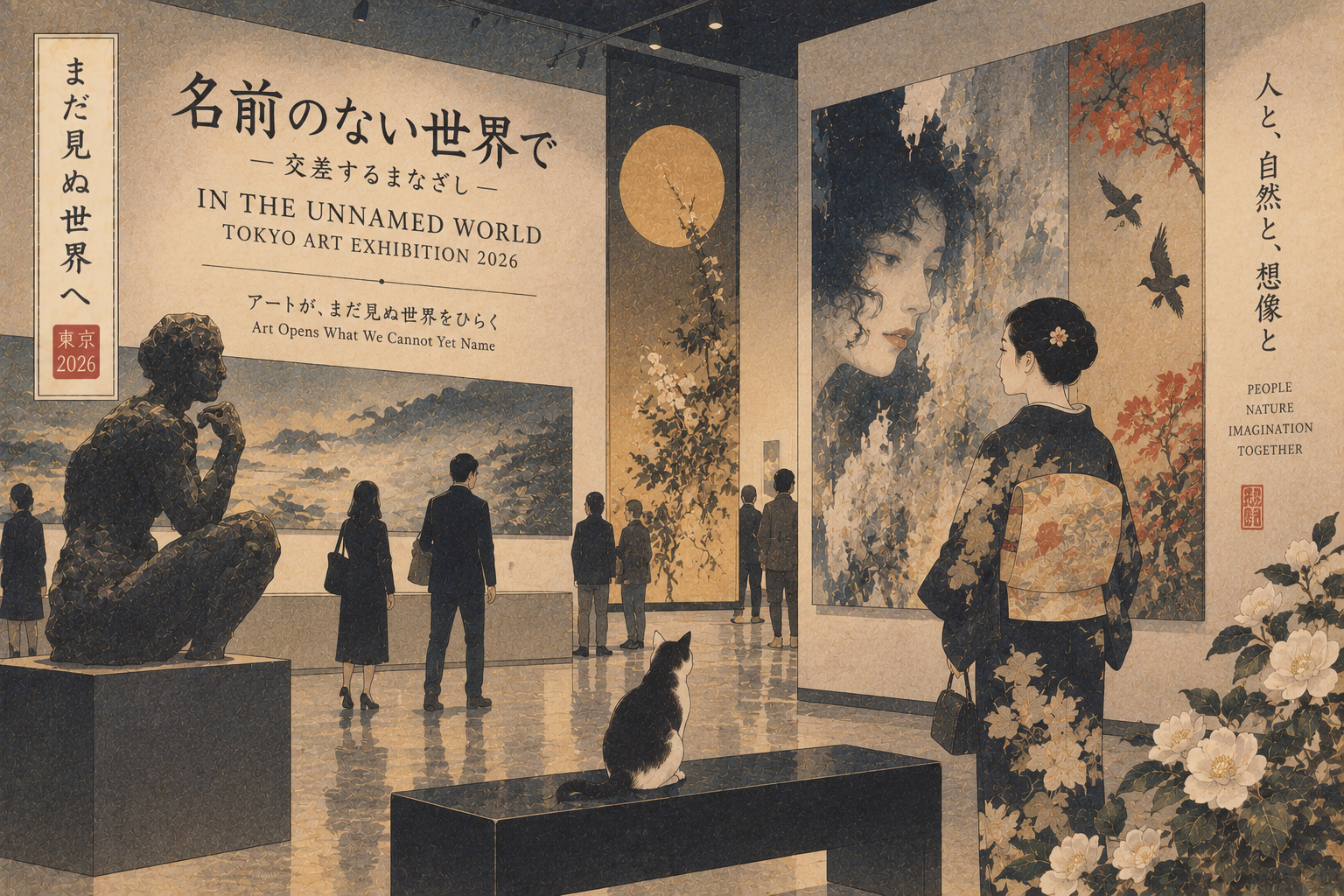
In the Unnamed World brings together Haisurō, Hiroshi Mishima, Tokiwa and Mugi Hamada at Kinosho Kikaku in Kyobashi from October 17 through October 30. Its organizing premise, described in Japanese exhibition listings, is that characters and human figures can carry memories, feelings and imaginary landscapes that have not yet acquired names. This is a preview based on published material, not a review of an exhibition already visited.
Four makers, four different answers
Grouping these artists together under the word “character” would obscure the differences. One develops near-spiritual beings informed by the mysterious worlds of anime, manga and games. Another makes invented, nameless personalities amid abstract patterns. A third takes images back and forth between screens, paint and sewn fabric. A fourth paints a fictional witch-like girl while testing how the painting itself becomes an object.
The question connecting them is not whether character imagery belongs in contemporary art. It already does. The more interesting issue is what each artist does to an image that might otherwise be recognized instantly, consumed quickly and forgotten.
Haisurō: the world behind a figure
Haisurō graduated in 2025 from the oil-painting program at Kyoto City University of Arts and, according to the exhibition profile published by Bijutsu Techo, is studying in its graduate oil-painting program in 2026. The artist received a jury-gallery award associated with OSAKA ART COMPETITION 2025 HANSHIN.
The works are described as centered on spirit-like protagonists and attentive to the mysterious possibilities of character-based fictional worlds. Rather than assuming every figure has a known narrative, a viewer can ask how posture, atmosphere and setting create the feeling that a story exists beyond the edge of the picture. The publicly accessible material does not establish a full list of works selected for this show.
Hiroshi Mishima: identity without a label
Hiroshi Mishima is described as self-taught, working in illustration and combining original unnamed characters with abstract designs. Beyond that, available exhibition materials provide little dependable biography. That absence should not be filled with invented career milestones or a speculative explanation of motive.
A title that withholds a name changes how one looks. Pattern may become a kind of environment; a figure may dissolve into it. The result invites the viewer to decide what counts as an individual and what remains an indistinct feeling. Whether the actual paintings achieve that effect is a question for a visit and, ideally, a conversation with the artist.
Tokiwa: bringing the screen back into matter
Born in 2001, Tokiwa graduated in 2024 from the fine-arts faculty of Tohoku Seikatsu Bunka University in Sendai. A detailed Japanese artist profile says Tokiwa completed an additional research-student period in 2025. The distinction matters in international coverage because the two Tohoku universities are not interchangeable.
The practice moves between digital and analogue production. Images are altered with paint and reconstituted by sewing together fabric. The stitches refuse the illusion of a seamless screen: idealized characters become physical objects subject to edges, seams and repairs. An artist profile connects this process to an aspirational ideal; it is more responsible to attribute that statement than to treat the work as clinical evidence of its maker’s inner life.
Mugi Hamada: a fictional girl in a very real painting
Mugi Hamada, born in Saitama Prefecture in 1999, graduated in 2023 from the oil-painting program at Musashino Art University. Her recurring fictional figure is a young girl conceived as a witch. Surrounding characters and settings translate elements of everyday experience into an invented world.
Hamada also investigates painting as a physical material, including shaped panels. The girl belongs to fiction; the paint has weight and thickness; the support occupies real space. That tension gives the work a different register from a character presented only as a digital file. Hamada previously held a 2024 solo exhibition at Kinosho Kikaku, titled Your Face Looks Better at Night in one published English rendering. This is not her first appearance at the gallery.
Why a small Kyobashi gallery matters
Kinosho Kikaku operates at 2-11-11 Kyobashi, Chuo Ward, in Tokyo’s gallery-rich district near Takaracho and Kyobashi stations. Its profile in Tokyo Art & Antiques describes a contemporary-art program focused on younger Japanese and international artists. The gallery is a commercial space, not a municipal museum.
That difference changes the experience. Smaller rooms can allow visitors to inspect a seam in a textile work, the edge of a shaped panel or the layering of pigment at intimate range. They also connect art to an economy of collectors, galleries and independent careers. No verified price list, sales forecast or evidence of market success for this exhibition was available at the reporting cutoff.
A longer history of people inside pictures
Japan has long produced visual narratives populated by figures whose appearances do cultural work: illustrated scrolls, actor prints and modern manga are obvious but very different examples. It is tempting to draw a single uninterrupted line from medieval scroll painting to every character-centered canvas today. That would be a historical shortcut, not a demonstrated influence on these four artists.
An Edo-period woodblock print existed as a reproducible commodity; a contemporary stitched canvas is a differently distributed object. Digital imagery introduces another tension: a picture can circulate endlessly online, but its material translation into painted or sewn form cannot be experienced fully through a phone. The present exhibition gives viewers a focused setting in which to investigate that shift.
The boundaries between illustration and painting
Modern art institutions have often constructed borders separating illustration, comics, design and “fine” art. Japanese contemporary practice repeatedly challenges such boundaries, but saying so should not collapse every artist into a single trend. Mishima’s independent illustration practice and the others’ studio-based approaches point toward varied training and different relationships with media.
A useful way to view the show is to notice what remains after you remove a caption: brushwork or printing, visible stitching, the force of a face, the scale of the work and the questions raised by a title. Those are artistic decisions rather than simply references to popular culture.
What “unnamed” can mean
The title may suggest the unlabelled identity of a figure. It can also suggest a feeling that has not yet found words. The event description explicitly connects named fictional protagonists to indistinct emotions within viewers. Our broader reading is critical interpretation; it is not a quotation from all four artists or evidence of a shared manifesto.
That distinction is important. A show about imagination should invite interpretation, not grant a journalist permission to invent a maker’s intention. The works may reward audiences precisely because no one meaning has been decided for them in advance.
How to look—and what remains unknown
For visitors, start with differences rather than similarities. Watch how a character meets the background; whether the apparent scene remains a flat image; how paint, cloth or panel edges interrupt an illusion; and whether the visual language changes when you step closer. The experience of viewing an original is especially significant where materials and construction are part of the concept.
As of the October 15 reporting cutoff, a complete verified checklist of works, dimensions, prices and fabrication details was not available in the public material consulted. The four artists were not interviewed for this article, and the exhibition had not opened. Those limits preclude descriptions of visitor reactions or claims that any particular newly displayed work has already been critically acclaimed.
An invitation to discover
Tokyo’s art calendar is filled with major names, expensive installations and international branding. A four-artist gallery exhibition can still pose an unusually resonant question: Why do we sometimes recognize ourselves in a person who does not exist?
The answer may differ for every visitor—and that is the point worth investigating. In the Unnamed World offers an opportunity to look closely at how a generation of Japanese artists handles identity, emotional projection and the tangible stuff of art in a life saturated with images.
Visiting details
In the Unnamed World is scheduled for October 17–30, 2026 at Kinosho Kikaku, Hoei Building 101, 2-11-11 Kyobashi, Chuo-ku, Tokyo. Published opening hours are noon to 6 p.m.; the gallery is closed Sundays and Mondays. Admission is free.
Check the gallery’s current information before visiting, since schedules can change. The venue is within walking distance of Takaracho and Kyobashi subway stations and Tokyo Station.