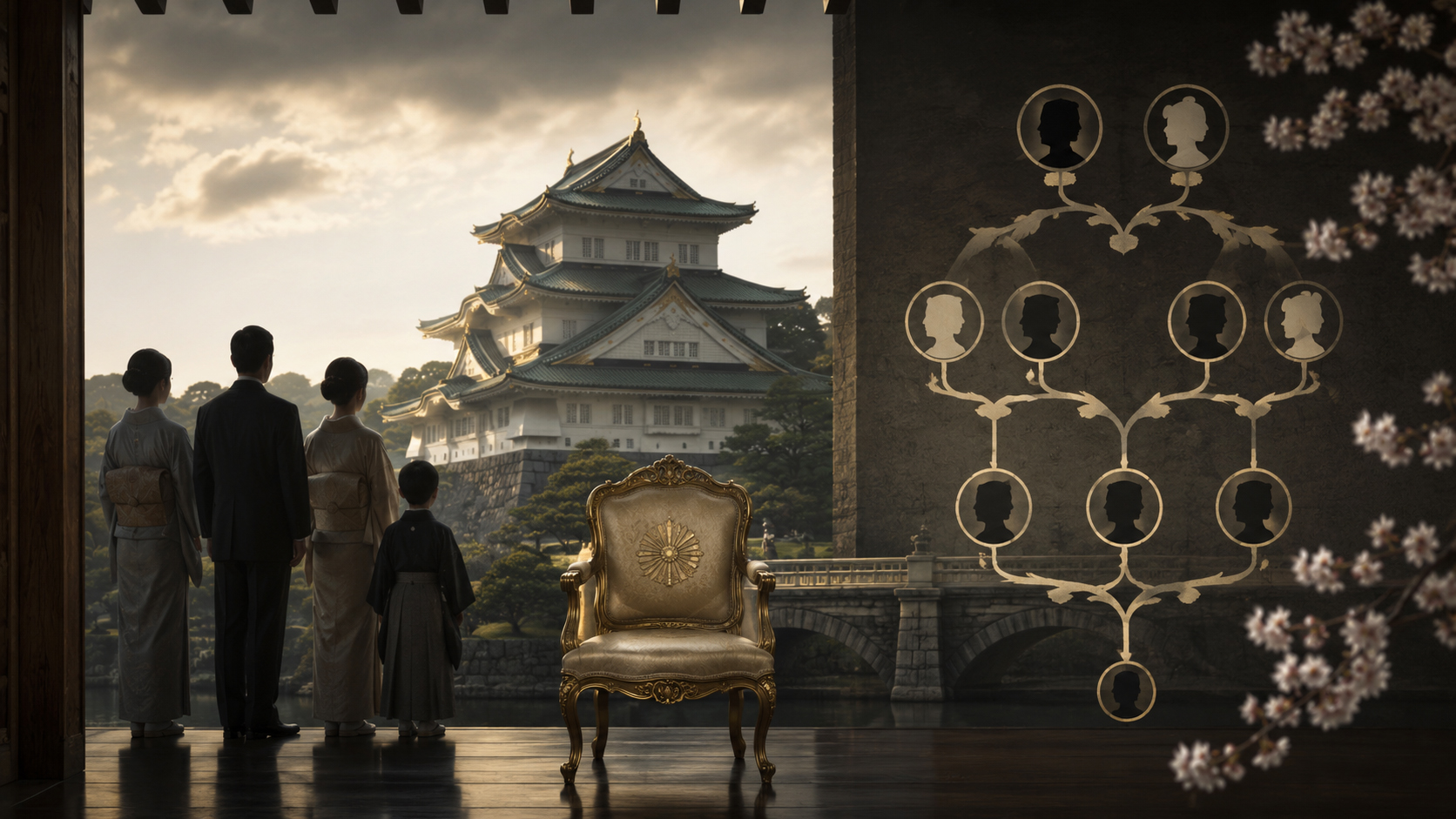
Japan’s imperial succession debate is a quiet crisis. It does not move like an election campaign or a financial market. It rarely produces street protests. Yet it reaches into the deepest layers of postwar Japan: law, gender, family, public trust, constitutional symbolism and the meaning of tradition itself.
In June 2026, parliamentary leaders moved toward a draft consensus on two measures meant to preserve the Imperial Family’s shrinking capacity. One would allow female members of the family to retain imperial status after marrying commoners. The other would permit male descendants from former imperial branches, removed from the royal register in 1947, to be adopted back into the family. Together, the measures are designed to keep the institution functioning. They do not, however, solve the central question that many Japanese citizens now ask with increasing directness: why can Princess Aiko, the only child of Emperor Naruhito and Empress Masako, not inherit the throne?
The question is not only who becomes emperor
The succession debate is often framed around the throne itself. But the more immediate institutional problem is the number of people available to perform imperial duties. The emperor and imperial family receive foreign guests, attend palace rituals, visit disaster areas, support cultural and welfare activities, appear at national events and provide a ceremonial point of continuity for the state.
Under the current system, female royals lose their status when they marry commoners. Former Princess Mako’s departure from royal status in 2021 made that rule visible to a global audience. For Japan, the problem is cumulative: women perform public duties as adults, but marriage can remove them from the institution. In a country already wrestling with demographic decline, the Imperial Family is constrained not only by birth rates but by law.
The narrow path written into law
Article 1 of the Imperial House Law limits succession to male descendants in the male line. Article 2 sets the order through sons, grandsons, other descendants, brothers and uncles. Under the current law, being female or descending through a female line excludes a person from succession.
This principle was formalized in the Meiji era and carried into the postwar Imperial House Law. Yet Japanese history includes reigning empresses, including Suiko, Jitō, Genmei, Genshō, Kōken/Shōtoku, Meishō and Go-Sakuramachi. The modern dispute is not whether women ever reigned. They did. The dispute is whether the contemporary state should maintain a male-line-only system or adapt the rules to the realities of a smaller, modern royal household.
Conservatives emphasize continuity through the male line. Reformers argue that institutional survival and public legitimacy require a broader debate, including female and possibly female-line succession. That argument is not merely legal. It touches history, religion, democratic culture, gender equality and the emotional bond between the public and the imperial institution.
Princess Aiko and the option everyone can see
For many citizens, Princess Aiko is the most visible and intuitive alternative. She is the emperor’s only child, increasingly active in public duties and widely admired for her poise. Public support for allowing a woman to reign has remained high in recent years.
Yet the June 2026 proposals do not make Princess Aiko an heir. Allowing women to remain royal after marriage would help preserve the number of working royals, but it would not expand succession rights. This is the gap at the heart of the current compromise: the public sees a possible successor, while the law sees only a princess who cannot inherit.
That distinction matters. Princess Aiko’s popularity is not a substitute for legal design. But if what feels natural to the public and what the law permits continue to diverge, the symbolic monarchy’s foundation of acceptance and respect may weaken over time.
What the former-branch adoption plan means
The second pillar of the proposal would allow male descendants of former imperial branches to be adopted into the Imperial Family. These branches left imperial status in 1947 as part of the postwar reorganization of the monarchy. Supporters see this as a way to preserve male-line continuity without opening the throne to female or female-line succession.
The challenge is social as much as legal. Many of the potential candidates have lived their entire lives as private citizens. Some may work in ordinary careers, have families outside the palace world and have no desire to become public figures. Adoption into the Imperial Family would not be a symbolic title change. It would alter residence, work, movement, marriage expectations, public speech and family privacy.
That is why public acceptance is uncertain. A man descended from a former imperial branch may satisfy a genealogical criterion, but the monarchy rests on more than genealogy. It also rests on public recognition and respect. If citizens see such men as strangers elevated by political design, the solution could feel artificial even if it is legally precise.
A compromise that preserves women but not succession
The current political compromise would let female royals remain in the family after marriage while avoiding a direct debate over female succession. That may ease the shortage of working royals, but it does not answer the deeper question of the throne.
It also raises practical questions. If a princess remains imperial after marriage, what is the status of her spouse? What is the status of her children? If only she remains royal, a household could be divided between public and private status. If her spouse and children are included, the debate inevitably moves toward female-line succession. Either route requires delicate legal design.
The draft discussions therefore stress transitional treatment and respect for the wishes of the individuals involved. That is not a minor point. These reforms are not only institutional. They would reshape the lives of a very small number of people whose private choices are already unusually constrained by public duty.
The postwar structure behind today’s dilemma
The 1947 reforms sharply reduced the size of the Imperial Family. Eleven former branches left the royal register. In the decades immediately afterward, the risks were not yet urgent because there were multiple male royals. Over time, the combination of male-line-only succession and the departure of women after marriage narrowed the future.
In that sense, the adoption proposal is an attempt to reopen a door that postwar reform closed. But reopening it after nearly eighty years is not a simple restoration. The former branches have lived outside the palace world for generations. History can establish lineage, but it cannot automatically create personal willingness or public emotional acceptance.
Where public opinion stands
Polls have repeatedly shown broad support for a reigning empress. That does not mean every respondent has a detailed position on female-line succession. Often, the public reaction begins with a simpler question: why should the emperor’s daughter be excluded?
But the monarchy is not elected by opinion poll. It depends on history, law and continuity, not majoritarian politics alone. That is why the debate is difficult. Public feeling cannot be ignored, but public feeling cannot be the only rule.
Still, Japan’s symbolic monarchy derives its strength from public acceptance. A system can be legally coherent and still lose social legitimacy if it no longer makes sense to the people it symbolizes. The succession debate is therefore not only a conservative-versus-progressive argument. It is a test of whether legal tradition and public intuition can be brought back into alignment.
- How the government drafts amendments to the Imperial House Law
- Whether female royals may choose whether to retain status after marriage
- What age, consent and public-duty rules are set for former-branch adoption
- How spouses and children of female royals are treated
- Whether Japan eventually opens a separate debate on female and female-line succession
What does it mean to preserve tradition?
The most powerful word in this debate is “tradition.” For some, preserving tradition means maintaining male-line succession. For others, it means adapting the institution so that it survives with public respect in a changing society. Both sides claim continuity with Japanese history.
But living traditions are not museum objects. Some are preserved by resisting change. Others are preserved by changing before the structure breaks. Japan’s imperial succession debate asks what kind of continuity the country actually wants: the continuity of an unaltered rule, or the continuity of an institution that can still command natural respect from the public.
Princess Aiko’s public role, Prince Hisahito’s future burden, the lives of female royals, the wishes of former-branch descendants, conservative historical arguments and reformist equality arguments all meet in one small institutional space. No solution will satisfy everyone. But delay itself is now a decision.
The June 2026 debate is not the end of the story. It is the opening of a more difficult chapter. The Imperial Family stands far from day-to-day politics, yet it reflects Japan’s postwar order, family law, gender norms, demographic decline and national identity. That is why this succession crisis is not only about the palace. It is about modern Japan looking at one of its oldest institutions and asking what must change so that it can continue.


Sources and further reading
This Japan.co.jp report is based on public materials from the Imperial Household Agency, parliamentary reporting and international news coverage.
- Imperial Household Agency: The Imperial House Law
- Imperial Household Agency: Members of the Imperial Family
- The Japan Times: Parliamentary draft proposal on imperial family reform
- Nippon.com: Diet draft proposal on imperial family seen approved
- The Times: Japan’s succession crisis and former-branch adoption proposal
- Associated Press: Princess Aiko and calls to change male-only succession
- TBS News Dig: Domestic reporting on the former-branch adoption debate