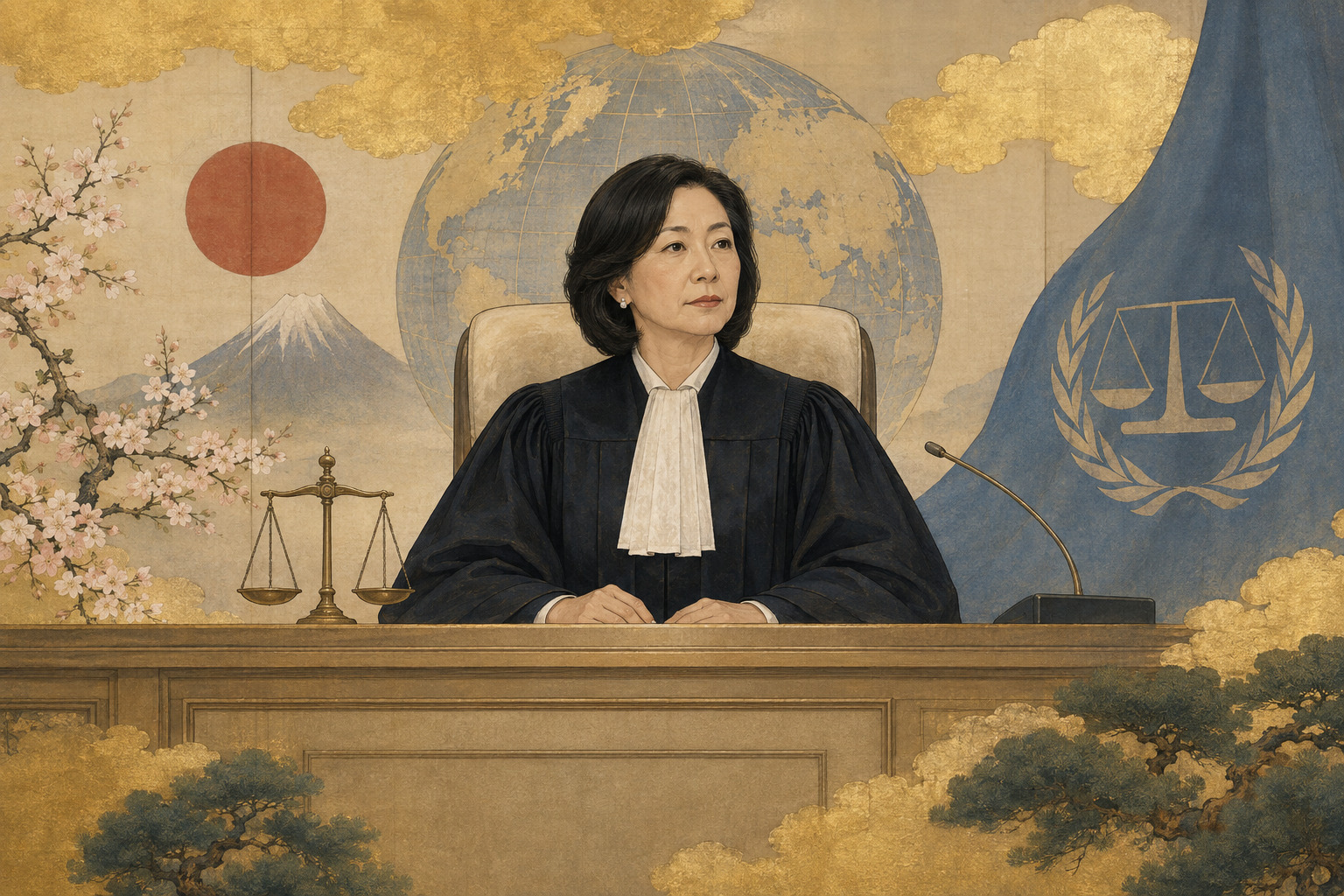
Former Defense Minister Gen Nakatani brought an unusually direct message to Tokyo on September 4: Japan should protest the United States' decision to sanction Tomoko Akane, the Japanese president of the International Criminal Court, and it should ask Washington to reverse it. His intervention moved a confrontation centered in Washington and The Hague squarely into Japanese politics.
Nakatani is no natural critic of the U.S.-Japan alliance. He is a veteran lawmaker in the governing Liberal Democratic Party and has twice served as defense minister. That background gave force to his argument that loyalty to an ally and support for international law are not mutually exclusive. A cross-party parliamentary group he co-chairs plans to deliver a request to Chief Cabinet Secretary Minoru Kihara on September 15, according to Japanese and international reporting.
For Prime Minister Sanae Takaichi's government, the problem has at least three layers. One is diplomatic: whether to confront its most important security ally publicly. A second is institutional: whether sanctions on a sitting international judge compromise the independence of a court Japan has supported for nearly two decades. The third is commercial: how Japanese banks and businesses should handle transactions that touch the U.S. financial system even though an American executive order does not automatically become Japanese law.
The essentials
- U.S. action
- On August 18, Washington added Akane and ICC senior trial lawyer Abdoulaye Seye to the Specially Designated Nationals and Blocked Persons List.
- Core effect
- Property and interests in property within U.S. jurisdiction are blocked; U.S. persons are generally prohibited from dealing with the designated individuals.
- Wind-down
- General License 12 allows certain transactions ordinarily necessary to wind down dealings through 12:01 a.m. EDT on September 17.
- Japan's stake
- Japan joined the Rome Statute in 2007 and, according to its Foreign Ministry, is the ICC's largest assessed contributor.
- The court
- The ICC has 125 states parties. The United States and Israel are not among them.
A sanction already in force
Secretary of State Marco Rubio announced the designations on August 18 under Executive Order 14203. On the same day, the Treasury Department's Office of Foreign Assets Control placed Akane and Seye on its SDN List. The listing blocks property and property interests in the United States or in the possession or control of U.S. persons and generally bars U.S. persons from transactions involving those designated. The executive order also provides for entry restrictions.
The timing matters. An OFAC license permits transactions ordinarily incident and necessary to winding down dealings involving Akane or Seye until 12:01 a.m. Eastern Daylight Time on September 17—1:01 p.m. that day in Japan. That is a limited exit window, not a delayed effective date. The designations took effect on August 18. Among its conditions, the license requires payments to a blocked person to be made into an interest-bearing blocked account at a U.S. financial institution.
Japanese entities are not automatically bound merely because the U.S. president issued an order. Their exposure depends on facts such as the parties, ownership, currency, location, payment route and any U.S. personnel or infrastructure involved. A dollar payment that clears through the United States can create a different risk from a purely domestic yen transaction. Even where U.S. jurisdiction is absent, banks may decline lawful business rather than accept uncertainty—a practice commonly called overcompliance.
No public evidence reviewed for this report establishes which Japanese companies, if any, have stopped specific transactions with the court because of Akane's designation. That gap is important. The potential reach of sanctions is substantial, but the measurable harm to Japanese commerce and the ICC's daily operations has not yet been disclosed in a form that permits a firm total.
A compliance distinction
A connection to a designated person does not make every transaction unlawful. Ownership, counterparties, jurisdiction, licenses and payment paths can change the answer. This report describes the sanctions framework; it is not legal or compliance advice for any particular transaction.
Washington's case—and the Court's answer
The Trump administration says the ICC has no legitimate jurisdiction over the United States or Israel because neither country is party to the Rome Statute. Rubio said Akane and Seye had directly engaged in efforts by the court to investigate, arrest, detain or prosecute officials of governments that had not consented to ICC jurisdiction. The State Department's August 18 release did not identify a particular ruling or case-specific act by Akane as the basis for her designation.
The court's legal framework starts from a different premise. Under the Rome Statute, territorial jurisdiction can arise when alleged crimes occur on the territory of a state party, even if the accused is a citizen of a country outside the treaty. Jurisdiction can also follow a United Nations Security Council referral or a nonmember state's ad hoc acceptance. The court is designed to complement national systems, acting only when relevant states are unwilling or unable genuinely to investigate or prosecute.
Those principles do not eliminate legal disputes about a particular situation. They show why the issue cannot be reduced to the nationality of a suspect or defendant. Territory, admissibility, state sovereignty and judicial independence all matter. Washington characterizes ICC action against officials of nonconsenting states as an encroachment. The court maintains that it applies authority granted by its member states under the treaty.
The sanctions designation does not adjudicate that dispute. It uses economic and immigration powers to exert pressure. The ICC called the latest designations a flagrant attack on the independence of an impartial judicial institution. The United States, for its part, described the court as politicized and called on countries to end funding and participation. Both are institutional positions and should be read as such, not as settled findings about the legality of the underlying cases.
Tokyo's words grow more restrained
The Japanese government's public record reveals a change in tone. When Takaichi met Akane on January 7, the prime minister praised her leadership and said Japan would “strongly support” both the ICC and its president as part of a foreign policy grounded in the rule of law. The day after the designation, the Foreign Ministry said the U.S. action was “very unfortunate” and promised communication with relevant countries.
Foreign Minister Toshimitsu Motegi spoke with Akane by telephone for about 20 minutes on August 28. The ministry's summary said they exchanged views on the circumstances surrounding the court. It did not say Japan had lodged a protest with Washington or demanded that the designation be withdrawn. A spare public readout does not prove that quiet diplomacy is absent. It does explain why lawmakers are pressing for a visible statement of policy.
“Diplomacy earns trust only when it says what must be said.”Gen Nakatani, as reported from his September 4 appearance at the Japan National Press Club. Translation by Japan.co.jp.
Nakatani argued that the U.S.-Japan alliance and the defense of the rule of law are not a binary choice. He asked the government to protest, seek withdrawal of the sanctions and reaffirm continued support for the court. He also called for practical help so that Japanese companies and financial institutions could continue legitimate dealings. His position is one possible approach. The government may judge that private engagement is more likely to preserve cooperation with Washington. Public protest and private engagement carry different diplomatic costs, but neither is without policy consequence.
Akane has framed the matter institutionally as well. In an August 26 interview with Reuters, she said her work had not so far been obstructed by the restrictions, but urged Japan to use its close relationship with the United States and to support ICC member states facing pressure. Her emphasis was not personal relief alone; it was the resilience of the court.
Why Japan matters to the ICC
The International Criminal Court was established in 2002 after the Rome Statute entered into force. It has jurisdiction over individuals accused of genocide, crimes against humanity, war crimes and the crime of aggression, subject to the treaty's limits. It is a court of last resort rather than a replacement for national criminal justice.
Japan deposited its instrument of accession on July 17, 2007, and became a full member on October 1 that year. Since then it has become the largest contributor to the court's assessed budget, according to the Foreign Ministry, and has supplied judges and prosecutors. Japan has also contributed to the Trust Fund for Victims and other court-related programs. Its support is financial, diplomatic and professional.
Akane embodies that investment without representing the Japanese government. A former prosecutor, director-general of Japan's Research and Training Institute of the Ministry of Justice, Supreme Public Prosecutors Office prosecutor and ambassador for international judicial cooperation, she was elected to the ICC bench in December 2017 and took office in March 2018. On March 11, 2024, she became the first Japanese person elected president of the court. Her judicial term runs through March 10, 2027.
Her nationality makes the dispute politically immediate in Japan. It is not, however, the only basis on which Tokyo could respond. A separate institutional question is whether a state that has invested heavily in a treaty court will defend the court's judges from personal economic pressure when it disagrees with the country applying it.
A conflict spanning four U.S. administrations
U.S. resistance to the ICC long predates the current designation. Congress enacted the American Servicemembers' Protection Act in 2002. In June 2020, the first Trump administration issued Executive Order 13928, creating sanctions authority against people associated with certain ICC investigations. The immediate context was the court's work concerning Afghanistan.
President Joe Biden terminated that national emergency and sanctions framework in April 2021. His administration continued to object to some assertions of ICC jurisdiction, but said economic sanctions were inappropriate and ineffective. President Donald Trump revoked Biden's order on returning to office in January 2025 and issued Executive Order 14203 on February 6. The new order sharply criticized the arrest warrants for Israeli Prime Minister Benjamin Netanyahu and former Defense Minister Yoav Gallant.
Sanctions timeline
- 2002: The Rome Statute enters into force; the ICC opens. The United States enacts the American Servicemembers' Protection Act.
- June 2020: Executive Order 13928 creates an ICC-related blocking and entry-ban framework.
- April 2021: Executive Order 14022 ends that emergency and revokes the 2020 order.
- February 2025: Executive Order 14203 re-establishes ICC-related sanctions.
- August 18, 2026: The United States designates Akane and Seye.
The history complicates any claim that there is one permanent American position. Concern about jurisdiction over nationals of nonmember states has crossed party lines. The decision to place judges and court personnel under economic sanctions has not. Japan is therefore responding both to a longstanding structural disagreement and to a specific instrument chosen by the present administration.
Four tests before mid-September
- Public language: Does Tokyo move beyond “very unfortunate” to a formal protest or request for withdrawal?
- Commercial guidance: Does the government give Japanese banks and companies a clear channel for questions about legitimate transactions?
- Collective action: Does Japan coordinate a response with other Rome Statute members, including through the Assembly of States Parties?
- Operational evidence: After the General License 12 deadline, do payroll, procurement, travel or professional services at the court encounter documented disruption?
The designation has made Tokyo's vocabulary of international order expensive. Supporting the rule of law in general terms carries little immediate cost. Doing so when Japan's security ally targets the Japanese head of a court—and asks other countries to withdraw funding and participation—requires a choice of words, channels and financial safeguards.
That need not become a choice between the alliance and the court. It is a test of whether Japan can manage disagreement inside the alliance while preserving the institutions it says underpin international order. The parliamentary request on September 15 and the wind-down deadline on September 17 will be the first concrete markers of how far Tokyo is prepared to move from regret to policy.