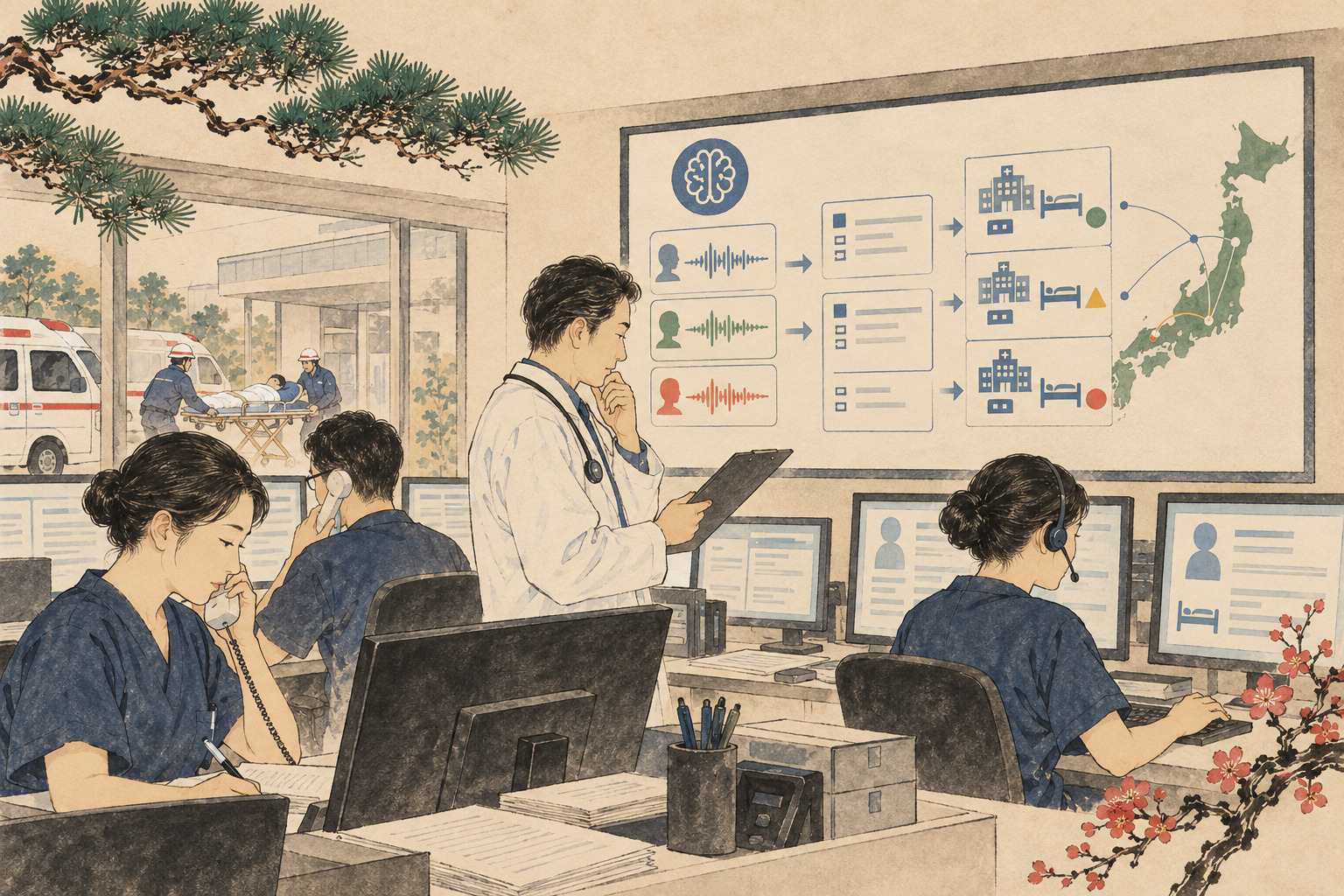
A hospital's most consequential data may sometimes belong to the patient who never entered the building. An ambulance crew calls to ask whether a patient can be accepted. A community clinic calls with a referral. Someone contacts the emergency department at night. If the hospital accepts the patient, the subsequent care enters the electronic medical record. If the answer is no, the reason may disappear into a handwritten note, a phone recording that nobody reviews, or an undocumented conversation.
On September 18, Dr.JOY launched a new product intended to turn those calls into structured data. Ukeire Call AI records referral calls, ambulance-service contacts and after-hours emergency inquiries, transcribes them in real time, and uses AI to classify whether the patient was accepted and why an acceptance request was declined. The resulting data can be analyzed by department, time, staff member and reason. [1][2]
One distinction is essential. As of the public materials reviewed through September 21, Dr.JOY has not disclosed how many hospitals are already using this specific new product or named a first customer. The company's figure of 213 facilities, including sites still preparing for deployment, refers to its broader AI-phone business launched in 2024—not to Ukeire Call AI alone. [1][3]
The patient who was not admitted may leave no hospital record
Patients who are accepted by an emergency department or arrive after a referral eventually generate clinical documentation. Patients who are turned away at the telephone stage may never become patients of that institution, so the logic behind the decision is less likely to end up in the hospital's usual clinical data systems.
Dr.JOY calls this problem the “invisible refusal.” Referral coordination, ambulance contacts and after-hours inquiries often reach different hospital units, and those units may use different records: paper notes, PBX recordings, spreadsheets or verbal handoffs. That makes it difficult to answer basic management questions later: How many cases were declined? Why? Did the refusals cluster by specialty, hour or day? [1][2]
Ukeire Call AI creates a dedicated 050 telephone number for each intake channel, or can receive calls forwarded from an existing number. It transcribes conversations in real time. According to the product description, the AI can classify acceptance status and refusal reason and extract information such as chief complaint, medical history and, for emergency calls, vital signs. Audio, transcript, AI summary and internal notes are available from the call record. [1][2]
A refusal is not automatically a failure
Hospitals may have legitimate reasons not to accept a patient: no available bed, no appropriate specialist, an operating physician, unavailable equipment, infection-control constraints, the wrong level of care, or a clinical situation better handled elsewhere. Emergency medicine cannot be managed by maximizing acceptance percentage alone.
Dr.JOY's proposition is to make the reasons visible. If a hospital learns that refusals cluster overnight because one specialty is consistently unavailable, that may trigger a staffing discussion. If “no bed” dominates on certain days, bed-management practices may warrant review. If the delay is frequently caused by difficulty reaching the responsible physician, the communication route may be the problem. [1][2]
But the AI-generated category is not necessarily ground truth. Medical shorthand, noisy calls, multiple speakers and implicit reasoning can all create classification errors. The company has not published accuracy, sensitivity, specificity, misclassification rates or independent validation for the acceptance-status and refusal-reason tagging. Any use as a management metric therefore requires human review and careful category governance.
The 19.7% figure is not a national government statistic
At the 76th Japan Hospital Association Congress in July 2026, Dr.JOY presented an analysis under the title “19.7% of acceptance refusals have an ‘unknown reason’.” The September product announcement cites that finding as part of the development rationale. [1][4]
The figure is a Dr.JOY analysis, not a nationwide statistic produced by Japan's health ministry or Fire and Disaster Management Agency. The public conference pages do not disclose the full sample size, participating hospitals, observation period, call volume or classification protocol. It should therefore not be generalized as “19.7% of all Japanese hospital refusals have no known reason.”
At the same conference, Dr.JOY also presented an estimate that lost referral opportunities could reach ¥360 million a year in a hospital scenario. That is a company analysis, not a universal loss figure; actual economics vary dramatically with case mix, reimbursement, bed use and referral volume. [4]
This is different from the government's “difficult ambulance transport” measure
Japan already has a government metric for cases in which ambulance crews struggle to find an accepting hospital. The Fire and Disaster Management Agency classifies a “difficult transport case” in its weekly survey as one involving at least four acceptance inquiries and at least 30 minutes at the scene. The survey draws from designated major fire departments and representative departments across prefectures. [12]
That measure is important, but it does not cover exactly the same universe as Ukeire Call AI. FDMA focuses on ambulance transport. The new product also covers referrals from other medical institutions and after-hours inquiries. A patient who is redirected before an ambulance transport—or a referred patient declined before arriving—may never appear in the same government statistic.
The underlying emergency-call volume is enormous
Japan recorded 7,686,235 ambulance dispatches and 6,761,871 ambulance transports in 2025, according to preliminary FDMA figures. In 2024, ambulance dispatches reached 7,718,380 and transported patients reached 6,769,172, historically very high levels. [10][11]
FDMA reported an average 44.6 minutes in 2024 from the emergency call to physician handoff at the receiving hospital—about 5.1 minutes longer than in 2019 before the COVID-19 pandemic. Older adults accounted for 63.3% of ambulance transports. [11]
Not all of that time is caused by hospital acceptance calls. On-scene care, distance, traffic, patient condition and hospital selection all matter. But in a system processing millions of emergency transports, even small improvements in the information flow around acceptance decisions can be operationally significant.
From AI answering the phone to AI analyzing the phone call
Dr.JOY launched its healthcare-specific AI phone in June 2024, initially focused on outpatient appointment booking, changes, cancellations and confirmations. The company reported 105 facilities by July 2025, more than 200 by August 2026 and 213, including facilities preparing for deployment, by September 1. [3][7]
The use cases broadened into health screening, pharmacy inquiries, regional coordination, visiting reservations and pre-visit medical consultation. Those earlier AI-phone products largely automate the first layer of incoming communication. Ukeire Call AI is different: it often records conversations between professionals and turns the conversation itself into analyzable data. [2][3]
November 2013 — The company that became Dr.JOY is established.
2015 — Dr.JOY's in-hospital communication service formally launches.
June 2024 — Healthcare-specific AI-phone service launches.
July 2025 — AI-phone installations reach 105 facilities.
March 2026 — Dr.JOY reports results from an AI pre-visit consultation pilot at Urasoe General Hospital.
July 2026 — Ukeire Call AI and the “invisible refusal” analysis are presented at the Japan Hospital Association Congress.
September 18, 2026 — Ukeire Call AI launches commercially.
Timeline based on Dr.JOY disclosures. [3][4][6][7][8]
Urasoe General Hospital shows what medical phone AI can look like—but it is a different service
Dr.JOY has not yet publicly identified a Ukeire Call AI hospital customer. It has, however, reported a separate AI-phone project at Urasoe General Hospital in Okinawa. From November 2025 through February 2026, the hospital tested an AI pre-visit consultation service in which patients described symptoms to an AI phone and a medical-triage engine estimated urgency. This is a different product and workflow from Ukeire Call AI. [6]
Dr.JOY said the pilot received 753 calls, of which 580 completed the call flow, and that about 77% of consultations were completed through the AI phone. Later conference material described nurse call-handling time falling from around 10 minutes to four minutes per case, while the March pilot release described direct pre-pilot nurse calls as averaging about five minutes. The difference underscores the need to preserve measurement context rather than merge vendor figures from different workflows. [5][6]
The example nevertheless demonstrates why hospital telephone automation is no longer simple appointment booking. Calls can contain symptoms, urgency, medical history, department selection and clinical handoff information. The closer telephone AI gets to care decisions, the more important governance and human oversight become.
One call becomes data in five stages
| Stage | What happens |
|---|---|
| 1. Receive | Call arrives on a dedicated 050 number or is forwarded from an existing hospital number. |
| 2. Record | Audio is recorded and transcribed in real time. |
| 3. Internal consultation | The call can be transferred to the responsible department; the transferred conversation can also be transcribed. |
| 4. AI classification | Acceptance, refusal reason and selected patient information are summarized and tagged. |
| 5. Dashboard | Accumulated calls are analyzed by specialty, staff member, day, time and reason. |
Based on the product description. [2]
Hospitals can use a PC and headset, a mobile app or a DECT cordless phone. Dr.JOY also advertises automated creation of faxed visit-result reports and a QR-code function intended to make it easier to carry call information into the electronic medical record. [1][2]
“EHR reflection” does not necessarily mean full EHR integration
The launch announcement refers to reflecting call information into the EHR through QR codes. That should not be interpreted as a universal, bidirectional API integration with every hospital EHR. The public materials do not identify supported EHR vendors, patient-matching logic, write-back fields or interoperability specifications. [1]
A more precise description is that the product provides a method to transfer or reflect call information into hospital workflows. It does not establish that every recorded call automatically becomes a fully integrated EHR record.
Once a conversation becomes a KPI, a new management risk appears
Dashboards showing acceptance rates, refusal reasons, staff tendencies and time-of-day heat maps can help identify bottlenecks. But the same numbers could be misused as a crude “doctor refusal ranking.”
A specialty with a low acceptance rate may simply receive many inappropriate referrals. A physician treating high-acuity cases may have fewer available beds. A medically correct refusal may protect a patient from transfer to an unsuitable facility. Without case-mix adjustment and operational context, acceptance-rate comparisons can be unfair or unsafe.
The data therefore need to be read alongside bed capacity, staffing, equipment, referral appropriateness and clinical criteria. AI can count and classify decisions; it cannot automatically explain their causal meaning.
Recorded calls are highly sensitive medical information
Referral and emergency calls may contain names, dates of birth, symptoms, medical history, medications and vital signs. Recording and transcribing them creates a new repository of sensitive healthcare data.
Dr.JOY says Ukeire Call AI is designed in accordance with the Japanese healthcare security framework commonly described as the “three-ministries/two-guidelines” regime. The company cites ISO/IEC 27001 and ISO/IEC 27017 certifications, AES-256 encryption and data storage in the AWS Tokyo Region. [1]
MHLW updated its Guidelines for the Safety Management of Medical Information Systems to Version 7.0 in June 2026, requiring healthcare organizations to address access control, cybersecurity, outsourced-service management and business continuity. [13][14]
Dr.JOY's statement that the service conforms to the relevant guidelines is a vendor claim; it is not an individual MHLW certification of the product. Actual security also depends on hospital-side device controls, permissions, call-recording procedures, retention periods, audit logs and staff practice.
A recording is evidence—but not the whole truth
Recording a conversation can help resolve what was said. It does not by itself determine whether the medical acceptance decision was appropriate. Telephone information may be incomplete. The ambulance crew and physician may understand severity differently. Bed availability can change minutes later.
AI adds another interpretive layer. Original audio, transcript, AI summary and refusal tag are four different representations of the call. In a safety review or dispute, users need to be able to return to the original recording rather than relying only on an automatically generated summary. Dr.JOY's product page says audio playback, transcripts and AI summaries can be reviewed together, which is an important design feature. [2]
A company born from a doctor's frustration with paper and telephone work
Dr.JOY was established in November 2013. Its president, physician Hiroaki Ishimatsu, says the company grew out of his experience of clinical work being crowded by paper documents and telephone tasks, leaving less time for patients. The in-hospital communication service Dr.JOY launched formally in 2015. [8][9]
The company now covers communication, AI telephony, attendance and shift management, visiting workflows and other hospital operations. Ukeire Call AI extends the original productivity theme from automating nonclinical tasks to creating structured operational data from work that previously disappeared into conversations. [9]
What remains unknown
As of September 21, the public materials do not disclose the number of Ukeire Call AI customer hospitals, a first named customer, pricing, contract term, call volume per site, AI acceptance-classification accuracy, refusal-reason tagging accuracy, false-classification rates, measured changes in acceptance rates, ambulance handoff times, occupancy or hospital revenue after adoption.
The 213-facility footprint of Dr.JOY's broader AI-phone product demonstrates that the company has an established sales and operating base. It does not demonstrate the effectiveness of this newly launched acceptance-call product. That will require real-world deployment data and verification by participating hospitals.
Turning the refused call into hospital-management data
Hospitals have historically accumulated data about patients who arrived: visits, beds, tests, procedures, diagnoses and discharge. The person who never arrived because the acceptance call ended with “no” was much easier to lose from the dataset.
That is what makes Ukeire Call AI interesting. If refusals are really driven by beds, the hospital may have a capacity-management problem. If they are driven by specialist coverage, the on-call model may be the issue. If nobody can reach the responsible physician, the communication system may be the bottleneck. If referral information is consistently incomplete, the regional referral process may need redesign.
But visibility must not become pressure to accept every patient. The goal of good data is not a cosmetically high acceptance rate. It is to accept the patients the hospital can safely treat and to redirect others to an appropriate alternative as quickly as possible.
The most valuable thing the AI can preserve is therefore not the bare fact that a hospital said no. It is the reasoning that allows humans to review why. As hospital telephone conversations become management data, the deeper test will not be transcription accuracy alone. It will be whether the data helps the system make safer, faster and more accountable decisions for the patient on the other end of the call.
Sources & documents
- Dr.JOY: Launch of Ukeire Call AI, recording and analyzing referral and emergency acceptance calls (Sept. 17, 2026; Japanese primary source)
- Dr.JOY: Ukeire Call AI product page (Japanese primary source)
- Dr.JOY: Broader AI-phone service exceeds 200 facilities (Aug. 3, 2026)
- Dr.JOY: 76th Japan Hospital Association Congress report and 19.7% 'unknown reason' analysis (July 13, 2026)
- Dr.JOY: 28th Japan Society for Health Care Management conference report (June 3, 2026)
- Dr.JOY: AI phone plus medical triage pilot at Urasoe General Hospital (Mar. 30, 2026)
- Dr.JOY: AI phone reaches more than 100 facilities after first year (July 14, 2025)
- Dr.JOY: Company profile and history
- Dr.JOY: President's message
- Fire and Disaster Management Agency: 2025 ambulance dispatches and transports, preliminary figures (Mar. 30, 2026)
- Fire and Disaster Management Agency: 2025 White Paper, emergency-medical-service conditions
- Fire and Disaster Management Agency: Weekly survey of difficult ambulance-transport cases
- Ministry of Health, Labour and Welfare: Guidelines for the Safety Management of Medical Information Systems, Version 7.0 (June 2026)
- MHLW: Cybersecurity measures for healthcare
- Dr.JOY: Product release notes for Ukeire Call AI