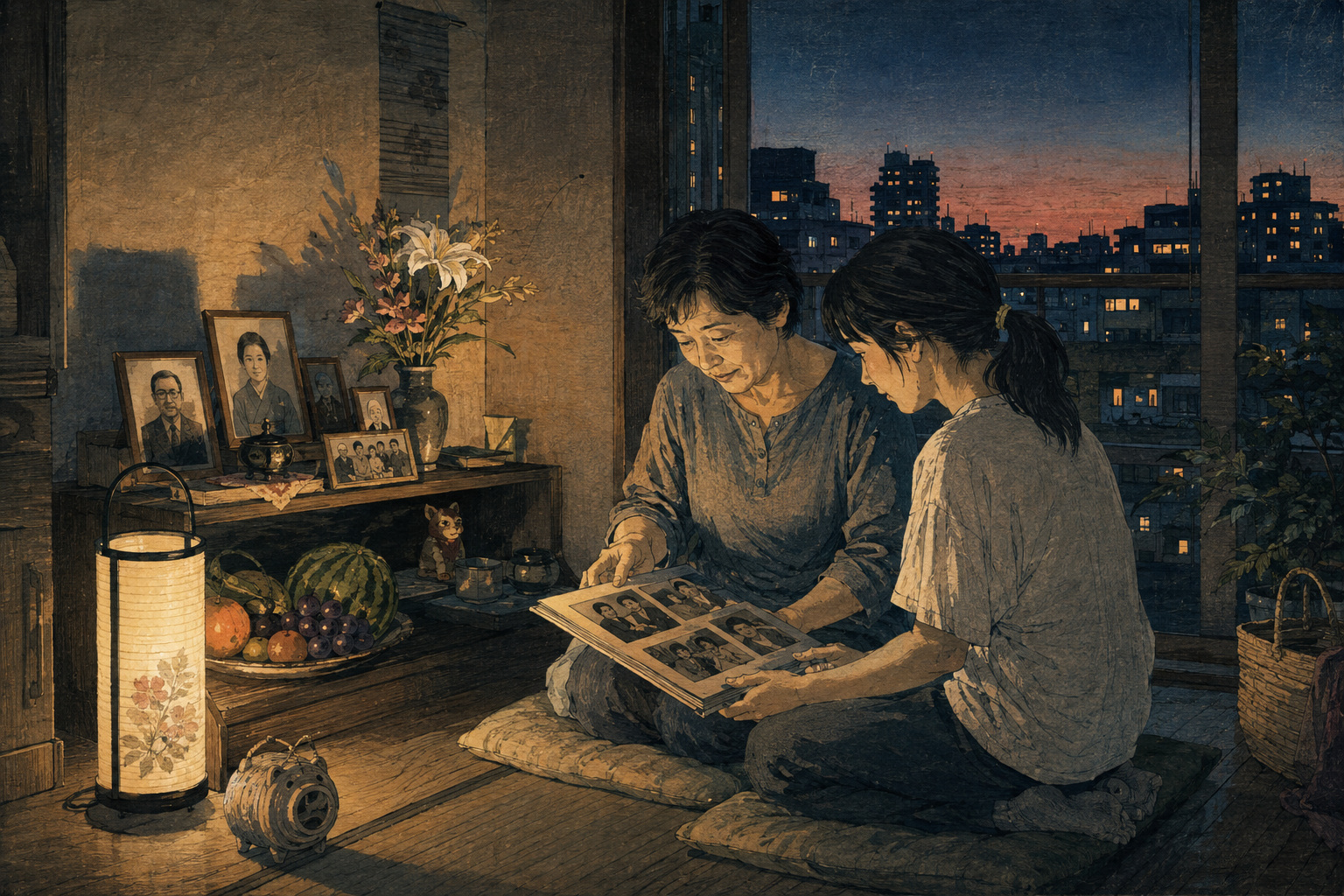
At first glance, it is only a shelf.
There is a framed photograph of a woman laughing before the camera was quite ready. Beside it sits the watch she wore every day, stopped now at a meaningless minute. A cup holds fresh water. A battery-powered candle gives off no heat. Lower down, almost hidden beneath the flowers, is the frayed red collar of a dog that once waited at the apartment door.
No priest has declared this arrangement an altar. It may contain no Buddha image, no ancestral tablet and no incense burner. The family may call it a kuyō corner, a place to say good morning, or nothing at all. Yet during Obon it does something an altar has long done: it makes absence addressable. Someone clears the dust, changes the water, adds a favorite sweet and speaks into the room.
This is not the disappearance of Japanese memorial culture into interior decoration. Nor is it a single new movement with a founding date. It is a practical, intimate answer to several changes at once: smaller homes, families spread across the country, graves without successors, religious distance, friendships that do not fit the lineage, and pets mourned as family. The dead are still given a place. The place is being renegotiated.
The Survey Finds Memory Already Living at Home
In February and March, NEXER and online Buddhist-goods seller Nagomi Kobo asked 400 adults nationwide who had lost a family member or another important person how they remembered the dead. Praying at a butsudan and visiting a grave tied at 60.8%, confirming that the established places remain powerful. But the other answers opened the walls: 38.8% spoke inwardly to the deceased, 30.3% looked at a portrait or photograph, and 27.5% made an offering of flowers or food.
Asked directly whether it was important to have a place or space for remembrance at home, 72.8% said very or somewhat important. Yet memory did not wait obediently for that place. The most common prompt was an unexpected view, smell or piece of music, selected by 59.5%. Death anniversaries were chosen by 47.0%, Obon or equinox weeks by 44.5%, and birthdays or other anniversaries by 21.3%.
The finding is less a verdict than a tension. People value a defined place, but the dead return in undefined moments. A shelf or photograph stands between those two experiences. It does not confine memory. It catches it. The sudden smell of a familiar meal can lead to the picture; the picture can lead to a greeting; the greeting can become a habit.
The limits deserve equal attention. The survey was conducted online, the participants were pre-screened for bereavement, and a Buddhist-goods retailer helped produce it. It cannot tell us how representative the percentages are of all Japan. It can show, with unusual clarity, the range of practices people recognized in their own lives.
| 2026 evidence | Population or object | What it shows | What it cannot show |
|---|---|---|---|
| Remembrance poll | 400 bereaved adults, online | 72.8% valued a home space; photos, offerings and inward conversation were common | Not a random national sample; no causal claim |
| Housing and altar poll | 500 adults nationwide, online | 34.2% had a butsudan; 72.5% preferred compact or shelf-sized forms | Preferences are not purchases or national market share |
| 2026 product releases | Retailer and manufacturers | Mini Bon shelves, cordless lanterns and bookcase-sized memorial boxes are available | Corporate releases do not measure adoption |
| Pet survey and service | 190 current pet owners; one memorial organizer | Demand for individualized farewells and a hybrid pet-Obon service | Small, hypothetical-preference poll; one event is not a national rate |
A Photograph Can Change the Meaning of a Shelf
Objects do not need to be rare to become charged. A pair of glasses, recipe book, train pass or chipped sake cup acquires force because a hand repeatedly used it. After death, the item carries two times at once: the ordinary life in which it was barely noticed and the present in which no new use will be added.
Photographs do something different. Anthropological research on Japanese memorial objects describes how the iei, or memorial portrait, makes a particular face available to the household while the ihai, the mortuary tablet inscribed with a posthumous name, locates the deceased within Buddhist and ancestral practice. They may be displayed in or above a butsudan, but they are not interchangeable. One presents likeness; the other carries ritual identity.
An informal memorial shelf may have only the likeness. That apparent simplicity can be expansive. A photograph can be changed when the remembered person disliked the official portrait. Two friends can be placed together. A living-room corner can include a former partner, a mentor, a pregnancy loss or a pet without asking whether the relationship belongs in an inherited grave. The household decides what the arrangement means and who is allowed to appear there.
That freedom comes with ambiguity. To describe every collection of photographs and keepsakes as a butsudan would erase important religious distinctions. A Buddhist household altar ordinarily centers a sacred image, mortuary tablets and ritual forms shaped by sect and temple. A private memorial display may borrow the grammar of light, flowers, food and greeting without claiming the same status. The resemblance is real; so is the difference.
The Butsudan Has More Than One Origin Story
It is tempting to tell a tidy history: large traditional altars once filled Japanese homes, modern life shrank them, and the miniature is the final stage. The scholarship is far less linear.
Recent ethnographic work by Lok Hang Hui reviews competing accounts of the butsudan. Folklorist Yanagita Kunio associated it with the shōryōdana, a temporary shelf prepared to receive ancestral spirits during Bon. Historian Takeda Chōshū instead emphasized the jibutsudō, a private devotional hall maintained by elite families that became smaller and more domestic. Both practices continued after box-shaped household altars appeared, leaving no single uncontested ancestor for the furniture seen today.
Medieval Pure Land traditions deepened lay access to Buddhist images and memorial observance. Forty-nine-day rites and later anniversaries gave grief a schedule extending beyond the funeral. The domestic altar gathered multiple presences into one cabinet: a Buddha or bodhisattva, the dead of the household, the authority of a temple lineage, and the daily labor of the person who opened the doors, offered rice and kept the space clean.
This complexity matters in 2026. If the household altar was assembled historically from temple ritual, family structure, objects and repetition, changing one element does not automatically destroy the whole. A shelf without doors can still sustain repetition. A photograph may carry intimacy that a formal tablet does not. A compact altar may be religiously conventional inside even when its exterior resembles modern furniture.
The Edo Household Made Remembrance Visible
The early modern state gave domestic Buddhist practice a new public weight. Under the Tokugawa temple-registration system, usually dated from the 1630s, households had to affiliate with Buddhist temples, in part to demonstrate that they were not Christian. Temples recorded families and certified status. Funeral and ancestral rites became intertwined with administration, locality and household continuity.
The butsudan was therefore never only a private cabinet. It could show that a household belonged to an accepted religious and social order. It connected daily space to the family temple, and the living generation to named predecessors. The altar’s permanence made the household itself appear continuous even as its members died.
But official structures never exhausted private feeling. A daughter offering tea could be performing doctrine, family duty, affection and habit in the same gesture. One generation might address an ancestor through a posthumous Buddhist name; the next might focus on a smiling photograph. The physical altar held these motives together without requiring them to be identical.
Modern memorial corners inherit that layered quality, even when their owners reject formal religion. The practice of giving the dead a visible position in the home is older than the language of “personalized memorialization.” What is new is the degree to which individuals can select the scale, design, objects and membership of the space.
Obon Has Always Rearranged the House
Obon is often pictured as a journey outward—to a hometown, temple or cemetery. Its older choreography also turns decisively inward. The dead are welcomed home. A family may clean the altar, prepare a temporary spirit shelf, set out seasonal food, hang lanterns and use welcoming and sending fires to mark arrival and departure. Regional forms vary, and not every household performs each act, but domestic space is not secondary to the festival. It is one of its stages.
The shōryōdana makes this visible. Constructed for the season and later dismantled, it proves that impermanence is not the opposite of ritual seriousness. For several days, ordinary architecture is revised: a table becomes a place for ancestors; a doorway becomes a threshold between worlds; a cucumber and eggplant fitted with legs become spirit vehicles in familiar popular custom.
Today’s small home memorial therefore does not drag a cemetery into the living room. It works within an old Obon idea—that hospitality can make a temporary address for the dead. The photograph is cleaned because a guest is expected. The favored snack is offered because memory has a taste. The small light does what a lantern has always done: it declares that someone has prepared the way home.
Seventh century — Court records describe early Urabon-e offerings and sutra lectures for ancestors.
Medieval centuries — Lay Buddhist devotion and scheduled memorial rites deepen.
1630s onward — Temple registration reinforces household affiliation and ancestral observance.
1873 — Calendar reform eventually divides Bon among July, August and lunar observance.
Postwar decades — Urban apartments, migration and smaller households challenge the dedicated Buddhist room.
2026 — Compact products and surveys make the negotiation between memory and living space unusually visible.
When the House Lost the Buddhist Room
Postwar urbanization did not simply make Japanese houses smaller. It separated functions once held together. Adult children moved away from the place containing the family grave and altar. Apartments were designed without a butsuma, the dedicated Buddhist room. A single household’s ritual property might remain with one sibling while the emotional relationships were spread across several cities.
A May 2026 online survey by NEXER and Nagomi Kobo gives one imperfect snapshot. Among 500 adults, 34.2% said their home had a butsudan. Asked for an ideal size, 39.8% chose a compact altar that could fit in a living room and 32.7% chose a mini or shelf-sized version. Combined, 72.5% preferred those two smaller formats; 27.5% chose a larger, floor-standing form. Separately, 45.6% said they would definitely or perhaps want a modern design suited to a living room.
These answers are preferences in a retailer-associated internet poll, not a census of religious life. But they reveal the design problem with precision. The question is no longer only whether a household believes in keeping an altar. It is whether the object can coexist with the television, books, children’s toys, rental rules and limited storage of the room people actually inhabit.
Moving the memorial into the living room also changes its social rhythm. A closed altar in a separate room can command formal attention. A photograph near the dining table catches the eye during breakfast. Visibility becomes casual, sometimes almost companionable. The dead are no longer visited only when the doors are opened; they share the background of the day.
The 2026 Miniature: Design as Evidence, Not Census
Manufacturers have answered with objects that look less like inherited architecture and more like contemporary storage. For Obon 2026, major retailer Hasegawa highlighted compact and cordless lanterns and a small Bon shelf that could sit on living-room furniture, saying urban customers often lacked room for conventional displays.
In March, Maruki introduced a movable mini altar called NOAN, measuring 30 centimeters high, 35 wide and 20 deep, designed to hold photographs and small keepsakes. In July, household-goods maker Aimedia released a box intended to fit beside paperback books: 27 centimeters wide, only 10 deep and 31 high. It included a photo holder, sliding offering tray and storage, and was marketed for small homes, care facilities, pet remembrance and life after closing a conventional altar.
The bookcase box also carries a quiet lesson in safety. Its maker forbids real flames and recommends LED candles and incense substitutes. A memorial adapted to a crowded shelf must adapt ritual technology as well as scale. Cordless lanterns remove trailing wires; artificial flame makes unattended daily remembrance less dangerous.
These launches are not market statistics. A press release can establish that a product exists and how its maker describes the need; it cannot establish that Japan has embraced it. Their value as evidence is material. The dimensions show exactly how designers translate remembrance into centimeters. The photograph, flower, tablet and offering remain. Empty architectural volume is removed.
A Space Wider Than the Family Register
The classic family grave and inherited altar organize remembrance through a household line. That form can be profound, but not every decisive relationship follows descent, marriage or succession. A close friend may have no formal place in another family’s altar. A separated partner may be absent from the ritual household. A mentor may be remembered by hundreds of people yet belong to none of their graves.
A private home memorial can cross those boundaries. It can place a friend beside a parent without claiming they share a lineage. It can hold a letter whose meaning would be embarrassing to explain at a public ceremony. It can preserve a relationship without negotiating with a grave’s successor or asking a temple to classify it.
Privacy is not automatically liberation. The family shelf can conceal conflict, and the freedom to select can become the power to erase. Keepsakes may be disputed. One mourner’s comforting photograph may be another’s painful intrusion. If a memorial occupies shared space, the living need consent and room as well.
Still, the expansion is culturally significant. The March 2026 remembrance survey deliberately asked about a deceased “family member or important person.” That wording recognizes what the formal household sometimes cannot: grief follows attachment, not paperwork.
Pets Return Through the Same Door
The dog collar on the shelf is not a comic imitation of human mourning. In many households it marks a relationship structured by feeding, walking, illness, touch and daily return. Anthropologist Barbara Ambros has traced the growth of Japanese pet memorial spaces since the pet boom of the 1990s, describing animals as liminal family members: treated with cremation, Buddhist rites, home memorials and sometimes shared burial, yet not always granted the same ritual status as human kin.
In 2026, those practices are visible in both commerce and ceremony. Dear Pet scheduled its eighth annual “Rainbow Bridge Everyone’s Obon Memorial Service” for August 8 in Tokyo, with online participation alongside the in-person rite. The program included Buddhist chanting, a sermon, submitted photographs and messages, and ritual burning. The physical attendance reached capacity, according to the organizer.
A separate NEXER survey with Japan Animal Memorial questioned 190 current pet owners about future arrangements. Among them, 23.7% preferred cremation attended by family and 21.1% preferred individual cremation with the remains returned. Those are hypothetical choices in a small commercial poll, not records of completed funerals. They nevertheless show why products now make room for urns, paw prints, collars and favorite toys.
Bereavement research offers a warning against condescension. A systematic narrative synthesis of studies on bonds after a pet’s death found that continuing connections can comfort some mourners and intensify distress for others. Pet grief may also be “disenfranchised”—deeply felt but weakly recognized by employers, institutions or relatives. A small home memorial cannot settle grief. It can make the relationship visible where the wider culture gives it little space.
Private Does Not Have to Mean Solitary
A memorial corner appears to turn remembrance inward, from temple and cemetery to apartment. But private objects can become social instruments. A visitor asks about the old photograph. A child learns why the dog’s bowl is filled during Obon. Siblings on a video call watch the same candle switched on in two cities. The shelf begins a story.
Digital memorials extend that room without replacing it. Research on Japanese domestic altars has described experiments in digitalized and personalized ancestor remembrance—more portable and affordable, but still unfinished as ritual forms. The pet-Obon service’s hybrid format offers a practical example: photographs and messages travel online, while chanting and burning occur at a shared physical ceremony.
There is nevertheless a cost when all remembrance becomes invisible to others. Public rites tell mourners that their dead matter beyond the individual mind. Temples supply expertise and continuity; cemeteries provide shared rules and durable access; family gatherings distribute the work of remembering. A private shelf can complement these institutions, but it cannot automatically reproduce their community or longevity.
The most resilient arrangement may be plural: a grave when travel is possible, a temple memorial on an anniversary, a photograph at breakfast, an online gathering for distant friends. Flexibility is not the absence of form. It is the use of several forms so that one broken link does not end remembrance.
What Makes a Memorial—and What Does Not
There is no universal kit that turns furniture into sacred space. For one Buddhist household, correct placement and consecrated objects matter. For another person, the moral center is simply care: dusting a photograph, saying a name, cooking a dish, keeping an item safe. Religious guidance should come from the relevant temple or tradition rather than from a lifestyle trend.
The meaning is produced through attention and repetition. A new product purchased once and ignored is only an object. A plain photograph greeted every morning may become a dense point of relationship. Expense, size and decorative polish are poor measures of devotion.
- Meaning: Is this a Buddhist altar, a personal remembrance space, or a combination understood by the household?
- Belonging: Whose photograph or keepsake is included, and have shared-space disagreements been discussed?
- Practice: What repeated act—water, flowers, greeting, music, food—keeps the space alive?
- Safety: Are real flames and incense permitted and supervised, or should LED substitutes be used?
- Future: Who will care for photographs, tablets or remains if the resident moves, becomes ill or dies?
The final question is easily avoided because miniature memorials feel light and portable. Yet every memorial creates a future obligation. A photograph must eventually pass to someone or be respectfully released. An urn requires a plan. Digital pages need passwords and stewards. Making remembrance flexible now should not make its later fate invisible.
On August 15, the House Holds Both Worlds
This morning, across much of Japan, the official architecture of remembrance remains busy. Temple bells sound. Cemeteries fill. Family altars are opened and offerings refreshed. None of that has been replaced by a picture on a bookshelf.
But the picture changes what “home” can mean. It lets an office worker in Tokyo greet a parent whose grave is in Kagoshima. It gives an elderly resident in a care facility a portable arrangement. It permits a friend to remember a friend, and a family to set a dog’s collar beside the summer flowers. It brings memorial action within arm’s reach on days when heat, distance, disability, money or conflict closes the road to the cemetery.
The old Obon promise is not that the dead permanently occupy the house. They arrive, are hosted and are sent on. The small memorial honors that movement. It can be assembled or cleared, opened or folded, spoken to or quietly passed in the course of the day. Its modest scale does not diminish the relationship. It admits that the living room must remain a living room.
Tonight the electric candle will make a pool of light no larger than a hand. Outside it, the apartment continues: dishes, television, messages, an air conditioner working against the August heat. Inside it, a face, a watch and a red collar hold their places.
The dead have not been reduced to a shelf. The shelf has been enlarged by attention—large enough, for a moment, to hold two worlds.
Reporting notes and principal sources
The 2026 percentages below come from commercial online surveys and must not be read as official national statistics. Product releases establish availability and corporate positioning, not adoption. Historical claims draw on scholarly work; household practice varies by Buddhist sect, temple, region, belief and family.
- NEXER and Nagomi Kobo: 2026 survey of 400 bereaved adults and at-home remembrance
- NEXER and Nagomi Kobo: 2026 survey of 500 adults on butsudan ownership, placement and size
- Lok Hang Hui: “Butsudan as a Rhythmic Normotopia in Japanese Homemaking”
- Fabio Gygi: Japanese memorial portraits, mortuary tablets and material presence
- Asuka Historical Museum: early Urabon-e records in Japan
- National Archives of Japan: adoption of the Gregorian calendar
- Hasegawa: compact Bon shelves and lanterns offered for 2026
- Maruki: 2026 NOAN miniature altar dimensions and intended use
- Aimedia: 2026 bookcase memorial box, specifications and flame-safety guidance
- Barbara Ambros: pet memorial spaces and liminal family membership in Japan
- Dear Pet: 2026 hybrid “Rainbow Bridge” Obon memorial service
- NEXER and Japan Animal Memorial: 2026 survey of pet owners’ funeral preferences
- Hughes and Harkin: systematic narrative synthesis of continuing bonds after pet loss
- Gould, Kohn and Gibbs: digital reinvention of Japanese domestic altars
- Hannah Gould: care, disposal and the afterlives of Japanese Buddhist altars