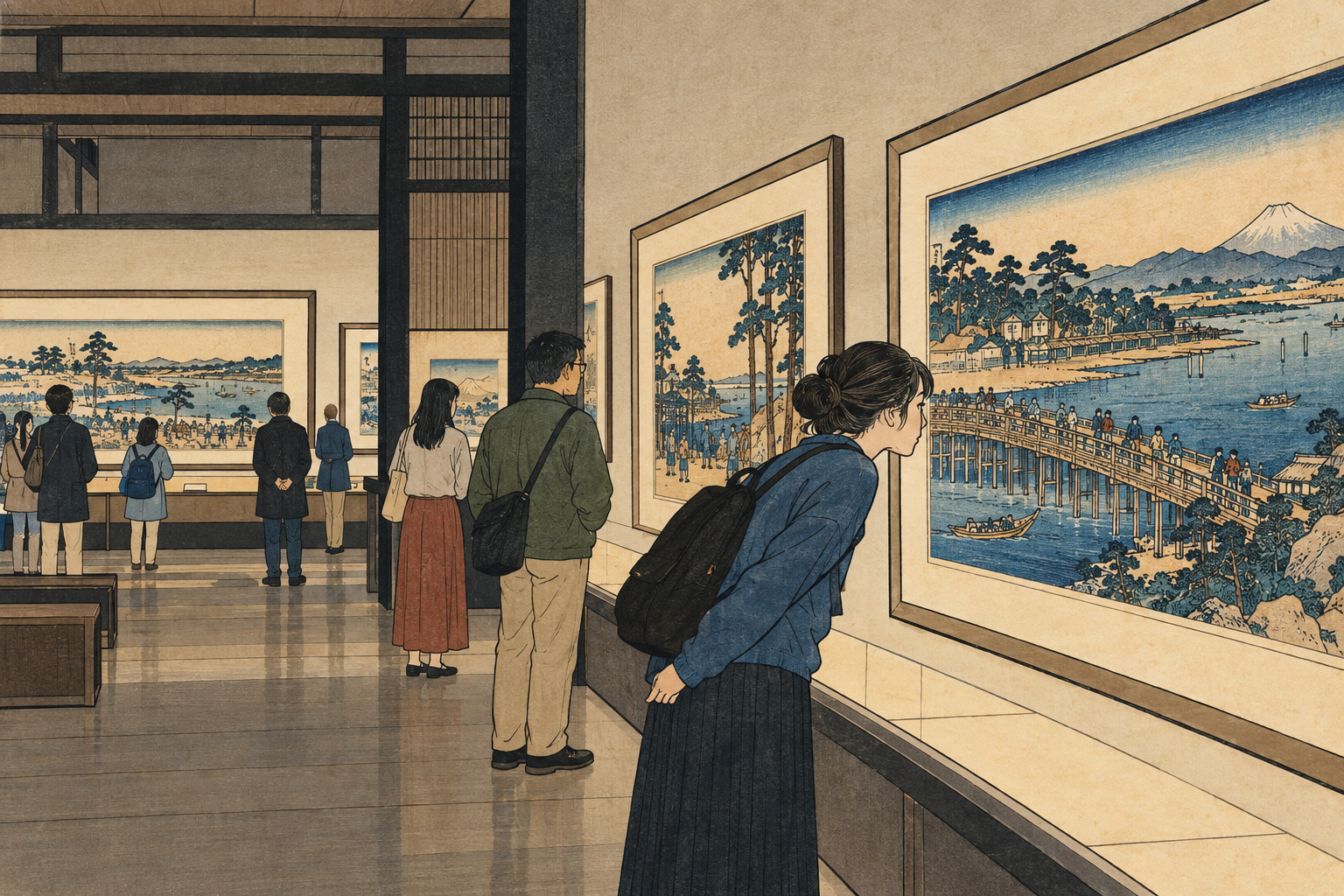
Tokyo National Museum’s new Hiroshige exhibition begins with a change in ownership that can outlast any exhibition season. The museum has received 1,025 ukiyo-e works formerly in the collection of Uchiyama Susumu. Its commemorative show, Hiroshige: New Perspectives on Edo Japan, is scheduled for September 29–December 20 in Room A of the Honkan.[1]
The gift is the news; the opportunity is to look beyond a handful of familiar images. A substantial collection allows prints to be studied in relation to one another—as parts of series, products of workshops and objects that have survived collecting histories of their own.
Three visits would reveal three different displays
The exhibition changes completely between its three parts. The 1,025-item acquisition should not be mistaken for the number displayed at once, nor should visitors expect all three major series on a single visit.[1],[2]
| Dates | Principal focus |
|---|---|
| September 29–October 25 | The Fifty-Three Stations of the Tōkaidō Road and views of Edo |
| October 27–November 23 | The Sixty-Nine Stations of the Kiso Road, other landscapes and bird-and-flower prints |
| November 25–December 20 | One Hundred Famous Views of Edo |
For someone principally interested in Hiroshige’s celebrated Edo series, the third part is the relevant period. The opening display instead follows the Tōkaidō. The distinction changes how to plan a visit, but it also suggests how to read the artist: a road series and a city series ask different things of a landscape image.
A collection that began with a familiar harbor
According to the museum, Uchiyama, a Shizuoka-born businessman, began collecting after acquiring a Hiroshige image of his home area’s Ejiri-Shimizu harbor as a student. Encounters with ukiyo-e displays in Boston and London later encouraged more sustained collecting.[1]
That path links local recognition with international museum experience. A print could first matter because it depicted a place the collector knew, then become part of a wider understanding of art. The resulting collection records a later history of attention, as well as the history of the images themselves.
Its transfer into museum care creates a continuing basis for comparison. Future exhibitions can place different works together and ask different questions. That is an implication of the acquisition, not a claim that a particular new research project or public-access program has already been announced.
An Edo artist shaped by a market for places
Utagawa Hiroshige lived from 1797 to 1858. The Shizuoka City Tokaido Hiroshige Museum of Art traces his background to an Edo firefighting family and his apprenticeship, around 1811, to Utagawa Toyohiro. His artist’s name combined a character from his teacher’s name with one from his own.[3]
Around 1833, the Hōeidō edition of his Tōkaidō series began publication. The Shizuoka museum connects its popularity with contemporary enthusiasm for travel. Famous-place pictures could bring a route, a destination or the experience of a journey into the hands of someone looking at a sheet of paper.[3]
For today’s viewer, the useful question is how a landscape conveys an experience. A map emphasizes where places sit relative to one another. A print can make a particular moment—departure, difficult weather or a pause on the road—feel like the defining character of a place.
The Kiso Road had more than one author
The Kiso Road series complicates the idea of a single artist’s vision. The Nakasendo Hiroshige Museum of Art explains that its 70 prints cover Nihonbashi and the route’s 69 stations. Keisai Eisen began the project and produced 24 designs before Hiroshige took over.[4]
Publishers also changed, and the series was reissued. Its history belongs to publishing as well as individual creativity. Reading the series title and publisher information can therefore matter as much as recognizing a famous artist’s signature.[4]
This is one reason a complete sequence offers something a selection of highlights cannot. Repeated formats make differences easier to notice: the distance between viewer and subject, the prominence of travelers, or the balance between open space and densely described terrain. Comparison turns looking into an active inquiry.
The labor inside the color
A multicolored woodblock print—nishiki-e—was the outcome of several kinds of expertise. The Adachi Foundation describes a system involving the designer, block carver and printer, coordinated by the publisher. An image attributed to Hiroshige still depended on other hands to become a printed object.[5]
Those roles are especially useful to remember when examining a sky or a stretch of water. Adachi’s technical account explains the importance of brush adjustment in producing bokashi, or graduated shading. A gentle transition in color is an effect achieved through printing practice, not simply a boundary drawn in the design.[6]
The question changes from “What did Hiroshige depict?” to “How was this effect made visible?” Fine lines, areas of color and subtle transitions all reward attention. The collaborative process adds depth to the achievement rather than diminishing the designer’s contribution.
A city seen through framing
The final display includes the 1857 designs Plum Estate, Kameido and Sudden Shower over Shin-Ōhashi Bridge and Atake. The museum’s Japanese titles are 「亀戸梅屋舗」 and 「大はしあたけの夕立」. Their emphatic framing and diagonal movement invite viewers to consider how composition changes a place’s appearance.[2]
Try asking what the picture lets you see, and what it keeps outside the frame. A foreground form can interrupt a distant view without preventing the scene from being legible. A bridge can organize movement across the image. The familiar subject becomes an exercise in directing attention.
Hiroshige’s bridge also acquired another material life. The Van Gogh Museum’s collection account describes Vincent van Gogh’s 1887 painted adaptation, in which rain became fine brushstrokes. The comparison makes international influence tangible: a composition traveled, while its medium and handling changed.[8]
Public ownership brings a duty of care
Museum ownership does not mean permanent display. Tokyo National Museum’s conservation guidance explains that controlling light and exhibition duration helps reconcile access with preservation. Prints containing light-sensitive colorants need particular care.[7]
This matters to the meaning of a gift. Acquisition begins an ongoing responsibility to preserve, document and make objects accessible. A rotating exhibition offers access within limits; those limits help keep later access possible. The museum’s general conservation policy should not, however, be read as a complete explanation of every curatorial decision in this show.
Visitors should check the museum’s official page for current hours, closures, admission concessions and changes. The most important choice is the display period: the opening Tōkaidō presentation and the later Edo presentation are different encounters with the collection.[1],[2]
Hiroshige’s images are familiar enough to recognize quickly. This exhibition offers a reason to slow that recognition down. Follow a road through the picture, study a passage of shading, then compare it with the next print. The lasting value of the gift lies partly in making that kind of looking available again, under new questions and to new viewers.
