Heat is no longer weather. It is an economy.
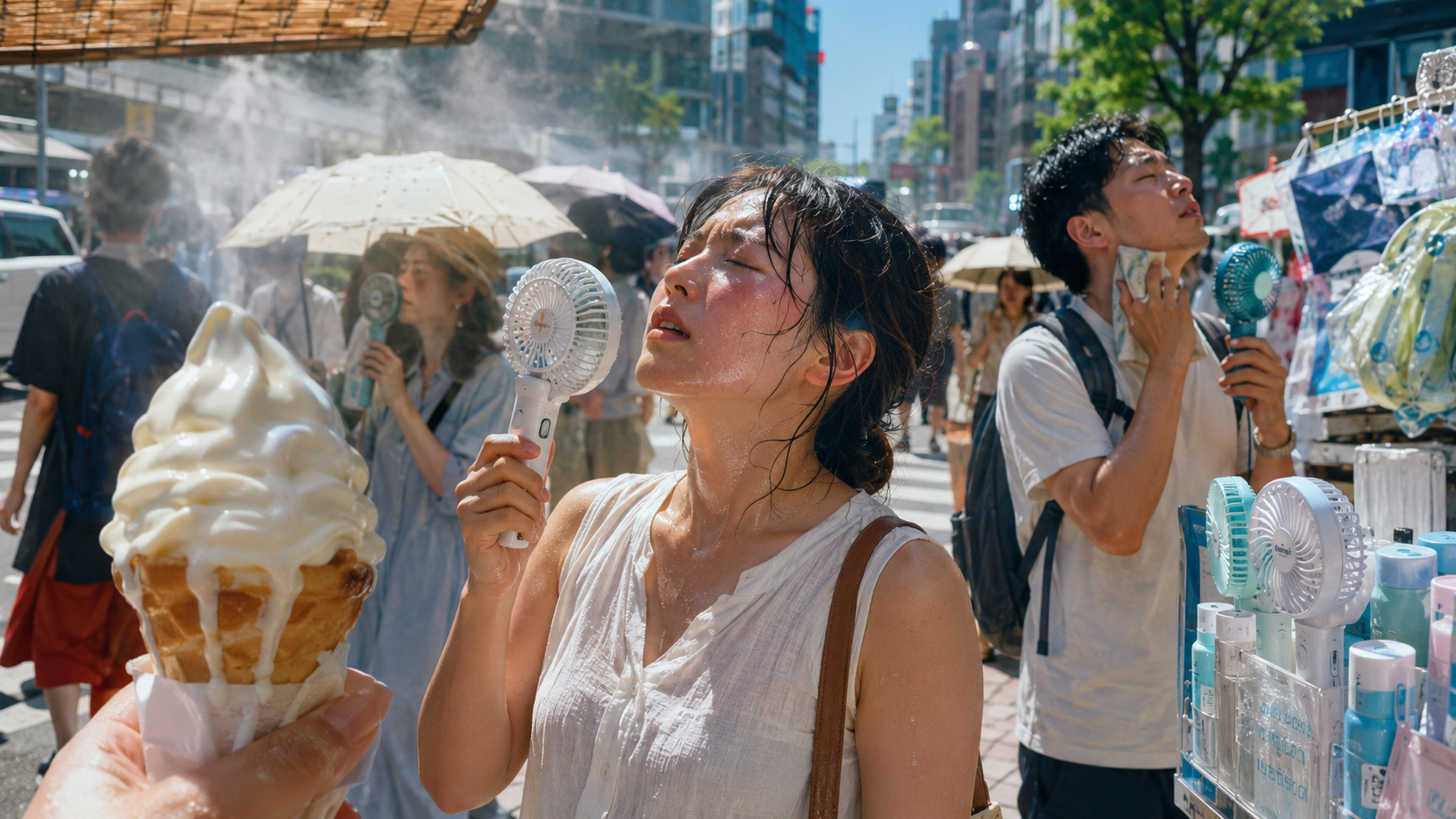
Japanese summer used to be described with wind chimes, shaved ice, yukata and fireworks. Those things still exist, thank goodness. But in 2026, another sound has joined the soundtrack: the tiny mechanical whine of the neck fan. On train platforms, at crosswalks, outside convenience stores, little personal propellers are spinning under people’s chins. It is not exactly poetry. It is more like wearable air conditioning.
Heat has escaped the weather map. It now moves electricity demand, retail shelves, clothing design, drugstore displays, workplace safety rules and household budgets. A 35°C day is a forecast, a sales event and a labor-risk warning. A 40°C day has become serious enough that Japan’s weather authorities introduced the term “kokushobi,” or brutally hot day, for temperatures at or above 40°C. When a country needs a new word for heat, the thermometer has already won the argument.
This summer, Japanese companies are turning discomfort into products: cooling fabrics, fan-equipped workwear, portable multifunction fans, ice slurry machines, cooling towels, cooling sprays, sun umbrellas, bedding pads and gadgets that make the human body look increasingly like a small appliance. It is practical. It is slightly ridiculous. It is very Japan.
A country invents a word for 40°C
In April 2026, the Japan Meteorological Agency introduced “kokushobi” as a forecast term for days when temperatures reach 40°C or higher. Until recently, Japan’s familiar danger word was “moshobi,” a day of 35°C or above. But recent summers have made the old vocabulary feel underpowered.
Japan’s heat is not just heat. It is humidity, concrete, asphalt, crowded trains, urban heat islands, tropical nights, school sports, elderly households, outdoor work and the cultural expectation that one should somehow remain neat while slowly becoming soup. The heat index matters because the human body does not experience temperature in a spreadsheet. It experiences it on a station platform in a damp shirt.
Forecasts for summer 2026 point to above-normal temperatures across much of Japan. Japan Weather Association warned that extremely hot days may increase after the rainy season, particularly in eastern and western Japan. In plain language: this is not a summer to improvise. This is a summer to plan, hydrate and know which convenience store has the best freezer aisle.
The cooling-goods boom: Japan turns itself into a gadget
Japanese retail is fast at converting discomfort into a product category. Rakuten trend data highlighted cooling clothes and portable multifunction fans, while a Tokyo exhibition on June 5 reportedly brought together 29 companies selling extreme-heat countermeasures. The marketplace is telling consumers: do not merely survive the heat; accessorize against it.
The most interesting shift is that cooling goods are moving from novelty to infrastructure. Neck fans used to look eccentric. Now they look normal. Fan-equipped clothes, once associated mainly with construction sites, are spreading through warehousing, agriculture, delivery, outdoor events and security work. Cooling towels, sprays and wipes have become drugstore summer essentials.
Japan is a country that likes to look orderly, even in disorder. So companies offer cooling products that promise dignity under thermal assault: clothes that breathe, jackets that puff with air, plates that chill the neck, sprays that rescue the commuter, bedding that negotiates a ceasefire between body and mattress. It is funny until you step outside. Then it is brilliant.
The winners of the heat economy
The heat economy has many winners. Some companies sell wind. Some sell ice. Some sell shade. Some sell the feeling of cold against the skin. Others sell sensors, warnings and workplace systems that turn heatstroke prevention into operational management.
At work sites, heat countermeasures are no longer a perk. They are safety equipment. Construction, logistics, farming, security, manufacturing and outdoor events all face the same problem: if workers collapse, the site stops. Fan jackets and cooling vests are not cute summer accessories. They are tools for keeping the economy running.
At home, the same logic appears in miniature. Electricity bills are high. Air conditioning is necessary, but every degree lower costs money. Cooling pads, neck rings, sleep gear and personal fans are marketed as ways to help the air conditioner, or perhaps to help the family budget feel less guilty. The idea is almost science fiction: cool the human as if the human were a room.
Then antitrust officials showed up at the ice-cream freezer
And then Japan’s summer story walked straight into antitrust law. In June, the Japan Fair Trade Commission conducted on-site inspections at six major ice-cream makers on suspicion of price fixing. Reports named Meiji, Morinaga Milk Industry, Morinaga & Co., Lotte, Ezaki Glico and Akagi Nyugyo.
The suspected behavior centers on whether the companies exchanged information and coordinated the timing or size of price increases for ice-cream products. Reports have described synchronized hikes, including 10-yen increments. At this stage, the matter remains an investigation and an allegation; the companies have indicated cooperation with the authorities.
Still, the emotional force of the story is obvious. Rice is expensive. Electricity is expensive. Imported goods are expensive. The yen is weak. And now, as Japan approaches another punishing summer, the frozen treat that helps people endure the day is dragged into a cartel headline. That is not just business news. That is a national mood event.
| Theme | What is happening | Why it matters |
|---|---|---|
| Cooling goods | Companies are pushing cooling clothes, portable fans, ice slurry devices and cooling bedding. | The category now touches household budgets, labor safety and electricity demand. |
| Ice-cream probe | The JFTC is investigating six major makers over suspected price coordination. | A small summer pleasure has become a consumer-protection story. |
| Kokushobi | Japan added a forecast term for days of 40°C or higher. | The summer has changed enough to require new vocabulary. |
A short history of Japanese ice cream
Japan’s ice-cream history begins in the Meiji era, when “aisukurin” became one of the sweet novelties of modernization. At first it was not a casual snack. Milk, sugar, ice and refrigeration were expensive. Ice cream required industry before it could become memory.
After World War II, frozen sweets became part of childhood. The freezer case at the local shop, the post-bath treat, the summer vacation popsicle, the small happiness bought with coins. As home refrigerators spread during the high-growth era and convenience stores conquered the night, ice cream became a national everyday pleasure.
That is why an ice-cream price story hits harder than its size suggests. It touches the childhood economy: the memory of buying something cold when the pavement was hot. It touches the office-worker economy: the small reward after a brutal commute. It touches the parent economy: “one only” at the convenience store. A few yen can carry a lot of emotion when the product is a summer ritual.
Why summer prices make people angry
Summer goods are bought under pressure. People buy drinks because they are thirsty, cooling sheets because they cannot sleep, fans because the platform is unbearable, and ice cream because civilization occasionally requires sugar and cold. The choice is real, but the need is not optional. That is why price increases in summer categories can feel personal.
Companies have real cost pressures too: ingredients, labor, logistics, electricity, frozen transport, packaging and retailer margins. Price increases are not automatically abusive. A hotter summer can increase sales while also increasing distribution and refrigeration costs. Ice cream is simple to eat but not simple to make, store and move.
The issue is whether price changes reflect competition or coordination. Markets are supposed to work even when consumers are sweaty and irritated. If companies secretly reduce the consumer’s choices at the very moment consumers need the product most, that is not the romance of capitalism. That is the freezer aisle getting mugged.
Japanese companies are designing discomfort
One of Japan’s great commercial skills is breaking discomfort into tiny sellable problems. You are not merely hot. Your neck is hot. Your back is damp. Your makeup is failing. Your lunch may spoil. Your pet is at risk. Your elderly parent refuses to use the air conditioner. Your phone is overheating. Your mattress has become an enemy state. Each problem becomes a product.
This “micro-design of discomfort” is familiar in Japan. Hay fever, rainy season, static electricity, shoe odor, humidity, dry skin, aging, commuting, sleep. The retail shelf is a museum of small inconveniences turned into purchase decisions. Summer 2026 has simply opened a new wing of the museum.
But the joke has an edge. If cooling products sell well, it means society is adapting. It also means the built environment and work culture are not adapting fast enough. Portable fans help. So do shade trees, rest breaks, later work hours, better insulation, school safety rules, power planning and clearer tourist guidance. Cooling the individual is useful. Cooling the society is harder.
Tourists meet the Japanese summer survival kit
Inbound tourists will meet this economy quickly. Kyoto stones, Asakusa crowds, Shibuya crossings, Nara deer and Kamakura slopes are beautiful. In July and August, they are also intensely hot. Visitors arrive for temples and discover drugstore cooling aisles. They buy matcha ice cream, portable fans, cooling wipes and sun umbrellas, then slowly become honorary members of the Japanese summer survival club.
There is opportunity here. Heat warnings in multiple languages, shaded walking routes, cool rest stops, misting areas, station guidance and tourist maps that acknowledge the body as well as the scenery. If Japan wants to welcome more summer visitors, heat management must become part of hospitality.
Handled well, Japan’s summer wisdom can become part of the travel experience: wind chimes, uchimizu water sprinkling, shaved ice, yukata, parasols, fans and absurdly specific cooling gadgets. Old wisdom plus new retail can make summer less like punishment and more like a strange but memorable adventure.
Will coolness become a luxury?
In the long run, the heat economy will probably grow. Japan is aging. Cities are warmer at night. Electricity demand is political. Outdoor work is harder. School sports, festival schedules, construction shifts and commuting habits will all face pressure. “This is how we have always done summer” is not a strategy.
The risk is that coolness becomes unequal. A well-insulated home, a generous air-conditioning budget, a shaded neighborhood, an indoor job, a flexible schedule: these are protections. Old housing, outdoor work, low income, elderly isolation and heat-retaining city blocks are vulnerabilities. Heat comes for everyone, but coolness is distributed.
That is why the cooling-products story matters. Neck fans are funny. Cooling clothes are odd. The phrase “ice-cream cartel” sounds like a villain in a very sticky manga. But beneath the absurdity are climate change, inflation, consumer protection, worker safety, urban design and public health. Japan’s summer has become a policy problem wearing a portable fan.
Still, we want the ice cream
After all the analysis, one fact remains: ice cream on a hot day is wonderful. It may be the only economic good that can make a person forgive the entire afternoon. Economists can discuss price formation. Regulators can inspect documents. Consumers can complain online. But when the humidity is unbearable, a cold bar from a convenience-store freezer can feel like a small act of mercy.
Japanese summer can be brutal. The walk to the station becomes a character test. A suit becomes a mistake. Cicadas conduct meetings louder than executives. The moment the convenience-store doors open and the air conditioning hits, one briefly believes in civilization again. Then comes the freezer decision: chocolate, vanilla, fruit ice, azuki, cup, cone, bar. This is not trivial. This is moral philosophy at -18°C.
If competition works, prices are honest, companies make good products, and consumers can still afford a small frozen happiness, that is the best outcome. The heat may be unavoidable. But Japan’s small summer pleasures should not become hotter than the weather itself.
- Japan is expected to face above-normal summer temperatures, making cooling goods a mainstream retail and safety category.
- Cooling clothes, portable fans, ice slurry devices and cooling bedding are shifting from novelty products to household and workplace tools.
- Japan’s antitrust watchdog is investigating six major ice-cream makers over suspected price coordination; the matter remains an allegation and investigation.
- Ice-cream prices are a supply-chain issue, an inflation issue and an emotional consumer story because frozen treats are part of Japan’s summer memory.
- Heat countermeasures are no longer just products; they are tied to urban planning, labor safety, tourism, elderly care and electricity policy.
Sources and references
This article draws on public reporting from Nippon.com/Jiji, AP, The Guardian, Mainichi/Kyodo, Japan Weather Association, the Japan Meteorological Agency and the Japan Fair Trade Commission. All cartel references are treated as allegations under investigation.
- Japanese Firms Launch New Items to Address Heat Wave
- Summer 2026 Weather Forecast for Japan
- Japan Fair Trade Commission official site
- AP: Japanese fair trade officials raid 6 ice cream makers
- Guardian: Alleged ice-cream cartel in Japan investigated
- Mainichi/Kyodo: Japan watchdog raids six ice cream makers
- JMA Seasonal Forecasts
- JMA Tokyo Climate Center seasonal outlook discussion