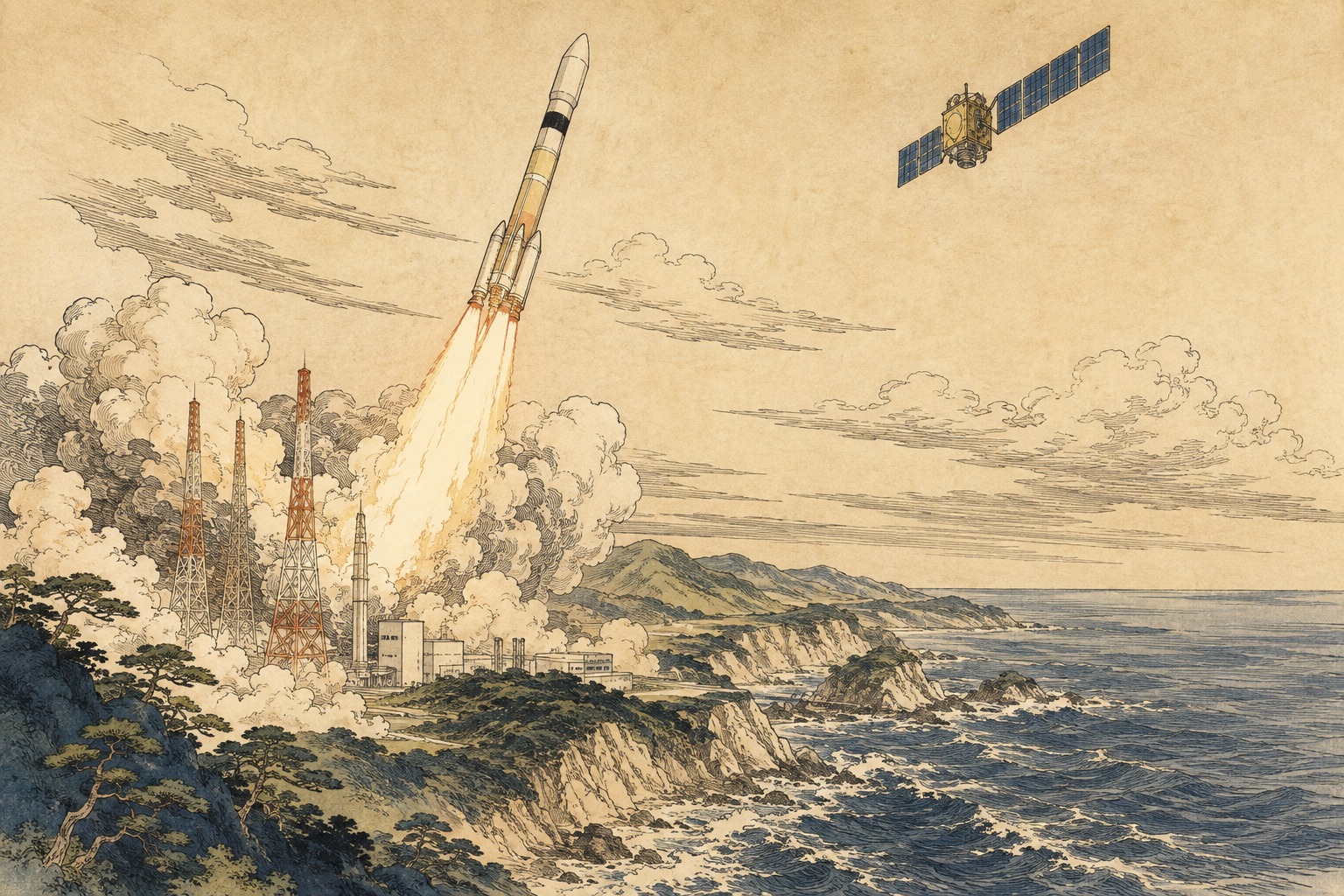
At 4:23:31 in the morning, summer darkness still covered Tanegashima, leaving only a thin indigo distinction between sea and sky. Fire from the Yoshinobu Launch Complex abruptly became the center of the landscape. H3 Flight No. 9, roughly 57 meters tall, rose on two LE-9 main engines and two SRB-3 solid rocket boosters. From the ground, success looked like a pillar of light. In the control room, it was twenty-nine minutes of checking that hundreds of measurements continued to follow their expected lines.
The solid boosters separated about one minute and 56 seconds after liftoff. At roughly three minutes and 44 seconds, the fairing that had protected the satellite from the atmosphere fell away. Main-engine cutoff, stage separation, the second stage’s first burn, a long coast and then a second burn followed. The plan called for spacecraft separation at about 29 minutes and 10 seconds. JAXA reported the actual separation at approximately 29 minutes and 4 seconds. H3 had handed the roughly 4.9-ton satellite not to low Earth orbit, but to a transfer orbit reaching toward an altitude of nearly 36,000 kilometers.
For the rocket, separation was the end of the assignment. For the spacecraft, it was the beginning. Michibiki-7 must deploy its solar arrays, reshape its orbit with its own propulsion, and verify its antennas, clocks, signal-generation equipment and links to ground systems. A successful launch and the start of public service are not the same event.
Turning Each Line of a Flight Plan Into Reality
A rocket’s outward violence conceals a sequence organized to the second. Soon after leaving the pad, Flight No. 9 pitched east over the Pacific. It discarded the boosters, released the fairing after the atmosphere had thinned, and consumed the first stage’s liquid hydrogen and liquid oxygen. The second stage did more than perform one long burn: it shut down, coasted for more than eleven minutes, restarted and then supplied the velocity required for a high transfer orbit.
| Major event | Planned elapsed time | Purpose |
|---|---|---|
| SRB-3 separation | 1 min 56 sec | Discard the two spent solid rocket boosters. |
| Payload fairing separation | 3 min 44 sec | Remove the protective shell after atmospheric flight. |
| Main-engine cutoff and staging | 4:59 and 5:07 | End the first stage’s work and transfer flight to the upper stage. |
| Second-stage first burn | 5:20 to 12:53 | Provide the principal upper-stage ascent before a long coast. |
| Second-stage second burn | 24:28 to 28:50 | Shape a transfer orbit with an apogee near 35,586 kilometers. |
| Spacecraft separation | Planned 29:10; actual about 29:04 | Release Michibiki-7 as an independent spacecraft. |
The launch plan described the target as a quasi-geostationary transfer orbit with a perigee of about 370 kilometers, an apogee of about 35,586 kilometers and an inclination of 22.9 degrees. From there, the satellite must use its own propulsion to circularize and reach its slightly inclined quasi-geostationary operating orbit. A geostationary satellite appears fixed over one point on Earth. A quasi-geostationary satellite appears to move modestly near the equator. Michibiki-7 therefore fills a position different from both the familiar figure-eight quasi-zenith orbits and a perfectly geostationary slot.
The 57-Meter Choice Called “22S”
The vehicle configuration was H3-22S. The first “2” denotes two LE-9 first-stage engines; the second denotes two SRB-3 solid boosters; “S” identifies the short payload fairing. Excluding the satellite, the fully fueled vehicle weighed roughly 422 tons. The first stage burned liquid hydrogen and liquid oxygen, with the solid boosters adding the enormous thrust needed at liftoff. A single LE-5B-3 engine, descended from Japan’s H-IIA program, powered the second stage.
H3 was conceived not as one fixed rocket but as a family configured for each payload. It can combine two or three LE-9 engines with zero, two or four solid boosters, and it can use different fairings. Flight No. 6, successfully launched in June, was the first “30” configuration: three LE-9 engines and no solid boosters. Flight No. 9 returned to the 22S used for large spacecraft bound for high orbits. The two consecutive successes therefore came from substantially different H3 configurations.
Flight No. 9 also carried a crucial change largely invisible from outside. Its payload support structure, or PSS—the load-bearing pedestal connecting the spacecraft to the upper stage—used a fastener-joined design for the first time on H3. This was not a cosmetic revision. It changed the construction of the structure at the center of the December 2025 failure investigation.
December 22, 2025: The Engines Burned, but the Payload Was Not Protected
H3 Flight No. 8 also carried a Michibiki satellite. Michibiki-5 was intended to move Japan closer to an independent seven-satellite positioning constellation. Instead, the upper stage’s second engine burn failed to rise normally and stopped early. The satellite could not be placed into its planned orbit, and JAXA declared the launch a failure.
The investigation identified the principal cause not inside the engine, but in the payload support structure. An internal delamination created during manufacturing progressed under the shock of fairing separation and other flight loads until the PSS broke. A launch vehicle is one coupled mechanical system: upper-stage propulsion, electronics, structure and spacecraft all affect one another. When the structure carrying the payload fails, the consequences do not remain confined to the “pedestal.”
Japan’s response proceeded in two stages. Flight No. 6 used an already manufactured PSS that was inspected, repaired and load-tested. That vehicle flew as planned in June and demonstrated the boosterless H3-30 configuration. Operational satellite missions beginning with Flight No. 9 adopted the fastener-joined PSS designed to remove the delamination risk. The August success was therefore not simply another flight of the same repaired hardware. It was the next test of the failure theory, using a different corrective design on a different rocket configuration with a valuable operational payload.
- March 2023, Test Flight No. 1: Failure after the second-stage engine did not ignite; ALOS-3 was lost.
- February 2024, Test Flight No. 2: H3’s first successful flight, carrying a test payload and two small satellites.
- July 2024, Flight No. 3: ALOS-4 placed into orbit.
- November 2024, Flight No. 4: Kirameki-3 placed into orbit.
- February 2025, Flight No. 5: Michibiki-6 placed into orbit.
- October 2025, Flight No. 7: HTV-X1 launched successfully before Flight No. 6 was ready.
- December 2025, Flight No. 8: Failure to place Michibiki-5 into its intended orbit.
- June 2026, Flight No. 6: Successful demonstration of the boosterless three-engine configuration.
- August 2026, Flight No. 9: Michibiki-7 injected into its predetermined orbit.
H3 Began With Failure Before It Could Build a Record
Development of H3 began in 2014. Its purpose was to succeed H-IIA and preserve Japan’s ability to reach space on its own terms while providing the price, responsiveness and launch cadence needed to compete internationally. Its new LE-9 first-stage engine scaled up an expander-bleed cycle intended to simplify the engine and reduce the number of parts. Combustion-chamber and turbopump problems, however, repeatedly delayed the inaugural launch.
When Test Flight No. 1 finally flew in March 2023, the first stage performed, but the second-stage engine did not ignite. With no prospect of delivering the ALOS-3 Earth-observation satellite to orbit, controllers sent a destruct command. JAXA spent about seven months narrowing the possible electrical failure scenarios and modifying the engine igniter and second-stage propulsion controller. Test Flight No. 2 succeeded in February 2024, followed by Flights 3, 4, 5 and 7.
That made the Flight No. 8 failure particularly serious. H3 was no longer merely a prototype seeking its first success; it was becoming Japan’s operational flagship when it lost a second major satellite. Flight No. 9 does not erase either loss. Its value is that it converts an investigation into flight data and demonstrates that the vehicle can be changed so that it does not travel the same path twice.
Michibiki Is More Than “Japan’s GPS”
Satellite navigation is far more than the blue dot on a smartphone. Precise position and time signals support road, maritime and agricultural navigation; automated construction and surveying; logistics; synchronization of electric grids; and timestamps in financial systems. Positioning, navigation and timing—PNT—is infrastructure that is almost invisible until it becomes unavailable.
Japan’s Quasi-Zenith Satellite System, known as Michibiki, broadcasts signals compatible with GPS and improves the number and geometry of satellites visible in urban canyons and mountainous terrain when used alongside GPS and other constellations. It also layers on services developed for Japan and the wider Asia-Pacific region: the centimeter-level CLAS correction service, MADOCA-PPP high-precision corrections, disaster and crisis messages, and authentication intended to help receivers detect spoofed navigation data.
The history began with the first Michibiki launch in September 2010. In 2011, the government decided to establish an initial four-satellite system and eventually expand to seven. Satellites 2, 3 and 4 launched in 2017, enabling the four-satellite service that began in November 2018. A replacement for the original satellite launched in 2021, and Michibiki-6 followed in February 2025. The five currently operating spacecraft consist of three in quasi-zenith orbits—Michibiki-1R, 2 and 4—and two geostationary satellites, Nos. 3 and 6.
September 2010 The first Michibiki satellite is launched.
September 2011 Japan commits to a four-satellite system and a future seven-satellite constellation.
2017 Michibiki-2, 3 and 4 are launched.
November 2018 Full service begins with four satellites.
October 2021 The replacement for the original satellite is launched.
February 2025 Michibiki-6 is launched and later becomes the fifth operational spacecraft.
December 2025 Michibiki-5 is lost in the H3 Flight No. 8 failure.
August 2026 Michibiki-7 is launched; Japan aims initially for six-satellite operation.
Why a Position Fix Needs Four Satellites
A navigation satellite broadcasts its position and a precise time. A receiver calculates distance from the time required for that signal to arrive. Three ranges may appear sufficient to solve three-dimensional position, but an ordinary receiver’s clock contains error. Four unknowns—latitude, longitude, altitude and receiver clock offset—must be solved together. That requires signals from at least four satellites.
The four-satellite Michibiki system greatly improves GPS availability and sky geometry, but it does not keep four Japanese satellites visible at all times. The planned seven-satellite architecture combines four quasi-zenith spacecraft, two geostationary spacecraft and one quasi-geostationary spacecraft. It is designed to maintain at least four Michibiki satellites over Japan, allowing continuous positioning without depending on another country’s constellation.
Michibiki-7 fills that unique quasi-geostationary position. It weighs about 4.9 tons at launch and 1.8 tons without propellant, and spans about 19 meters when its solar arrays are deployed. Built on Mitsubishi Electric’s DS2000 satellite bus, it broadcasts navigation and augmentation signals in the L1, L5 and L6 bands. Satellites 5 through 7 also carry elements of JAXA’s Advanced Satellite Navigation System, or ASNAV. By measuring distances between satellites and between satellites and ground stations more precisely, the program aims to improve the estimated orbit and clock data and demonstrate ordinary compatible smartphone positioning approaching the one-meter level.
“No. 7” Does Not Mean Seven Satellites Are Ready
The name makes it easy to assume that the seventh spacecraft completes a seven-satellite system. It does not. The original satellite has been replaced, and Michibiki-5 was lost in December 2025. The Cabinet Office’s post-launch statement explicitly described Michibiki-7 as joining five satellites now in operation. A JAXA briefing likewise said that, after No. 7, the immediate goal is to begin service with six spacecraft.
Michibiki-7 is essential to the seven-satellite plan, but it is not the last missing spacecraft. The public material reviewed for this article does not establish a confirmed launch or service date for a replacement for Michibiki-5. It would therefore be premature to say that Japan has completed independent continuous positioning.
The government is already looking beyond seven to eleven satellites. With only seven, a single failure can create periods when fewer than four are available in the required geometry. Eleven would add enough margin to preserve continuous positioning after the failure of any one satellite. Autonomy in this context does not mean abandoning GPS, Galileo or other partner systems. It means retaining a national reference when those systems cannot be used.
The Heavy Standard Left by H-IIA’s 49 Wins and One Loss
H3 inherited more than hardware. H-IIA flew 50 times between 2001 and 2025 and succeeded on 49 of those missions. After the failure of Flight No. 6 in 2003, it completed 44 consecutive successful launches before retirement. Together with H-IIB, that experience carried government, weather and Earth-observation satellites, lunar and asteroid missions, space-station cargo and foreign commercial spacecraft.
Yet H-IIA’s reliability did not make it a high-volume answer to a rapidly expanding global launch market. H3 was designed around civilian components, revised production processes, additive manufacturing, new avionics and multiple configurations. JAXA set a goal of roughly ¥5 billion for the smallest configuration under specified mature-production conditions, while seeking a much higher annual launch rate and commercial customers beyond guaranteed government demand.
The market, however, does not buy a target price; it buys a schedule backed by evidence. Satellite operators ask whether a rocket will fly in the contracted period, inject accurately, and keep shock and vibration within promised limits. Flight No. 9 is consequential. But after two failures in nine launches, H3 needs repetition more than celebration. Reliability will be built only by succeeding across configurations, orbits and customers until a launch begins to look as routine as H-IIA made it appear.
The Quiet Success That Must Follow the Flame
In video from Tanegashima, the rocket disappeared into cloud within minutes. At roughly the twenty-nine-minute mark, the spacecraft separated and the launch was declared successful. Michibiki-7’s contribution will take months to become visible: transfer to operational orbit, health checks, integration with the ground segment, signal-quality evaluation and an official decision to begin service. None of that produces a column of fire.
An accurate assessment therefore requires two statements at once. H3 Flight No. 9 delivered an important operational satellite to its intended orbit and recorded a second consecutive success after the December failure. H3 is still building a mature operational record, and Michibiki has not yet completed its seven-satellite constellation. The first truth should not be minimized; the second should not be hidden.
If Michibiki-7 enters service as planned, it will cease to be the spacecraft seen atop a rocket. It will become a farm machine holding its line, a vehicle retaining its position in a mountain valley, a disaster message reaching a distant receiver, or a power grid and financial system sharing the same precise time. A machine with a 19-meter solar span will dissolve into millions of small assurances that something is in the right place at the right moment. That is how the success of a rocket becomes ordinary life.
Reporting Notes and Principal Sources
This article uses public information available through August 12, 2026 at 9:18 AM JST. Successful spacecraft separation does not mean that service has begun. The reviewed material did not state a firm operational date for Michibiki-7, a confirmed replacement launch schedule for Michibiki-5 or a start date for seven-satellite service; this article does not infer them.
- JAXA: Launch result of Michibiki No. 7 aboard H3 Flight No. 9
- JAXA: Michibiki-7 / H3 Flight No. 9 launch plan
- JAXA: Michibiki-7 and H3 Flight No. 9 mission overview
- JAXA: H3 Flight No. 9 press kit
- JAXA: Launch result of H3 Flight No. 6, the H3-30 test vehicle
- JAXA: Investigation and response to the H3 Flight No. 8 failure
- Cabinet Office: Statement on the launch of Michibiki-7
- Cabinet Office: Michibiki-7 overview and specifications
- Cabinet Office: Features and services of the seven-satellite constellation
- JAXA: Advanced Satellite Navigation System press kit
- JAXA: H3 flight and development history
- JAXA: H-IIA operational record