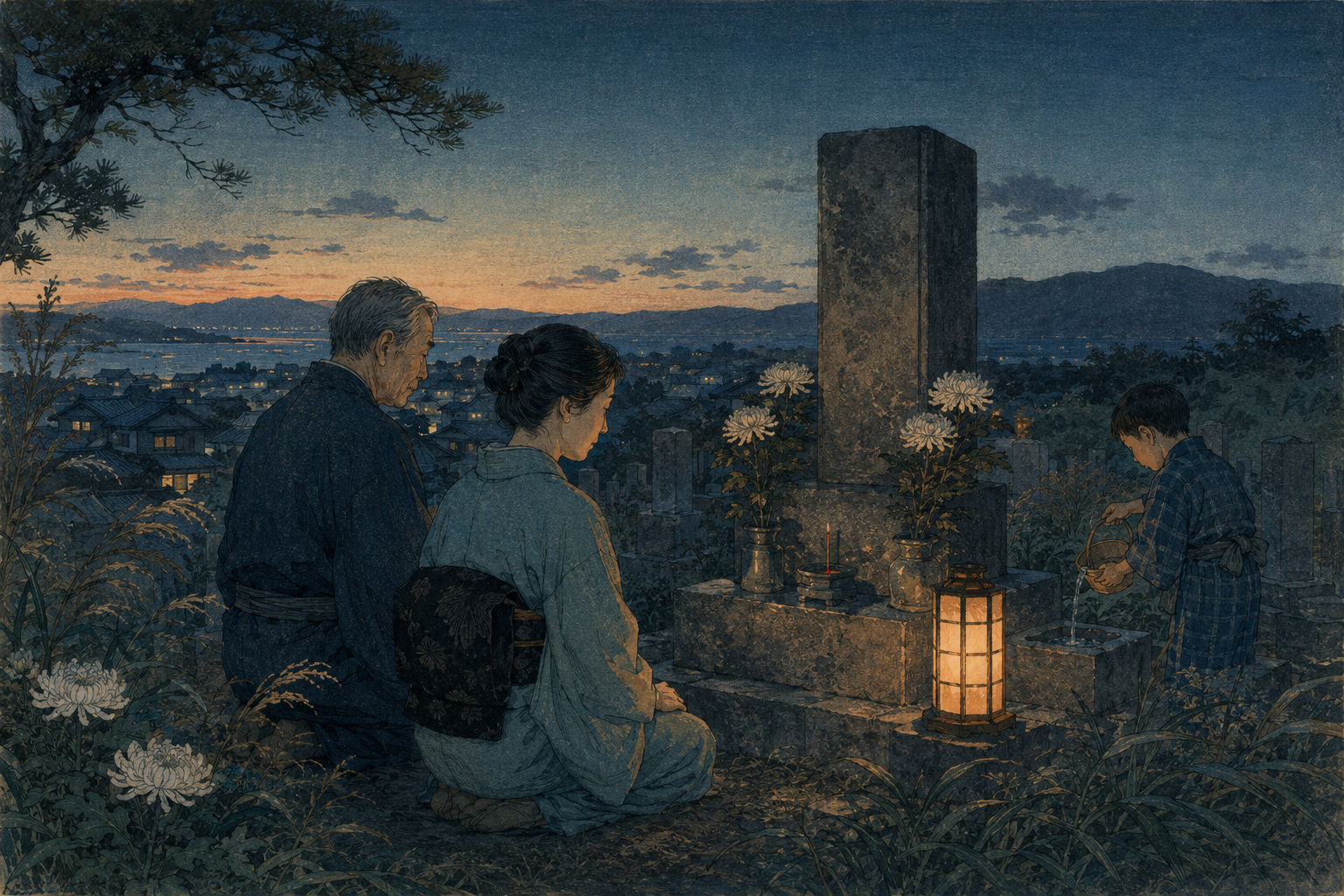
The first act is often not prayer. It is work.
Someone fills a bucket. Someone pulls summer weeds from the narrow gap beside the stone. Water darkens the granite; a brush reaches into the carved family name; wilted flowers are removed and fresh ones arranged. Children are told where to stand. Incense catches, fails, then catches again. Conversation thins. Hands come together.
The grave has not answered. Nothing visible has changed except that the stone is clean. Yet visitors sometimes describe a shift inside themselves: gratitude, calm, reassurance, a sense that the dead and the family are near. A national survey released before Obon in 2026 gives those private impressions a public outline. Its value lies not in proving a cure, but in asking why the physical journey—the road, the water, the stone and the bodily sequence of care—can feel different from remembering at home.
On August 15, during the central days of month-late Obon across much of Japan, that question is lived before it is analyzed. Families are not merely thinking about ancestors. They are going somewhere to meet a relationship that death altered but did not necessarily end.
What the 2026 Survey Actually Found
Ohakanri surveyed 1,000 men and women aged 35 to 64 nationwide in June. Eighty-point-four percent said they knew of at least one relative’s grave that they had visited. Among those 804 people, 65.4% had gone to one within the preceding year. The release therefore supports a modest but important conclusion: grave visiting remains a living practice among many working-age adults, not only an obligation preserved by the elderly.
The emotionally richest results came from a smaller group. One hundred respondents who had visited between three months and five years earlier were asked about values, motives and feelings. Seventy-two percent selected remembering the deceased or ancestors as a reason for going. Afterward, the leading responses included feeling family connection, sensing the deceased as close, becoming calm and feeling grateful.
Those four responses are the heart of this story, but the denominator matters. They were not percentages drawn from all 1,000 respondents, and the published release did not provide the numerical share for each feeling in accessible text. Nor did it disclose enough recruitment and weighting detail to treat the panel as a probability sample of every Japanese adult. The questions allowed multiple answers, so the emotions could coexist. A visitor could feel gratitude and pain, closeness and absence, relief and exhaustion on the same afternoon.
| Survey layer | Who answered | Finding | Responsible reading |
|---|---|---|---|
| Grave awareness | 1,000 adults, 35–64 | 80.4% recognized at least one relative’s grave | Does not cover younger adults, people over 64 or every kind of memorial |
| Recent visit | 804 who recognized a grave | 65.4% had visited within one year | Self-report, not independently observed behavior |
| Motives and feelings | 100 who visited 3 months–5 years earlier | 72% cited remembrance; connection, closeness, calm and gratitude ranked highly afterward | Suggestive subsample, not clinical evidence of treatment |
| Separate NEXER poll | 400 bereaved adults nationwide | 70.0% said remembrance practices provided some peace or support | All remembrance practices, not grave visits alone |
A Place Turns Memory Into an Action
At home, remembrance can arrive without permission: a voice in a song, a familiar smell, a recipe made the wrong way. A grave visit is different because it is intentional. It puts a time around memory and gives the body a script. Travel. Enter. Clean. Offer. Speak or remain silent. Bow. Leave.
That script can reduce the impossible scale of bereavement to a sequence of possible tasks. The visitor cannot reverse death. The visitor can replace the water, polish the stone and bring the flowers a parent liked. Care that no longer has a living body to receive it is given a material destination.
Psychologists Michael Norton and Francesca Gino explored a related mechanism in three experiments on losses ranging from bereavement to broken relationships and even a lost lottery. Participants who recalled or performed rituals reported less grief, and a restored sense of control helped explain the association. Their research did not test Japanese grave visits, and cleaning a family grave cannot be reduced to a laboratory exercise. It nevertheless clarifies why a structured act may matter when loss has made a person feel powerless.
The Relationship Is Changed, Not Simply Ended
Older Western theories of mourning often emphasized detachment: health meant releasing the bond and reinvesting elsewhere. Contemporary bereavement research is less certain that a clean severance is either possible or desirable. The idea of “continuing bonds” describes an ongoing inner relationship sustained through memory, conversation, possessions, values, prayer, sensed presence and visits to meaningful places.
A 2023 systematic review synthesized 79 studies representing about 13,366 bereaved people. It found no simple rule that continuing bonds are always helpful or always harmful. They could bring comfort and practical support, help a person reconstruct meaning and identity, or intensify distress. Circumstances of death, conflict, culture, spirituality and the form of the bond all mattered.
Japan is not merely an example added to a universal theory after the fact. Scholar Dennis Klass argued that Japanese Buddhist ancestor rites provide culturally developed forms for managing continuing bonds. The relationship with the deceased becomes embedded in a network of living relatives, temple affiliations, household practice and social time. The dead are remembered not only inside an isolated mind but through acts other people recognize.
That social recognition may explain why the survey’s leading emotional response was not only “I felt better,” but connection with family. The visit can join three groups at once: the person standing at the stone, relatives standing nearby and predecessors named or imagined across generations.
Why the Stone and Soil Matter
People can remember anywhere. Why travel through heat and traffic to one plot of ground?
Research on continuing bonds and place suggests that relationships with the dead often become rooted in locations. In interviews in Sweden and Britain, sociologists Annika Jonsson and Tony Walter found that mourners associated the deceased with particular places and characteristic actions. Damage or loss of such a place could produce a troubling new absence. Geographer Avril Maddrell similarly describes memorial landscapes as spaces where material form, memory and the paradoxical “absence-presence” of the dead are negotiated.
A Japanese family grave intensifies that geography. The urns or remains may be there. The name of the household is carved there. Previous visits have left a sediment of remembered gestures: how a father held the ladle, where a grandmother placed the flowers, which child once complained about the mosquitoes. The site is not only a container for the dead. It is an archive made from repetition.
Physical presence also limits distraction. A phone can display thousands of photographs while carrying thousands of interruptions. At the grave, the stubbornness of stone narrows attention. Weight, temperature, incense, cicadas and the effort of getting there give memory sensory edges. This does not make physical memorials superior for everyone. It explains why “being there” can be psychologically distinct.
Obon Brought the Dead Home Before the Modern Family Grave
The association between Obon and graves is ancient in feeling but layered in history. The Buddhist Urabon-e observance reached Japan through continental texts and ritual. The Nihon Shoki records temple offerings on the fifteenth day of the seventh month in 606; an Urabon-e ceremony appears explicitly in an account from 657; in 659, temples in the capital were instructed to lecture on the Ullambana Sutra for the benefit of ancestors.
Over centuries, court and temple rites joined local practices of welcoming and sending ancestral spirits. Fires, lanterns, food, dance, household altars and graveside visits formed different combinations by region. The familiar modern sequence—welcome the ancestors, host them, then send them back—is not one ritual copied unchanged from the seventh century. It is a long convergence of Buddhist memorial practice, kinship, seasonal custom and local belief.
The calendar changed abruptly in 1873, when the Meiji state replaced the lunisolar calendar with the Gregorian one. Communities eventually settled into July Bon, month-late August Bon or continuing lunar observance. But the underlying movement remained recognizable: the dead come near, and the living prepare a place.
606 — The Nihon Shoki records seventh-month temple offerings.
657–659 — Early Urabon-e observance and sutra lectures for ancestors appear in court records.
Early modern era — Temple parish systems, household memorials and local Bon customs deepen.
1873 — Calendar reform eventually divides Obon among July, August and lunar dates.
Postwar decades — Migration to cities makes the summer grave visit part of mass homecoming.
2026 — Surveys find both continued grave visiting and increasingly diverse memorial forms.
The “Traditional” Family Grave Is Also Modern
The family grave that many people picture—a stone marked as the ancestral grave of a named household, holding successive generations—is not a timeless national form. Buddhist graves, temple affiliations and ancestor rites have much older histories, but scholars trace the consolidation of the modern ie no haka to the Meiji family system and the modern state.
The legal and social architecture expected an ie, or continuing household, to transmit property, name and ancestral obligations through a successor. The family grave became both symbol and mechanism of continuity. Civil law treated graves and ritual property differently from ordinary inheritance, entrusting them to the person who would carry on ancestral rites.
Sociologist Yukiko Matsumoto described what changed after the Second World War and rapid economic growth. As the binding force of the ie weakened, grave and ancestor practices became less exclusively obligatory and more attached to affection for deceased close family members. That transition helps make sense of the 2026 survey. The visitor may be performing an inherited form, but the reported motive is not chiefly abstract duty. It is remembering someone.
This is history working inward. An institution built to demonstrate the endurance of a household becomes a place where one person misses another particular person.
Gratitude Is Not the Opposite of Grief
Why would gratitude appear after a grave visit? One possibility is narrative. Daily grief can fix attention on the ending: the illness, the telephone call, the empty chair. A deliberate visit may widen the frame from how a person died to what that person gave. Cleaning the grave can become a wordless sentence: this life reached mine, and I am here because it did.
Gratitude can also travel across generations. Visitors may know little about the people whose posthumous Buddhist names are inscribed on a tablet, yet the family line supplies a structure for acknowledging dependence. The feeling need not require literal belief that ancestors intervene. It can be ethical, spiritual, historical or all three.
Calm may come from a different movement: giving grief permission. In ordinary life, sorrow interrupts work and social performance. At the grave, sadness is not an error in the schedule; it is the reason for the schedule. Tears do not need explanation. Silence does not need filling. The visit creates a bounded interval in which attention to the dead is legitimate.
“Emotional healing” should therefore be used carefully. Healing need not mean closure, forgetting or the end of pain. It can mean that sorrow becomes bearable enough to sit beside gratitude, that an unfinished thought is spoken, or that a person returns home with a little more room inside the story.
Two 2026 Surveys, One Important Tension
A separate national online poll by NEXER and Buddhist-goods retailer Nagomi Kobo surveyed 400 adults who had lost a family member or another important person. Grave visiting and praying at a home altar tied as the most common remembrance practices, each selected by 60.8%. Seventy percent said acts of remembrance gave them at least some peace or support.
But the same poll complicates any claim that a cemetery is the only meaningful place. Seventy-two-point-eight percent considered it important to have a place or space for remembrance at home. The most common trigger for remembering the dead was an unplanned moment—a view, smell or piece of music—reported by 59.5%. Anniversaries, Obon and equinox weeks remained important, but memory also lived in ordinary time.
The lesson is not “grave versus home.” Rituals form an ecology. The butsudan allows daily address; photographs preserve a face; food recreates a habit; Obon coordinates the family; the grave anchors memory in a shared location. A person may use all of them, some of them or none. The emotional function lies in the relationship between act, meaning and person—not in a mandatory object.
- A destination: grief is given a place rather than left everywhere at once.
- A script: cleaning and offerings turn helplessness into bounded care.
- A continuing bond: the relationship is addressed in a changed form.
- A family bridge: stories and gestures move between generations.
- A calendar: Obon makes private remembrance socially legitimate and shared.
The Evidence Also Contains Sorrow
Not everyone leaves reassured. In the NEXER survey, 30% did not say remembrance brought peace or support. Some respondents explained that remembering renewed sadness or intensified the wish to see the person again. The systematic review of continuing bonds likewise found comfort and distress, sometimes intertwined.
A grave can carry conflict as readily as affection. There may be anger at the deceased, guilt over an absence, family disagreement, religious estrangement or trauma surrounding the death. The location may be inaccessible, damaged, unbearably hot or controlled by relatives with whom the visitor cannot safely meet. A ritual imposed as duty may feel very different from one freely chosen.
Nor should a survey turn mourning into self-help advice: “visit and you will heal.” Grief has no single correct timetable. WHO’s ICD-11 includes prolonged grief disorder among conditions clinicians may diagnose, while emphasizing culturally informed assessment. Persistent, disabling longing and impairment deserve professional care; a cemetery visit is not a substitute for it. At the same time, ordinary sorrow should not be pathologized simply because it returns at Obon.
When the Grave Itself Is Changing
The emotional importance of place exists beside a practical crisis of succession. Households are smaller; relatives live farther apart; many adults have no child who can inherit maintenance responsibilities. The legal and cultural model that assumed an endless line of grave keepers no longer matches every life.
Kamakura Shinsho’s 2026 consumer survey, drawn from 1,267 people who bought a grave or memorial through its portal in 2025, shows the new landscape. Tree burials remained the largest category at 47.4%. Collective or jointly enshrined graves reached 16.4%, exceeding both conventional family graves at 15.2% and columbaria at 15.5%. Because respondents were customers of a grave portal, those numbers are not national market shares. They are nevertheless strong evidence of demand for memorials that do not require a single successor forever.
Change in form does not necessarily mean disappearance of place. A tree burial has a landscape. A collective grave offers a destination. A columbarium supplies an address, sometimes indoors and close to a station. Even a family that closes an old grave may seek another locus where hands can be joined. In a July 2026 survey of attitudes toward sea scattering, 74.2% still said a place of prayer would be desirable even if ashes were scattered at sea.
The future question is therefore not simply whether Japan keeps the stone family grave. It is how to preserve access, care and meaningful presence when inheritance, mobility and belief change.
A Visit Is Also a Conversation Among the Living
Children learn the grave through small instructions: pour water gently, do not step there, place your hands together. Those gestures can transmit religion, but they also transmit biography. Who chose the family name on the stone? Why is one favorite sweet offered? Which relative traveled from Manchuria, survived a war, opened a shop, raised three children or loved baseball?
The grave becomes a prompt. Stories that rarely emerge at a dining table surface because names are visible and generations are physically arranged in one place. A child may not retain the doctrine, but may remember that a usually reserved parent spoke softly to a dead grandmother. The emotional lesson is that relationships deserve care even when the person cannot respond.
This social function is easy to miss when grave visiting is described only as private spirituality. It can reconcile neither every family nor every history. But when it works, it converts lineage from an abstract diagram into narrated lives. The visitor leaves knowing not only whom the family lost, but something about how the family became itself.
On the Central Day of Obon
Today, in much of Japan, ancestral spirits are understood to be close. Some families will have visited the grave on the welcoming day. Others will go today or tomorrow. Some will pray at home, hire help because distance or age makes travel impossible, visit a new kind of memorial, or choose no ritual at all.
The 2026 survey cannot tell us that one choice is psychologically best. Its smaller emotional module is too limited, grief is too diverse and culture is not a dosage. What it does show is that many people can name what they carry away from a grave: connection, nearness, calm and thanks.
Those feelings are not supernatural measurements. They are reports from the border between memory and place. The bucket is emptied. The incense burns down. The family turns toward the gate, leaving the stone where it was.
But the visit has rearranged the living for a moment. Grief had an address. Care had something to do. And on the walk home, absence did not feel quite so shapeless.
Reporting notes and principal sources
This article distinguishes self-reported survey associations from clinical evidence. Ohakanri’s 2026 poll was an online survey of 1,000 adults aged 35–64; the detailed values and post-visit feelings module used 100 respondents who had visited within the preceding three months to five years. Percentages from separate surveys with different populations are not directly comparable. Psychological mechanisms are presented as interpretations supported by broader research, not as proof that grave visiting causes recovery.
- Ohakanri: nationwide 2026 survey of grave awareness, visits, motives and post-visit feelings
- NEXER and Nagomi Kobo: 2026 survey of remembrance practices and emotional support
- Norton and Gino: experimental research on ritual, grief and perceived control
- Hewson et al.: systematic review of continuing bonds after bereavement
- Dennis Klass: continuing bonds in Japan and North America
- Jonsson and Walter: continuing bonds and place
- Avril Maddrell: memory, memorial landscapes and absence-presence
- Yukiko Matsumoto: modern family graves, ancestor worship and changing affection
- Kenji Mori: burial, Japanese law and succession of ancestral rites
- Asuka Historical Museum: ancient Urabon-e records in Japan
- National Archives of Japan: the 1872–73 calendar reform
- Kamakura Shinsho: 2026 consumer survey of purchased grave and memorial forms
- En and 366: 2026 survey on sea scattering, changing memorial forms and desire for a place of prayer
- World Health Organization: ICD-11 guidance including prolonged grief disorder