The oldest dated example is not the beginning of a tradition. One inscription becomes an anchor for a much larger history.
A date cut into steel
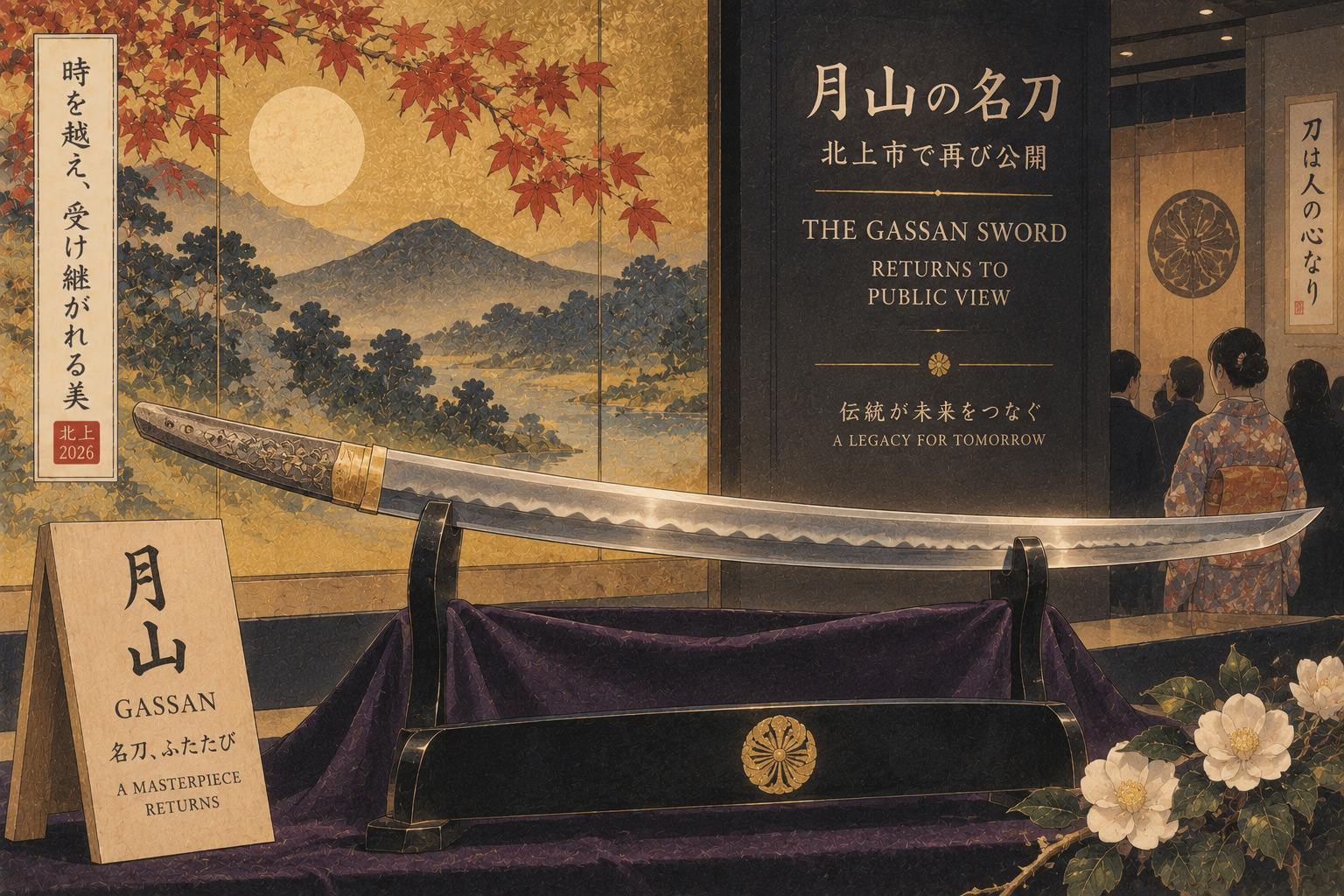
In a museum in northern Japan, a sword usually kept from public view is becoming the centerpiece of an exhibition that asks a deceptively difficult question: how can an object made six centuries ago tell us where a craft came from? Kitakami City Museum in Iwate Prefecture opens Gassan Descends: Tracing the Oldest Dated Gassan Sword on October 17, displaying a privately owned prefecturally designated cultural property inscribed “Gassan, eighth month of Ōei 3.” That Japanese-era date corresponds to 1396.
The exhibition runs until December 20, 2026. Its attraction is not simply the age of the blade. It is the distinctive, flowing appearance of the worked steel—and what a dated piece can contribute to a history otherwise shaped by traditions, surviving artifacts, and gaps in the record.
What “oldest” actually means
The museum identifies the featured object as the oldest dated Gassan sword. The qualification matters. A dated inscription is a documentary anchor, but the existence of a sword from 1396 does not establish that the Gassan smithing tradition started in that year. Japanese museum records place the tradition’s reported origins in the Kamakura period, while noting that firmly documented signed examples survive from the Muromachi period onward.
A sword can preserve evidence of the age it was made, the characteristics of its steel and the conventions of its workshop. It cannot, without independent evidence, identify every owner, battlefield or journey in its 630-year history. That is a more interesting historical position than treating the inscription as a complete biography.
The mountain behind the name
Gassan is more than a swordmaking label. Mount Gassan, in present-day Yamagata Prefecture, is one of the Dewa Sanzan, the three sacred mountains central to a long history of regional religious practice. The museum draws a poetic connection between the sword’s rippling steel and the bark of cedars surrounding the five-story pagoda at Mount Haguro.
The comparison enriches the object’s cultural setting, but it should not be mistaken for proof that a particular medieval blacksmith intentionally encoded a religious symbol in every ripple. Understanding Gassan blades requires keeping documented technology, place-based history and later interpretation in conversation without treating them as interchangeable.
The waves are in the steel, not painted on it
The signature feature is ayasugi-hada, a repeated, wave-like grain pattern in the blade’s jigane, or worked steel. In English writing, the term is sometimes rendered as a cedar-grain or wavy steel pattern. It is important not to confuse this forged surface grain with the hamon, the temper line associated with differential hardening near a blade’s cutting edge.
Japanese swordmaking involves heating, forging, shaping, hardening and careful polishing. Repeated folding and working can contribute to visible structures, but a specific Gassan pattern cannot responsibly be explained by a simplistic count of folds alone. Materials, forging decisions and finishing all matter. In the right light, subtle shifts in the steel become a record of specialized knowledge, rather than mere ornament.
A comparative exhibition, not just one masterpiece
Kitakami’s display will place the dated Gassan blade alongside earlier and later Gassan work, the Osaka Gassan school, Naminohira blades, work attributed to Tajimanokami Munetsugu, and northern traditions including Mokusa and Hōju. It will also feature Southeast Asian kris blades noted for their characteristic surface patterns.
This comparison raises a useful caution: similar visual effects do not automatically demonstrate a shared manufacturing process or direct historical exchange. The objects differ in geography, materials, uses and cultural meanings. What the exhibition can show most directly is the visual diversity of worked metal, and how strongly material surfaces shape the identity of a craft tradition.
Northern Japan belongs in the sword history
Popular accounts of Japanese swords often favor the major centers associated with the classical regional traditions. Yet smiths in the northeast made important contributions, and Kitakami’s exhibition is deliberately situated within that broader northern landscape. The inclusion of Mokusa and Hōju work asks visitors to see Tōhoku as a place of technical activity and regional exchange, not merely a distant supplier of weapons.
The date 1396 falls in the early Muromachi era. It is tempting to connect a striking blade to particular military campaigns, but no documentary ownership history for the featured sword has been established in the accessible exhibition notice. The date is valuable precisely because it establishes a chronological point that more speculative narratives cannot replace.
How a mountain craft reached Osaka and Nara
The Gassan tradition did not remain fixed geographically. According to the museum, the craft moved from Yamagata to Osaka toward the end of the Edo period, and its descendants now carry the practice forward in Nara. Osaka History Museum has chronicled the family’s later achievements and the pressures faced by swordmakers as Japan modernized.
The 1876 prohibition on wearing swords in public undermined the profession’s former market. Yet the first Sadakazu Gassan continued to produce blades and was appointed an Imperial Household Artist in 1906. A later master, the second Sadakazu Gassan, was recognized in 1971 as a holder of the Important Intangible Cultural Property of Japanese swordmaking. That legacy turns the 1396 object from an isolated curiosity into one chapter of a changing craft economy.
An object and a skill need different protections
A physical sword can be preserved, classified and displayed, but the practiced skills needed to reproduce its techniques must be taught from one generation to the next. Japan’s Agency for Cultural Affairs recognizes important intangible cultural properties as specialized human skills, distinct from the designation of physical artifacts.
For a visitor, the distinction changes what counts as historical evidence. The blade provides an artifact to examine; master smiths, polishers and scholars can explain how an inherited technique is understood today. Neither automatically supplies an unbroken, fully documented chain of knowledge from the fourteenth century to the present.
The people keeping the grain visible
The museum has scheduled a lecture by Sadanobu Gassan, introduced as a sixth-generation Osaka Gassan-school swordsmith, on October 31 from 1:30 to 3:00 p.m. Attendance is free, limited to 50 people, with advance telephone registration opening October 23 at 9 a.m.
On November 7, sword polisher Mashū Kikuchi will demonstrate polishing and discuss the exhibition. That event is also free and requires no reservation. Polishing is central to how the surface grain and temper pattern become visible, but the museum’s announcement does not say that the demonstration involves the privately owned 1396 sword itself.
Planning a visit
The exhibition is at the museum’s main building, 14-59 Tachibana, Kitakami, Iwate Prefecture. It opens at 9 a.m. and closes at 5 p.m., with final admission at 4:30 p.m. Admission is normally ¥500 for adults, with selected free-admission dates including October 17, 18 and 31 and November 1 and 3. The museum posts additional closures during the run.
Visitors should look for three things: the dating inscription, the changing appearance of the ayasugi grain under exhibition lighting, and contrasts among the displayed regional sword traditions. These details are best understood through careful examination, not through photographs alone.
The lasting importance of one uncertain life
A 630-year-old sword is a powerful survivor, but it is not a time machine. Its blade offers material evidence; its inscription fixes a date; its wider story must be reconstructed from other objects and documents. When the record stops, responsible history says so.
What makes Kitakami’s exhibition worth traveling for is the combination of close observation and cultural depth. A single piece of steel opens onto medieval northern Japan, sacred landscapes, difficult metallurgical work, nineteenth-century upheaval and the modern challenge of preserving rare skills. The sword has endured. The larger question is what kind of knowledge can endure with it.