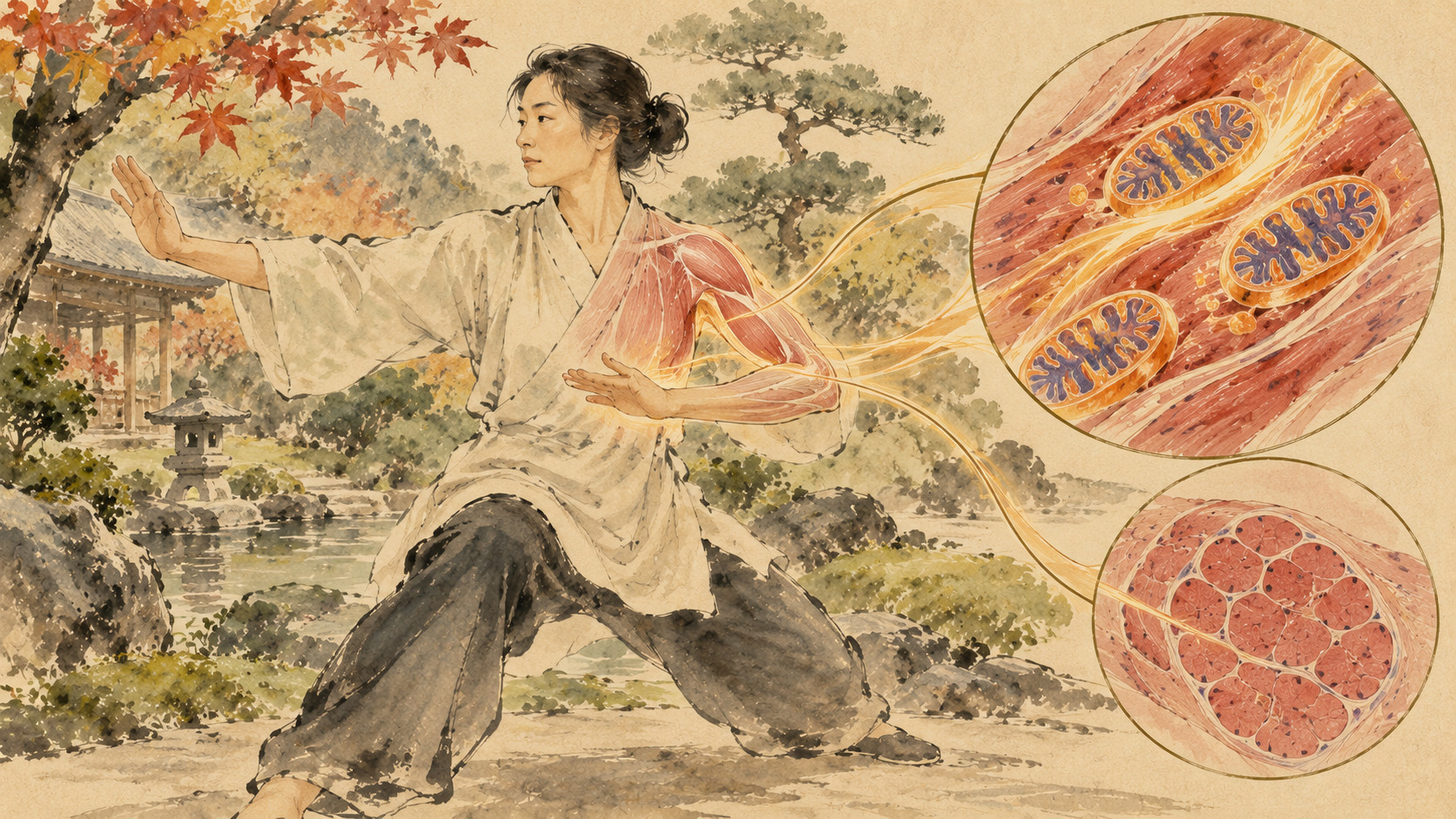
Better performance in old mice is a discovery—not proof of a treatment for aging humans.
An old medicine, a different question
The moment an older adult begins avoiding stairs, the issue may be much larger than the loss of muscle mass. Strength depends on neuromuscular coordination, the machinery that contracts muscle fibers, and the cell’s capacity to generate usable energy. A Japanese research group has now found an unexpected clue in a medicine already prescribed for a very different problem: low blood platelets caused by immune disease.
Researchers associated with the Tokyo Metropolitan Institute for Geriatrics and Gerontology tested fostamatinib, a spleen tyrosine kinase inhibitor used in immune thrombocytopenia. In mouse-derived muscle cells it changed the organization and respiration of mitochondria; in aged mice, treatment coincided with better performance on muscle-function tests. That is scientifically interesting—but it is not evidence that the drug reverses human frailty.
What is new, and when it happened
The peer-reviewed paper appeared online in Scientific Reports on August 24, 2026. The Tokyo institute published its Japanese announcement on September 7, and Science Japan covered the work October 19. The latest coverage should not be confused with a new approval, new clinical trial or new October laboratory discovery.
The authors are Toshihiko Takeiwa, Wataru Sato, Kotaro Azuma, Kazuhiro Ikeda, Kuniko Horie and Satoshi Inoue. Their affiliations encompass the Tokyo Metropolitan Institute for Geriatrics and Gerontology, Saitama Medical University and the University of Tokyo Graduate School of Medicine. The scientific and financial disclosures are available in the original paper, which identifies the work as an experimental study in cells and mice.
The machinery inside the cellular powerhouse
Mitochondria are famous for producing energy, but treating them as batteries that merely get larger or smaller misses their intricacy. In the inner mitochondrial membrane, several protein complexes take part in electron transport and help establish the gradient used to make ATP. Their arrangement matters as well as their presence.
Complexes I, III and IV can assemble into higher-order structures commonly called mitochondrial respiratory-chain supercomplexes. Scientists continue to investigate how these structures influence electron transport, stability and energy efficiency in different tissues. The Japanese group had already developed ways to visualize and quantify supercomplex arrangements, allowing it to ask a more precise question than whether a drug simply makes mitochondria multiply.
Why a blood-disorder drug entered muscle research
SYK, short for spleen tyrosine kinase, plays a familiar part in immune-cell signaling. Earlier work by this research group had linked partial suppression of SYK with increased supercomplex formation and exercise-performance changes in mice. That led to a practical hypothesis: might a medicine that already inhibits SYK produce a related effect in older animals?
Fostamatinib is converted in the body into its active metabolite, R406. It is prescribed for immune thrombocytopenia, in which an immune process reduces platelet counts and can increase bleeding risk. The fact that it is an existing medicine offers a starting point for pharmacological research, not a shortcut past the safety standards of a new indication.
First, the muscle cells
In one part of the study, researchers treated C2C12 cells, a commonly used mouse-derived skeletal-muscle cell model, with R406. Analyses of mitochondrial protein complexes showed more respiratory-chain supercomplex formation. Measurements also found increased oxygen consumption, consistent with enhanced mitochondrial respiration under the study conditions.
These measurements offer a plausible link between molecular organization and cellular activity. They cannot answer whether an elderly patient would walk farther, fall less often or maintain independence. A cultured mouse cell has neither the drug metabolism of a whole person nor the many interacting causes of age-associated muscle impairment.
Then the aged mice
The researchers administered fostamatinib to aged mice and assessed muscle function. In the published experiments, treated animals performed better on grip-strength and wire-hanging tests, alongside changes in respiratory supercomplex formation. This second stage matters because it connects a molecular observation with actual physical performance in an animal.
RNA sequencing of quadriceps muscle also identified increased expression of gene groups associated with actin nucleation and electrical activity. The results are consistent with changes that may affect muscle quality, but the gene data do not establish a single direct causal explanation. Nor do grip tests in mice automatically translate into clinical benefit in humans.
The long history of studying muscle aging
Aging research has moved steadily beyond counting muscle fibers. Loss of strength may be disproportionate to loss of size; motor-unit changes, chronic disease, nutrition, inflammation and altered mitochondrial function all contribute. Sarcopenia, the clinical syndrome associated with diminished strength and skeletal-muscle quantity or quality, increases risks of mobility limitations and falls.
Japan’s aging population makes that question especially urgent. But the established pillars of assessment and management—including resistance exercise, nutrition and attention to associated illness—are not displaced by this experiment. The new paper is best understood as a proposal for future molecular interventions, not an alternative exercise prescription or a treatment recommendation.
The promise and trap of drug repurposing
Drug repurposing, sometimes called repositioning, attempts to identify valuable new applications for established medicines. Prior clinical experience can make some aspects of development more tractable, but a completely different target population can change the risk-benefit calculation. Treating a diagnosed platelet disorder is not equivalent to exposing otherwise stable older adults to a medicine over years to preserve strength.
Japan’s PMDA lists fostamatinib sodium hydrate as the active ingredient of TAVALIS tablets. U.S. prescribing information warns of hypertension, liver injury or elevated liver tests, diarrhea and neutropenia, among other risks. This article is not medical advice, and the research offers no justification for self-prescribing or prescribing the drug solely to improve muscle strength outside appropriate evidence and clinical oversight.
Years of groundwork behind a new experiment
The study builds on a sequence of investigations at the Tokyo institute into imaging the architecture of mitochondrial respiratory complexes. A research explainer published several years earlier described experiments connecting SYK inhibition, greater supercomplex formation and exercise endurance in mice. The 2026 contribution was to test fostamatinib and its metabolite in models relevant to aging.
A complete history of mitochondrial science is far broader: discoveries of oxidative phosphorylation, electron-transport complexes and the dynamic inner membrane helped turn a vague cellular “powerhouse” metaphor into a molecular research field. Whether a supercomplex improves energy output depends on context, and researchers still debate how arrangement, stability and metabolic performance relate. Independent replication is important.
The test that has not happened
The published paper does not contain a randomized clinical study showing that fostamatinib improves human grip strength, walking speed, disability risk or outcomes in sarcopenia. Follow-up work must examine dose and duration, reproducibility in other animal models, whether altering supercomplexes actually causes the functional gain, and the tradeoff between muscle effects and known drug toxicities.
The disciplined conclusion is still worth sharing: a medicine created for one biological problem has revealed a potentially useful connection between kinase signaling, mitochondrial organization and old muscle. Translating that connection into something safe and meaningful for people is the question researchers now have to answer.
Sources and original research
Based on the original research, Japanese institutional statements and official medicine labels. No claim of human therapeutic efficacy is made.