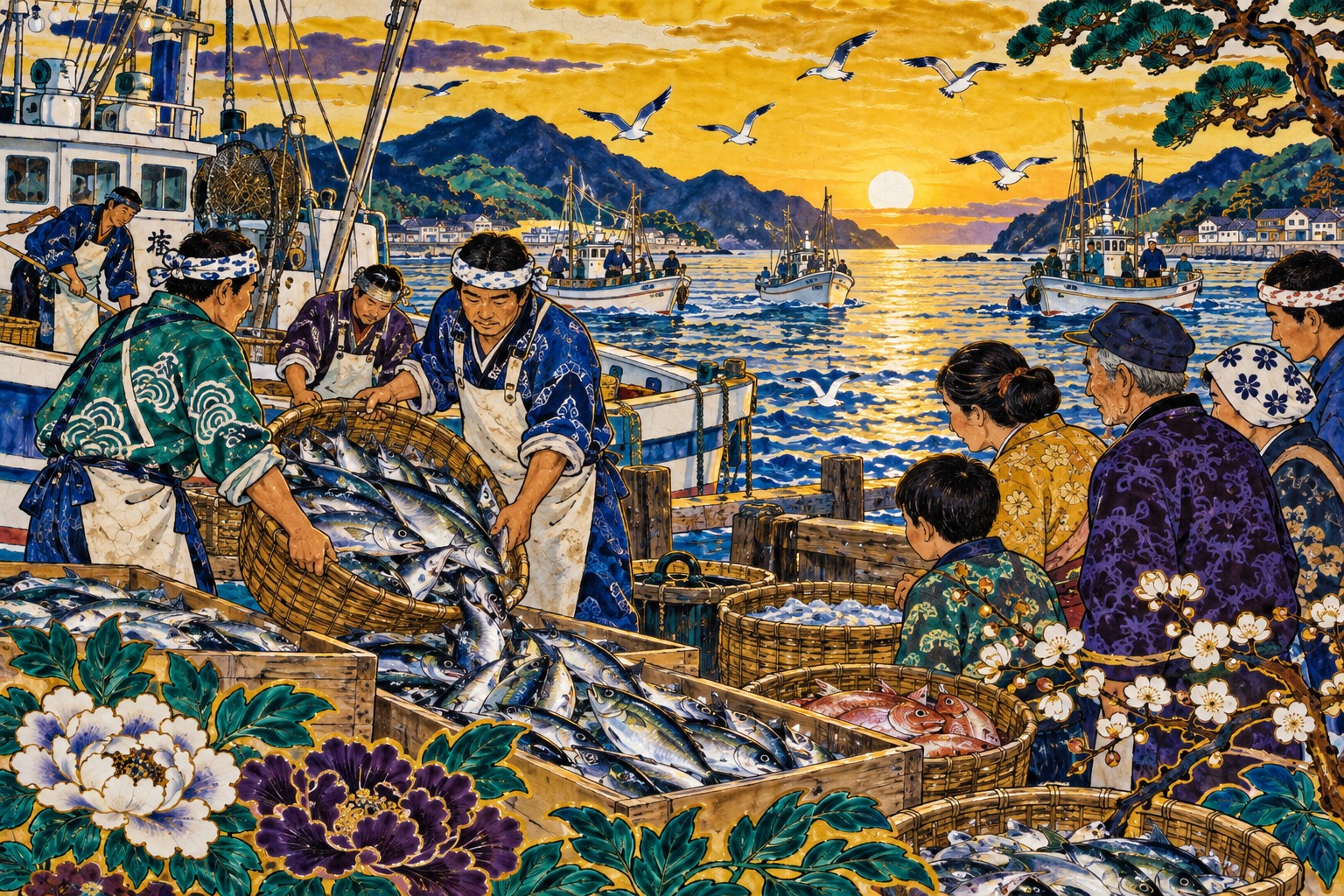
For decades, Japan’s fisheries story could be told as a descending line. Combined fishing and aquaculture output peaked at 12.82 million metric tons in 1984. Preliminary government statistics put 2025 production at 3.5774 million tons, down another 1.6 percent in a year. The reasons range from the retreat of distant-water fishing and the collapse of a historic sardine boom to weaker production capacity, resource conditions and a rapidly changing ocean. A new national survey asks what citizens want to preserve as that old model recedes.
A Poll Timed to Shape the Next National Plan
The Cabinet Office released its July 2026 Survey on the Fisheries Industry on September 4. The Fisheries Agency calls it the first Cabinet Office opinion survey dedicated specifically to the sector; questions about fisheries had appeared in a broader food, agriculture, forestry and fisheries poll in 2018. This time, the agenda is tightly focused on changes in the marine environment, expectations for policy and public relationships with fishing villages.
The timing is institutional. Japan’s Basic Plan for Fisheries is rewritten roughly every five years under the 2001 Basic Act on Fisheries. The present plan was approved by the Cabinet in March 2022. A Fisheries Policy Council subcommittee began work on its successor in April 2026, with a Cabinet decision targeted for March 2027. The survey is evidence for that process, not a referendum that settles it.
What the survey actually represents. Questionnaires went by post to 3,000 Japanese nationals aged 18 or older nationwide. The field period ran from July 16 to August 23; 1,522 responses were received, for a 50.7 percent response rate. The preliminary tabulation covers questionnaires received by August 14 and may be revised in the confirmed release.
Those boundaries are important. Foreign nationals living in Japan were outside the target population. Nonresponse may distinguish the people who mailed back a fisheries survey from those who did not. Most headline questions allowed multiple answers, so percentages do not form a single ranked budget and totals exceed 100. The exercise records stated expectations, not behavior under binding prices, taxes, catch limits or trade-offs.
Food First, but the Mandate Is Wider
Asked what roles they expected fisheries to perform, 81.0 percent selected the stable and sustainable provision of seafood through fishery resources and aquaculture. Conservation of environments such as seagrass beds and tidal flats followed at 60.9 percent. Maintaining fishing-village economies, employment and social ties drew 44.5 percent, while monitoring and reporting suspicious activity by foreign vessels drew 43.8 percent. Urban-rural exchange and nature experiences were selected by 16.9 percent.
This is not nostalgia for an industry frozen in time. The public describes fisheries as a living infrastructure: a food system, environmental steward, coastal employer and set of eyes at sea. The policy difficulty is that these functions do not always generate revenue in the same transaction. A fisher paid for a catch is not automatically paid for monitoring coastlines, maintaining community life or conserving habitat.
Stable Supply Does Not Mean Catching Without Limits
On policy, the largest share—71.6 percent—expected technical development and operating improvements in fishing and aquaculture. Releasing juvenile fish and conserving spawning or feeding grounds such as seagrass beds and tidal flats reached 57.1 percent. Catch limits and other resource management drew 56.9 percent, while enforcement against illegal operations by foreign vessels reached 54.5 percent. Disaster prevention and mitigation in fishing areas was selected by 32.1 percent, environmental measures such as recyclable gear by 24.3 percent, and development of easy-to-prepare products to expand fish consumption by 19.3 percent.
The pattern rejects a simple opposition between conservation and production. Respondents want technology, flexible operations, cultivation and resource discipline to work together. That fits the physical reality. When a familiar species moves or fails to arrive, a quota alone cannot create a market for the fish now landing at the port. Boats, gear, processing lines, auctions, recipes and consumer recognition may all have to change.
How a Fishing Power Lost Two-Thirds of Its Volume
Japan expanded after World War II from coastal grounds to offshore and distant waters. The arrival of 200-nautical-mile jurisdictions in the late 1970s constrained access abroad. A surge in Japanese sardine then lifted total output to the 1984 peak. When that resource fell with a broad ocean-regime shift, production dropped sharply into the mid-1990s. Later declines have combined fewer fishers and vessels with resource and environmental pressures.
The ocean is now altering geography as well as abundance. The Fisheries Agency reports that warm-water species have expanded northward, while some cold-water species no longer migrate as far south into Japanese waters. Yellowtail catches have increased in northern regions; prolonged poor catches of Pacific saury, Japanese flying squid and salmon have destabilized communities built around particular seasons and processing systems.
The survey found 82.7 percent knew at least something about rising temperatures around Japan and the resulting changes in fish species or volume. Awareness is not the same as agreement on cause in every fishery, but it gives adaptation policy a broad public vocabulary.
1977 — Japan establishes a 200-nautical-mile fishing zone as access to distant grounds contracts.
1984 — Fishing and aquaculture production peaks at 12.82 million tons.
2001 — The Basic Act on Fisheries establishes stable supply and healthy industry development as core principles.
2022 — The current Basic Plan for Fisheries is approved.
2026–27 — The first dedicated poll feeds debate toward a new plan targeted for March 2027.
Seventy-Three Percent Accept Some Premium—in Theory
The most commercially striking question presented seafood identified as produced with attention to resource sustainability and the environment. Some 59.5 percent said they would buy it at a price 10 to 20 percent higher than other products. Another 8.4 percent accepted a premium of up to 30 percent, and 5.4 percent said price would not deter them. Together, 73.3 percent selected an option that tolerated some premium. By contrast, 24.0 percent would purchase only at the same price and reject even a small increase.
The result suggests room for ecolabels, traceability and differentiated products. It does not establish a guaranteed green premium. Survey answers are hypothetical, household budgets vary and the label itself must be trusted. A durable system must verify what “sustainable” means, prevent vague environmental claims and show that added value reaches producers instead of vanishing between vessel and shelf.
Japan Wants to Help at the Checkout
Asked what consumers could do to maintain fisheries, 65.0 percent chose actively purchasing domestically produced seafood. Almost as many—63.7 percent—selected greater use of frozen and processed products alongside fresh fish, including reducing waste. Interest in industry and village problems reached 36.3 percent; choosing products made under resource-management or environmental standards reached 29.5 percent.
These answers arrive during a long retreat from fish at the table. Per-capita edible seafood consumption fell from 40.2 kilograms in fiscal 2001 to 21.4 kilograms in fiscal 2023. Meat moved ahead in fiscal 2011 and has remained higher. Price matters, but so do convenience, preparation, bones, household size and changing tastes. The popularity of frozen and processed seafood in the survey is therefore more than a secondary preference: it points toward convenience as part of any credible conservation-and-consumption strategy.
The Distance Between Buying Fish and Joining a Village
When the question turned directly to declining fishing communities, 74.4 percent said they would support them by buying and consuming domestic seafood. Donations or hometown-tax contributions drew 35.9 percent. Visiting through tourism and events reached 23.7 percent, and following or sharing information 20.5 percent. Only 4.5 percent selected deeper activity such as dual-location living or volunteering. Just 6.3 percent said they had no particular wish to become involved.
That gap between broad sympathy and intensive participation is not necessarily indifference. Geography, time, housing, transport and work set real limits. The Fisheries Agency’s “umigyo” policy uses seafood sales, restaurants, recreation and other harbor resources to create income and jobs beyond landing fish. Officials estimate fishing villages receive about 20 million exchange visits. The harder task is turning a meal or day trip into repeat demand, investment, outside skills or a lasting relationship.
Three Tests for Turning Opinion Into Policy
The next Basic Plan faces three tests suggested by the poll. First, stable supply must be measured as resilience, not a return to the tonnage of 1984. Flexible species, aquaculture, processing and markets must follow the ocean that exists. Second, stated willingness to pay for sustainable seafood must be converted into verifiable standards, transparent distribution and producer income. Third, the broad base of consumer support needs a practical ladder toward visits, donations, secondary work and community participation.
A postal survey of 1,522 respondents cannot specify the answer for every port, fleet and stock. It does show that the public does not regard fisheries as a relic. People expect a future-facing food system that protects resources while sustaining places. The political work begins where the questionnaire ends: deciding which costs are public, which are carried by consumers and industry, and how success will be measured when the sea itself will not hold still.