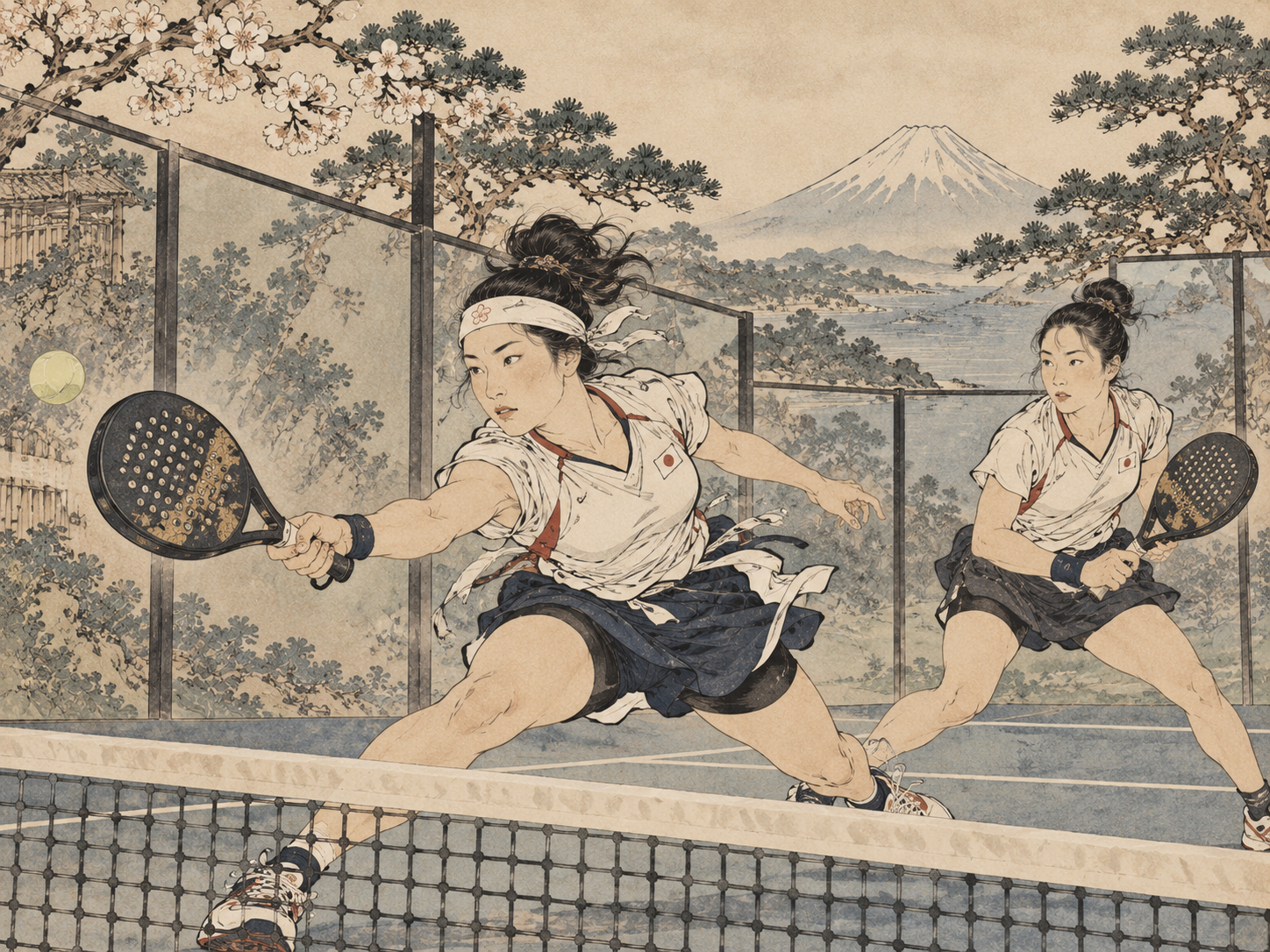
Padel had never awarded an Asian Games gold medal before Aichi-Nagoya 2026. The first women to own one are Japanese.
On Oct. 3 at Nagoya Higashi Sports Center, Kae Tokumoto and Saki Tsukamoto defeated Indonesia’s Fadna Kusumawati and Fitriani Sabatini 6–3, 6–4 to win the inaugural women’s padel title. The Japan Padel Association calls them the first champions of a sport making its formal Asian Games debut.
They said they wanted gold — then delivered it
The pair had to win their way onto the national team. On May 30–31, Tokumoto and Tsukamoto won the women’s section of Japan’s final “Road to Nagoya PADEL” selection tournament at PADEL DOJO in Amagasaki, Hyogo. JPA then selected them as Japan’s women’s representatives.
After that selection victory, both players publicly said they were targeting gold. Four months later, the promise had become the result.
After the final, Tokumoto spoke of the emotion of becoming the first champion at a home Asian Games. Tsukamoto thanked supporters and said she hoped the victory would help more people discover and play padel. Their comments were not only about a medal; they were about using the medal to grow a sport that is still small in Japan.
What exactly is padel?
Padel resembles tennis but is played on a smaller 20-by-10-meter court enclosed by glass and mesh. It is normally played as doubles. The ball can remain in play after bouncing and rebounding from the walls. The racket is solid and perforated rather than strung, and the serve is underhand.
The enclosed court makes rallies easier to sustain for recreational players, but advanced play requires its own specialized geometry: positioning, lobs, control of the net, reading wall rebounds and coordinating with a partner.
It began in a Mexican home in 1969
According to the International Padel Federation, the sport began in Acapulco, Mexico in 1969. Enrique Corcuera did not have enough space at his home for a regulation tennis court, so he built a smaller 20-by-10-meter court enclosed by walls. Alfonso of Hohenlohe later introduced the game to Spain, and it also spread to Argentina.
Its modern growth has been explosive. FIP’s 2025 World Padel Report put active participation above 35 million, with more than 77,300 courts and 24,600 clubs across 150 countries and 20 dependent territories. In Asia alone, FIP estimated around 2.2 million amateur players, 4,600 courts and 1,700 clubs in 2025.
Japan’s organized padel history is barely a decade old
The Japan Padel Association was established in June 2016 to promote and organize the sport domestically. It became a formal member of the International Padel Federation in July 2017 and says it is working toward a goal of one million Japanese players by 2030.
JPA currently lists 25 facilities and 50 courts nationwide. Its facility guide identifies Padel One Tokorozawa in Saitama as the site of Japan’s first padel court. Compared with tennis, football or even newer urban sports, the physical base remains tiny.
Institutionally, 2026 was also a milestone. JPA joined the Japan Sport Association as an approved organization, a step it described as recognition that padel had developed sufficient participation, continuity and national governance to enter a new stage as an organized Japanese sport.
Kae Tokumoto: from banking to an Asian title
The Japanese Olympic Committee lists Kae Tokumoto, born April 20, 1991, as a Sacred Heart University graduate affiliated with Tactical. Her own official site says she continued competing while working in banking and left that career in 2025 to pursue padel professionally.
That path reflects how young the sport’s professional structure still is in Japan. Tokumoto did not emerge from a mature domestic professional league. She built a sporting career alongside conventional employment before moving into full-time competition.
Saki Tsukamoto: elite sport alongside a corporate career
The JOC lists Saki Tsukamoto, born June 4, 1991, as a Waseda University graduate whose employer and affiliation are Tokyo Gas and Tactical.
Padel’s default doubles format makes the partnership itself a competitive asset. Net positioning, coverage, wall defense and lob decisions depend on coordination between two players. The straight-sets final score was decisive, but it was not an individual-star event.
Japan’s other three pairs also made the quarterfinals
JPA says the other three Japanese men’s and women’s pairs in the Asian Games all reached the final eight. The women’s gold was the standout result, but Japan’s broader team performance suggested that the host nation was not competitive in only one pairing.
The continental competition, however, is moving quickly. FIP estimated that Asian participation and court infrastructure grew about 20% in 2025, driven heavily by the Middle East. Saudi Arabia alone had more than 1,000 courts and an estimated 400,000 amateur players in 2024. Japan’s medal does not erase the infrastructure gap.
| Item | Detail |
|---|---|
| Women’s champions | Kae Tokumoto / Saki Tsukamoto |
| Final | Japan 2–0 Indonesia (6–3, 6–4) |
| Venue | Nagoya Higashi Sports Center |
| Competition | Sept. 28–Oct. 3, 2026 |
| Japan selection | May 30–31, PADEL DOJO, Amagasaki, Hyogo |
| JPA | Founded June 2016; joined FIP in July 2017 |
| Domestic facilities | 25 facilities / 50 courts listed by JPA |
Can a gold medal create courts and players?
For an emerging sport, winning at a home multi-sport event can create something marketing budgets struggle to buy: a large population seeing the sport for the first time at exactly the moment national athletes succeed.
That can help schools, local governments, facility operators and sponsors justify trying the sport. But padel has a physical constraint. It needs a dedicated enclosed court. Unlike running, football or many racket activities, expansion requires capital, land and operators willing to build specialized infrastructure.
JPA’s one-million-player goal for 2030 therefore depends on more than medals. Japan needs more courts, affordable introductory programs, coaches, junior pathways and opportunities outside a handful of metropolitan facilities.
- Post-Games growth in trial players and federation participation
- The pace of court expansion from the current 25 facilities and 50 courts
- Tokumoto and Tsukamoto’s results and world rankings on the FIP circuit
- Growth of junior programs and coach certification
- Sponsorship and sustainable income for elite Japanese players
- How JPA defines and measures progress toward its 2030 one-million-player goal
A title nobody can ever win again
Sport produces records that can be broken and championships that can be repeated. “First,” however, belongs permanently to whoever gets there first.
When padel became an Asian Games sport in Aichi-Nagoya, the first women standing on top of its medal podium were Kae Tokumoto and Saki Tsukamoto. The scoreline—6–3, 6–4—will remain in the record book. For Japanese padel, the larger question is how many people see that result and pick up a racket for the first time.
Worldwide, more than 35 million people already play the sport. Japan has just 50 courts. The gold medal does not close that gap, but it gives a young Japanese sports community the strongest introduction it has ever had.
Sources & Reference Material
- Japan Padel Association, women’s Asian Games gold announcement, Oct. 3, 2026 (Japanese).
- Japan Padel Association, Road to Nagoya selection tournament and national-team selection, 2026.
- Japanese Olympic Committee, Kae Tokumoto athlete profile.
- Japanese Olympic Committee, Saki Tsukamoto athlete profile.
- Japan Padel Association, organizational history and 2030 participation goal.
- Japan Padel Association, current domestic facilities count.
- Japan Padel Association, approved-organization membership in the Japan Sport Association, 2026.
- International Padel Federation, history of padel.
- International Padel Federation, World Padel Report 2025 headline data.
- International Padel Federation, Asian padel growth data, Nov. 7, 2025.
- Kae Tokumoto official website, career biography.
Reporting cutoff: Oct. 6, 2026, 1:21 PM JST. Public materials reviewed do not establish complete round-by-round match scores, athlete compensation or national-team expenses, post-medal growth in Japanese registrations, or the precise definition and annual milestones behind JPA’s one-million-player target for 2030.