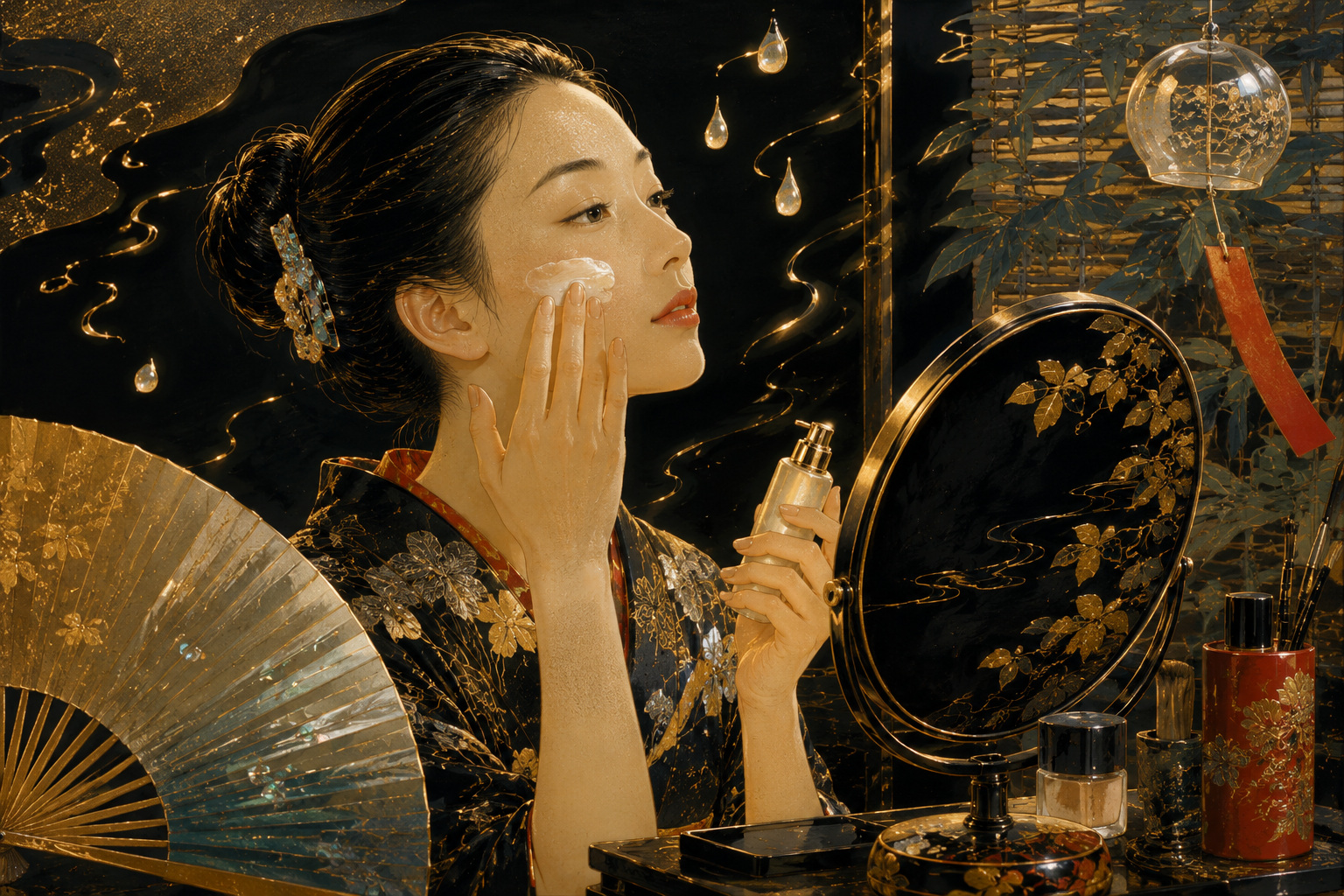
At eight in the morning in Tenjin, Fukuoka, a short walk to the station can raise beads of sweat on the forehead. Subway air conditioning dries them. Returning to street level starts the cycle again. Sunscreen, primer, foundation and concealer encounter water, oil, friction and facial movement before the workday has properly begun. The even film created at the mirror becomes a small climate experiment.
Style B, based in Daimyo in Fukuoka’s Chuo Ward, has presented a primer aimed directly at makeup failure caused by facial perspiration. Its new ANSUA brand says a microscopic, sponge-like powder captures sweat and sebum; a light-beige tint blurs uneven color and texture; SPF50+ and PA+++ provide ultraviolet protection; and moisturizing ingredients address air-conditioned dryness.
The idea did not come from the laboratory of a national cosmetics conglomerate. Style B was founded in 2016, has capital of ¥9 million and lists 47 employees in recruitment material. Its core business is direct-marketing support for single-product, repeat-purchase sellers. After helping other companies with advertising, acquisition, customer relationship management and mail-order operations, it is becoming product owner, interviewer, advertiser and retailer itself.
Calling it a wholly independent startup would also be misleading. The recruitment profile names Findstar as its shareholder, and Style B belongs to the wider Findstar group of advertising and direct-commerce businesses. Its scale as a 47-person operating company is real, but so is its access to a larger group’s capital, expertise and distribution relationships.
Sweat and Sebum Are Not the Same Shine
Understanding makeup breakdown begins by separating water from oil. Sweat is mostly water released by eccrine glands; as the body warms, evaporation from the skin removes heat. Sebum is a lipid mixture released by sebaceous glands that helps protect skin and hair. Both can look shiny in a mirror, but they interact differently with a cosmetic film.
Sweat carries water and salts between pigment and powder particles and can move a film as droplets form. Sebum mixes with oily cosmetic components, often deepening color, creating patchiness and increasing gloss. Hands, handkerchiefs, masks and hair then abrade the weakened layer. Facial muscles continually fold the thin film around the eyes and mouth. “Makeup collapse” is not one failure; it is the combined effect of water, oil, movement and friction.
A 1988 paper in the Journal of the Society of Cosmetic Chemists of Japan analyzed wear through several dimensions, including visible disintegration, changes in gloss and changes in color. A 2019 technical review described the main formulation strategies: strengthen the film with resins or other solid oils, treat powders to resist water or oil, or use porous powders to adsorb perspiration and sebum. ANSUA’s “sponge-like powder” belongs to this established family of powder engineering.
What Does “Physically Block” Mean?
The release repeatedly qualifies its claim with a footnote: the primer adsorbs sweat and sebum and thereby “physically suppresses” perspiration. An absorbent or adsorbent cosmetic powder, however, does not switch off secretion by the eccrine gland. A conventional primer can receive water and oil at the surface, preserve a dry feel and help a makeup film retain its shape.
The distinction matters because sweating is a vital thermoregulatory function. Excessive perspiration beyond the body’s needs may be hyperhidrosis and can warrant medical evaluation, but a cosmetic landing page is neither diagnosis nor treatment. Sudden heavy sweating, night sweats or perspiration accompanied by palpitations, dizziness or unexplained weight change should not be treated simply as a makeup problem.
ANSUA is sold as a UV makeup primer, not as a quasi-drug antiperspirant. The accurate interpretation is therefore not “it stops sweating,” but “it aims to adsorb sweat and sebum and reduce visible breakdown.” To know how well, for how many hours, at what temperature and humidity, and on which skin types, readers would need test protocols, comparators, participant numbers and statistical results. The release provides none of those details.
Face Powder Was a Film a Thousand Years Ago
Japan’s history of placing color on skin reaches deep into antiquity. The Japan Cosmetic Industry Association notes red pigment on the faces of Kofun-period haniwa figures. Rouge and white powder arrived with cultural exchange from the Asian continent and Korean Peninsula in the late sixth century. A record for 692 says the monk Kanjo produced lead-based white powder in Japan and presented it to Empress Jito.
The white face, altered brows and blackened teeth of the Heian period communicated rank and taste. By Edo, cosmetic practice had matured around three colors: red, white and black. White powder was mixed with water and spread with fingers or a brush. The skill of producing a thin, even finish was already a problem of dispersing pigment and making it adhere to skin—the same physical challenge beneath modern foundation.
Beauty’s film also had a cost. Concern about lead toxicity drove research into lead-free face powder from around 1877, and a lead-free commercial product appeared in 1904. Cosmetic history is not merely a procession of colors. It is a history of safer materials, manufacturing controls and the slow correction of claims and practices once taken for granted.
692 A record describes Japan-made lead white presented to Empress Jito
Edo period White powder, rouge, blackened teeth and brows define a red-white-black culture
Circa 1877 Lead toxicity accelerates research into lead-free powder
1904 Lead-free face powder reaches the market
1954 Pancake foundation is introduced from the United States
2016 Style B is founded in Fukuoka
2026 Style B announces ANSUA primer, although the release lists a 2024 launch date
After the War, the Face Had to Be Finished Faster
As women moved further into public and professional life in the Taisho period, “speed makeup” was promoted. Powder expanded beyond a single white shade; stick lipstick, vanishing cream, cold cream and emulsions grew more common. Cosmetics became increasingly Westernized. After World War II, American films and magazines exerted a strong influence, and the introduction of pancake foundation in 1954 helped make base makeup a conspicuous everyday category.
The design problem shifted from “make the face white” to “make it look natural, apply it quickly and keep it stable.” Cover discoloration without appearing thick. Diffuse light to soften the shadow of pores. Avoid dryness, resist oil, survive perspiration and block ultraviolet radiation. Contradictory jobs accumulated in a film only micrometers thick.
ANSUA is characteristic of this convergence. Light beige, soft focus, adsorption, moisture and UV protection sit in one product. That may simplify a rushed morning, but multiple functions also require multiple kinds of evidence. “Serum ingredients” means ingredients are present; it does not by itself establish the size or clinical significance of a skin benefit.
Japan’s 2025 Summer Was the Hottest on Record
The environmental change behind the pitch is real. According to the Japan Meteorological Agency, Japan’s mean temperature from June through August 2025 was 2.36°C above the 1991–2020 baseline, the highest summer anomaly since national records began in 1898. It surpassed the previous record of +1.76°C in both 2023 and 2024. Over the long term, Japanese summers have warmed at 1.38°C per century.
Across the agency’s long-running 13-station series, the annual number of days reaching at least 35°C rose by 2.9 days per century from 1910 through 2025. The average in the most recent 30 years was about 4.2 times the average in the earliest 30-year period. This is more than one uncomfortable season. It means old assumptions beneath cosmetics, uniforms, commutes, outdoor work and air-conditioning design are failing together.
The company release weakens its own climate argument by labeling 35°C a “manatsubi.” JMA defines a summer day, or natsubi, as 25°C or higher; a manatsubi as 30°C or higher; and a mōshobi as 35°C or higher. If climate data are the premise for product development, the terms and numbers are not decorative copy.
| Stress | Effect on the cosmetic film | Common formulation response |
|---|---|---|
| Sweat | Water, salts, flow and evaporation | Water resistance, adhesion, adsorbent powders |
| Sebum | Mixes with oils; changes color and gloss | Oil-adsorbing powder and oil-resistant treatments |
| Friction | Hands, cloth and masks remove the film | Film strength and rub resistance |
| Dryness | Cracking, flaking and creasing | Humectants and flexible films |
| Ultraviolet light | Sunburn and photoaging | UV absorbers or scatterers; uniform coverage |
What SPF50+ and PA+++ Promise—and What They Do Not
SPF principally measures protection against UVB-induced erythema. PA grades UVA protection; PA+++ indicates “high” or “very good” UVA protection in the Japanese system. SPF50+ occupies a high protection range. It does not mean that one morning application is a 50-hour clock. Laboratory testing uses a specified, even application, while consumers often apply less and then lose film to sweat, sebum, towels and masks.
The Japan Cosmetic Industry Association has a separate standardized notation for UV water resistance. On the public ANSUA material examined for this article, Japan.co.jp found SPF50+ and PA+++ but not a “UV Water Resistance ★/★★” claim. A product name containing “sweat-resistant” is not the same as displaying the result of that standardized water-resistance test. Extended outdoor exposure still calls for shade, clothing, a hat and appropriate reapplication.
Style B also describes the product as “non-chemical,” a Japanese industry shorthand that usually means no organic UV absorbers and reliance on mineral scattering agents. It does not mean the product contains no chemicals. Skin compatibility varies; the sales page itself advises people prone to reactions to perform a patch test on an inconspicuous area.
When an Advertising Company Sells Its Own Product
The most revealing part of Style B’s story is not that a cosmetic company learned advertising. It is that an advertising and direct-marketing specialist became a cosmetic proprietor. In the single-product subscription business, the critical figures are not only the cost of acquiring a customer but how long that customer continues and the lifetime value of the relationship. Find a precise anxiety, write a powerful headline, reduce the first-purchase barrier and convert the order into a repeat cycle.
The ANSUA sales page offers the first tube at ¥2,420 including tax with free shipping. Thereafter, it says two tubes arrive every two months at ¥5,236 each, a 15% discount, plus ¥330 shipping. There is no minimum number of deliveries, but cancellation must be requested at least ten days before the next shipment. The company says the initial order cannot be cancelled or changed after confirmation. A 20-day refund guarantee applies only to the first purchase, requires a telephone request and leaves return shipping to the customer.
That does not make the model inherently improper. Replenishment prevents forgotten purchases and gives a small brand predictable revenue. But a shopper who sees only “¥2,420 first order” understands something very different from one who reads the recurring quantity and price. Because Style B’s expertise is persuasion, it has a special responsibility to make total cost and exit terms as prominent as the product benefit.
- Is this a 2026 launch, or did the product actually launch in 2024?
- What are the volume, complete ingredient list and ordinary one-time price?
- What temperature, humidity, duration, sample size and comparator were used in wear tests?
- Does the product carry a standardized UV water-resistance rating?
- How does it interact with a customer’s foundation, skin tone and dryness?
- How many units arrive later, at what unit price and shipping charge?
- What are the cancellation deadline and full refund conditions?
The Social Demand for a “Cool Face”
Makeup breakdown is a technical issue and a social one. Perspiration is normal physiology, yet in retail, interviews, weddings and offices, an even and dry-looking face is easily associated with being composed, clean or professional. The release itself speaks to the embarrassment of meeting people after makeup fails.
That burden has fallen disproportionately on women: endure heat while appearing not to feel it; protect against ultraviolet light without looking heavily made up; conceal age-related change while appearing natural. A sweat-resistant primer may reduce that labor. It may also reinforce the rule that visible sweat is a personal failure. A good product expands choice; it should not define people who decline it as unfinished.
Extreme Heat Is Rewriting the Cosmetic Brief
The “face sweat” problem found by a small Fukuoka company looks narrow, but it opens into the larger story of climate change. The record summer of 2025 has altered 2026 product briefs, search terms and advertising language. Like clothing, housing, schools and public transport, cosmetics can no longer be designed only for the temperatures of the past.
Whether ANSUA genuinely rescues a workday will be determined by transparent formulation, independent testing, use across diverse skin types and clear subscription terms—not by the company’s adjectives. The quiet, accurate explanation that a powder adsorbs perspiration and protects a film is closer to the technology than the dramatic promise to “block sweat.”
From the white powder of 692 to pancake foundation in 1954, wear testing in the 1980s and porous powders in 2026, the question has remained: how can color placed on a face survive until the end of the day? What has changed is the summer. Cosmetics are no longer fighting one passing bead of sweat, but a Japanese climate that is hotter, longer, more humid and repeatedly rewriting its records.
Reporting notes and principal sources
This article uses public material available through August 5, 2026 at 9:41 a.m. JST. Product performance, testimonials and brand intent are attributed to the company and distinguished from independently verified evidence.
- Style B: ANSUA Sweat-Resistant UV Primer announcement (August 4, 2026)
- Official ANSUA sales page: pricing, subscription conditions and product claims
- Style B: corporate profile
- Style B recruitment profile: business, capital and ownership
- Japan Meteorological Agency: long-term change in summer temperature
- JMA: change in annual extremely hot days
- JMA: definitions of Japanese heat-day terms
- Japan Cosmetic Industry Association: a cultural history of cosmetics
- JCIA: UV water-resistance labeling Q&A
- Journal of the Society of Cosmetic Chemists of Japan: makeup technology (2019)
- Baker, Physiology of sweat gland function (2019)