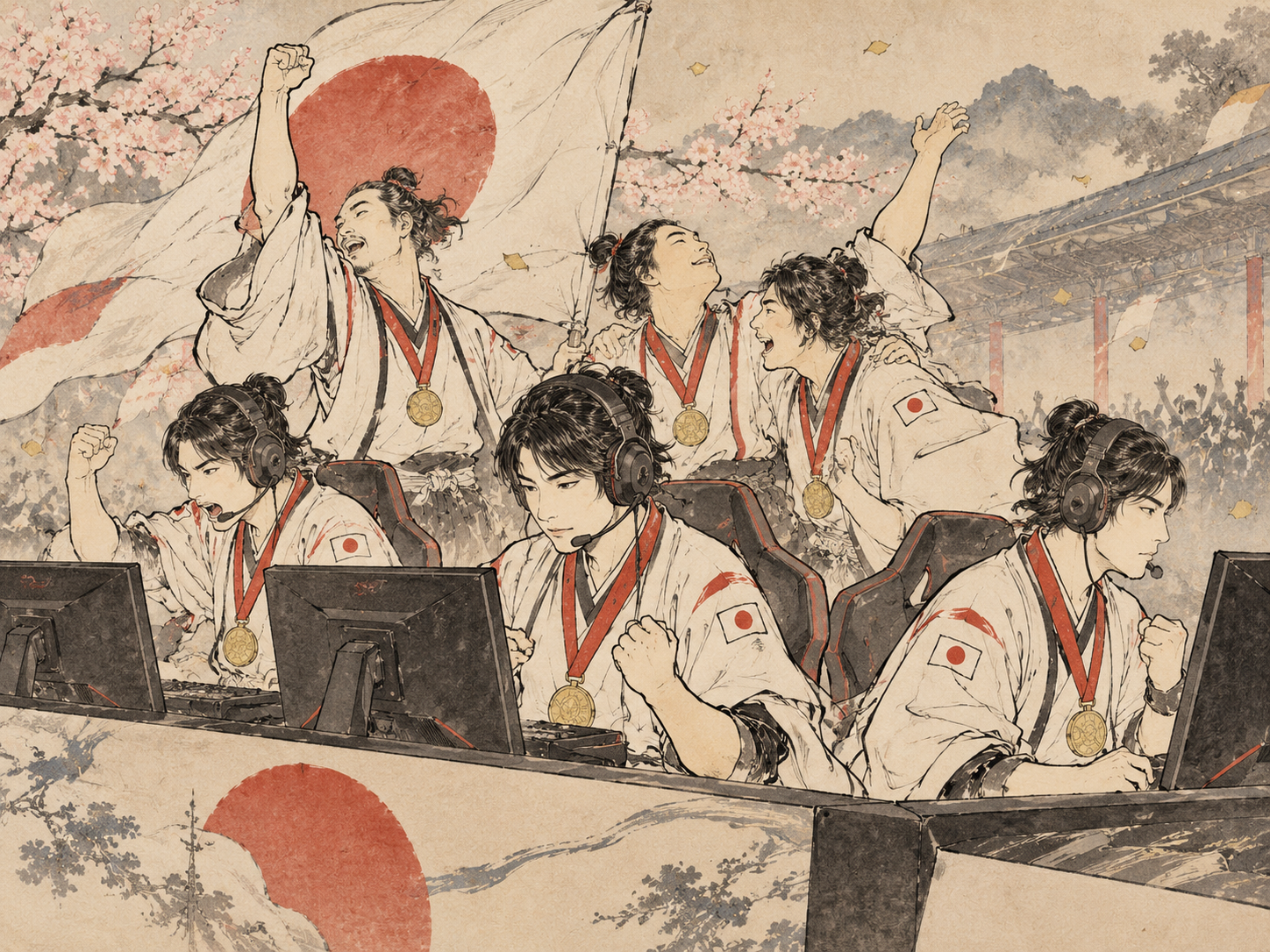
In 2018, esports at the Asian Games was still an experiment. Japan won the Pro Evolution Soccer demonstration event in Jakarta-Palembang, but that gold did not count in the official national medal table. Eight years later, at a home Asian Games in Aichi-Nagoya, the institutional landscape looked very different.
Japan finished the 2026 Asian Games esports program with two gold medals, two silvers and one bronze. Gold came in Puyo Puyo esports and Pokémon UNITE; silver in the three-title fighting-team event and Identity V; bronze in eFootball. The Japan eSports Union, now operating as the Japan eSports Association under the acronym JESU, says roughly 500 competitors from 29 countries and regions contested 11 events across 13 titles. Japan sent 25 athletes into seven events.
Japan’s first official gold came from Puyo Puyo
The breakthrough gold belonged to Yuki Kurihara in Puyo Puyo esports. Competing against a field from 10 countries and regions, Kurihara swept the group stage, then beat Singapore in the quarterfinal, Thailand in the semifinal and South Korea in the final. JESU identified him as the youngest athlete in Japan’s Asian Games delegation.
That result had symbolic weight. Japan is one of the world’s defining videogame-producing countries, but that heritage had not automatically translated into Asian Games esports medals. At Hangzhou, Japan fielded esports athletes but the JOC’s official medal list records no Japanese esports medalist.
Pokémon UNITE delivered the second gold
Japan’s Pokémon UNITE team—Yudai Koseko, Hiroki Sato, Mashika Shirakawa, Yoshiki Takada, Koto Toba and Renta Azuma—gave the host nation its second esports gold. Japan beat South Korea and India in the group stage, then swept Chinese Taipei and South Korea in the knockout rounds before defeating Indonesia 3–1 in the final.
The two golds came from very different competitive structures: a solo puzzle title and a team-based multiplayer battle arena. That matters because “esports strength” is not one skill. It spans individual execution, team communication, drafting, strategy and game-specific knowledge.
A fighting event built from three separate games
The fighting-team event was unusual even by esports standards. Kojiro Higuchi represented Japan in Street Fighter 6, Daichi Nakayama in Tekken 8 and Akihito Sawada in THE KING OF FIGHTERS XV. Their results were combined into one national-team medal event.
Japan beat the United Arab Emirates and Palestine in group play, then Bahrain in the quarterfinal and Hong Kong, China in the semifinal before losing to South Korea in the gold-medal match. The silver linked decades of Japanese arcade and console fighting-game culture to a format designed for a multi-sport event rather than a conventional publisher-run tournament.
Identity V turned into a Japan-China final
Japan’s seven-player Identity V squad—Yuto Awata, Mao Uenaka, Masahiro Uemura, Ryuhi Oyama, Ryo Kamiya, Masumi Onuma and Kentaro Maeda—entered the knockout stage as host nation, beat Thailand and Malaysia and reached the final against China.
JESU says three of the five sets in the final ended drawn. China ultimately took gold and Japan silver. A Chinese-developed game producing a Japan-China medal final in Japan illustrates how little national borders in esports align with the ownership of the underlying game IP.
The eFootball bronze was Japan’s first official Asian Games esports medal
The first medal chronologically came on Sept. 23. Hideya Kida competed on PC and Yuga Chatani on mobile in eFootball, which drew entries from 19 countries and regions. Japan topped its group, beat Jordan in the quarterfinal and lost to Iran in the semifinal, taking bronze.
There is a neat historical symmetry. Japan won the Pro Evolution Soccer demonstration event in 2018. The football-game lineage then delivered Japan’s first official Asian Games esports medal in 2026 after esports had acquired full medal status.
In 2018, esports was still being tested
When esports first appeared at Jakarta-Palembang 2018, it was explicitly a demonstration event. JESU says the organization itself was created in 2018 by bringing together multiple domestic esports bodies, in part so Japan could send a national team to that Asian Games.
Naoki Sugimura and Tsubasa Aihara beat Iran to win the Winning Eleven 2018 event. The tournament proved that esports athletes could operate inside the Asian Games environment, but the medals were not official. In 2020, the Olympic Council of Asia approved esports as a medal sport for Hangzhou 2022, which was ultimately held in 2023.
JOC recognition changed what “Team Japan” means
In June 2024, JESU was approved as a provisional member of the Japanese Olympic Committee. For Aichi-Nagoya, JESU selected and recommended candidate athletes, and the JOC completed the formal recognition process before the 25-player roster was announced as TEAM JAPAN.
That institutional layer matters. Multi-sport events bring rules beyond the game itself: athlete registration, national-team selection, anti-doping, image rights, delegation management and coordination with an Olympic committee. JESU has also been affiliated with the Japan Anti-Doping Agency since 2021.
Eleven events and 13 titles make “esports” a misleading singular
The Aichi-Nagoya program was larger than Hangzhou’s, with 11 medal events built around 13 titles. The formats ranged across PC, mobile and console, individual and team competition, puzzle games, football, racing, MOBAs, survival games, asymmetrical multiplayer and fighting games.
That diversity creates a governance problem unlike most conventional sports. A 100-meter sprint is defined by a sports federation. An esports title is intellectual property owned by a commercial publisher. Rules can change through software updates, the competitive balance can shift with patches and a title can ultimately be discontinued.
Asian Games organizers therefore have to place privately owned software inside a public national-team medal structure, balancing competition rules, licensing, patch control, hardware standards, broadcasting and sponsor interests.
Five medals also reveal where Japan did not win
Japan’s result was strong but not universal. Ryota Kokubun finished fourth in Gran Turismo 7. The PUBG Mobile team finished ninth among 12 participants. The five medals came across puzzle, MOBA, fighting, asymmetrical survival and football simulation.
That breadth is encouraging, but it also demonstrates why a single national “esports development” program would be too crude. A fighting-game player, a mobile MOBA team and an eFootball pair require different coaching, practice environments and international competition structures.
| Medal | Event | Japan’s result |
|---|---|---|
| Gold | Puyo Puyo esports | Yuki Kurihara beat South Korea in the final |
| Gold | Pokémon UNITE | Japan beat Indonesia 3–1 in the final |
| Silver | Fighting Team Event | Street Fighter 6 / Tekken 8 / THE KING OF FIGHTERS XV; lost final to South Korea |
| Silver | Identity V | Lost final to China |
| Bronze | eFootball™ | Lost semifinal to Iran |
Japan is both competitor and creator
Esports has an additional strategic dimension for Japan because the country is not only producing athletes. Many of the games in which Japan medaled are tied closely to Japanese intellectual property: Puyo Puyo, Pokémon, Street Fighter, Tekken, THE KING OF FIGHTERS and eFootball.
That dual role can be an advantage. It also creates a need for transparent boundaries between sports governance and the commercial interests of publishers, platforms and sponsors. As esports becomes more institutional, competitive legitimacy has to coexist with the fact that the playing field itself is a commercial product.
- How JESU evaluates the development systems behind the five medals
- Whether national-team selection becomes more transparent and repeatable
- How international events handle game updates and title changes
- Compensation and career support for national-team athletes
- The pipeline from schools and regional tournaments to elite representation
- JESU’s status within the JOC after its current provisional-membership period
From a game tournament to national representation
The significance of Aichi-Nagoya extends beyond the medal count. Roughly 500 players from 29 countries and regions competed. Japan’s 25 players entered as formally recognized TEAM JAPAN athletes at Aichi Sky Expo over a 10-day esports program.
In 2018, the novelty was that esports existed at the Asian Games at all. In 2026, the news was which titles Japan won, where it lost and what the national program should learn next.
That change is institutionalization. Two golds, two silvers and a bronze are sporting results. They are also evidence that Japanese esports has moved beyond being merely a videogame culture and into the machinery of selection, representation and international multi-sport competition.
Sources & Reference Material
- Japan eSports Association (JESU), Japan wins five esports medals at the 2026 Aichi-Nagoya Asian Games, Oct. 5, 2026 (Japanese primary release).
- JESU, Aichi-Nagoya 2026 esports overview, events and schedule.
- JESU, formal confirmation of Japan’s 25-player esports delegation, July 15, 2026.
- JESU, Japan’s Winning Eleven gold in the 2018 Asian Games demonstration event, Sept. 2, 2018.
- JESU, provisional membership in the Japanese Olympic Committee, June 11, 2024.
- Japanese Olympic Committee, Hangzhou Asian Games medal and placing list.
- Japanese Olympic Committee, Hangzhou Asian Games esports section.
- International Esports Federation, esports confirmed as an official medal sport for Hangzhou 2022, Dec. 20, 2020.
Reporting cutoff: Oct. 6, 2026, 1:21 PM JST. Public materials reviewed do not establish title-by-title national-team budgets, athlete compensation for representative duty, selection costs, commercial terms between governing bodies and game publishers, or JESU’s JOC status after the current provisional-membership period.