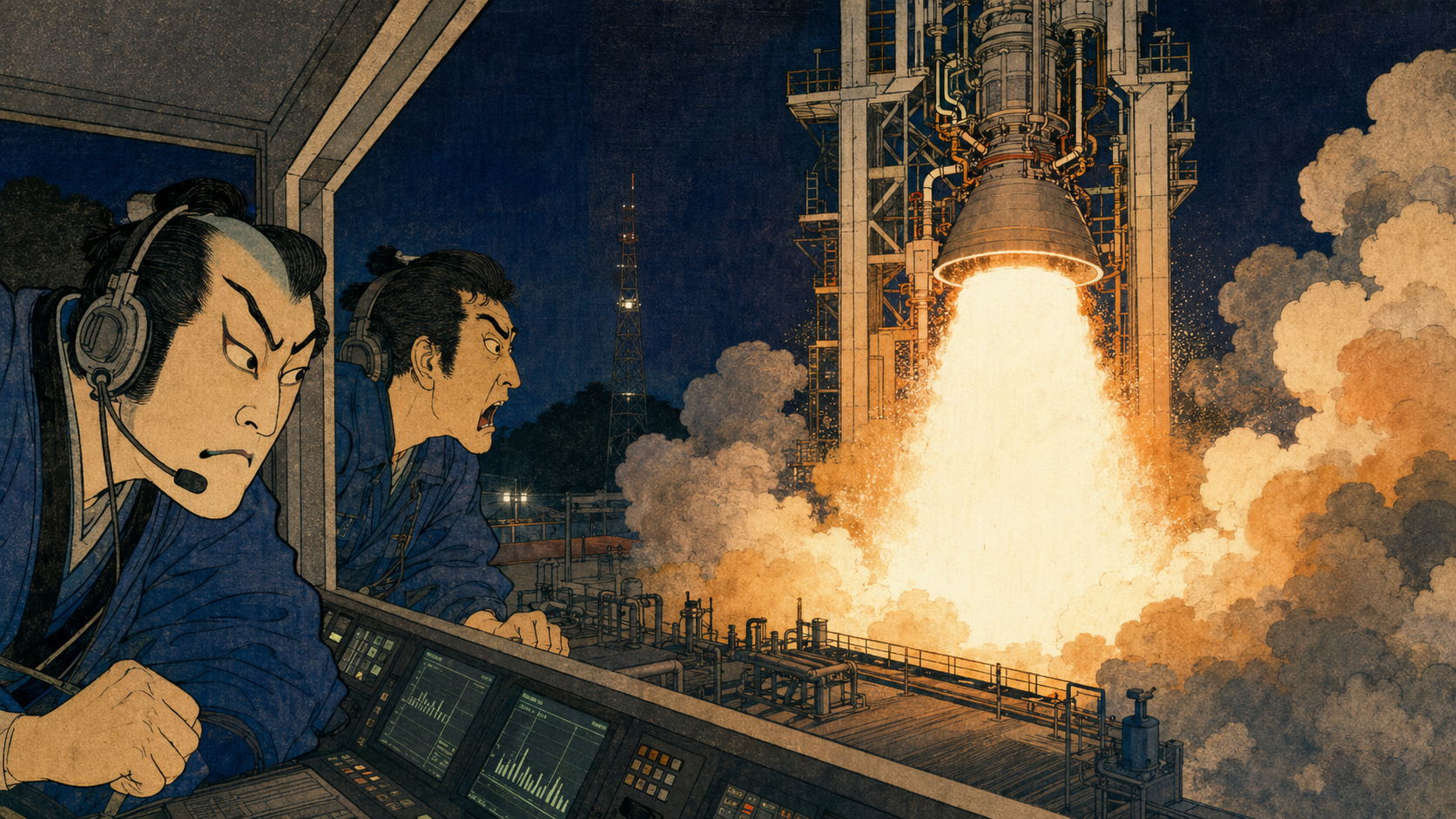
At nine in the morning, a white cylinder secured horizontally at the Tanegashima Space Center in Kagoshima Prefecture came alive. Flame surged from its nozzle. Smoke swallowed part of the test stand and drifted toward the sea. For roughly 130 seconds, the M-35a solid rocket motor—the proposed second stage of Japan’s Epsilon S launcher—burned through the complete duty cycle it would face on the way to orbit. The Japan Aerospace Exploration Agency said the test ended normally.
Nothing lifted from a launchpad, and nothing reached space. Yet those two minutes carried nearly the tension of a launch. The new E-21 second-stage motor originally designed for Epsilon S exploded during ground tests in 2023 and again in 2024. Its predecessor, the Epsilon-6 rocket, failed to reach orbit in 2022 after a separate malfunction in its attitude-control system. Japan’s compact solid-fuel launcher program has spent almost four years moving through failure reports, damaged facilities, delayed satellites and hard choices.
The test was not simply a successful firing of a “redesigned E-21.” The M-35a is a replacement motor derived from the flight-proven M-35 used on the enhanced Epsilon. Materials that are no longer available have been substituted, and the design has been adapted to the new rocket. That combination of heritage and change still had to be proved under full heat and pressure. The fire at Tanegashima made a particular kind of engineering judgment visible: to move forward, JAXA first chose to step back.
A solid rocket has no stop button
It is often called an engine, but the M-35a is not a liquid-fueled machine that pumps propellants into a combustion chamber. Fuel and oxidizer are mixed into a solid propellant and cast inside a cylindrical case. The inner shape of that propellant grain controls how its burning surface changes over time. Once ignited, the motor must continue until it has consumed essentially all of the propellant intended for the burn. It cannot throttle down, shut off or wait while engineers diagnose a problem.
That is why a full-duration static firing is more than spectacle. Grain geometry, burn rate, internal pressure, insulation, case strength and nozzle performance must work together across the entire 130-second history. JAXA measured thrust, combustion pressure, temperatures, structural strain and acceleration. An initial judgment that the test ended normally clears a major gate, but it is not final flight certification. Engineers must still compare every sensor trace with predictions and inspect the hardware after the fire.
- The M-35 is a second-stage motor with flight heritage on the enhanced Epsilon.
- The M-35a replaces unavailable raw materials used in propellant and insulation.
- It offers less performance than the E-21 but a faster, lower-risk route back to flight.
- This interim configuration is known as Epsilon S “Block 1.”
It began in 1955 with a rocket the size of a pencil
Japan’s solid-rocket story did not begin as a gigantic national project. The Pencil rocket was 23 centimeters long, 1.8 centimeters in diameter and weighed roughly 200 grams. In 1955, a University of Tokyo team led by Hideo Itokawa fired it horizontally in Kokubunji, west of central Tokyo. Before aiming at the sky, the engineers learned to measure a small machine on the ground. The method—test, observe, enlarge—is recognizable at Tanegashima seven decades later.
Pencil led to Baby, Kappa and Lambda rockets. A K-6 reached an altitude of 60 kilometers in 1958. Development of the larger Mu family began in 1963. Then, in February 1970, the fifth L-4S placed Ohsumi, Japan’s first satellite, into orbit. Japan became the fourth country after the Soviet Union, the United States and France to launch its own satellite.
The Mu lineage carried an unusually independent program of X-ray astronomy, solar research, space physics and planetary exploration. Its final form, the M-V, became one of the world’s most capable all-solid launch vehicles. It flew seven missions, six successfully, and sent the Hayabusa probe toward asteroid Itokawa. But performance came with high cost and complicated ground operations. The M-V retired after its final flight in September 2006, leaving its successor a difficult brief: preserve the precision of a scientific launcher while making access to space smaller, cheaper and faster.
Epsilon tried to make rockets less exceptional
The first Epsilon flew on September 14, 2013. It inherited M-V technology but set out to simplify the entire act of launching. The rocket would conduct much of its own checking. Ground installations would shrink. Instead of filling a control room with large teams watching specialized consoles, a compact group would supervise an automated system through ordinary computers.
JAXA said the number of launch-control personnel could fall from about 80 for M-V to eight for Epsilon. The standard campaign from erecting the first stage through post-launch work could fall from 42 days to seven. The phrases “mobile launch control” and “launching a rocket from a laptop” captured a real design philosophy: move complexity from the launch site into automated checks and software, and lower the threshold for universities, research institutes and young satellite companies.
The first five Epsilon flights succeeded. Epsilon-4 demonstrated technology for carrying multiple satellites, while Epsilon-5 delivered nine spacecraft at once. But the market outside Japan was changing even faster. Rocket Lab’s Electron offered frequent dedicated missions. SpaceX made it inexpensive for small satellites to share a much larger rocket. A Japanese “private car” to orbit would need more than reliability; it would need quick contracting, flexible destinations, regular launches and a credible price.
The five promises inside the letter S
In 2020, JAXA and IHI Aerospace signed a basic agreement to develop Epsilon S and transition toward a private-sector launch service. The S was assigned five meanings: Synergy with Japan’s larger H3 rocket; Speed in launch operations; Smart performance; Superior competitiveness; and commercial Service.
The plan aimed to carry more than 600 kilograms to sun-synchronous orbit and more than 1,400 kilograms to low Earth orbit. It envisioned two launches in three months, no more than 12 months from contract to launch, satellite acceptance within 10 days of liftoff, and “late access” to the payload until three hours before launch. The broader goal was to bridge 60 years of state-supported solid-rocket engineering into an IHI Aerospace-led business.
A new, larger second stage called E-21 was central to that leap. More propellant and greater performance would make the launcher more useful to commercial customers. But in rocketry, the distance between an ambitious specification and a reliable vehicle is crossed by material behavior under punishing heat, pressure and vibration. The E-21 found that boundary twice.
2022: Epsilon-6 is lost
At 9:50:43 a.m. on October 12, 2022, Epsilon-6 lifted off from the Uchinoura Space Center in Kagoshima carrying eight spacecraft, including JAXA’s RAISE-3 technology demonstrator. The first and second main stages completed their burns. Afterward, however, the vehicle’s attitude moved away from its target. When controllers concluded that orbit could not be achieved, they sent a destruct command at 9:57:11.
The direct cause was not the second-stage main motor. Investigators traced the failure to the liquid-propellant reaction-control system, or RCS, associated with the second stage. A leak around a seal in a diaphragm tank most likely allowed the flexible diaphragm to cover a liquid outlet, preventing the system from producing the required attitude-control thrust. The inquiry also identified a broader weakness: verification had not been sufficiently rigorous when using hardware with flight heritage.
That organizational lesson matters now. “Proven” does not mean “unchanged,” and it never means “inspection unnecessary.” The M-35a may descend from a motor that has flown, but replacement materials and integration into a different vehicle create a new configuration. Its pedigree made it a strong candidate; the July test was required to make the pedigree relevant.
2023 and 2024: two explosions on the test stand
Nine months after the Epsilon-6 loss, JAXA tested the E-21 at the Noshiro Rocket Testing Center in Akita Prefecture on July 14, 2023. Around 20 seconds after ignition, combustion pressure began to depart from the prediction. At about 57 seconds, the motor exploded. No one was injured and no third-party property was damaged, but the vacuum firing building and its equipment suffered serious damage.
JAXA investigated, changed the design and prepared another firing. On November 26, 2024, an E-21 again ignited, this time at Tanegashima. Pressure became abnormally high from about 17 seconds. Gas leaked at 48.9 seconds; at 49.3 seconds, the motor exploded. The second failure damaged the test facility and forced another pause.
Material presented to Japan’s space-policy review bodies points to excessive erosion of insulation near the aft end of the motor case, followed by case failure. Investigators have examined several possible ways abnormal burning might begin near the boundary between propellant and insulation. As of 2026, they had not reduced the initiation mechanism to a single definitive explanation. The persistence of uncertainty is not a footnote. It is the reason the program needed another route to flight.
The two explosions left satellites waiting. They included Vietnam’s LOTUSat-1 Earth-observation mission and Japan’s SOLAR-C solar observatory. Schedules matter: spacecraft age in storage, scientific partnerships plan around launch windows, and customers can move to other rockets. Yet compressing an investigation to protect a date can create the next accident. JAXA chose to continue the E-21 inquiry while opening a parallel recovery path.
The M-35a is a disciplined retreat
In February 2026, JAXA outlined a staged return based on the M-35a, derived from the M-35 motor already flown on enhanced Epsilon missions. The interim vehicle is called Epsilon S Block 1. It is not a declaration that the E-21 no longer matters. The higher-performance motor remains a subject of investigation and future development. Block 1 is a bridge intended to restore an operational launch capability before every E-21 question is answered.
The compromise is measurable. The original Epsilon S target was more than 600 kilograms to sun-synchronous orbit. Block 1 is expected to provide at least 400 kilograms. Not every spacecraft can fly under the same conditions. SOLAR-C exceeds what this configuration can carry directly. For LOTUSat-1, planners have considered insertion into an elliptical orbit followed by use of the satellite’s own propulsion.
Nor could engineers simply pull an old M-35 from storage. Some raw materials used in its propellant and insulation are obsolete or unavailable. Substitutes can change burn rate, adhesion, heat transfer and mechanical properties. Those changes require analysis, manufacturing controls and full-scale testing. The 130-second firing was the experiment that connected old flight history to a motor Japan can actually manufacture now.
What engineers asked during those 130 seconds
| Measurement | The question behind it |
|---|---|
| Thrust and pressure | Do the propellant and nozzle produce the required force along the predicted curve? |
| Temperature | Can the case, insulation, joints and nozzle survive the thermal environment? |
| Strain | How does the structure deform under internal pressure and heat, and is it within limits? |
| Acceleration and vibration | Is there unexpected motion that could signal combustion instability or structural resonance? |
| Post-fire condition | Did insulation erosion, bonding surfaces and nozzle components match the safety margins? |
According to TV Asahi’s report from the site, JAXA recorded thrust, pressure, temperature, strain and acceleration, and judged the test to have ended normally. A motor that appears to burn to completion on video is not necessarily a motor that behaved exactly as designed. Engineers will examine tiny waves in the pressure trace, the timing of temperature rises, structural loads and the thickness of insulation left behind.
The location itself was part of the recovery. The Tanegashima facilities damaged in the 2024 explosion had to be repaired and returned to safe operating condition. The firing also required weather that would carry alumina particles in the exhaust offshore. The test restarted more than a motor: it exercised the safety zones, instrumentation, weather decisions and operational discipline around it.
Why Japan still needs a small launcher
If Japan has the much larger H3, why retain Epsilon S? The answer resembles the difference between hiring a private truck and waiting for space on a bus. Rideshare aboard a large rocket can reduce the price per kilogram, but the small satellite usually accepts the primary customer’s date and destination. A dedicated small launcher sells control: a particular orbit, on a useful date, without waiting for a larger passenger.
That control can determine the value of a mission in Earth observation, disaster monitoring, science or national security. Domestic launch sites, vehicles and operators also provide sovereign access to space, reducing dependence on foreign schedules and export rules. Solid-propellant production skills, launch-range knowledge and an experienced engineering workforce are strategic capabilities that are slow to rebuild once interrupted.
Sovereignty, however, is not a license for inefficiency. The global market already offers inexpensive rideshare and small rockets that fly often. Epsilon S will need repeatable manufacturing, predictable schedules, a competitive price and a chain of successful missions. The Speed and Service promised in 2020 are technical goals, but they are also promises to customers.
What happens next
JAXA must first complete detailed analysis of the firing and inspect the motor. If pressure, thrust, thermal response and structural condition agree with the qualification criteria, the program can manufacture the flight M-35a and move toward vehicle integration. The stages must be assembled at Uchinoura, avionics and range systems checked, and a “Y-0” rehearsal must run through launch procedures before flight. Work on the new first stage, payload interfaces and launch infrastructure proceeds in parallel.
The current target is a demonstration launch within fiscal 2026, which ends in March 2027. That schedule depends on what the data say. A calendar must not outrun a safety judgment. The successful ground firing satisfies a crucial necessary condition; it does not guarantee a successful orbital mission.
Meanwhile, the E-21 investigation continues. To recover the payload performance and commercial promise of the original Epsilon S, JAXA and IHI Aerospace must explain both anomalies at the levels of material, manufacturing, analysis and test—and demonstrate that the failure cannot recur. Block 1 is not the destination. It is a way to keep flying and learning while the harder answer is completed.
From Pencil to orbit—and back to the test stand
The 1955 Pencil and the 2026 M-35a share a method: hold the machine on the ground, make it burn, measure what happens, and move only when the evidence permits. Between them stand Ohsumi, the Mu science missions, M-V and Hayabusa, the compact Epsilon, the loss of Epsilon-6, and two destroyed E-21 test articles. Japan’s solid-rocket history is not a chain of successes. It is a chain of lessons precise enough to survive failures.
The M-35a does not fulfill every original ambition for Epsilon S. Payload falls, the high-performance E-21 remains unresolved, and the launch vehicle still has to prove itself in flight. But the recovery plan demonstrates a form of maturity that rocket programs need: keep an uncertain cause open, retest even proven architecture when materials change, and choose reliable flight over the largest number in a brochure.
If Epsilon S next rises from Uchinoura, the July 23 firing will become an almost invisible part of its prehistory. The rocket will disappear into cloud and attention will move to the announcement of orbit. Yet that flight will depend on a motor that stayed fixed to the ground at Tanegashima and absorbed every second of heat and pressure with nowhere to go. Japan’s small launcher has not returned to space yet. For the first time in years, however, it has burned all the way in the right direction.
Sources and references
The result remains preliminary while JAXA completes detailed data analysis and post-fire inspection. Primary JAXA and education ministry documents were used for the technical history and failure investigations.
- JAXA: M-35a second-stage ground-firing test notice
- TV Asahi: M-35a burns for about 130 seconds and test ends normally
- sorae: JAXA completes the M-35a firing and begins detailed analysis
- The Mainichi: JAXA eyes a launch by March 2027 after successful test
- MEXT: February 2026 Space Development and Utilization Subcommittee minutes on M-35a and Block 1
- MEXT: September 2025 subcommittee minutes on the E-21 investigation
- JAXA: The 2023 E-21 firing anomaly
- JAXA: The 2024 E-21 firing anomaly and investigation
- MEXT and JAXA: Final investigation of the Epsilon-6 launch failure
- JAXA: Epsilon S development and the IHI Aerospace agreement
- JAXA: Epsilon Launch Vehicle project
- ISAS/JAXA: History of Japan’s space science
- ISAS/JAXA: Japan’s solid-rocket history from Pencil to Epsilon
- ISAS/JAXA: M-V launch vehicle