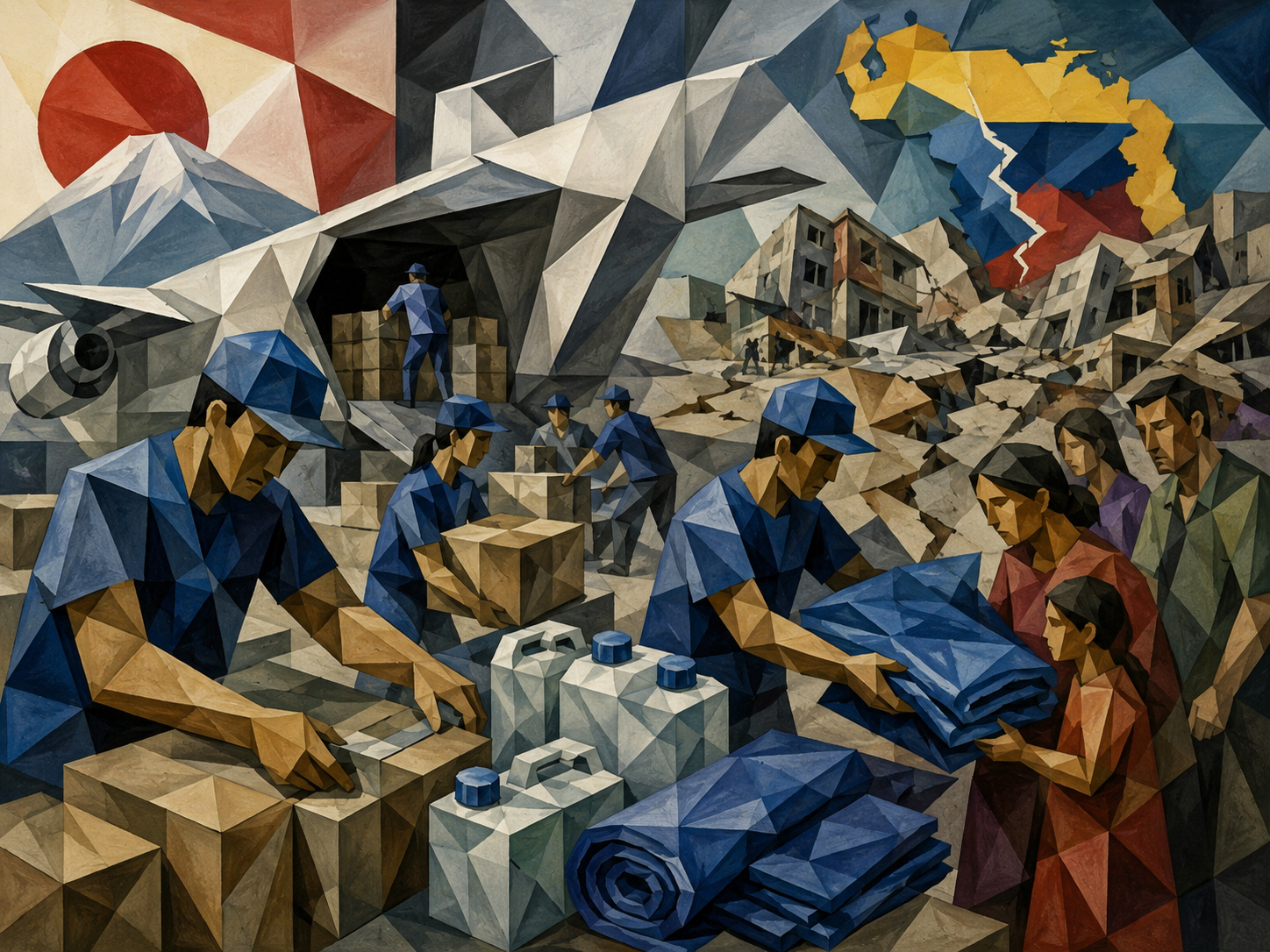
Japan is not sending Venezuela a grand reconstruction package. It is sending plastic sheets, portable jerry cans and water purifiers. On paper, that can look modest. On the ground after a major earthquake, it can mean the difference between rain and shelter, thirst and transportable water, disease and a safer cup to drink.
On June 30, Japan’s Ministry of Foreign Affairs announced that, following a request from the Government of Venezuela, Japan would provide emergency relief goods through the Japan International Cooperation Agency, or JICA. The shipment responds to the damage caused by the powerful earthquakes that struck Venezuela on June 24. Reports described two severe tremors, measured at magnitude 7.2 and 7.5, hitting within a short interval and causing major damage around Caracas, La Guaira and the Caribbean coastal corridor.
This could be treated as a short foreign-aid item. It deserves more. The story contains Japan’s disaster diplomacy, JICA’s practical relief system, Venezuela’s long national crisis, and the deeper history of Japan’s relationship with Latin America. Japan knows earthquakes. That is why the small list of relief goods is worth reading carefully.
What Japan is sending
The official MOFA announcement is brief: Japan will send plastic sheets, portable jerry cans and water purifiers to Venezuela through JICA. The choice of goods matters. This is not a search-and-rescue deployment. It is early-stage survival support for displaced people, damaged neighborhoods and strained local services.
Japan prepares for such moments in advance. JICA and MOFA describe emergency relief goods that are stockpiled for rapid delivery, including tents, blankets, sleeping pads, plastic sheeting, portable water containers and water purifiers. The idea is simple: when a disaster-hit government asks for help, Japan can move useful goods quickly instead of designing a response from zero.
That approach feels very Japanese. It is practical, prepared, and focused on what the field can use. Instead of making a loud political statement, it sends items that can be carried, unfolded, filled, filtered and used immediately.
Why Venezuela’s earthquake is so difficult
Venezuela’s disaster is not only an earthquake story. It is a compound crisis. Seismic shock, damaged buildings, dense urban areas, damaged hospitals, political instability, shortages, migration and weakened public systems are all layered on top of one another. Reuters reported WHO concerns that Venezuela’s health system was under serious strain after the earthquakes. AP reported hospitals overwhelmed by trauma patients and warned of infectious-disease risks as displaced people crowded into unsanitary conditions.
An earthquake lasts seconds. The disaster does not. Water pipes break. Roads close. Hospitals lose capacity. Families sleep outside. Shelters crowd. Clean water, toilets, medicine and food become the real front line. After the first rescue phase, the next battle is against infection, untreated chronic illness, interrupted maternity care, trauma, and long-term displacement.
The Guardian reported satellite-based estimates suggesting damage or destruction to far more buildings than early official counts captured. Exact numbers may continue to change, but the humanitarian pattern is clear: rubble, water stress, hospital pressure and displacement are converging into a national emergency.
Why water sits at the center
Among Japan’s relief goods, water is the central theme. Jerry cans and water purifiers are basic infrastructure in portable form. If water pipes are broken and a truck arrives with safe water, people still need containers to carry it home. If wells, streams or tanks remain available but contaminated, people need filtration. If shelters are crowded, handwashing becomes disease prevention.
Earthquake coverage often focuses on collapsed towers and dramatic rescues. Disaster medicine focuses just as much on water and sanitation. Clean water is needed for wound care, infant formula, medication, cooking, surgery, toilets and hygiene. In a damaged hospital or crowded shelter, water is not a convenience. It is a medical supply.
That is why Japan’s package, while modest, is logical. Tarpaulins create temporary roofs. Portable jerry cans make water movable. Water purifiers protect the quality of that water. Each item helps turn a broken environment into something survivable.
Japan’s long experience with disaster diplomacy
When Japan sends disaster relief overseas, two memories travel with the shipment. One is Japan’s own disaster history: the Great Kanto Earthquake, the Hanshin-Awaji Earthquake, the Great East Japan Earthquake, the Noto Peninsula earthquake and many others. Japan knows how quickly earthquakes can break cities, ports, hospitals, homes and family life.
The second memory is gratitude. After the Great East Japan Earthquake, help arrived from all over the world: rescue teams, supplies, donations, messages, prayers and gestures from countries large and small. Japan remembers being helped. That memory is part of the quiet moral background when Japan responds to disasters elsewhere.
JICA’s emergency relief system is a way of turning that memory into logistics. Goods are stocked. Requests are assessed. Shipments are arranged. When appropriate, Japan can also send rescue teams, medical teams or specialists. The Venezuela response belongs to the goods-provision side of that system.
Venezuela’s heavier background
Venezuela was once one of the richer countries in South America. It had oil, ports, a Caribbean coastline, a strong urban culture, baseball, music and a tradition of receiving migrants. It also has some of the world’s largest oil reserves. But the 21st century brought political crisis, economic collapse, inflation, sanctions, shortages, insecurity and the erosion of public services.
Venezuela’s crisis became a regional migration crisis. Millions of Venezuelans left the country, spreading across Colombia, Peru, Chile, Ecuador, the United States, Spain and other destinations. Families were divided between relatives abroad and relatives at home. The earthquake struck a society that was already weakened by years of hardship.
That is why the disaster is not only about broken buildings. It is also about national resilience. A weak hospital network faces mass casualties. A shortage-stressed city faces sudden displacement. Families searching for missing relatives do so in neighborhoods that may already have lacked stable supplies. Disasters expose the weaknesses that existed before the ground moved.
The Japan-Venezuela relationship
Japan and Venezuela established diplomatic relations in 1938, interrupted them during the Second World War, and reestablished them in 1952. MOFA’s basic data also records the presence of Japanese nationals and people of Japanese descent in Venezuela. The community is not large, but the relationship has history: migration, trading companies, energy, automobiles, finance and diplomacy.
For postwar Japanese companies, Venezuela was an oil and resource country and part of the broader Latin American market. Japanese automakers, machinery firms, trading houses and financial institutions interacted with Venezuela in different eras. Political relations have sometimes been distant or complicated, but humanitarian relief operates in a different register.
Diplomacy is not only summits and communiqués. Sending water after a disaster is diplomacy. Delivering shelter material to people who lost roofs is diplomacy. Whether or not governments agree politically, helping disaster victims is one of the most basic forms of state-to-state decency.
Why Japan’s aid often looks quiet
Japan’s emergency assistance can look understated. It often appears as a short MOFA release, a JICA shipment, a handover ceremony and practical goods from a warehouse. That is partly because Japan is not always good at telling its aid story. It is also because Japan’s aid culture often emphasizes fit, field use and coordination over spectacle.
There are limits. Relief goods cannot rebuild hospitals. Jerry cans cannot repair homes. Water purifiers cannot resolve Venezuela’s political or economic crisis. But in the first days and weeks after a disaster, useful support matters more than perfect support. Japan’s package is designed for that window.
Japan.co.jp’s view
This story highlights a part of Japanese diplomacy that deserves more attention. Japan can contribute to the world not only as a technology or finance power, but as a country that understands disasters. It sends not abstractions but useful things: tarpaulins, containers and water purifiers. There is a quiet strength in that.
Venezuela is far away from Japan. But a collapsed home, a broken water line, an overwhelmed hospital and a sleepless night after an aftershock are not foreign experiences to Japanese readers. Japan has known them. That is why this aid is not just a foreign-news item. It is a gesture from one earthquake country to another.
Politics divides the world. Disasters reveal the human layer beneath the division. Japan’s shipment to Venezuela may be small in material terms, but it carries a larger message: when the ground breaks, the first obligation is to help people stand again.
Reader guide
| Item | How to read it |
|---|---|
| What happened | On June 30, Japan announced emergency relief goods for Venezuela through JICA after earthquake damage. |
| Goods sent | Plastic sheets, portable jerry cans and water purifiers — basic survival goods for shelter, water transport and clean drinking water. |
| Why it matters | After major earthquakes, rescue is only the first stage. Water, sanitation, temporary shelter and medical continuity are life-saving. |
| Historical background | Japan and Venezuela established diplomatic relations in 1938 and reestablished them in 1952 after wartime interruption. |
| Japan.co.jp view | This is quiet, practical disaster diplomacy from a country that knows earthquakes and remembers being helped. |
Sources and references
This article draws on Japan’s Ministry of Foreign Affairs, JICA, Reuters, Associated Press, The Guardian, Al Jazeera, WHO-related reporting, and official Japan-Venezuela basic data. Death tolls, injury counts, building-damage estimates, and hospital-impact figures may change as assessments continue.
- MOFA Japan: Emergency Assistance in Response to the Earthquake Damage in Venezuela.
- JICA: Emergency Disaster Relief and stockpiled priority goods.
- MOFA Japan: Emergency Relief Goods.
- Reuters: Venezuela health system strained after earthquakes, WHO says.
- Associated Press: Aid groups warn Venezuela's healthcare system is near its limit after earthquakes.
- The Guardian: satellite damage estimates and humanitarian need.
- Al Jazeera: international pledges of aid.
- MOFA Japan: Japan-Venezuela basic data and diplomatic history.